
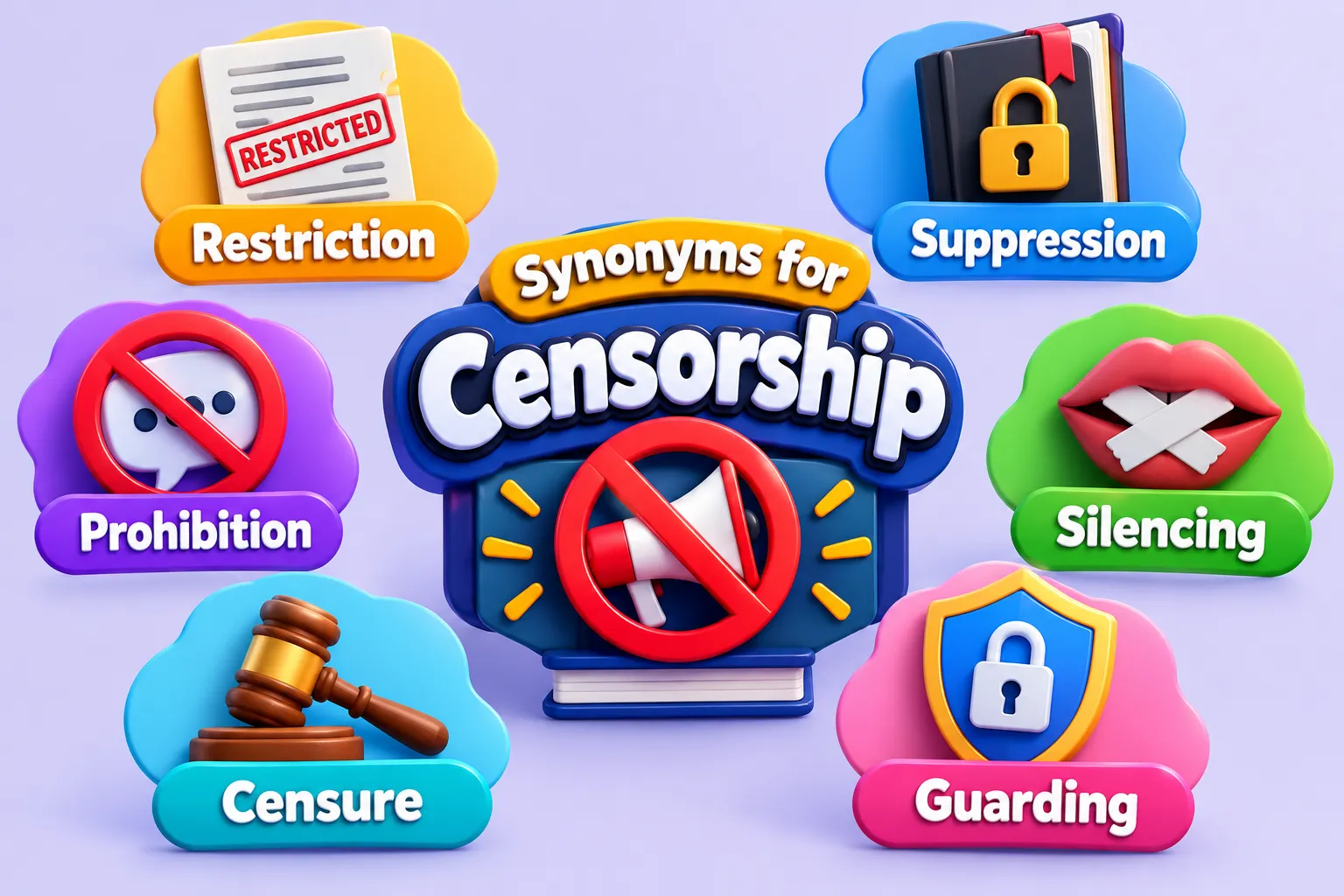
Synonyms for censorship include suppression, restriction, control, prohibition, silencing, banning, and redaction. These words describe different ways of limiting information or freedom of expression. For example, suppression means preventing information from reaching the public, while redaction means removing certain details from a document. Therefore, choosing the right synonym depends on the context.
Censorship means controlling or restricting information, ideas, or opinions. For example, a government may ban a book because it disagrees with its message. Similarly, a website may remove a post that breaks its rules. Both actions can involve censorship.
People often discuss censorship when they talk about freedom of speech, education, politics, media, and the internet. Learning synonyms for censorship can help you understand these topics. It can also improve your writing and help you avoid repeating the same word.
However, related words do not always have the same meaning. Some describe a complete ban, while others refer to removing certain details or limiting access to information. In this guide, you will learn the meaning, history, pronunciation, and word forms of censorship. You will also discover 26 synonyms and related terms, along with simple meanings and examples.
Meaning of Censorship
Definition
Censorship (Noun): The act of reviewing, removing, or restricting information, speech, images, or other content that people can see or hear.
Governments, schools, media companies, websites, and other organizations may censor content. Sometimes, they do so to protect people from harmful material. However, censorship can also limit freedom of expression.
Examples
- The film company removed several scenes because of censorship rules.
- Many people protested against the censorship of news reports.
Connotative Meaning
Connotation refers to the feelings or ideas that a word suggests beyond its basic meaning.
The word censorship can have a positive, negative, or neutral tone. Its meaning often depends on the situation.
- Positive tone: Some people support censorship when it protects children from harmful content.
- Negative tone: Others connect censorship with unfair control and the loss of freedom.
- Neutral tone: In a factual report, censorship may simply describe the process of reviewing and restricting content.
Etymology of Censorship
The word censorship comes from censor, which is linked to the Latin word censere. This Latin word means “to assess” or “to judge.” Over time, English speakers began using censorship to describe the review and control of information.
| Period | History and Meaning |
|---|---|
| Old English (450–1100) | People used other words to express ideas about judgment, control, and restriction. The modern word censorship was not yet in use. |
| Middle English (1100–1500) | The word censor entered English through Latin and French forms. It referred to a person who examined or judged something. |
| Modern English (1500–Present) | The word censorship developed to describe the review, removal, or restriction of books, news, art, speech, and other content. |
Pronunciation of Censorship (IPA)
- IPA: /ˈsen.sə.ʃɪp/
- Syllables: cen-sor-ship (3 syllables)
Affixation Pattern of Censorship
Understanding word formation can help you recognize related words and expand your vocabulary.
- Root: Censor refers to a person or process that examines or restricts content.
- Prefix: The word censorship has no prefix.
- Suffix: The suffix -ship helps form nouns that describe a state, condition, position, or quality.
Word Formations
| Word | Part of Speech | Meaning |
|---|---|---|
| Censor | Noun | A person who examines content and decides whether to restrict it. |
| Censor | Verb | To remove or restrict information or other content. |
| Censored | Verb/Adjective | Describes content that someone has restricted, removed, or edited. |
| Censoring | Verb/Noun | The act of examining and restricting content. |
| Censorship | Noun | The practice of controlling or restricting information. |
| Censorial | Adjective | Related to a censor or the examination of content. |
| Censorious | Adjective | Too quick to criticize other people or their actions. |
| Uncensored | Adjective | Describes content that people can view or share without censorship. |
26 Synonyms of Censorship With Meanings and Examples
The following words are synonyms or closely related terms for censorship. Some describe general restrictions, while others refer to specific ways of controlling information. Therefore, consider each word’s meaning before using it in your writing.
1. Suppression (Noun)
Meaning: The act of stopping information, ideas, or opinions from reaching the public.
Examples:
- The government faced criticism for suppressing news.
- The report exposed attempts to suppress public criticism.
2. Restriction (Noun)
Meaning: A rule or action that limits what people can say, do, access, or share.
Examples:
- The new rule restricted access to certain websites.
- Journalists protested against restrictions on news reporting.
3. Control (Noun)
Meaning: The power to manage or limit the information people can access or share.
Examples:
- The group wanted greater control over online content.
- Government control of the media became a major public issue.
4. Prohibition (Noun)
Meaning: An official rule that prevents people from doing, using, or sharing something.
Examples:
- The prohibition of the book sparked a public debate.
- The law prohibited certain types of advertising.
5. Silencing (Noun)
Meaning: The act of stopping someone from expressing an opinion or sharing information.
Examples:
- The silencing of critics worried many citizens.
- She called the removal of the posts an attempt to silence public debate.
6. Banning (Noun)
Meaning: The act of officially stopping people from using, showing, publishing, or sharing something.
Examples:
- The authorities banned the film after a public debate.
- Banning the article did not stop people from discussing it.
7. Redaction (Noun)
Meaning: The removal or hiding of specific details from a document before someone shares it.
Examples:
- The editor removed private details through redaction.
- The agency explained why it redacted parts of the report.
8. Suppressing Information (Phrase)
Meaning: Keeping facts or details from reaching other people.
Examples:
- Suppressing information can damage public trust.
- The group faced accusations of suppressing information about the event.
9. Filtering (Noun)
Meaning: The process of blocking or sorting content so people cannot access certain material.
Examples:
- The school filtered websites that contained unsuitable material.
- Internet filtering prevented users from visiting several websites.
10. Editing (Noun)
Meaning: Changing or removing parts of written, visual, or recorded content before publication or display.
Examples:
- The film editor removed several scenes from the movie.
- The writer edited the article before publication.
11. Omission (Noun)
Meaning: The act of leaving out information or details.
Examples:
- The omission of key facts changed the report’s meaning.
- Readers questioned why the writer omitted the main argument.
12. Excision (Noun)
Meaning: The act of cutting out or removing part of a text or other material.
Examples:
- The editor removed several scenes through excision.
- The team excised private details from the document.
13. Curtailment (Noun)
Meaning: The act of reducing or limiting an activity, right, or freedom.
Examples:
- The curtailment of press freedom drew criticism.
- Citizens opposed the government’s attempt to curtail public debate.
14. Limitation (Noun)
Meaning: A rule or condition that reduces what people can do or access.
Examples:
- The newspaper faced limitations on its news coverage.
- The website limited the number of posts users could share.
15. Constraint (Noun)
Meaning: Something that limits a person’s freedom, choices, or actions.
Examples:
- Legal constraints affected what the newspaper could publish.
- The writers worked under strict content constraints.
16. Curbing (Noun)
Meaning: The act of controlling or reducing an activity.
Examples:
- The new policy aimed to curb harmful online content.
- Critics feared the policy would curb free speech.
17. Crackdown (Noun)
Meaning: Strong action taken to stop an activity or enforce rules.
Examples:
- The crackdown on independent media drew criticism.
- The government launched a crackdown on illegal broadcasts.
18. Muting (Noun)
Meaning: The act of making a voice, opinion, or message less noticeable or preventing others from hearing it.
Examples:
- The muting of public voices raised concerns.
- The platform faced criticism for muting certain discussions.
19. Disallowance (Noun)
Meaning: The act of refusing to permit something.
Examples:
- The disallowance of the article surprised the writer.
- The rules led the website to disallow several posts.
20. Embargo (Noun)
Meaning: An official restriction that prevents information from being released until a specified time or condition.
Examples:
- The newspaper kept the report under an embargo until Monday.
- The media followed the embargo on the announcement.
21. Blackout (Noun)
Meaning: A complete or temporary stop in the release of news or information.
Examples:
- The news blackout left people searching for answers.
- Officials imposed a blackout on updates about the event.
22. Gagging (Noun)
Meaning: The act of preventing someone from speaking freely or sharing information.
Examples:
- The group accused officials of gagging journalists.
- The gagging of witnesses raised legal concerns.
23. Prior Restraint (Noun)
Meaning: An attempt to stop information from being published before it becomes public.
Examples:
- The court considered whether prior restraint was justified.
- Journalists challenged the order because it could stop publication in advance.
24. Content Moderation (Noun)
Meaning: The process of reviewing content to decide whether it follows a platform’s rules.
Examples:
- The platform removed posts that broke its rules.
- The company explained how its content moderation policy works.
25. Information Control (Noun)
Meaning: The management or restriction of information that people can access or share.
Examples:
- Information control became a major topic in the debate.
- The report examined how officials controlled information during the crisis.
26. Media Control (Noun)
Meaning: The power to manage or restrict the news and other content shared through the media.
Examples:
- Media control affected the range of views shown on television.
- The group called for less government control of the media.
Prototype Meaning of Censorship
The most common meaning of censorship involves controlling, removing, or restricting information. For example, people may think of a banned book, a film with removed scenes, a blocked news story, or a social media post that a platform takes down.
Censorship can occur in schools, governments, workplaces, and online platforms. However, its purpose and effects vary from one situation to another. Some organizations restrict content to protect privacy or prevent harm. In contrast, others may use censorship to stop people from accessing important information or expressing their views freely.
Prototype Categorization of Censorship Synonyms
You can group synonyms and related terms for censorship according to the type of restriction they describe.
- General restriction: Suppression, restriction, control, prohibition, and limitation describe broad efforts to limit speech or information.
- Blocking expression: Silencing, muting, and gagging focus on preventing people from expressing their views.
- Removing or changing content: Redaction, editing, omission, and excision describe the removal or alteration of parts of a document or message.
- Limiting access: Filtering, content moderation, and banning describe ways of deciding what people can view or share.
- Official limits and enforcement: Curtailment, constraint, curbing, crackdown, and disallowance describe efforts to restrict or stop an activity.
- Controlling information release: Embargo, blackout, prior restraint, information control, and media control describe limits on when, how, or whether information becomes public.
These groups make it easier to choose the right word. For example, redaction usually means removing parts of a document. By comparison, prior restraint refers to preventing information from being published in the first place.
However, some related terms are not direct synonyms in every situation. Therefore, always consider the meaning and context before choosing a replacement.
Antonyms of Censorship
Censorship has no single antonym that works in every situation. However, the following words and phrases describe ideas that oppose the restriction of speech or information.
| Antonym | Part of Speech | Meaning |
|---|---|---|
| Freedom of speech | Noun phrase | The right to express ideas and opinions. |
| Free expression | Noun phrase | The ability to share thoughts, views, or creative work freely. |
| Openness | Noun | A willingness to share information and ideas. |
| Transparency | Noun | The practice of being open about information and decisions. |
| Disclosure | Noun | The act of making information known. |
| Publication | Noun | The act of making written or other content available to the public. |
| Access | Noun | The ability or right to obtain or view information. |
| Free press | Noun phrase | A media system that can report news without unfair control. |
| Unrestricted communication | Noun phrase | Communication without limiting rules or controls. |
| Open debate | Noun phrase | A discussion in which people can express different views. |
Frequently Asked Questions
What does censorship mean?
Censorship means reviewing, removing, or restricting information, speech, or other content. For example, it can affect books, films, news reports, websites, and public discussions.
When should I use the word censorship?
Use censorship when discussing the control or restriction of information in the media, books, films, public speech, or online content. For example, you might use it when discussing a government ban on a book.
Is censorship positive or negative?
Its meaning depends on the situation. Some people support certain restrictions to protect privacy or children from harmful content. However, others oppose censorship because it can limit freedom of expression and access to information.
How is censorship different from similar words?
Censorship is a broad term for controlling or restricting content. In comparison, redaction means removing parts of a document, while filtering means blocking selected content. Similarly, banning means officially prohibiting something from being used, shown, or shared.
Conclusion
Learning the meaning of censorship and its related words can improve your vocabulary. It can also help you discuss media, information, and freedom more clearly. For example, suppression, restriction, redaction, and silencing describe different ways of limiting information or expression.
Choosing the right synonym makes your writing clearer and helps you avoid unnecessary repetition. However, remember that related words do not always have exactly the same meaning. Redaction, for instance, usually involves removing parts of a document, while censorship covers a wider range of actions.
To improve your English, learn one new word each day and use it in your own sentence. In addition, read articles and notice how writers use these words in context. With regular practice, you can build a stronger vocabulary, write more clearly, and express your ideas with greater confidence.
Read More:
Synonyms for Route: 30 Empowering Words

I am Rubab content specialist focused on creating accurate, user-friendly, and search-optimized language resources. Through Synonyminstant, I help readers find synonyms, antonyms, meanings, and vocabulary with ease. Every article is carefully researched and optimized to provide reliable information, clear explanations, and an excellent user experience.

