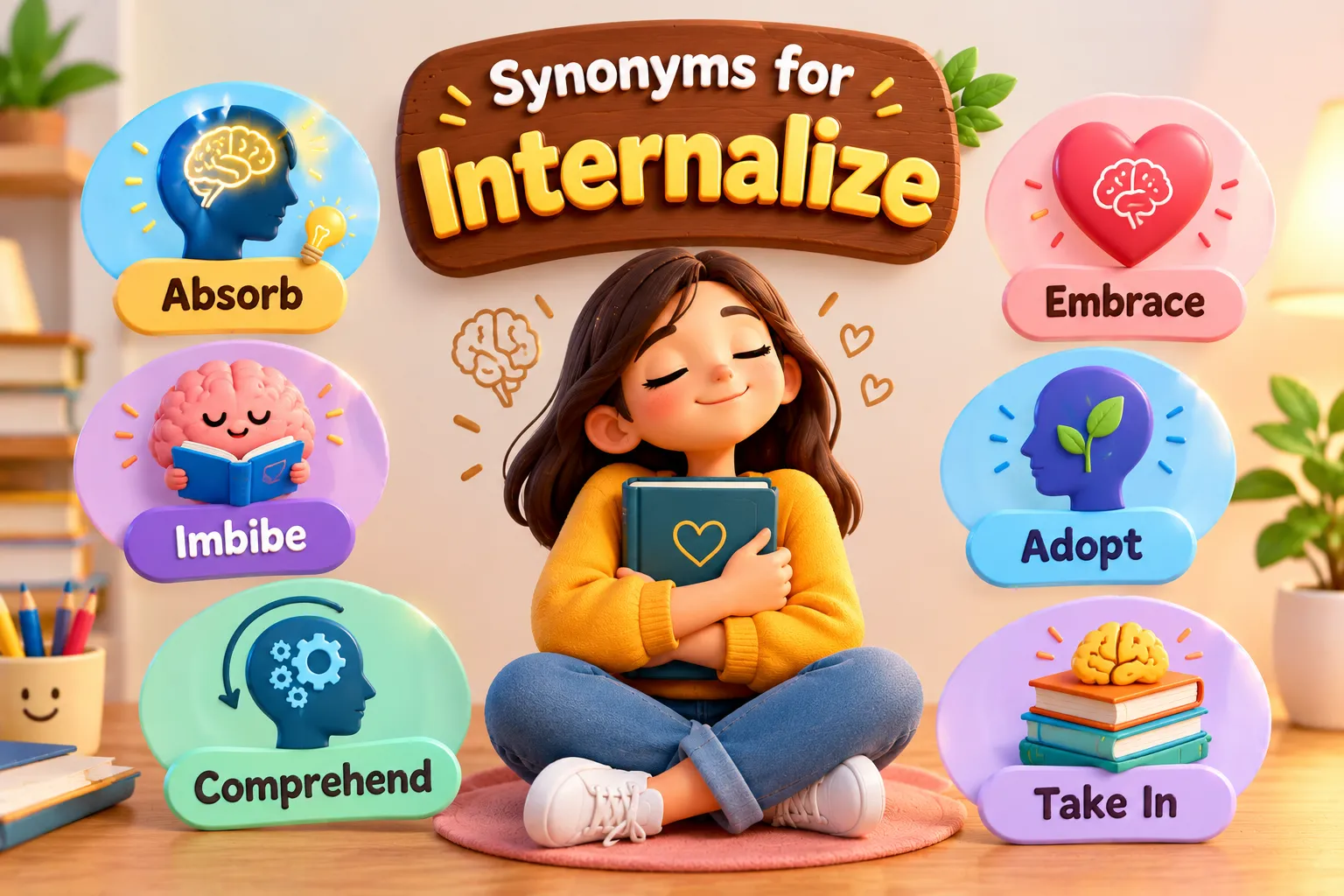
Synonyms for internalize include absorb, learn, understand, adopt, assimilate, embrace, and take in. These words describe the process of learning ideas, values, feelings, or knowledge so deeply that they become part of how you think, feel, or act.
To internalize something means to learn it so well that it becomes part of your thoughts, beliefs, or behavior. For example, a student may study a lesson many times until they understand it and can use it in daily life. This is a form of internalizing knowledge. The word is common in education, psychology, personal growth, and everyday life. Learning synonyms for internalize helps English learners express ideas in different ways. It also helps writers create clear content without repeating the same word. However, each synonym has a slightly different meaning. Some focus on learning facts, while others describe accepting beliefs or making feelings part of your inner life. This guide explains the meaning, history, pronunciation, word forms, and 28 synonyms of internalize with simple definitions and examples.
Meaning of Internalize
Definition
Internalize (Verb): To learn, accept, or absorb an idea, belief, feeling, or piece of knowledge so deeply that it becomes part of your thinking or behavior.
Examples
- Children may internalize the values they learn from their parents.
- She practiced the rules until she could internalize them.
Connotative Meaning
Connotation means the feeling or idea a word suggests beyond its basic meaning.
- Positive tone: Internalize can suggest deep learning, personal growth, and a strong understanding of good values.
- Negative tone: It can describe taking in harmful beliefs, fear, or unfair ideas.
- Neutral tone: It can simply describe the process of making information or ideas part of your thinking.
Etymology of Internalize
The word internalize comes from internal, which refers to something inside. The suffix -ize turns the adjective into a verb meaning to make or treat something in a particular way.
| Period | History and Meaning |
| Old English (450–1100) | The modern word internalize was not used in Old English. Older English words expressed ideas about what was inside or within. |
| Middle English (1100–1500) | The direct modern form was not yet in common use. English used words related to inner and internal as language developed. |
| Modern English (1500–Present) | Internal developed from Latin internus, meaning “inner.” The verb internalize later came to mean making ideas, values, or knowledge part of one’s inner thinking. |
Pronunciation (IPA)
- IPA: /ɪnˈtɜː.nə.laɪz/ (British English); /ɪnˈtɝː.nə.laɪz/ (American English)
- Syllables: in-ter-nal-ize (4 syllables)
Affixation Pattern of Internalize
- Root: internal, meaning inside or within.
- Prefix: inter- historically means “between” or “among,” but in internalize, it belongs to the established word internal rather than acting as a separate prefix with that meaning.
- Suffix: -ize, which forms a verb meaning to make or cause to become.
Word Formations
| Word | Grammatical Category | Meaning |
| Internal | Adjective | Relating to the inside of something. |
| Internally | Adverb | In a way that relates to the inside or inner thoughts. |
| Internalize | Verb | To absorb an idea, belief, or feeling deeply. |
| Internalized | Verb/adjective | Learned or absorbed deeply into one’s thinking. |
| Internalizing | Verb/gerund | The process of absorbing ideas, beliefs, or feelings. |
| Internalization | Noun | The process of making something part of one’s thinking or behavior. |
| Internalizer | Noun | A person who tends to absorb ideas or feelings deeply; an uncommon term. |
28 Synonyms of Internalize With Meaning & Examples
These words have meanings close to internalize, but they are not all exact replacements. The best choice depends on whether you mean learning information, accepting beliefs, or absorbing feelings.
1. Absorb (Verb)
Meaning: To take in information or ideas and understand them.
Examples:
- She reads slowly to absorb every detail.
- Students absorb new ideas through practice.
2. Assimilate (Verb)
Meaning: To take in and make new knowledge or ideas part of what you already know.
Examples:
- He needed time to assimilate the new information.
- The class used examples to assimilate difficult concepts.
3. Learn (Verb)
Meaning: To gain knowledge or a skill through study or experience.
Examples:
- Children learn values from their families.
- I learn new words by using them in sentences.
4. Understand (Verb)
Meaning: To know the meaning of something clearly.
Examples:
- She worked hard to understand the lesson.
- I understand why honesty matters.
5. Adopt (Verb)
Meaning: To accept and begin using an idea, belief, or way of acting.
Examples:
- The team adopted a new set of values.
- He adopted a calmer way of dealing with stress.
6. Embrace (Verb)
Meaning: To accept an idea or belief willingly.
Examples:
- She embraced the idea of lifelong learning.
- They embraced values of kindness and respect.
7. Take In (Phrasal Verb)
Meaning: To receive and understand information or ideas.
Examples:
- It took me a while to take in the news.
- Students need time to take in new facts.
8. Grasp (Verb)
Meaning: To understand an idea or meaning clearly.
Examples:
- He quickly grasped the main point.
- It took her time to grasp the lesson.
9. Comprehend (Verb)
Meaning: To understand something fully.
Examples:
- The students began to comprehend the topic.
- He struggled to comprehend the message.
10. Digest (Verb)
Meaning: To think about information carefully until you understand it.
Examples:
- I need time to digest what the teacher said.
- She paused to digest the feedback.
11. Learn by Heart (Phrase)
Meaning: To remember information so well that you can repeat it without help.
Examples:
- He learned the poem by heart.
- We learned the speech by heart before the show.
12. Memorize (Verb)
Meaning: To learn information so that you can remember it.
Examples:
- She memorized the key terms for the test.
- He memorized the rules before the game.
13. Master (Verb)
Meaning: To learn something so well that you can use it with skill.
Examples:
- She mastered the basic grammar rules.
- He practiced daily to master the new skill.
14. Internalize Deeply (Phrase)
Meaning: To make an idea or belief a lasting part of your thinking.
Examples:
- Children may internalize deeply the values they see at home.
- He worked to internalize deeply the lessons from his mistakes.
15. Incorporate (Verb)
Meaning: To include something as part of a larger whole.
Examples:
- She incorporated the advice into her daily routine.
- The teacher incorporated new ideas into the lesson.
16. Integrate (Verb)
Meaning: To combine something with other ideas or parts so they work together.
Examples:
- He integrated the new rules into his work habits.
- Students integrated the facts into their final project.
17. Accept (Verb)
Meaning: To agree to receive or believe something as true or valid.
Examples:
- She accepted the feedback and learned from it.
- He accepted the idea that mistakes can help us grow.
18. Believe (Verb)
Meaning: To accept something as true.
Examples:
- She believes that kindness matters.
- He began to believe in his own abilities.
19. Imbibe (Verb)
Meaning: To absorb ideas, values, or knowledge gradually.
Examples:
- Children may imbibe habits from the people around them.
- He imbibed a love of reading from his parents.
20. Ingrained (Adjective)
Meaning: Deeply fixed in someone’s habits, beliefs, or behavior.
Examples:
- Respect was an ingrained part of her upbringing.
- The habit became ingrained after years of practice.
21. Absorb Into (Phrase)
Meaning: To take something in as part of your knowledge or way of thinking.
Examples:
- She absorbed the lesson into her daily practice.
- He absorbed the team’s values into his work style.
22. Assimilate Into (Phrase)
Meaning: To make something part of an existing system of knowledge or beliefs.
Examples:
- The learner assimilated the new facts into her understanding.
- He assimilated the advice into his approach to work.
23. Make One’s Own (Phrase)
Meaning: To understand or accept an idea so fully that it feels personal.
Examples:
- She made the lesson her own through practice.
- He made the advice his own and used it every day.
24. Learn Internally (Phrase)
Meaning: To take in knowledge or ideas through personal thought and reflection.
Examples:
- She learned internally from the experience.
- He reflected on the event to learn from it internally.
25. Reflect On (Phrasal Verb)
Meaning: To think carefully about an experience or idea.
Examples:
- He reflected on the teacher’s advice.
- She took time to reflect on her choices.
26. Process (Verb)
Meaning: To think about information or feelings so you can understand them.
Examples:
- She needed time to process the news.
- He processed the feedback before replying.
27. Reconcile (Verb)
Meaning: To bring different ideas or feelings into agreement.
Examples:
- He tried to reconcile the new facts with his old beliefs.
- She reconciled her feelings with what she had learned.
28. Absorb Emotionally (Phrase)
Meaning: To take in an emotional message or experience and let it affect your feelings.
Examples:
- The child absorbed the tension in the room.
- She absorbed the encouragement and felt more confident.
Prototype Meaning
The most typical meaning of internalize is to take an idea, lesson, belief, or feeling into your mind so deeply that it shapes how you think or act. People often imagine a student who learns a lesson and then uses it without needing constant reminders. The word also applies to values learned from family, habits built through practice, and feelings that affect how someone sees themselves. It means more than simply hearing or memorizing something. It suggests that the idea has become part of a person’s inner understanding.
Prototype Categorization
The synonyms for internalize can be grouped by the type of learning or acceptance they describe. These groups help writers choose a word that matches the intended meaning.
- Taking in knowledge: Absorb, assimilate, take in, and digest focus on receiving and understanding information.
- Learning and understanding: Learn, understand, grasp, and comprehend describe gaining knowledge or seeing the meaning of an idea.
- Remembering and gaining skill: Learn by heart, memorize, and master focus on memory or skill. They do not always mean that an idea has become part of someone’s beliefs.
- Accepting ideas and values: Adopt, embrace, accept, and believe describe accepting ideas, beliefs, or ways of acting.
- Making ideas part of a whole: Incorporate, integrate, imbibe, and make one’s own suggest adding knowledge or values to existing thinking or behavior.
- Thinking through experiences: Reflect on, process, and reconcile describe thinking about information, feelings, or beliefs.
- Showing beliefs through actions: Own and embody can describe accepting responsibility or acting in line with a belief, though neither is an exact synonym in every context.
- Deeply held habits and feelings: Ingrained describes something already fixed in a person’s habits or beliefs, while absorb emotionally describes taking in an emotional experience.
Using these groups helps you avoid choosing a word that changes the meaning. For example, memorize means remembering facts, while internalize suggests that the knowledge or idea has become part of how you think or act.
Antonyms of Internalize
The opposite of internalize depends on the context. The words below describe failing to absorb an idea, rejecting it, or keeping it separate from one’s beliefs.
| Antonym | Part of Speech | Meaning |
| Reject | Verb | To refuse to accept an idea or belief. |
| Ignore | Verb | To pay no attention to information or advice. |
| Disregard | Verb | To treat something as unimportant or not worth following. |
| Forget | Verb | To fail to remember information or an experience. |
| Dismiss | Verb | To decide that an idea is not worth considering. |
| Resist | Verb | To oppose or refuse to accept something. |
| Externalize | Verb | To express an inner thought or feeling outwardly rather than keep it inside. |
| Misunderstand | Verb | To understand something incorrectly. |
| Overlook | Verb | To fail to notice or consider something. |
| Unlearn | Verb | To stop using or believing something that was learned before. |
Short Questions and Answers
What does internalize mean?
Internalizing means to absorb an idea, belief, feeling, or lesson so deeply that it becomes part of your thinking or behavior.
When should internalize be used?
Use internalize when someone learns or accepts something deeply, such as a lesson, value, habit, or belief.
Is internalisation positive or negative?
It can be either. Internalizing helpful values can support growth, while internalizing harmful beliefs or unfair criticism can have negative effects.
How is internalize different from similar words?
Memorising means to remember information. Understanding means to know what something means. Internalizing suggests that an idea has become part of your thinking, beliefs, or behavior.
Conclusion
Learning internalize and its synonyms can help you express ideas about learning, belief, and personal growth more clearly. Words such as absorb, assimilate, adopt, and embrace can describe different ways people take in knowledge or values. Other words, such as memorize and understand, focus on memory or meaning rather than deep acceptance. Knowing these differences helps you choose the right word and avoid repetition in your writing. It can also improve your speaking by helping you explain thoughts and experiences with greater accuracy. Try learning one new synonym each day and writing a sentence with it. With regular practice, you can build a stronger vocabulary and become more confident in English.
Read More:
Synonyms for Censorship: 26 Useful Alternatives

I’m Ayesha Haram, an English content and SEO writer at SynonymsInstant.com. I focus on creating helpful vocabulary resources, word guides, and practical English content that readers can understand quickly. I combine language research, clear explanations, and SEO-focused writing to produce reliable content that supports learners, writers, and everyday English users.