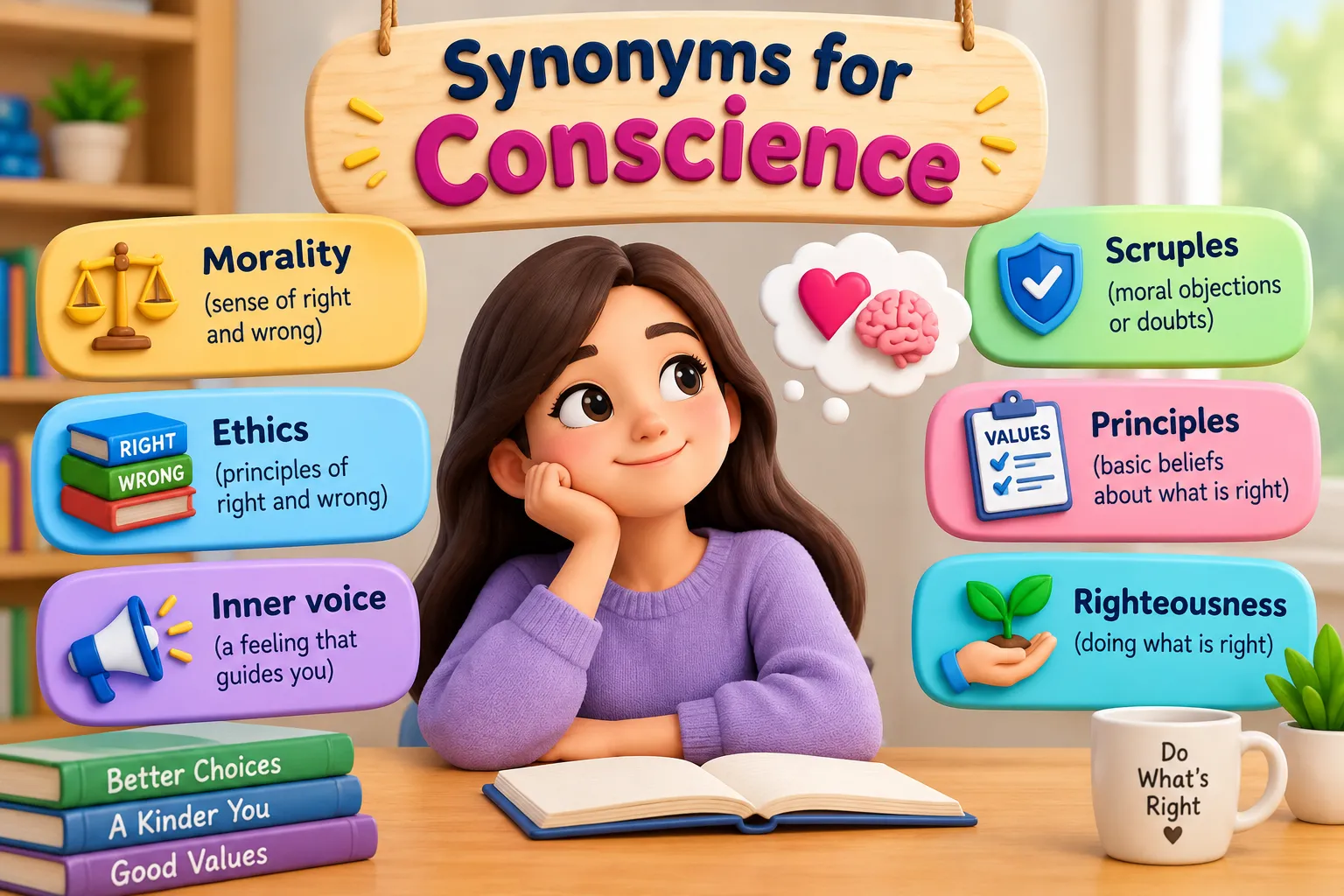
Synonyms for conscience include moral sense, inner voice, sense of right and wrong, moral awareness, and ethical judgement. Conscience helps people decide whether an action is right or wrong. For example, a student may feel guilty after cheating because their conscience tells them it is wrong. Words such as integrity, morality, and scruples are related to conscience, but each has a slightly different meaning. The best alternative depends on the situation. Learning these words can help you express thoughts about honesty, responsibility, values, and moral choices more clearly in everyday conversations, essays, and professional writing.
Conscience is the inner sense that helps us understand what is right and wrong. Imagine finding a wallet on the road. You could keep the money, but your conscience may tell you to return it to its owner. This inner feeling helps guide our choices and reminds us to act honestly. The word conscience is common in discussions about honesty, personal values, responsibility, and moral behaviour.
Learning synonyms for conscience helps English learners express ideas with greater accuracy. It also helps students and content writers avoid repeating the same word. For example, inner voice sounds personal, while moral judgment sounds more formal. These phrases are related, but they do not always mean exactly the same thing. This guide explains the meaning, history, pronunciation, and word forms of conscience. It also explores 30 synonyms and related expressions with simple meanings, examples, and semantic categories.
Meaning of Conscience
Definition
Conscience (Noun):
Conscience is the inner sense that helps a person judge whether their actions are right or wrong.
Examples
- My conscience told me to return the money I found.
- She felt guilty because her conscience reminded her that she had lied.
- A clear conscience helped him feel at peace.
- His conscience would not let him ignore the unfair treatment.
Connotative Meaning
Connotation (the feeling or idea associated with a word beyond its basic meaning) helps explain the emotional tone of conscience.
- Positive tone: Conscience can suggest honesty, kindness, responsibility, and strong moral values. Example: “Her clear conscience gave her peace of mind.”
- Negative tone: Conscience can be linked to guilt, regret, or shame after a wrong action. Example: “His conscience troubled him after he broke his promise.”
- Neutral tone: The word can describe a person’s moral awareness without judging them as good or bad. Example: “The story explores the role of conscience in human decisions.”
Conscience is often linked to positive values, but it can also bring uncomfortable feelings when people believe they have done something wrong.
Etymology of Conscience
The word conscience comes from Latin and has a long history in English.
- Old English (450–1100): The modern word conscience was not commonly used in Old English in its present form. Ideas about moral awareness were expressed through other words and religious concepts.
- Middle English (1100–1500): Conscience entered English through Old French conscience, from Latin conscientia. The Latin word was linked to knowledge, awareness, and knowing something within oneself.
- Modern English (1500–Present): Conscience developed its familiar meaning of an inner sense of right and wrong. Today, it is used in everyday speech, literature, religion, philosophy, law, and discussions about personal responsibility.
The Latin elements are associated with con- (“with” or “together”) and scire (“to know”). The word’s history reflects the idea of inner knowledge or awareness.
Pronunciation (IPA)
- IPA: /ˈkɒn.ʃəns/ in British English; /ˈkɑːn.ʃəns/ in American English.
- Syllables: con-science
- Total syllables: Two
- Stress: The first syllable is stressed.
Although conscience and conscious look similar, they have different meanings. Conscience relates to right and wrong, while conscious means awake or aware.
Affixation Pattern of Conscience
Root
- Conscience: From Latin conscientia, meaning knowledge or awareness.
- The word is historically linked to Latin con- and scire, but modern English speakers generally treat conscience as a complete word.
Prefix
- Con-: A Latin element meaning “with” or “together.” It is part of the word’s historical formation, rather than a prefix usually added to science in modern English to form conscience.
Suffix
- -ence: A noun-forming ending found in many English words. In conscience, it belongs to the word’s historical development.
Word Formation Table
| Word | Part of Speech | Meaning |
| Conscience | Noun | An inner sense of right and wrong |
| Conscientious | Adjective | Careful, responsible, and guided by duty |
| Conscientiously | Adverb | In a careful and responsible way |
| Conscientiousness | Noun | The quality of being careful and responsible |
| Conscienceless | Adjective | Lacking a sense of right and wrong |
| Unconscionable | Adjective | Shockingly unfair or morally unacceptable |
| Unconscionably | Adverb | In a way that is shockingly unfair or unacceptable |
Note: Conscious and consciously are related in spelling and history, but they do not mean the same thing as conscience.
30 Synonyms of Conscience With Meaning and Examples
Some words below are close synonyms, while others describe related moral qualities, feelings, or judgments. They are not all interchangeable. Choose the one that best matches your meaning.
1. Moral Sense (Noun Phrase)
Meaning: A moral sense is the ability to recognize right and wrong.
Examples:
- Her moral sense helped her make an honest choice.
- A strong moral sense can guide people through difficult decisions.
2. Inner Voice (Noun Phrase)
Meaning: An inner voice is a personal feeling or thought that guides someone’s choices.
Examples:
- His inner voice told him to admit his mistake.
- She listened to her inner voice before making the decision.
3. Moral Awareness (Noun Phrase)
Meaning: Moral awareness is an understanding of how actions affect what is right or wrong.
Examples:
- The lesson helped students develop moral awareness.
- Moral awareness can encourage people to treat others fairly.
4. Sense of Right and Wrong (Noun Phrase)
Meaning: A sense of right and wrong is the ability to judge whether an action is morally acceptable.
Examples:
- Parents can help children develop a sense of right and wrong.
- Her sense of right and wrong stopped her from cheating.
5. Moral Judgment (Noun Phrase)
Meaning: Moral judgment is the process of deciding whether an action is right or wrong.
Examples:
- His moral judgment guided him during the difficult situation.
- The case required careful moral judgment.
6. Ethical Sense (Noun Phrase)
Meaning: An ethical sense is an understanding of what is fair, responsible, or morally acceptable.
Examples:
- A strong ethical sense is useful in professional life.
- Her ethical sense helped her reject the dishonest offer.
7. Scruples (Noun)
Meaning: Scruples are doubts or concerns about whether an action is morally right.
Examples:
- He had scruples about taking credit for someone else’s work.
- She refused to lie because of her moral scruples.
8. Moral Compass (Noun Phrase)
Meaning: A moral compass is a set of values that guides a person’s decisions.
Examples:
- Her parents helped shape her moral compass.
- A strong moral compass can guide leaders through hard choices.
9. Integrity (Noun)
Meaning: Integrity is the quality of being honest and following strong moral principles.
Examples:
- The teacher showed integrity by treating every student fairly.
- Integrity matters even when no one is watching.
10. Morality (Noun)
Meaning: Morality is the set of principles people use to decide what is right and wrong.
Examples:
- The novel explores morality and human choices.
- People may disagree about morality in difficult situations.
11. Ethics (Noun)
Meaning: Ethics are principles that guide people in deciding what is right and responsible.
Examples:
- Medical ethics guide doctors in caring for patients.
- The company introduced rules about workplace ethics.
12. Ethical Awareness (Noun Phrase)
Meaning: Ethical awareness is the ability to notice moral issues and understand their importance.
Examples:
- Ethical awareness helps workers recognize conflicts of interest.
- The course improved students’ ethical awareness.
13. Moral Responsibility (Noun Phrase)
Meaning: Moral responsibility is the duty to act in a way that is right and fair.
Examples:
- Drivers have a moral responsibility to protect others on the road.
- He accepted moral responsibility for his decision.
14. Sense of Duty (Noun Phrase)
Meaning: A sense of duty is a strong feeling that you should do what is expected or right.
Examples:
- Her sense of duty made her help the community.
- He completed the task out of a sense of duty.
15. Principle (Noun)
Meaning: A principle is a belief or rule that guides how someone behaves.
Examples:
- Honesty is an important principle in her life.
- He refused to break his principles for money.
16. Conviction (Noun)
Meaning: A conviction is a strong belief that guides a person’s views or actions.
Examples:
- She acted according to her conviction that everyone deserves respect.
- His convictions shaped the way he treated others.
17. Moral Belief (Noun Phrase)
Meaning: A moral belief is an idea about what is right or wrong.
Examples:
- Her moral beliefs influenced her decision.
- People may have different moral beliefs about the same issue.
18. Sense of Justice (Noun Phrase)
Meaning: A sense of justice is a belief in fairness and equal treatment.
Examples:
- His sense of justice led him to speak up for the student.
- A strong sense of justice can help people challenge unfair rules.
19. Honesty (Noun)
Meaning: Honesty is the quality of telling the truth and acting fairly.
Examples:
- Honesty helped her earn the trust of her friends.
- He chose honesty over an easy lie.
20. Decency (Noun)
Meaning: Decency is the quality of behaving in a fair, kind, and acceptable way.
Examples:
- Basic decency means treating others with respect.
- She showed decency by helping the injured stranger.
21. Goodness (Noun)
Meaning: Goodness is the quality of being kind, honest, and morally good.
Examples:
- His goodness was clear in the way he helped others.
- The story celebrates kindness and goodness.
22. Virtue (Noun)
Meaning: Virtue is a good moral quality, such as honesty, courage, or kindness.
Examples:
- Patience is a virtue that helps people handle stress.
- The teacher encouraged students to practice virtue.
23. Guilt (Noun)
Meaning: Guilt is the feeling that you have done something wrong.
Examples:
- He felt guilt after blaming his friend unfairly.
- Her guilt led her to apologize.
24. Remorse (Noun)
Meaning: Remorse is deep regret for doing something wrong.
Examples:
- He showed remorse for hurting his brother.
- Her remorse was clear when she asked for forgiveness.
25. Regret (Noun)
Meaning: Regret is sadness or disappointment about something you did or failed to do.
Examples:
- She felt regret after speaking harshly to her mother.
- He expressed regret for missing the important meeting.
26. Shame (Noun)
Meaning: Shame is a painful feeling caused by believing that you have done something wrong or embarrassing.
Examples:
- He felt shame after being caught cheating.
- She admitted her mistake instead of hiding in shame.
27. Self-Examination (Noun)
Meaning: Self-examination is the act of thinking carefully about your own actions, beliefs, and behavior.
Examples:
- Self-examination helped him understand why he had acted unfairly.
- Regular self-examination can support personal growth.
28. Self-Awareness (Noun)
Meaning: Self-awareness is an understanding of your own thoughts, feelings, and behavior.
Examples:
- Self-awareness helped her notice her unfair assumptions.
- Greater self-awareness can improve decision-making.
29. Moral Consciousness (Noun Phrase)
Meaning: Moral consciousness is an awareness of moral values and the difference between right and wrong.
Examples:
- The story explores moral consciousness and personal choice.
- Education can encourage moral consciousness in young people.
30. Ethical Judgment (Noun Phrase)
Meaning: Ethical judgment is the ability to assess a choice based on moral principles.
Examples:
- The manager used ethical judgment to resolve the conflict fairly.
- Ethical judgment is important when a decision affects other people.
Prototype Meaning of Conscience
The most typical meaning of conscience is an inner sense that helps a person judge right and wrong. People often imagine a quiet inner voice that encourages them to tell the truth, keep a promise, or correct a mistake. A clear conscience may bring peace of mind, while a troubled conscience may cause guilt or regret. The word is closely linked to honesty, personal values, and moral responsibility. Although moral sense and inner voice are close alternatives, words such as integrity describe a person’s character, while guilt and remorse describe feelings that may follow a wrong action.
Prototype Categorization of Conscience Synonyms
Grouping these words by meaning helps writers choose a more precise alternative to conscience.
1. Inner Moral Guidance
These terms describe the inner ability or feeling that guides choices.
- Moral Sense: The ability to recognize right and wrong.
- Inner Voice: A personal feeling or thought that guides behavior.
- Moral Awareness: Understanding the moral side of an action.
- Sense of Right and Wrong: The ability to judge an action as right or wrong.
- Moral Compass: Values that guide choices.
Best for: Personal decisions, everyday situations, and discussions about doing the right thing.
2. Ethics and Moral Judgment
These terms focus on moral rules, principles, and decisions.
- Moral Judgment: Deciding whether an action is right or wrong.
- Ethical Sense: Understanding what is fair and responsible.
- Ethical Awareness: Recognizing moral issues.
- Ethics: Principles that guide behavior.
- Ethical Judgment: Assessing choices using moral principles.
- Moral Consciousness: Awareness of moral values.
Best for: Academic essays, professional conduct, research, and discussions about social responsibility.
3. Character and Good Values
These words describe good qualities or beliefs that guide behavior.
- Integrity: Honesty and strong moral principles.
- Morality: Principles about right and wrong.
- Principle: A belief that guides behavior.
- Conviction: A strong belief.
- Moral Belief: An idea about what is right or wrong.
- Honesty: Truthfulness and fairness.
- Decency: Acceptable and respectful behavior.
- Goodness: The quality of being morally good.
- Virtue: A good moral quality.
Best for: Describing a person’s character, values, or behavior.
4. Duty and Fairness
These terms focus on responsibility and justice.
- Moral Responsibility: A duty to act rightly.
- Sense of Duty: A feeling of responsibility.
- Sense of Justice: A belief in fairness.
- Scruples: Concerns about whether an action is morally acceptable.
Best for: Writing about fairness, professional duties, promises, and difficult choices.
5. Feelings After a Wrong Action
These words describe emotional responses that may follow a mistake.
- Guilt: Feeling that you have done something wrong.
- Remorse: Deep regret for a wrong action.
- Regret: Sadness about a past choice.
- Shame: Painful feelings about an action or situation.
Best for: Stories, personal experiences, apologies, and discussions about mistakes.
6. Reflection and Self-Understanding
These terms describe thinking about yourself and your behavior.
- Self-Examination: Carefully reviewing your own actions and beliefs.
- Self-Awareness: Understanding your thoughts, feelings, and behavior.
Best for: Personal development, reflective writing, and discussions about learning from mistakes.
How this categorization helps: These words have different meanings, so they cannot always replace conscience. Use moral compass when discussing guidance, integrity when describing character, ethical judgement when discussing a decision, and remorse when describing deep regret. Choosing the right term makes your writing more accurate and natural.
Antonyms of Conscience
There is no single perfect antonym for conscience. However, the following words describe a lack of moral concern, a failure to recognize right and wrong, or behavior that conflicts with conscience.
| Antonym or Contrasting Term | Part of Speech | Meaning |
| Unconscionability | Noun | The quality of being shockingly unfair or morally unacceptable |
| Shamelessness | Noun | A lack of shame about behavior others consider wrong |
| Ruthlessness | Noun | A willingness to act harshly without caring about others’ suffering |
| Heartlessness | Noun | A lack of kindness or concern for others |
| Immorality | Noun | Behavior that goes against accepted moral principles |
| Dishonesty | Noun | The act or quality of lying or deceiving others |
| Corruption | Noun | Dishonest or unethical behavior, often involving power |
| Unscrupulousness | Noun | A lack of concern about whether actions are morally right |
| Cruelty | Noun | Behavior that causes suffering without proper concern |
| Indifference | Noun | A lack of interest, concern, or feeling about something |
Note: These are contextual opposites, not exact antonyms in every sentence. For example, shamelessness means a lack of shame, while immorality refers to behavior that violates moral standards.
Short Questions and Answers
1. What does conscience mean?
Conscience is the inner sense that helps you judge whether your actions are right or wrong. It can guide your choices and cause guilt when you believe you have done something wrong.
2. When should conscience be used?
Use conscience when discussing moral choices, honesty, personal responsibility, or feelings about right and wrong. For example, “My conscience told me to tell the truth.”
3. Is conscience positive or negative?
The word is often linked to positive values because it can guide people toward honest behavior. However, a troubled conscience may bring guilt or regret after a mistake.
4. How is conscience different from similar words?
Conscience is the inner sense of right and wrong. Integrity is the quality of acting honestly, morality refers to principles about right and wrong, and remorse is deep regret after doing something wrong.
Conclusion
Learning synonyms for conscience helps you express ideas about honesty, values, and moral choices in a clearer way. Terms such as moral sense, inner voice, moral compass, and ethical judgment can make your writing more precise. Other related words, such as integrity, guilt, and remorse, describe character traits or feelings rather than conscience itself. Understanding these differences helps you choose the right word for each situation.
These words are useful for students, teachers, writers, and anyone who wants to improve their English. They can strengthen essays, conversations, stories, and professional writing. Try learning a few words each day and using them in your own sentences. Reading examples and comparing meanings will help you build vocabulary, avoid repetition, and speak with greater confidence. With regular practice, you can express complex ideas in simple and natural English.
Read More:
Synonyms for Negative Impact:25 Useful Alternatives

I’m Falak Naaz, an SEO writer at SynonymsInstant.com focused on creating clear, engaging, and search-friendly English content. I specialize in vocabulary, synonyms, antonyms, word usage, and language guides. I combine careful research with practical writing to deliver trustworthy content that helps readers choose the right words and improve their English with confidence.