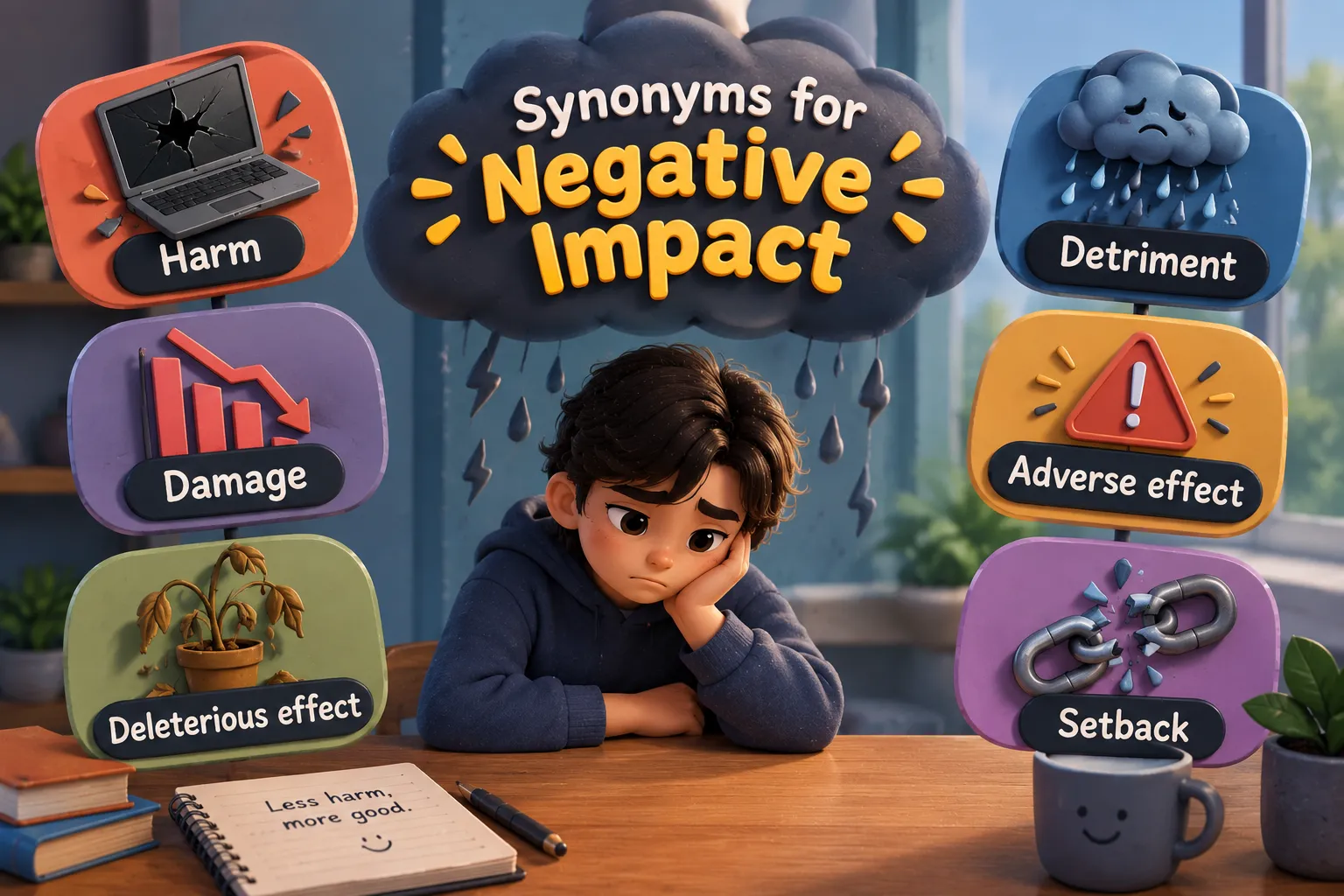
Synonyms for negative impact include harmful effect, adverse effect, detrimental effect, damaging influence, and harmful consequence. These phrases describe bad results caused by an action, event, or decision. For example, pollution can have a harmful effect on health, while poor planning can lead to damaging consequences. Some alternatives, such as setbacks and drawbacks, fit specific situations. Others, such as damage and harm, describe the result more directly. The best choice depends on the context. Learning these alternatives can help you write better essays, reports, articles, and professional messages without repeating the phrase “negative impact.”
A negative impact is a harmful or unwanted effect caused by an action, event, or decision. For example, too much screen time may affect sleep, and pollution may harm the environment. These are common examples of negative impacts in daily life. The phrase is often used in school essays, research papers, business reports, and news articles.
Learning synonyms for negative impact helps English learners express ideas in different ways. It also helps writers avoid repetition and choose words that match their meaning. For example, the adverse effect sounds formal, while the harmful result is simple and clear. Some alternatives describe direct damage, while others focus on problems, losses, or long-term consequences. This guide explains the meaning, pronunciation, history, and word forms of the phrase. It also provides 25 related expressions with simple meanings and examples to help you improve your vocabulary and writing skills.
Meaning of Negative Impact
Definition
Negative Impact (Noun Phrase):
A negative impact is a harmful, unwanted, or damaging effect that something has on a person, group, situation, or environment.
Examples
- Air pollution has a negative impact on human health.
- Poor planning can have a negative impact on a business.
- Too little sleep may have a negative impact on learning.
- Plastic waste has a negative impact on marine life.
Connotative Meaning
Connotation (the feeling or idea associated with a word beyond its basic meaning) helps explain the tone of negative impact.
- Positive tone: The phrase itself is not usually positive. However, discussing a negative impact can lead to positive action. Example: “The report helped the school reduce the negative impact of bullying.”
- Negative tone: The phrase usually suggests harm, loss, trouble, or an unwanted change. Example: “The storm had a negative impact on local farms.”
- Neutral tone: In research and reports, the phrase can describe an effect in a factual way. Example: “The study measured the negative impact of noise on sleep.”
The phrase generally has a negative meaning because it describes an unwanted effect.
Etymology of Negative Impact
The phrase negative impact combines two words with different histories.
- Old English (450–1100): Negative was not yet used in its modern English form. Old English had words for denial and refusal. Impact was also not an established English word during this period.
- Middle English (1100–1500): English adopted words influenced by French and Latin. The Latin root negare, meaning “to deny,” later contributed to negative. The word impact came from Latin impactus, related to impingere, meaning “to push or strike against.”
- Modern English (1500–Present): Negative developed from Latin through French and related European usage. Impact entered English through Latin, with early senses connected to striking or pressing against something. Over time, impact also came to mean an effect or influence. Today, negative impact commonly describes a harmful effect in education, science, business, health, and everyday life.
Pronunciation (IPA)
- Negative: /ˈneɡ.ə.tɪv/
- Impact: /ˈɪm.pækt/ when used as a noun in common American pronunciation.
- Syllables: Neg-a-tive im-pact
- Total syllables: Five
The main stress falls on the first syllable of both negative and impact.
Affixation Pattern of Negative Impact
Root
- Negative: From Latin negare, meaning “to deny.”
- Impact: From Latin impactus, related to the idea of striking or pushing against something.
Prefix
- Negative: No separate productive English prefix in its modern form.
- Impact: The word’s Latin history includes im- in its formation, but modern English speakers usually treat impact as a complete word.
Suffix
- Negative: The ending -ive helps form an adjective.
- Impact: The word has no productive suffix in its basic form.
Word Formation Table
| Word | Part of Speech | Meaning |
| Negative | Adjective | Harmful, unfavorable, or showing denial |
| Negatively | Adverb | In an unfavorable or harmful way |
| Negativity | Noun | A negative attitude or state |
| Negate | Verb | To cancel, deny, or make ineffective |
| Negation | Noun | The act of denying or making something negative |
| Impact | Noun / Verb | An effect or the act of affecting something |
| Impactful | Adjective | Having a strong effect |
| Impacted | Adjective / Verb | Affected or influenced |
| Impacting | Verb / Adjective | Affecting or having an effect |
| Impactfully | Adverb | In a way that has a strong effect; uncommon usage |
| Harm | Noun / Verb | Injury, damage, or an act that causes it |
| Harmful | Adjective | Causing or likely to cause harm |
| Harmfully | Adverb | In a way that causes harm |
| Damage | Noun / Verb | Physical or other harm or loss |
| Damaging | Adjective | Causing harm or loss |
| Detriment | Noun | Harm, loss, or disadvantage |
| Detrimental | Adjective | Causing harm or damage |
| Adverse | Adjective | Unfavorable or harmful |
| Adversely | Adverb | In an unfavorable way |
25 Synonyms for Negative Impact With Meaning and Examples
The following list includes close synonyms and related expressions. Some are direct replacements, while others fit only certain contexts. Choose the phrase that best describes the effect you mean.
1. Harmful Effect (Noun Phrase)
Meaning: A harmful effect is a result that causes damage or trouble.
Examples:
- Smoking can have a harmful effect on the lungs.
- Loud noise may have a harmful effect on sleep.
2. Adverse Effect (Noun Phrase)
Meaning: An adverse effect is an unwanted or unfavorable result.
Examples:
- The medicine may have an adverse effect on some patients.
- Heavy rain had an adverse effect on road conditions.
3. Detrimental Effect (Noun Phrase)
Meaning: A detrimental effect is a result that causes harm or makes a situation worse.
Examples:
- Poor nutrition can have a detrimental effect on growth.
- Stress may have a detrimental effect on student performance.
4. Damaging Influence (Noun Phrase)
Meaning: A damaging influence is something that harms a person, group, or situation.
Examples:
- Peer pressure can be a damaging influence on young people.
- False information may have a damaging influence on public opinion.
5. Harmful Consequence (Noun Phrase)
Meaning: A harmful consequence is a bad result that follows an action or event.
Examples:
- Careless driving can have a harmful consequence.
- Ignoring safety rules may lead to harmful consequences.
6. Bad Effect (Noun Phrase)
Meaning: A bad effect is an unwanted result of an action or situation.
Examples:
- Too much sugar can have a bad effect on health.
- The delay had a bad effect on our plans.
7. Ill Effect (Noun Phrase)
Meaning: An ill effect is a harmful or unwanted result.
Examples:
- The treatment caused no ill effects.
- Lack of exercise can have ill effects on health.
8. Damage (Noun)
Meaning: Damage is physical or other harm caused to a person, place, object, or situation.
Examples:
- The flood caused serious damage to homes.
- The rumor did damage to his reputation.
9. Harm (Noun)
Meaning: Harm is injury, loss, or damage caused to someone or something.
Examples:
- Air pollution can cause harm to children.
- The new rule did more harm than good.
10. Detriment (Noun)
Meaning: Detriment is harm or loss that makes a situation worse.
Examples:
- He worked long hours to the detriment of his health.
- Poor planning can be to the detriment of a project.
11. Setback (Noun)
Meaning: A setback is a problem or event that delays progress.
Examples:
- The canceled order was a setback for the company.
- Her illness caused a setback in her studies.
12. Drawback (Noun)
Meaning: A drawback is a disadvantage or feature that makes something less useful.
Examples:
- One drawback of city life is heavy traffic.
- The plan has a major drawback: it costs too much.
13. Disadvantage (Noun)
Meaning: A disadvantage is something that puts a person or situation in a less favorable position.
Examples:
- A lack of experience can be a disadvantage when applying for jobs.
- The delay placed the team at a disadvantage.
14. Downside (Noun)
Meaning: A downside is a negative part or feature of something.
Examples:
- The main downside of the job is the long commute.
- One downside of online learning is less face-to-face contact.
15. Repercussion (Noun)
Meaning: A repercussion is an effect or result that follows an action, often an unwanted one.
Examples:
- His careless comment had serious repercussions.
- The company faced financial repercussions after the mistake.
16. Unwanted Outcome (Noun Phrase)
Meaning: An unwanted outcome is a result that people did not want or expect.
Examples:
- The changes led to an unwanted outcome.
- Poor communication can create unwanted outcomes.
17. Undesirable Effect (Noun Phrase)
Meaning: An undesirable effect is a result that is not wanted or considered beneficial.
Examples:
- The chemical may have an undesirable effect on plants.
- The new schedule had an undesirable effect on family time.
18. Unfavorable Result (Noun Phrase)
Meaning: An unfavorable result is an outcome that does not support a goal or expectation.
Examples:
- The company reported an unfavorable result this quarter.
- The test showed an unfavorable result for the project.
19. Negative Consequence (Noun Phrase)
Meaning: A negative consequence is an unwanted result caused by an action or decision.
Examples:
- Skipping lessons can have a negative consequence for learning.
- The decision had a negative consequence for local workers.
20. Harmful Outcome (Noun Phrase)
Meaning: A harmful outcome is a result that causes injury, loss, or trouble.
Examples:
- Unsafe choices may lead to a harmful outcome.
- The lack of clean water had a harmful outcome for the community.
21. Adverse Impact (Noun Phrase)
Meaning: An adverse impact is an unfavorable effect on a person, system, or situation.
Examples:
- The policy had an adverse impact on small businesses.
- Noise can have an adverse impact on concentration.
22. Detrimental Impact (Noun Phrase)
Meaning: A detrimental impact is an effect that causes harm or reduces success.
Examples:
- Poor sleep can have a detrimental impact on memory.
- The cuts had a detrimental impact on public services.
23. Negative Influence (Noun Phrase)
Meaning: A negative influence is a person or thing that encourages harmful behavior or creates an unwanted effect.
Examples:
- Bad company can be a negative influence on teenagers.
- The misleading post had a negative influence on public opinion.
24. Disruptive Effect (Noun Phrase)
Meaning: A disruptive effect is a result that interrupts normal activity or progress.
Examples:
- The power failure had a disruptive effect on the school day.
- Constant noise can have a disruptive effect on work.
25. Harmful Change (Noun Phrase)
Meaning: A harmful change is a change that makes a situation worse.
Examples:
- The harmful change reduced the quality of the water.
- A sudden loss of funding caused a harmful change in services.
Prototype Meaning of Negative Impact
The typical meaning of negative impact is an unwanted effect that causes harm, loss, or difficulty. When people hear this phrase, they may think of pollution harming nature, stress affecting health, or a poor decision causing problems at work. The phrase can describe immediate damage or effects that develop over time. It is common in school essays, research, business reports, and public discussions because it explains how one thing affects another in an unfavorable way. The exact meaning depends on the context: a setback slows progress, damage describes harm, and an adverse effect highlights an unfavorable result.
Prototype Categorization of Negative Impact Synonyms
Grouping these alternatives helps writers choose the most suitable phrase for each context.
1. Direct Harm or Damage
These words focus on injury, damage, or harm.
- Harmful Effect: A result that causes harm.
- Damage: Harm to a person, object, reputation, or situation.
- Harm: Injury, loss, or damage.
- Harmful Outcome: A result that causes trouble or injury.
- Harmful Change: A change that makes something worse.
Best for: Health, safety, the environment, and personal well-being.
2. Formal and Academic Expressions
These phrases work well in essays, research papers, and professional reports.
- Adverse Effect: An unfavorable result.
- Detrimental Effect: An effect that causes harm.
- Adverse Impact: An unfavorable effect on a person or system.
- Detrimental Impact: An effect that reduces success or well-being.
- Undesirable Effect: A result that is not wanted.
Best for: Academic writing, scientific studies, and formal reports.
3. Problems and Disadvantages
These words describe weaknesses, obstacles, or difficulties.
- Setback: A problem that delays progress.
- Drawback: A disadvantage of something.
- Disadvantage: A condition that puts someone in a less favorable position.
- Downside: A negative feature or part.
- Unfavorable Result: An outcome that does not support a goal.
Best for: Product reviews, decision-making, business plans, and comparisons.
4. Later Results and Consequences
These expressions focus on what happens because of an action or event.
- Harmful Consequence: A bad result that follows an action.
- Negative Consequence: An unwanted result.
- Repercussion: A later effect, often an unwanted one.
- Unwanted Outcome: A result that was not desired.
- Cost: A loss or sacrifice linked to a choice.
Best for: Explaining decisions, behavior, policies, and long-term results.
5. Influence and Disruption
These terms describe effects on behavior, systems, or normal activities.
- Damaging Influence: Something that causes harm.
- Negative Influence: An influence that encourages harmful behavior or produces unwanted effects.
- Disruptive Effect: A result that interrupts normal activity.
- Impairment: A reduction in normal ability or function.
- Deterioration: A decline in quality or condition.
Best for: Education, relationships, health, work, and social issues.
6. Decline and Loss
These terms highlight reduced quality, value, or resources.
- Loss: The state of losing something valuable.
- Decline: A decrease in quality or amount.
- Deterioration: A process in which something becomes worse.
- Bad Effect: A simple phrase for an unwanted result.
- Ill Effect: A harmful result, often related to health or well-being.
Best for: Describing falling standards, financial problems, reduced performance, or changes in health.
How this categorization helps: The right synonym makes your meaning clearer. Use adverse impact in a formal report, drawback when discussing a weakness, setback when progress is delayed, and deterioration when something becomes worse over time. Always check the context before replacing negative impact with another phrase.
Antonyms of Negative Impact
The phrase negative impact has no single exact antonym that fits every context. However, the following words and phrases describe helpful, favorable, or beneficial effects.
| Antonym or Contrasting Phrase | Part of Speech | Meaning |
| Positive Impact | Noun Phrase | An effect that brings a good result |
| Beneficial Effect | Noun Phrase | A result that helps or improves something |
| Positive Influence | Noun Phrase | An influence that encourages helpful behavior or change |
| Advantage | Noun | A condition that gives someone a benefit |
| Benefit | Noun | Something helpful or useful |
| Improvement | Noun | A change that makes something better |
| Progress | Noun | Movement toward a goal or better condition |
| Gain | Noun | An increase or something valuable received |
| Favorable Outcome | Noun Phrase | A result that is helpful or desired |
| Positive Consequence | Noun Phrase | A good result that follows an action |
| Enhancement | Noun | An improvement in quality or value |
| Advantageous Effect | Noun Phrase | An effect that creates a benefit |
Short Questions and Answers
1. What does negative impact mean?
Negative impact means a harmful or unwanted effect caused by an action, event, or decision.
2. When should negative impact be used?
Use the phrase when explaining how something causes harm, creates a problem, reduces success, or makes a situation worse. It is common in academic, professional, and everyday writing.
3. Is negative impact positive or negative?
The phrase is negative because it describes an unwanted effect. However, discussing a negative impact can help people understand a problem and find a solution.
4. How is negative impact different from similar words?
Negative impact is a broad phrase for an unwanted effect. Damage focuses on harm, setback means a delay in progress, drawback describes a disadvantage, and repercussion often refers to a later result of an action.
Conclusion
Learning synonyms for negative impact helps you express problems and unwanted effects with greater accuracy. Words such as harmful effect, adverse impact, setback, and drawback can make your writing clearer and less repetitive. Each phrase has a slightly different meaning, so it is important to choose one that fits your topic. For example, use detrimental effect in formal writing, downside in everyday conversation, and repercussion when discussing the results of an action.
These terms are useful for students, teachers, researchers, bloggers, and professional writers. They can strengthen essays, reports, presentations, and discussions. To improve your English, practice using a few alternatives each day. Write your own sentences, compare similar words, and read examples in context. Regular practice will help you build a stronger vocabulary, communicate more clearly, avoid repetition, and write with greater confidence.
Read More:
Synonyms for Video: 27 Best Alternatives to Know

I’m Falak Naaz, an SEO writer at SynonymsInstant.com focused on creating clear, engaging, and search-friendly English content. I specialize in vocabulary, synonyms, antonyms, word usage, and language guides. I combine careful research with practical writing to deliver trustworthy content that helps readers choose the right words and improve their English with confidence.