
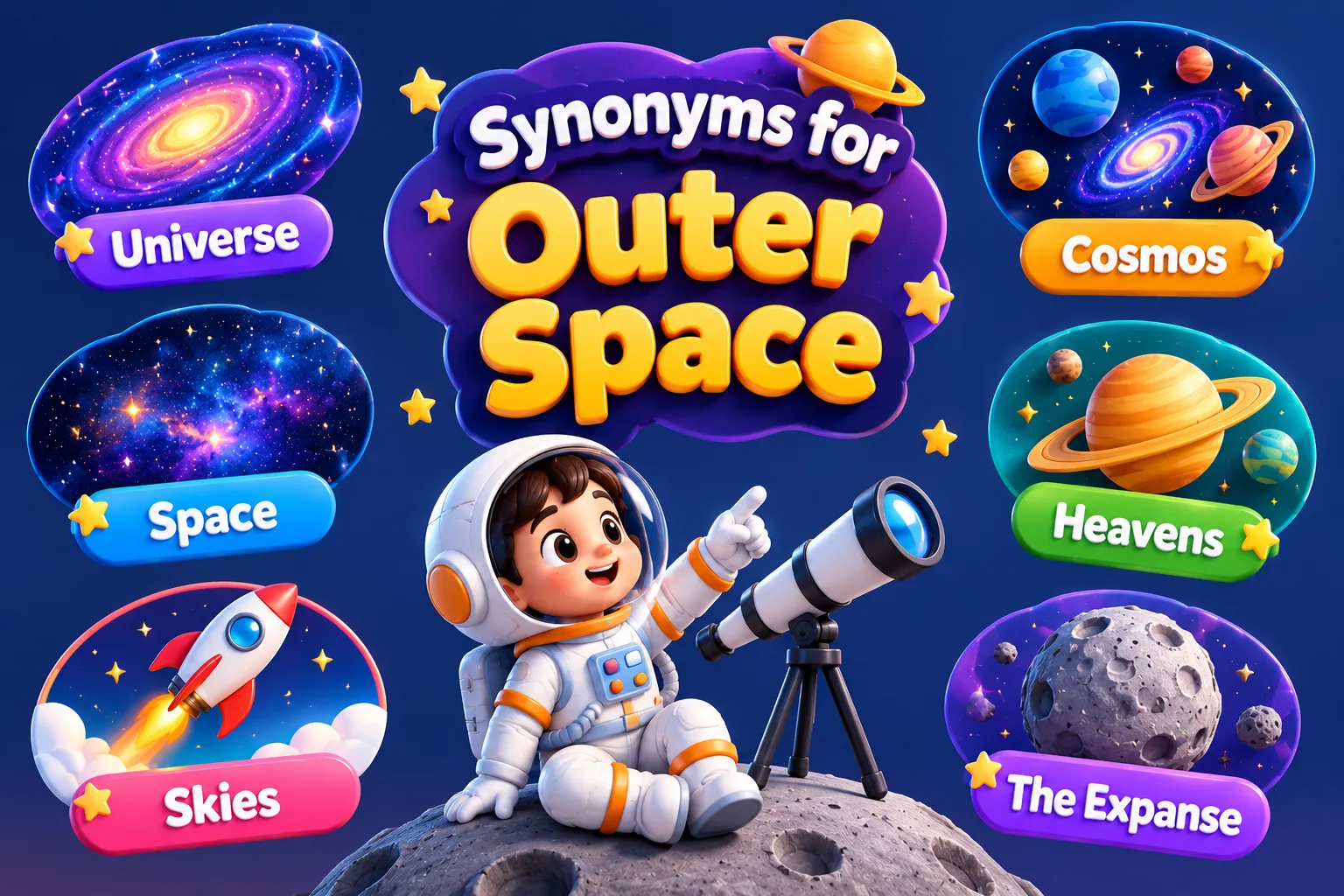
Synonyms for outer space include space, cosmos, universe, the void, celestial realm, and interstellar space. These terms describe the vast region beyond Earth’s atmosphere, where stars, planets, galaxies, and other celestial objects exist. Some refer to the whole universe, while others describe specific regions of space.
Outer space is the vast area beyond Earth’s atmosphere. It contains stars, planets, moons, galaxies, and many other objects. Imagine looking up at the night sky and seeing countless stars. All the space between these objects is part of the amazing world we call outer space. This term is common in science, astronomy, books, movies, and space exploration. Learning synonyms for outer space helps English learners build their vocabulary and describe the universe in different ways. It also helps writers avoid repeating the same words in articles, stories, and school assignments. However, related terms can have different meanings. Some refer to the entire universe, while others describe the space between stars or planets. This guide explains the meaning, history, pronunciation, word forms, and 25 related terms with simple meanings and examples.
Meaning of Outer Space
Definition
Outer Space (Noun): The vast region beyond Earth’s atmosphere where planets, stars, galaxies, and other celestial objects exist.
Examples
- Scientists use powerful telescopes to study outer space.
- Astronauts travel into outer space to conduct research.
Connotative Meaning
Connotation means the feeling or idea a word suggests beyond its basic meaning.
- Positive tone: Outer space can suggest wonder, discovery, adventure, and new possibilities.
- Negative tone: It may suggest darkness, danger, isolation, or the unknown.
- Neutral tone: In science, outer space simply refers to the region beyond Earth’s atmosphere.
Etymology of Outer Space
The phrase outer space combines two English words. Outer means farther outside, while space refers to an area or expanse. The phrase became widely used in the modern era as people developed a clearer scientific understanding of space beyond Earth.
| Period | History and Meaning |
| Old English (450–1100) | Outer space was not used as a fixed phrase. Old English had words such as ūtera, meaning “outer” or “farther outside,” and spǣce is not the direct Old English form of modern space. |
| Middle English (1100–1500) | Outer developed from earlier English forms. Space entered English through Old French espace, from Latin spatium, meaning an area, extent, or distance. |
| Modern English (1500–Present) | Outer space came to mean the region beyond Earth’s atmosphere. The phrase became especially common with the growth of astronomy, rockets, and spaceflight. |
Pronunciation (IPA)
- IPA: /ˌaʊ.tər ˈspeɪs/
- Syllables: out-er space (3 syllables)
Affixation Pattern of Outer Space
- Root: Outer and space are the two words in the phrase.
- Prefix: There is no prefix in the complete phrase outer space.
- Suffix: There is no suffix in the complete phrase.
Word Formations
| Word or Phrase | Grammatical Category | Meaning |
| Space | Noun | An area or vast expanse. |
| Outer | Adjective | Farther outside or beyond. |
| Outer space | Noun phrase | The region beyond Earth’s atmosphere. |
| Spacecraft | Noun | A vehicle designed to travel in space. |
| Spaceflight | Noun | Travel beyond Earth’s atmosphere. |
| Spaceflight | Noun | The act or process of traveling in space. |
| Spacefaring | Adjective | Able to travel or operate in space. |
| Space-based | Adjective | Located or operating in space. |
| Interstellar | Adjective | Existing or occurring between stars. |
| Interplanetary | Adjective | Existing or occurring between planets. |
| Extraterrestrial | Adjective/noun | From or related to beyond Earth; also, a possible life form from beyond Earth. |
| Astronomical | Adjective | Related to astronomy or celestial objects. |
25 Synonyms of Outer Space With Meaning & Examples
Note: Outer space has few exact synonyms. Some terms below are close alternatives, scientific terms, or related concepts. They are not interchangeable in every sentence.
1. Space (Noun)
Meaning: The vast area beyond Earth’s atmosphere or the area in which objects exist.
Examples:
- Scientists study space to learn about distant planets.
- The spacecraft traveled through space for several months.
2. Cosmos (Noun)
Meaning: The universe viewed as an organized whole.
Examples:
- The documentary explored the mysteries of the cosmos.
- Scientists continue to study the cosmos.
3. Universe (Noun)
Meaning: Everything that exists, including space, time, matter, and energy.
Examples:
- The universe contains billions of galaxies.
- Astronomers study how the universe began.
4. Interstellar Space (Noun Phrase)
Meaning: The space between stars.
Examples:
- The probe traveled into interstellar space.
- Interstellar space contains gas, dust, and particles.
5. Interplanetary Space (Noun Phrase)
Meaning: The space between planets in a planetary system.
Examples:
- A spacecraft crossed interplanetary space on its way to Mars.
- Scientists study particles found in interplanetary space.
6. Intergalactic Space (Noun Phrase)
Meaning: The space between galaxies.
Examples:
- Intergalactic space separates distant galaxies.
- Scientists study the matter found in intergalactic space.
7. Celestial Space (Noun Phrase)
Meaning: The region associated with celestial objects such as stars and planets.
Examples:
- The telescope captured images of celestial space.
- Researchers use advanced tools to study celestial space.
8. The Void (Noun Phrase)
Meaning: A vast or apparently empty region of space.
Examples:
- The spacecraft moved silently through the void.
- The image showed a dark void between distant objects.
9. The Heavens (Noun)
Meaning: The sky or the region beyond Earth, often used in poetic or religious language.
Examples:
- The ancient people watched the heavens for signs.
- Stars filled the heavens on a clear night.
10. Celestial Realm (Noun Phrase)
Meaning: A region associated with stars, planets, and other objects in the sky.
Examples:
- The story takes place in a distant celestial realm.
- The artist painted a colorful celestial realm.
11. Cosmic Space (Noun Phrase)
Meaning: The vast expanse of space on a cosmic scale.
Examples:
- The scientist studied the movement of matter in cosmic space.
- The film showed the beauty of cosmic space.
12. Cosmic Expanse (Noun Phrase)
Meaning: The immense stretch of space across the universe.
Examples:
- The telescope revealed the cosmic expanse beyond Earth.
- The stars appeared tiny against the cosmic expanse.
13. The Firmament (Noun)
Meaning: The sky or heavens, especially in older or literary language.
Examples:
- Stars shone brightly across the firmament.
- The poet described the moon in the night firmament.
14. The Empyrean (Noun)
Meaning: The highest heaven, especially in classical or poetic writing.
Examples:
- The poem described a glowing empyrean.
- The painter imagined angels in the empyrean.
15. The Great Beyond (Noun Phrase)
Meaning: An unknown or distant region beyond familiar places; often used poetically for space or the afterlife.
Examples:
- The science-fiction crew set out to explore the great beyond.
- The story imagined life in the great beyond.
16. Starfield (Noun)
Meaning: A field or region filled with visible stars.
Examples:
- The telescope captured a bright starfield.
- The spacecraft appeared as a tiny dot against the starfield.
17. Star System (Noun)
Meaning: A star or group of stars and the objects held by their gravity.
Examples:
- Scientists discovered a planet in a distant star system.
- The mission aimed to study a nearby star system.
18. Galaxy (Noun)
Meaning: A large group of stars, gas, dust, and dark matter held together by gravity.
Examples:
- Our solar system lies within the Milky Way galaxy.
- The telescope photographed a distant galaxy.
19. Galactic Space (Noun Phrase)
Meaning: Space within or associated with a galaxy.
Examples:
- The probe collected data about conditions in galactic space.
- Stars and gas fill much of galactic space.
20. Deep Space (Noun Phrase)
Meaning: Space far from Earth or its immediate surroundings.
Examples:
- The spacecraft sent signals from deep space.
- Deep-space missions need careful planning.
21. Near-Earth Space (Noun Phrase)
Meaning: The region around Earth where satellites and other objects travel.
Examples:
- Satellites help scientists monitor near-Earth space.
- Researchers track debris in near-Earth space.
22. Orbital Space (Noun Phrase)
Meaning: Space where objects follow an orbit around a planet or another body.
Examples:
- The satellite entered orbital space around Earth.
- The mission studied objects moving through orbital space.
23. The Expanse (Noun)
Meaning: A wide, open area that seems to stretch far into the distance.
Examples:
- The astronaut looked out at the dark expanse.
- The image showed the expanse beyond the Moon.
24. Outer Cosmos (Noun Phrase)
Meaning: A poetic expression for the distant or vast universe.
Examples:
- The story follows explorers into the outer cosmos.
- The artist imagined bright worlds in the outer cosmos.
25. Astral Realm (Noun Phrase)
Meaning: A mystical or imaginative region associated with stars or spiritual travel.
Examples:
- The fantasy novel describes an astral realm.
- The game lets players explore a glowing astral realm.
Prototype Meaning
The most common meaning of outer space is the vast region beyond Earth’s atmosphere. People often imagine a dark expanse filled with stars, planets, moons, and distant galaxies. They may also think of astronauts, rockets, satellites, and space telescopes. Outer space includes the regions between planets, stars, and galaxies, but it is not exactly the same as the universe. The universe includes all space, time, matter, and energy, while outer space usually refers to the region beyond Earth’s atmosphere.
Prototype Categorization
The related terms for outer space can be grouped by their meanings. These groups help writers choose words that fit science writing, fiction, or everyday descriptions.
- General terms: Space, cosmos, and universe describe broad ideas. Use space for the region beyond Earth, cosmos for the universe as a whole, and universe for everything that exists.
- Space between objects: Interstellar space, interplanetary space, and intergalactic space refer to the regions between stars, planets, and galaxies.
- Large or distant regions: Deep space, cosmic expanse, the void, and the expanse emphasize distance, scale, or apparent emptiness.
- Regions around celestial objects: Star system, galaxy, galactic space, orbital space, and near-Earth space refer to specific systems or locations.
- Scientific terms: Interstellar medium and space environment describe the matter and conditions found in space.
- Poetic and imaginative terms: The heavens, firmament, empyrean, astral realm, and cosmic realm are often used in poetry, religion, or fantasy rather than formal scientific writing.
- Descriptive phrases: Celestial space, celestial realm, cosmic space, and extraterrestrial space offer alternative ways to describe regions beyond Earth.
These categories help you select a term that matches your purpose. For example, interstellar space is precise in astronomy, while the great beyond is better suited to a story or a poetic description.
Antonyms of Outer Space
There is no exact antonym for outer space. However, the following terms describe places or environments that contrast with it.
| Opposing Term | Part of Speech | Meaning |
| Earth | Noun | The planet where humans live. |
| Earth’s surface | Noun phrase | The outer land and water surface of our planet. |
| Ground | Noun | The solid surface of the Earth. |
| Terrestrial environment | Noun phrase | The environment on Earth rather than in space. |
| Atmosphere | Noun | The layer of gases surrounding a planet. |
| Indoor space | Noun phrase | An enclosed area inside a building. |
| Enclosed area | Noun phrase | A space surrounded by walls or other boundaries. |
| Underground | Adverb/adjective | Beneath the surface of the Earth. |
Short Questions and Answers
What does outer space mean?
Outer space is the vast region beyond Earth’s atmosphere, where planets, stars, galaxies, and other celestial objects exist.
When should outer space be used?
Use outer space when discussing astronomy, space travel, rockets, planets, stars, or the region beyond Earth’s atmosphere.
Is outer space positive or negative?
The term is usually neutral. It can suggest wonder and discovery, but it may also bring to mind danger, darkness, or isolation.
How is outer space different from similar words?
Outer space usually means the region beyond Earth’s atmosphere. The universe includes everything that exists, while cosmos often refers to the universe as an organized whole. Interstellar space specifically means the space between stars.
Conclusion
Learning synonyms and related terms for outer space can improve your English vocabulary and make your writing more interesting. Words such as space, cosmos, deep space, and the heavens can describe different aspects of the vast region beyond Earth. However, these terms do not all mean exactly the same thing. For example, interstellar space refers to the space between stars, while the universe includes everything that exists. Choosing the right word helps you explain scientific ideas clearly and create vivid descriptions in stories. Try learning one new term each day and using it in a sentence. With regular practice, you can improve your writing, strengthen your speaking skills, and build confidence in English.
Read More:
Synonyms for Internalize: 28 Useful Alternatives

I’m Falak Naaz, an SEO writer at SynonymsInstant.com focused on creating clear, engaging, and search-friendly English content. I specialize in vocabulary, synonyms, antonyms, word usage, and language guides. I combine careful research with practical writing to deliver trustworthy content that helps readers choose the right words and improve their English with confidence.