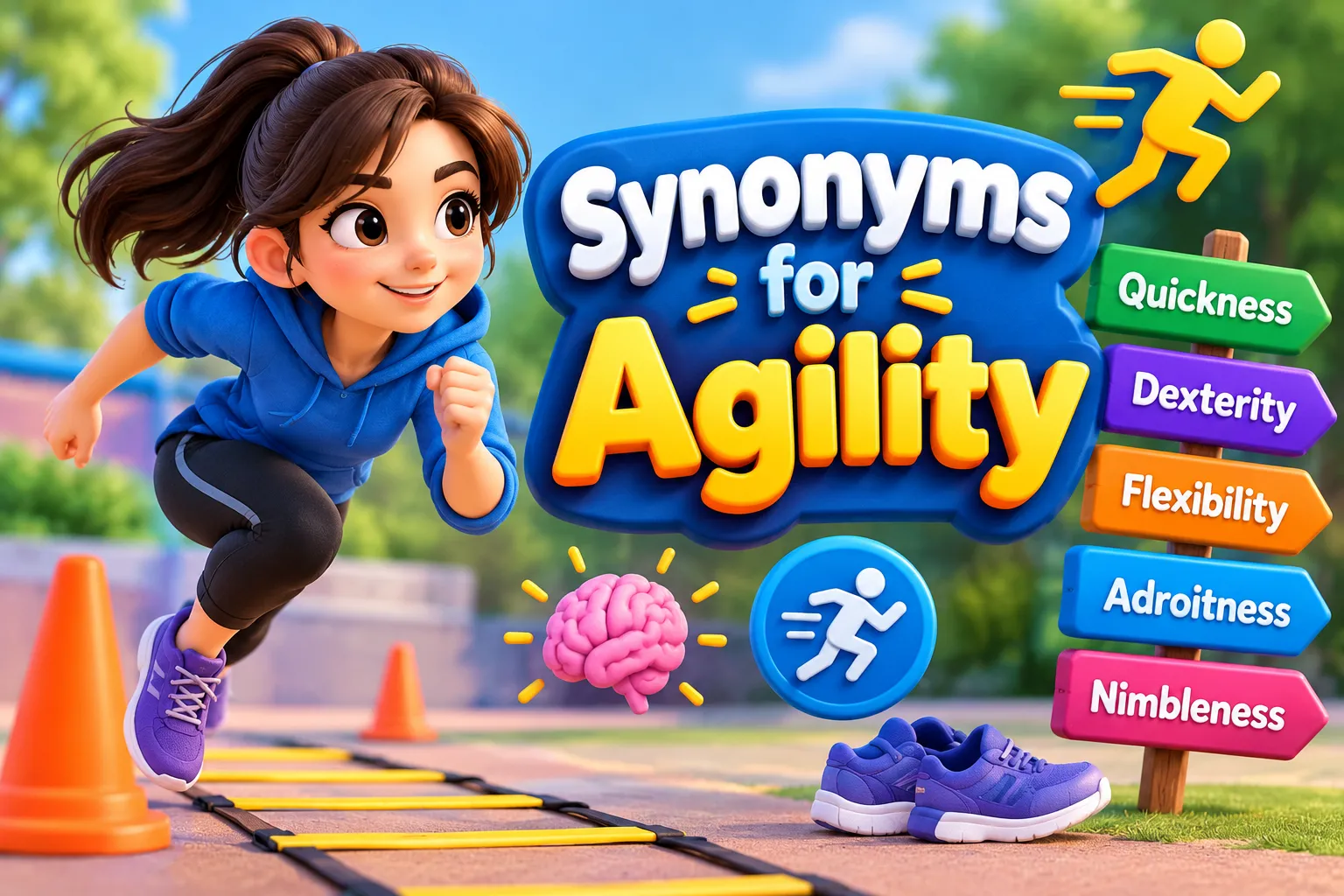
Synonyms for agility include nimbleness, flexibility, quickness, speed, dexterity, and adaptability. These words describe the ability to move quickly, change direction easily, or respond to new situations. Nimbleness often refers to physical movement, while adaptability describes adjusting to change. The best synonym depends on the context. Learning these alternatives helps improve your English vocabulary and writing.
Agility means the ability to move quickly and easily or respond to change without delay. For example, a football player needs agility to turn quickly and avoid an opponent. A worker may also need agility to handle new tasks or solve problems. People use this word in sports, business, fitness, and daily life. Learning synonyms for agility helps English learners describe movement, skill, and quick thinking in different ways. It also helps writers avoid repeating the same word in articles, essays, and reports. However, each synonym has a slightly different meaning. Some focus on physical movement, while others describe mental flexibility or the ability to adapt. This guide explains the meaning, pronunciation, history, and word forms of agility. It also provides 25 alternatives with simple meanings and examples.
Meaning of Agility
Definition
Agility (Noun): The ability to move quickly and easily or to respond to changes with speed and skill.
Examples
- The gymnast showed great agility during the competition.
- Business agility helps a company respond to changing needs.
Connotative Meaning
Connotation is the feeling or idea a word suggests beyond its basic meaning.
- Positive tone: Agility often suggests speed, skill, flexibility, and quick thinking.
- Negative tone: In some contexts, a lack of agility may suggest slowness or difficulty adapting.
- Neutral tone: The word can simply describe the ability to move or respond quickly.
Etymology of Agility
The word agility comes from Latin agilitas, meaning quickness or nimbleness. It is related to the Latin word agilis, meaning active or quick.
| Period | Historical development |
| Old English (450–1100) | The modern word agility was not used in Old English. Other words described quick movement and physical skill. |
| Middle English (1100–1500) | Agility entered English through French and Latin influences. |
| Modern English (1500–Present) | Agility came to describe quick and easy movement, and later the ability to respond rapidly to change. |
Pronunciation (IPA)
- IPA: /əˈdʒɪləti/
- Syllables: a-gil-i-ty (4 syllables)
Affixation Pattern of Agility
- Root: Agile, meaning quick and able to move or change easily.
- Prefix: No prefix in the word agility.
- Suffix: -ity, which forms a noun describing a quality or state.
Word Formations
| Word | Part of speech | Meaning |
| Agile | Adjective | Able to move or change quickly and easily |
| Agility | Noun | The ability to move or respond quickly |
| Agilely | Adverb | In a quick and nimble way |
| Agileness | Noun | The quality of being agile; less common than agility |
| Inagile | Adjective | Not agile; uncommon in modern English |
| Inagility | Noun | A lack of agility; rare usage |
25 Synonyms of Agility With Meaning & Examples
Some words below are close synonyms, while others describe a specific aspect of agility, such as physical movement, quick thinking, or adapting to change.
1. Nimbleness (Noun)
Meaning: The ability to move quickly and easily.
Examples:
- The cat showed great nimbleness as it climbed the tree.
- Her nimbleness helped her avoid the obstacle.
2. Quickness (Noun)
Meaning: The ability to move, act, or think fast.
Examples:
- His quickness helped him win the race.
- The player reacted with impressive quickness.
3. Dexterity (Noun)
Meaning: The ability to use your hands or body with skill and control.
Examples:
- The surgeon needed great dexterity.
- She showed dexterity while fixing the small parts.
4. Flexibility (Noun)
Meaning: The ability to bend, change, or adjust easily.
Examples:
- Flexibility helps gymnasts perform difficult moves.
- The team showed flexibility when the plan changed.
5. Speed (Noun)
Meaning: The rate at which someone or something moves or acts.
Examples:
- The runner moved at great speed.
- Speed helped the player reach the ball first.
6. Swiftness (Noun)
Meaning: The quality of moving or acting very quickly.
Examples:
- The swiftness of her response impressed the team.
- The bird escaped with great swiftness.
7. Lightness (Noun)
Meaning: The quality of moving with ease and little effort.
Examples:
- The dancer moved with lightness across the stage.
- His lightness of movement made the routine look easy.
8. Lithe Movement (Noun Phrase)
Meaning: Smooth, flexible, and graceful movement.
Examples:
- The dancer’s lithe movement caught everyone’s attention.
- The gymnast used lithe movement to complete the routine.
9. Gracefulness (Noun)
Meaning: The quality of moving in a smooth and pleasing way.
Examples:
- Her gracefulness made the dance beautiful.
- The skater moved with gracefulness across the ice.
10. Adaptability (Noun)
Meaning: The ability to adjust to new conditions or changes.
Examples:
- Adaptability is important in a changing workplace.
- Her adaptability helped her learn the new system.
11. Responsiveness (Noun)
Meaning: The ability to react quickly and appropriately.
Examples:
- The team’s responsiveness helped solve the problem.
- Quick responsiveness is useful in an emergency.
12. Alertness (Noun)
Meaning: The ability to notice things and respond quickly.
Examples:
- The driver’s alertness helped prevent an accident.
- Alertness is important during sports.
13. Readiness (Noun)
Meaning: The state of being prepared to act quickly.
Examples:
- The team’s readiness helped them start on time.
- Her readiness to respond impressed the manager.
14. Versatility (Noun)
Meaning: The ability to do many different things or handle different tasks.
Examples:
- The athlete’s versatility made her valuable to the team.
- Versatility helps workers manage different roles.
15. Mobility (Noun)
Meaning: The ability to move freely and easily.
Examples:
- Exercise can improve mobility.
- The player’s mobility helped him cover the field.
16. Coordination (Noun)
Meaning: The ability to control body movements smoothly and effectively.
Examples:
- Good coordination helps dancers perform complex steps.
- The child improved his coordination through practice.
17. Maneuverability (Noun)
Meaning: The ability to move or change direction easily.
Examples:
- The small car has excellent maneuverability.
- Maneuverability helped the player move past defenders.
18. Alertness of Mind (Noun Phrase)
Meaning: The ability to notice information and think quickly.
Examples:
- Alertness of mind helped her solve the puzzle.
- The game requires alertness of mind and quick reactions.
19. Agileness (Noun)
Meaning: The quality of being agile or quick to move.
Examples:
- The dog’s agileness helped it jump over the fence.
- His agileness was clear during the training session.
20. Pliability (Noun)
Meaning: The ability to bend or change shape without breaking.
Examples:
- The material’s pliability makes it easy to shape.
- Pliability is useful in certain gymnastic movements.
21. Elasticity (Noun)
Meaning: The ability to stretch and return to the original shape.
Examples:
- The band’s elasticity allows it to stretch easily.
- Elasticity can help the body move through a wider range.
22. Fluidity (Noun)
Meaning: The quality of moving smoothly without sudden stops.
Examples:
- The dancer performed each step with fluidity.
- Fluidity of movement made the routine look natural.
23. Quick Reflexes (Noun Phrase)
Meaning: The ability to react quickly to a sudden event.
Examples:
- Quick reflexes helped the goalkeeper block the shot.
- Drivers need quick reflexes in busy traffic.
24. Quick-Wittedness (Noun)
Meaning: The ability to think and respond quickly.
Examples:
- Her quick-wittedness helped her answer the tricky question.
- His quick-wittedness made the debate lively.
25. Resourcefulness (Noun)
Meaning: The ability to find clever ways to solve problems.
Examples:
- Her resourcefulness helped the team finish the project.
- Resourcefulness is valuable when plans go wrong.
Prototype Meaning
The most typical meaning of agility is the ability to move quickly, easily, and with control. People often imagine an athlete changing direction, a gymnast performing a complex move, or a player reacting fast during a game. The word also describes mental or workplace skills, such as responding to new information and adjusting plans. Its exact meaning depends on the situation, but it usually suggests speed, ease, and effective action.
Prototype Categorization
The synonyms of agility can be grouped into categories based on the skill they describe. These groups help writers choose the best word for each situation.
- Speed and quick action: Quickness, speed, swiftness, and promptness describe fast movement or action.
- Physical control and movement: Nimbleness, dexterity, mobility, coordination, maneuverability, and quick reflexes describe body control and fast reactions.
- Smooth and graceful movement: Lightness, lithe movement, gracefulness, and fluidity describe movement that looks easy, smooth, or elegant.
- Flexibility and physical qualities: Flexibility, pliability, and elasticity describe the ability to bend, stretch, or adjust physically.
- Mental alertness and quick thinking: Alertness, alertness of mind, and quick-wittedness describe noticing things and responding with speed.
- Adaptation and change: Adaptability, adaptiveness, and quick adaptation describe the ability to handle new situations.
- Range of skills and problem-solving: Versatility, versatility of movement, and resourcefulness describe handling different tasks or finding solutions.
- Preparedness and effective action: Readiness, responsiveness, and efficiency describe being prepared, reacting appropriately, and working well.
These categories help you choose a precise word. For example, use dexterity for skilled hand movements, adaptability for workplace changes, and fluidity for smooth movement.
Antonyms of Agility
| Antonym | Part of speech | Meaning |
| Clumsiness | Noun | Lack of skill or control in movement |
| Awkwardness | Noun | Difficulty moving smoothly or comfortably |
| Slowness | Noun | The quality of moving or acting slowly |
| Rigidity | Noun | The state of being stiff or unable to change easily |
| Inflexibility | Noun | The inability or unwillingness to bend or adapt |
| Stiffness | Noun | Difficulty moving or bending freely |
| Lethargy | Noun | A state of low energy or slow response |
| Inactivity | Noun | The state of not moving or acting |
| Immobility | Noun | The inability to move |
| Ineptness | Noun | A lack of skill or ability |
| Sluggishness | Noun | The quality of moving or reacting slowly |
| Unresponsiveness | Noun | A lack of quick or suitable reaction |
Short Questions and Answers
What does agility mean?
Agility means the ability to move quickly and easily or respond to changes with speed and skill.
When should agility be used?
Use agility when describing fast, controlled movement or the ability to respond quickly to change. It is common in sports, fitness, business, and problem-solving.
Is agility positive or negative?
Agility usually has a positive meaning because it suggests speed, skill, and adaptability. The context determines its exact meaning.
How is agility different from similar words?
Nimbleness focuses on quick physical movement, dexterity on skilled control, and adaptability on adjusting to change. Agility can include physical or mental quickness, depending on the context.
Conclusion
Learning agility and its synonyms can improve your English vocabulary and help you describe movement, skill, and quick thinking more clearly. Words such as nimbleness, dexterity, flexibility, and adaptability have related meanings, but each fits a different situation. Choosing the right synonym makes your writing more precise and helps you avoid repetition. These words are useful in sports, school, business, and everyday conversations. To build confidence, practice one or two synonyms each day. Write simple sentences and notice how these words appear in books and articles. With regular practice, you will learn to express ideas more naturally and choose words that match your meaning.
Read More:
Synonyms for Because: 30 Useful Words to Learn

I’m Falak Naaz, an SEO writer at SynonymsInstant.com focused on creating clear, engaging, and search-friendly English content. I specialize in vocabulary, synonyms, antonyms, word usage, and language guides. I combine careful research with practical writing to deliver trustworthy content that helps readers choose the right words and improve their English with confidence.