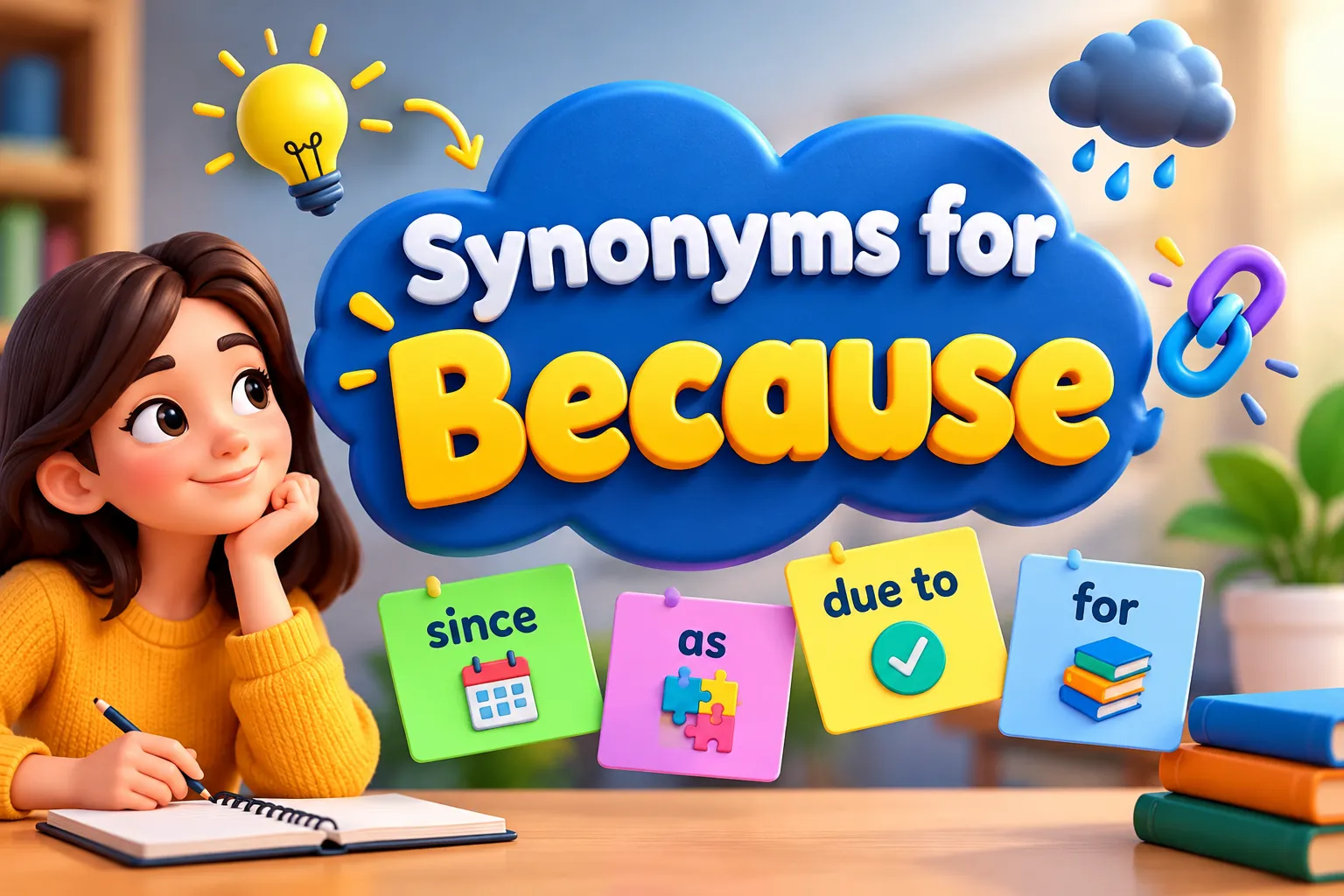
Synonyms for because include since, as, for, given that, and seeing that. These words explain why something happens or give a reason for an action. Some alternatives work best at the start of a sentence, while others fit formal writing. For example, use since to introduce a reason and due to before a noun phrase. Choosing the right alternative makes your English clearer and more varied.
Because it is a common word that explains why something happens. For example, you might say, “I stayed home because it was raining.” The word connects an action to its reason. People use it in daily talks, school assignments, emails, and articles. However, using because too often can make writing sound repetitive. Learning synonyms helps English learners express reasons in different ways. It also helps content writers make their work smoother and more engaging. Not every alternative fits every sentence, so it is important to learn how each one works. This guide explains the meaning, pronunciation, history, and word forms of because. It also covers 30 alternatives, with simple meanings and examples, to help you choose the best phrase for each situation.
Meaning of Because
Definition
Because (Conjunction): A word used to give the reason why something happens or why someone does something.
Examples
- I went to bed early because I was tired.
- She smiled because she received good news.
Connotative Meaning
Connotation is the feeling or idea a word suggests beyond its basic meaning.
- Positive tone: Because it can introduce a positive reason, such as success or happiness.
- Negative tone: It can introduce a problem or an unpleasant event.
- Neutral tone: Most often, because simply explains a cause or reason.
Etymology of Because
The word developed from the phrase by cause, which meant “by reason of” or “on account of.”
| Period | Historical development |
| Old English (450–1100) | The modern word because was not used in its current form. Old English used other words and phrases to express reasons. |
| Middle English (1100–1500) | The phrase by cause developed into forms such as because and because of. |
| Modern English (1500–Present) | Because became a common conjunction used to introduce the reason for an action or event. |
Pronunciation (IPA)
- IPA: /bɪˈkɔːz/ (also pronounced /bɪˈkʌz/ in some accents)
- Syllables: be-cause (2 syllables)
Affixation Pattern of Because
- Root: Because developed from the phrase by cause.
- Prefix: No prefix in the modern word.
- Suffix: No suffix in the modern word.
Word Formations
| Word or phrase | Grammatical category | Meaning |
| Because | Subordinating conjunction | Introduces a reason |
| Because of | Prepositional phrase | Gives a reason before a noun or noun phrase |
| Just because | Conjunction phrase | Introduces a reason, often with emphasis |
| Only because | Conjunction phrase | Shows that something happened for one specific reason |
| Not because | Conjunction phrase | Rejects a particular reason |
| Because of this | Linking phrase | Connects an earlier fact to its result |
Because it does not have a typical family of derived words formed by adding prefixes or suffixes. Most related forms are phrases.
30 Synonyms of Because With Meaning & Examples
Note: Some entries below are close synonyms, while others are phrases that express a reason in a specific sentence structure. Choose the form that fits your grammar.
1. Since (Conjunction)
Meaning: Used to explain why something happens.
Examples:
- Since it was late, we went home.
- I stayed inside since the weather was cold.
2. As (Conjunction)
Meaning: Used to give a reason for an action or event.
Examples:
- As I was tired, I went to bed.
- We took a taxi as it was raining.
3. For (Conjunction)
Meaning: Used mainly in formal or literary writing to introduce a reason.
Examples:
- She must be home, for the lights are on.
- He did not speak, for he had no answer.
4. Given That (Conjunction Phrase)
Meaning: Used to explain a reason based on a known fact.
Examples:
- Given that it was raining, we stayed home.
- Given that she was new, she did very well.
5. Seeing That (Conjunction Phrase)
Meaning: Used to introduce a reason that seems clear or important.
Examples:
- Seeing that everyone was ready, we began.
- Seeing that it was late, he called a taxi.
6. Considering That (Conjunction Phrase)
Meaning: Used to give a reason based on a particular fact or situation.
Examples:
- Considering that he was sick, he did well.
- Considering that the road was busy, we arrived early.
7. Inasmuch as (Conjunction Phrase)
Meaning: Used in formal writing to mean “because” or “to the extent that.”
Examples:
- Inasmuch as the rules have changed, we must adjust our plan.
- The request was approved, inasmuch as it met the main conditions.
8. Now That (Conjunction Phrase)
Meaning: Used to give a reason based on a new situation or fact.
Examples:
- Now that you are here, we can begin.
- Now that the rain has stopped, we can go outside.
9. In View of the Fact That (Phrase)
Meaning: Used to introduce a reason based on a particular fact.
Examples:
- In view of the fact that it was late, we ended the meeting.
- In view of the fact that costs had risen, the plan changed.
10. Due to (Prepositional Phrase)
Meaning: Used to explain a cause before a noun or noun phrase.
Examples:
- The match was canceled due to heavy rain.
- The delay occurred due to a technical problem.
11. Owing to (Prepositional Phrase)
Meaning: Used to explain the cause of something, often in formal writing.
Examples:
- The flight was delayed owing to bad weather.
- Owing to illness, she missed the class.
12. On Account of (Prepositional Phrase)
Meaning: Used to explain why something happened.
Examples:
- The picnic was canceled on account of rain.
- He stayed home on account of a headache.
13. Thanks to (Prepositional Phrase)
Meaning: Used to show that something happened because of a person or thing, often with a positive result.
Examples:
- Thanks to your help, I finished the project.
- Thanks to good planning, the event went well.
14. Because of (Prepositional Phrase)
Meaning: Used to give a reason before a noun or noun phrase.
Examples:
- We stayed inside because of the storm.
- The road was closed because of an accident.
15. As a Result of (Prepositional Phrase)
Meaning: Used to show that something happened due to a cause.
Examples:
- The game was delayed as a result of heavy rain.
- As a result of his hard work, he passed the exam.
16. By Reason of (Prepositional Phrase)
Meaning: Used in formal language to explain the cause of something.
Examples:
- The claim was accepted by reason of the new evidence.
- The rule applies by reason of the agreement.
17. In Light of (Prepositional Phrase)
Meaning: Used to explain a decision based on facts or new information.
Examples:
- In light of the weather, we moved the event indoors.
- The school changed its plan in light of recent results.
18. In View of (Prepositional Phrase)
Meaning: Used to give a reason for a decision or action.
Examples:
- In view of the risks, we changed the route.
- The meeting was postponed in view of the circumstances.
19. For the Reason That (Phrase)
Meaning: Used to state the reason for an action or event.
Examples:
- The request was denied for the reason that it was incomplete.
- She left early for the reason that she felt unwell.
20. In That (Conjunction Phrase)
Meaning: Used in formal writing to explain the way or respect in which something is true.
Examples:
- The plan is useful in that it saves time.
- The two methods differ in that one costs less.
21. As a Consequence of (Prepositional Phrase)
Meaning: Used to show that something happened because of another event.
Examples:
- The road closed as a consequence of the flood.
- As a consequence of the error, the report was revised.
22. Stemming From (Verb Phrase)
Meaning: Used to describe something that has its cause in an earlier event or condition.
Examples:
- The problem stemmed from a lack of planning.
- Her stress stemmed from a heavy workload.
23. Resulting From (Verb Phrase)
Meaning: Describes something caused by an event or action.
Examples:
- The damage resulting from the storm was severe.
- The errors resulting from poor planning delayed the work.
24. On the Grounds That (Phrase)
Meaning: Used to state the reason for a decision or judgment.
Examples:
- The request was refused on the grounds that it was incomplete.
- He was selected on the grounds that he had the right skills.
25. Insofar as (Conjunction Phrase)
Meaning: Used in formal writing to mean “to the extent that” or, in some contexts, “because.”
Examples:
- Insofar as the data is accurate, the conclusion is sound.
- The policy helps, insofar as it gives clear guidance.
26. Forasmuch as (Conjunction Phrase)
Meaning: An old-fashioned or legal expression meaning “since” or “because.”
Examples:
- Forasmuch as the agreement was signed, both parties must follow it.
- Forasmuch as the evidence was limited, the decision was delayed.
27. Seeing as (Conjunction Phrase)
Meaning: An informal way to introduce a reason.
Examples:
- Seeing as you’re here, we can start.
- Seeing as it is cold, take a coat.
28. Being That (Conjunction Phrase)
Meaning: An informal expression used by some speakers to introduce a reason.
Examples:
- Being that it was late, we went home.
- Being that she was busy, I sent an email instead.
29. In View of the Circumstances (Phrase)
Meaning: Used to explain an action based on the situation.
Examples:
- In view of the circumstances, we postponed the trip.
- In view of the circumstances, the teacher allowed more time.
30. For This Reason (Linking Phrase)
Meaning: Used to connect a reason already mentioned to a result or decision.
Examples:
- The roads were icy. For this reason, school was closed.
- He prepared well. For this reason, he felt confident.
Prototype Meaning
The main meaning of because is to give a reason for an action, event, or situation. When people hear this word, they usually expect an explanation. For example, “I stayed home because I was ill” explains why someone stayed home. Because links a cause to its result and helps readers understand how ideas connect. Other expressions can do the same job, but some are more formal or require different sentence structures.
Prototype Categorization
The alternatives to because can be grouped by how they express a reason. These groups help writers choose the best phrase for their tone and sentence structure.
- Common conjunctions: Since, as, and to introduce a reason directly. Since and as are common in everyday and formal writing, while for often sounds literary.
- Fact-based reasons: Given that, seeing that, considering that, now that, and seeing as introducing a reason based on a fact or situation.
- Formal expressions: Inasmuch as, insofar as, forasmuch as, and in that are more formal. Some are uncommon, legal, or limited to specific meanings.
- Cause before a noun phrase: Due to, owing to, on account of, because of, by reason of, in view of, and in light of are useful when followed by a noun or noun phrase.
- Cause and result expressions: As a result of, as a consequence of, stemming from, and resulting from show a cause or its effect. They may require sentence restructuring.
- Decision-based reasons: On the grounds that, for the reason that, and in view of the circumstances explain why a decision was made.
- Linking phrases: For this reason connects a previously stated cause to a result. It is useful when starting a new sentence.
Using the right category helps avoid grammar errors. For example, write “because it rained” but “because of the rain.” Both express a reason, but their grammar is different.
Antonyms of Because
Because is a conjunction that introduces a reason, so it has no exact antonym. However, the following words and phrases can express contrast or a different relationship between ideas.
| Contrasting word or phrase | Grammatical category | Meaning |
| Although | Conjunction | Introduces a contrast |
| Though | Conjunction | Shows that one fact does not prevent another |
| Even though | Conjunction phrase | Introduces a strong contrast |
| Despite | Preposition | Shows that something happens regardless of a condition |
| In spite of | Prepositional phrase | Shows contrast despite a condition |
| However | Linking adverb | Introduces a contrasting idea |
| Nevertheless | Linking adverb | Shows that something remains true despite a previous point |
| Yet | Conjunction/adverb | Introduces a contrast |
| Regardless of | Prepositional phrase | Means without being affected by something |
| Instead | Adverb | Shows an alternative rather than a reason |
These are not direct antonyms. They help express a different logical relationship, such as contrast rather than cause.
Short Questions and Answers
What does because mean?
Because it means “for the reason that.” It introduces the cause or reason for an action or event.
When should because be used?
Use because when you want to explain why something happened. For example, “I left early because I felt sick.”
Is it positive or negative?
Because it is neutral. The reason it introduces may be positive, negative, or neither.
How is it different from similar words?
Because it directly introduces a reason. Since and as can also give reasons, while due to and because of are followed by a noun or noun phrase. For this reason usually links a reason to a result in a separate sentence.
Conclusion
Learning because and its alternatives helps you explain ideas in a clear and natural way. Words such as since, as, and given that can introduce reasons, while phrases such as because of and due to work before nouns or noun phrases. Other expressions, such as for this reason, connect ideas across sentences. Choosing the right phrase can improve your writing, reduce repetition, and make your message easier to follow. Remember that these alternatives are not always interchangeable. Their grammar and tone may differ. Practice by writing a few sentences each day and replacing because with a suitable alternative. With regular practice, you can build stronger vocabulary and communicate with greater confidence.
Read More:
Synonyms for Computer: 27 Smart Alternatives to Explore

I’m Falak Naaz, an SEO writer at SynonymsInstant.com focused on creating clear, engaging, and search-friendly English content. I specialize in vocabulary, synonyms, antonyms, word usage, and language guides. I combine careful research with practical writing to deliver trustworthy content that helps readers choose the right words and improve their English with confidence.