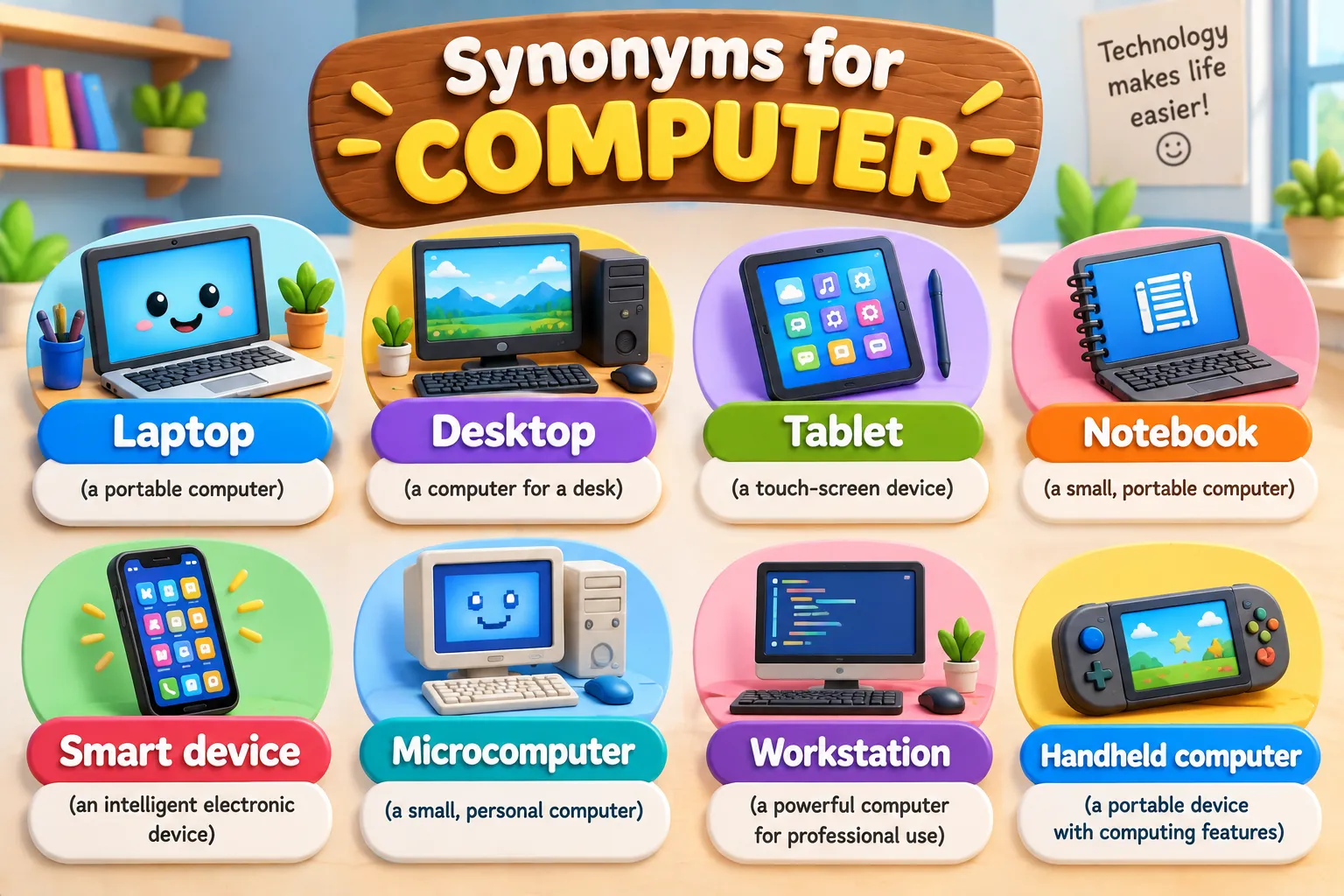
Synonyms for computer include PC, laptop, desktop, workstation, and computing device. These terms describe different types of computers or devices used to process data. A PC usually means a personal computer, while a workstation is designed for demanding tasks. Other alternatives, such as digital devices and electronic machines, are broader terms. The best word depends on the device and context.
A computer is an electronic device that processes data, stores information, and runs programs. People use computers to study, work, play games, and connect with others. For example, a student may use a laptop to write an assignment, while an office worker may use a desktop to manage files. The word computer is common in daily life, education, and business. Learning synonyms helps English learners describe different devices more clearly. It also helps writers avoid repeating the same word in articles and reports. However, not every alternative means exactly the same thing. Some words name specific computer types, while others describe digital or electronic devices more broadly. This guide explores the meaning, pronunciation, history, and word forms of computers, along with 27 related terms and examples.
Meaning of Computer
Definition
Computer (Noun): An electronic device that receives and processes data, stores information, and produces results by following instructions.
Examples
- I use my computer to complete school assignments.
- The office bought a new computer for its staff.
Connotative Meaning
Connotation is the feeling or idea a word suggests beyond its basic meaning.
- Positive tone: A computer may suggest learning, creativity, speed, and productivity.
- Negative tone: In some contexts, it may suggest screen dependence, technical problems, or too much time spent online.
- Neutral tone: The word usually names an electronic device without expressing a positive or negative opinion.
Etymology of Computer
The word computer comes from the verb compute, which means to calculate. It developed from Latin computare, meaning “to count” or “to calculate.”
| Period | Historical development |
| Old English (450–1100) | The modern word computer was not used in Old English. People used other words for counting and calculation. |
| Middle English (1100–1500) | Related forms of computers developed through French and Latin influences. |
| Modern English (1500–Present) | Computer first referred to a person who performed calculations. Later, it became the common name for electronic machines that process data. |
Pronunciation (IPA)
- IPA: /kəmˈpjuːtər/
- Syllables: com-put-er (3 syllables)
Affixation Pattern of Computer
- Root: Compute, meaning to calculate.
- Prefix: No prefix in the word computer.
- Suffix: -er, which can describe a person or thing that performs an action.
Word Formations
| Word | Part of speech | Meaning |
| Compute | Verb | To calculate or process data |
| Computer | Noun | A device that processes data |
| Computed | Verb/adjective | Calculated or worked out |
| Computing | Noun/verb | The use or process of computer systems |
| Computation | Noun | The act or result of calculating |
| Computational | Adjective | Related to calculations or computing |
| Computationally | Adverb | In a way related to computation |
| Computerized | Adjective/verb | Controlled or operated by a computer |
| Computerization | Noun | The process of using computers in a system |
| Computerized system | Noun phrase | A system that uses computer technology |
27 Synonyms of Computer With Meaning & Examples
Note: English has few exact synonyms for computer. The following list includes common alternatives, specific computer types, and related terms. Choose one that matches the device or situation.
1. PC (Noun)
Meaning: A personal computer designed for individual use.
Examples:
- I use my PC to study online.
- He bought a new PC for his home office.
2. Personal Computer (Noun)
Meaning: A computer designed for one person to use.
Examples:
- She uses a personal computer for her work.
- My personal computer stores all my school files.
3. Desktop Computer (Noun)
Meaning: A computer designed to stay on a desk.
Examples:
- The office uses a desktop computer for daily tasks.
- I bought a desktop computer for video editing.
4. Laptop (Noun)
Meaning: A portable computer with a built-in screen and keyboard.
Examples:
- I carry my laptop to college.
- Her laptop is useful for remote work.
5. Notebook Computer (Noun)
Meaning: A small, portable computer, similar to a laptop.
Examples:
- He uses a notebook computer while traveling.
- The notebook computer fits easily into her bag.
6. Workstation (Noun)
Meaning: A powerful computer designed for professional or technical work.
Examples:
- The designer uses a workstation to create 3D models.
- Engineers need a workstation for complex tasks.
7. Server (Noun)
Meaning: A computer that provides data or services to other computers.
Examples:
- The server stores the company’s website files.
- Our office server manages shared documents.
8. Mainframe (Noun)
Meaning: A large, powerful computer that handles many users and large amounts of data.
Examples:
- The bank uses a mainframe to process transactions.
- A mainframe can support many business operations.
9. Supercomputer (Noun)
Meaning: An extremely powerful computer used for complex calculations.
Examples:
- Scientists use a supercomputer to study climate patterns.
- The supercomputer can process huge amounts of data.
10. Tablet Computer (Noun)
Meaning: A portable computer with a touch screen.
Examples:
- She uses a tablet computer to read books.
- The teacher displays lessons on a tablet computer.
11. Computing Device (Noun Phrase)
Meaning: An electronic device that performs computing tasks.
Examples:
- A laptop is a common computing device.
- The school provides each student with a computing device.
12. Digital Device (Noun Phrase)
Meaning: An electronic device that handles digital information.
Examples:
- A computer is an important digital device.
- Students use digital devices to learn new skills.
13. Electronic Device (Noun Phrase)
Meaning: A device that uses electronic circuits to perform tasks.
Examples:
- The computer is an electronic device used for work.
- Many electronic devices can connect to the internet.
14. Data Processor (Noun)
Meaning: A system or device that processes data.
Examples:
- The data processor handles large sets of information.
- The company installed a new data processor.
15. Processing Machine (Noun Phrase)
Meaning: A machine designed to handle or process information or materials.
Examples:
- The computer works as a processing machine for digital data.
- The processing machine completes tasks at high speed.
16. Digital Computer (Noun)
Meaning: A computer that processes data in digital form.
Examples:
- A digital computer can perform complex calculations.
- The lab uses a digital computer for research.
17. Electronic Computer (Noun)
Meaning: A computer that uses electronic components to process information.
Examples:
- The electronic computer improved the speed of calculations.
- An electronic computer can store and process data.
18. Microcomputer (Noun)
Meaning: A small computer built around a microprocessor, often for personal use.
Examples:
- The early microcomputer made computing more accessible.
- A microcomputer can support many everyday tasks.
19. Handheld Computer (Noun Phrase)
Meaning: A small computer designed to be held in the hand.
Examples:
- The worker uses a handheld computer to scan products.
- A handheld computer is useful for collecting data in the field.
20. Portable Computer (Noun Phrase)
Meaning: A computer that can be carried from place to place.
Examples:
- A portable computer helps her work while traveling.
- He chose a portable computer for his mobile office.
21. All-in-One Computer (Noun Phrase)
Meaning: A desktop computer that combines key components with the display in one unit.
Examples:
- The all-in-one computer saves desk space.
- Our reception area has an all-in-one computer.
22. Gaming PC (Noun Phrase)
Meaning: A personal computer built or configured for video games.
Examples:
- He upgraded his gaming PC for better performance.
- The gaming PC runs modern games smoothly.
23. Thin Client (Noun)
Meaning: A computer that relies mainly on a server for processing or applications.
Examples:
- The office uses a thin client to access shared software.
- A thin client can reduce the need for powerful local hardware.
24. Embedded Computer (Noun Phrase)
Meaning: A computer built into a larger device to control specific functions.
Examples:
- An embedded computer controls the washing machine.
- The car uses an embedded computer to manage certain systems.
25. Analog Computer (Noun)
Meaning: A computer that represents data through continuous physical values.
Examples:
- An analog computer can model certain physical systems.
- Engineers once used analog computers for specialized calculations.
26. Hybrid Computer (Noun)
Meaning: A computer that combines analog and digital computing methods.
Examples:
- A hybrid computer can handle different types of data.
- Researchers may use a hybrid computer for specialized simulations.
27. Quantum Computer (Noun)
Meaning: A computer that uses quantum principles to perform certain types of computation.
Examples:
- Scientists are developing a quantum computer for advanced research.
- A quantum computer may solve some problems differently from a traditional computer.
Prototype Meaning
The most common meaning of computer is an electronic device that processes data and follows instructions to perform tasks. People often picture a desktop computer or laptop with a screen and keyboard. Computers help users write documents, browse the internet, store files, perform calculations, and run software. The word can also refer to more specialized systems, such as servers and supercomputers. The exact meaning depends on the type of computer and how it is used.
Prototype Categorization
The alternatives above fit into several groups. These categories help you choose the right term for a specific device or task.
- Personal computers: PC, personal computer, desktop computer, laptop, notebook computer, microcomputer, and gaming PC. These terms are useful for everyday personal or home computing.
- Portable computers: Laptop, notebook computer, tablet computer, handheld computer, and portable computer. Use these terms when portability matters.
- Powerful and specialized computers: Workstation, mainframe, supercomputer, quantum computer, analog computer, and hybrid computer. These describe systems designed for particular workloads or computing methods.
- Systems and network devices: Server, thin client, embedded computer, networked computer, and computing system. These terms describe computers that provide services, control devices, or work as part of a larger system.
- General computing terms: Computing device, digital device, electronic device, data processor, processing machine, digital computer, and electronic computer. These are broader terms, but they do not always mean exactly the same thing as computer.
- Integrated and work-focused systems: All-in-one computer and digital workstation. These terms describe particular setups or computer-based work environments.
Choosing the right category improves accuracy. For example, use a laptop for a portable computer, a server for a computer that provides network services, and a supercomputer for a system designed for very demanding calculations.
Antonyms of Computer
Computer is a noun for a device, so it does not have direct antonyms in the same way that a verb or adjective does. However, the following terms may express contrast in specific contexts.
| Contrasting term | Part of speech | Meaning |
| Human | Noun | A person who can perform tasks or calculations |
| Manual method | Noun phrase | A way of doing work by hand rather than using a computer |
| Paper-based system | Noun phrase | A system that stores or manages information on paper |
| Analog device | Noun phrase | A device that works with continuous physical signals; not necessarily the opposite of a computer |
| Mechanical calculator | Noun phrase | A machine designed mainly for mathematical calculations |
| Non-digital system | Noun phrase | A system that does not rely on digital technology |
These are contextual contrasts, not exact antonyms. For example, a manual method may replace computer use for a task, but it is not the opposite of a computer itself.
Short Questions and Answers
What does computer mean?
A computer is an electronic device that processes data, stores information, and follows instructions to perform tasks.
When should computers be used?
Use a computer when talking about a device that processes data. Use a more specific term, such as laptop, server, or supercomputer, when the type matters.
Is the computer positive or negative?
The word computer is neutral. It names a device. The context determines whether its use is described positively or negatively.
How is computer different from similar words?
A PC is usually a personal computer. A laptop is portable, while a server provides services to other computers. A computing device is a broader term that may include devices that are not traditional computers.
Conclusion
Learning the word computer and its related terms helps you build a stronger English vocabulary. Words such as PC, laptop, server, and workstation describe different types of computers and their uses. Choosing the correct term makes your writing more clear and precise. These words are useful in school, business, technology, and everyday conversations. Remember that many items in this list are related terms rather than exact synonyms. To improve your English, practice using one new term each day. Write simple sentences and notice how people use these words in articles and conversations. With regular practice, you can explain technology more accurately and speak with greater confidence.
Read More:
Synonyms for Conform: 29 Helpful Vocabulary Alternatives

I’m Ayesha Haram, an English content and SEO writer at SynonymsInstant.com. I focus on creating helpful vocabulary resources, word guides, and practical English content that readers can understand quickly. I combine language research, clear explanations, and SEO-focused writing to produce reliable content that supports learners, writers, and everyday English users.