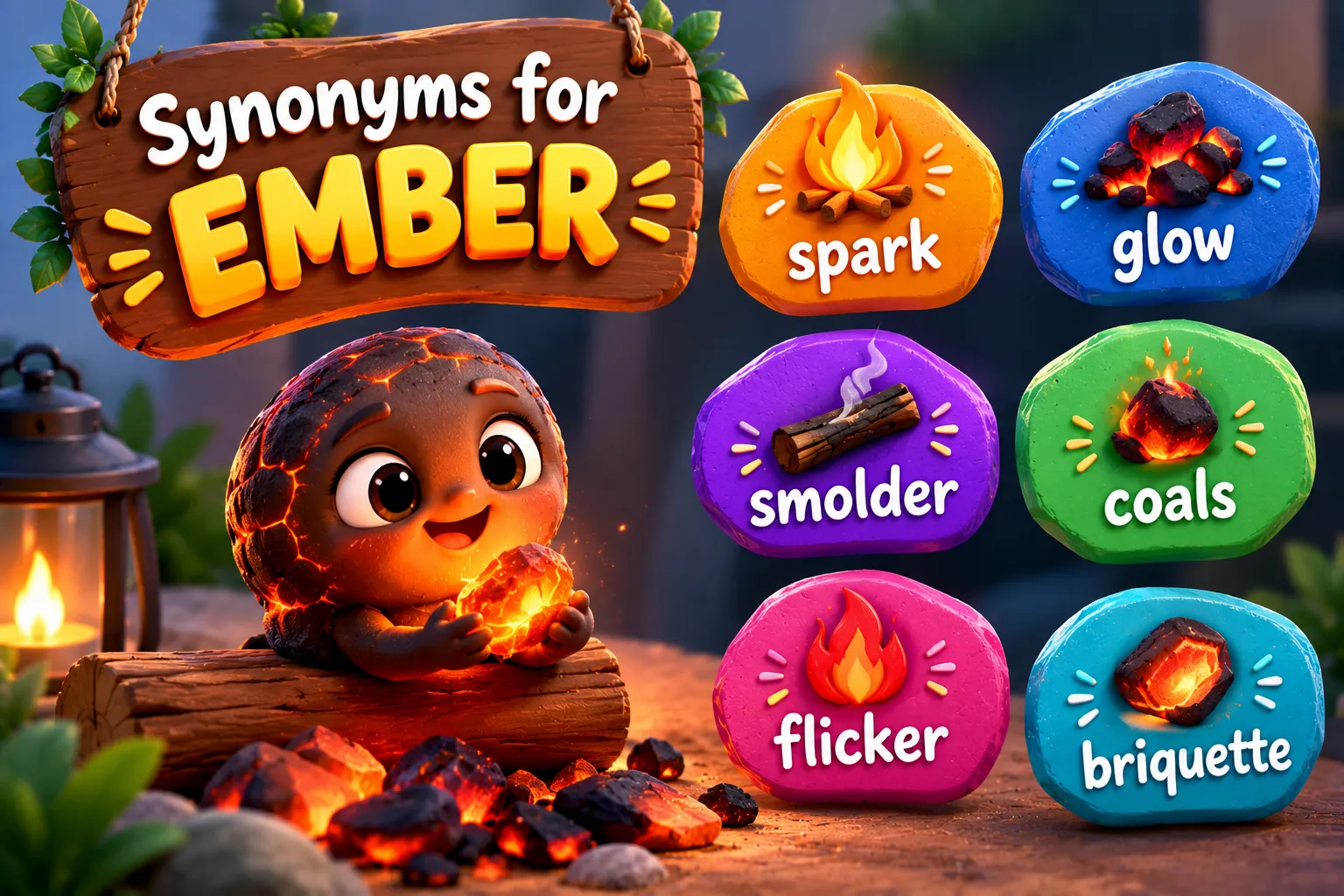
Useful synonyms and close alternatives include cinder, coal, spark, firebrand, glow, hot coal, burning coal, ash, fire, flame, flicker, glowing fragments, live coal, and burning fragments. The best word depends on the exact meaning. Cinder often refers to a partly burned piece left after a fire, while spark is a tiny glowing particle that can fly from a fire. Ember can also be used figuratively for a remaining feeling, memory, or hope.
An ember is a small piece of wood or coal that still glows after most of a fire has burned away. Imagine sitting beside a campfire late at night. The flames are gone, but a few red pieces of wood still shine in the dark. Those glowing pieces are embers. The word is common when people talk about fires, fireplaces, camping, and burning wood. It is also used in a figurative way to describe a feeling, memory, hope, or relationship that has not completely disappeared. Learning synonyms for ember helps English learners describe fire and glowing materials more clearly. It also gives writers more ways to create vivid images. This article explores the meaning, history, pronunciation, word formation, synonyms, examples, semantic categories, and antonyms of ember.
Meaning of Ember
Definition
Ember (Noun): A small piece of burning or glowing wood, coal, or other material left after a fire has mostly burned down.
Examples
- A red ember continued to glow in the fireplace.
- He placed another log on the glowing embers.
Connotative Meaning
Connotation: The feeling or idea that a word suggests beyond its basic meaning.
- Positive tone: Warmth, hope, comfort, memory, and lasting passion.
- Negative tone: Hidden danger, dying energy, destruction, or a fire that could start again.
- Neutral tone: A small piece of material that continues to glow after burning.
Etymology
The origin of ember is linked to Old English æmyrge, meaning a burning coal or ember. The word developed through Middle English forms before reaching its modern form.
| Period | Development |
| Old English (450–1100) | Ember is related to Old English æmyrge, referring to a burning coal or glowing piece left by a fire. |
| Middle English (1100–1500) | The word developed through forms such as emere and eimere, continuing to describe glowing or burning remains of a fire. |
| Modern English (1500–Present) | Ember became the standard modern form. It can describe both physical glowing remains and, figuratively, something that continues in a small but active form. |
Pronunciation (IPA)
- IPA: /ˈembər/
- Syllables: em-ber
Affixation Pattern of Ember
- Root: ember
- Prefix: None
- Suffix: None
- Word formations:
- ember — noun
- embers — plural noun
- embered — adjective/verb form, meaning covered with or containing embers
- ember-like — adjective
- ember-colored — adjective
29 Synonyms of Ember With Meaning & Examples
Important: There are few exact synonyms for ember. Many words below are close alternatives that describe glowing, burning, or fire-related material. The exact choice depends on context.
1. Cinder (Noun)
Meaning: A small partly burned piece left after a fire.
Examples:
- A glowing cinder fell from the fireplace.
- The fire left a pile of cinders behind.
2. Coal (Noun)
Meaning: A black or dark piece of carbon material that can burn and produce heat.
Examples:
- A piece of coal was still glowing.
- She placed more coal on the fire.
3. Live Coal (Noun Phrase)
Meaning: A piece of coal that is still burning or glowing.
Examples:
- One live coal remained in the fireplace.
- The cook moved the live coals with tongs.
4. Hot Coal (Noun Phrase)
Meaning: A piece of coal that remains hot after burning.
Examples:
- He stepped too close to the hot coal.
- The grill was filled with hot coals.
5. Firebrand (Noun)
Meaning: A burning piece of wood or other material taken from a fire.
Examples:
- He carried a firebrand from the campfire.
- A glowing firebrand lit the dark path.
6. Spark (Noun)
Meaning: A tiny glowing particle produced by burning material.
Examples:
- A spark flew from the fire.
- One spark landed on the dry grass.
7. Glow (Noun)
Meaning: A soft, steady light produced by something hot or warm.
Examples:
- The fireplace gave off a warm glow.
- The red glow of the coals filled the room.
8. Glowing Coal (Noun Phrase)
Meaning: A piece of coal that produces visible light because it is hot.
Examples:
- A glowing coal remained in the fire.
- She watched the glowing coals slowly fade.
9. Burning Coal (Noun Phrase)
Meaning: Coal that is still burning and producing heat.
Examples:
- The grill contained several burning coals.
- He moved the burning coal carefully.
10. Burning Fragment (Noun Phrase)
Meaning: A small piece of material that remains hot or burning.
Examples:
- A burning fragment fell onto the ground.
- The wind carried a burning fragment away.
11. Glowing Fragment (Noun Phrase)
Meaning: A small piece of material that still gives off light from heat.
Examples:
- A glowing fragment remained among the ashes.
- The child noticed a glowing fragment in the fireplace.
12. Fire Remnant (Noun Phrase)
Meaning: A remaining piece or trace of material from a fire.
Examples:
- Only a fire remnant remained after the flames disappeared.
- The workers cleared away the fire remnants.
13. Burning Remnant (Noun Phrase)
Meaning: A small remaining piece that is still burning or hot.
Examples:
- The burning remnant continued to glow.
- They carefully removed the burning remnants.
14. Fire Remains (Noun Phrase)
Meaning: Material left after a fire has mostly burned away.
Examples:
- The fire remains were still warm.
- They cleaned the fire remains the next morning.
15. Ash (Noun)
Meaning: The soft powder left after something has completely burned.
Examples:
- Gray ash covered the ground.
- The wood turned into ash after the fire.
16. Fire (Noun)
Meaning: The visible heat and light produced when something burns.
Examples:
- The fire slowly died down.
- They gathered around the warm fire.
17. Flame (Noun)
Meaning: The visible burning part of a fire.
Examples:
- A small flame appeared in the fireplace.
- The flame grew brighter as the wood burned.
18. Flicker (Noun)
Meaning: A small, unsteady movement or light from a flame.
Examples:
- A flicker of light came from the fireplace.
- The candle gave a gentle flicker.
19. Firelight (Noun)
Meaning: The light produced by a fire.
Examples:
- The room was filled with warm firelight.
- We sat together in the soft firelight.
20. Hearth Glow (Noun Phrase)
Meaning: The warm light produced by a fire in a fireplace or hearth.
Examples:
- The hearth glow made the room feel cozy.
- She enjoyed the soft hearth glow on winter nights.
21. Fire Glow (Noun Phrase)
Meaning: The light or warmth visible from a burning fire.
Examples:
- The fire glow could be seen from the doorway.
- The fire glow lit the campsite.
22. Red Coal (Noun Phrase)
Meaning: A coal that is hot and glowing red.
Examples:
- A red coal remained beneath the wood.
- He moved the red coals closer together.
23. Hot Cinder (Noun Phrase)
Meaning: A partly burned piece that remains hot after a fire.
Examples:
- A hot cinder fell onto the floor.
- The hot cinders continued to glow.
24. Fire Chip (Noun Phrase)
Meaning: A small piece of burning or burned wood.
Examples:
- A fire chip broke away from the log.
- The wind carried a small fire chip across the ground.
25. Burning Piece (Noun Phrase)
Meaning: A small piece of material that is still burning.
Examples:
- A burning piece of wood fell from the fire.
- He removed the burning piece carefully.
26. Hot Fragment (Noun Phrase)
Meaning: A small piece of material that remains very hot.
Examples:
- A hot fragment remained under the ashes.
- They found several hot fragments after the fire.
27. Fiery Remnant (Noun Phrase)
Meaning: A remaining part of a fire that still has heat or light.
Examples:
- The fiery remnant glowed in the darkness.
- A few fiery remnants remained after the flames died.
28. Fire Trace (Noun Phrase)
Meaning: A small remaining sign or mark left by a fire.
Examples:
- Only a fire trace remained after the flames were gone.
- The fire traces showed where the wood had burned.
29. Residual Heat (Noun Phrase)
Meaning: Heat that remains after the main source of heat has decreased or disappeared.
Examples:
- The stones were warm from the residual heat.
- The residual heat kept the room comfortable.
Prototype Meaning
The most typical meaning of ember is a small piece of wood or coal that remains hot and glowing after the flames of a fire have mostly disappeared. People usually imagine a dark fireplace or campfire with small red or orange pieces shining beneath gray ash. The word often suggests something that is not fully gone but still contains heat or energy.
Prototype Categorization
- Direct fire remains: cinder, coal, live coal, hot coal, firebrand, hot cinder — these are closest to the physical meaning of ember.
- Glowing material: glowing coal, burning coal, glowing fragment, burning fragment, red coal, hot fragment — useful when emphasizing heat and visible light.
- Fire-related remains: fire remnant, burning remnant, fire remains, fiery remnant, fire trace — useful for describing what remains after a fire.
- Light and glow: glow, firelight, flicker, hearth glow, fire glow, lingering glow — best when focusing on the light rather than the physical material.
- Burning material: burning piece, fire chip, flame, fire — useful when describing active burning rather than a dying fire.
- Heat and residue: ash, residual heat — related to the results of burning, but not exact synonyms for ember.
This categorization helps writers choose a word based on whether they want to describe the material, heat, light, or remaining effect of a fire.
Antonyms of Ember
Because ember names a physical object, it has no perfect direct antonym. However, these words express the opposite ideas of heat, burning, or remaining fire.
| Antonym | Part of Speech | Meaning |
| Ice | Noun | Frozen water with no fire or heat. |
| Coldness | Noun | A state of having little or no heat. |
| Chill | Noun | A feeling or condition of coldness. |
| Extinguishment | Noun | The act of putting out a fire completely. |
| Darkness | Noun | The absence of light. |
| Dampness | Noun | The state of being slightly wet, making burning difficult. |
| Unburned material | Noun Phrase | Material that has not yet been burned. |
| Cold ash | Noun Phrase | Ash that has lost its remaining heat. |
| Dead fire | Noun Phrase | A fire that has completely stopped burning. |
| Extinguished fire | Noun Phrase | A fire that has been completely put out. |
Short Questions and Answers
What does ember mean?
An ember is a small piece of wood, coal, or other material that remains hot and glowing after a fire has mostly burned down.
When should ember be used?
Use ember when describing a small glowing piece left from a fire. It can also be used figuratively for a remaining feeling, hope, memory, or relationship.
Is ember positive or negative?
Ember is usually neutral when describing fire. In figurative language, it can have a positive meaning when it suggests hope or lasting love, or a negative meaning when it suggests a danger that could return.
How is ember different from similar words?
An ember is a small piece that remains hot and glowing after a fire has burned down. A spark is usually smaller and may fly through the air, while ash is the powdery material left after burning.
Conclusion
Learning ember and its related words can make your English more vivid and precise. An ember is more than simply a piece of burned wood or coal. It is a small, glowing remnant that still holds heat after most of a fire has disappeared. Words such as cinder, coal, firebrand, spark, glow, live coal, hot cinder, and glowing fragment can help describe different parts of a fire. Some alternatives focus on the material, while others focus on its light, heat, or remaining effect. English learners can practice these words by describing a fireplace, campfire, or burning wood in their own sentences. Writers can also use the figurative meaning of ember to describe hope, love, memories, or passion that continues to exist. Daily vocabulary practice will improve word choice, writing, speaking, and English confidence.
Read Mopre:
Synonyms for game changer: 28 Uplifting Alternatives for Writing

I am Rubab content specialist focused on creating accurate, user-friendly, and search-optimized language resources. Through Synonyminstant, I help readers find synonyms, antonyms, meanings, and vocabulary with ease. Every article is carefully researched and optimized to provide reliable information, clear explanations, and an excellent user experience.