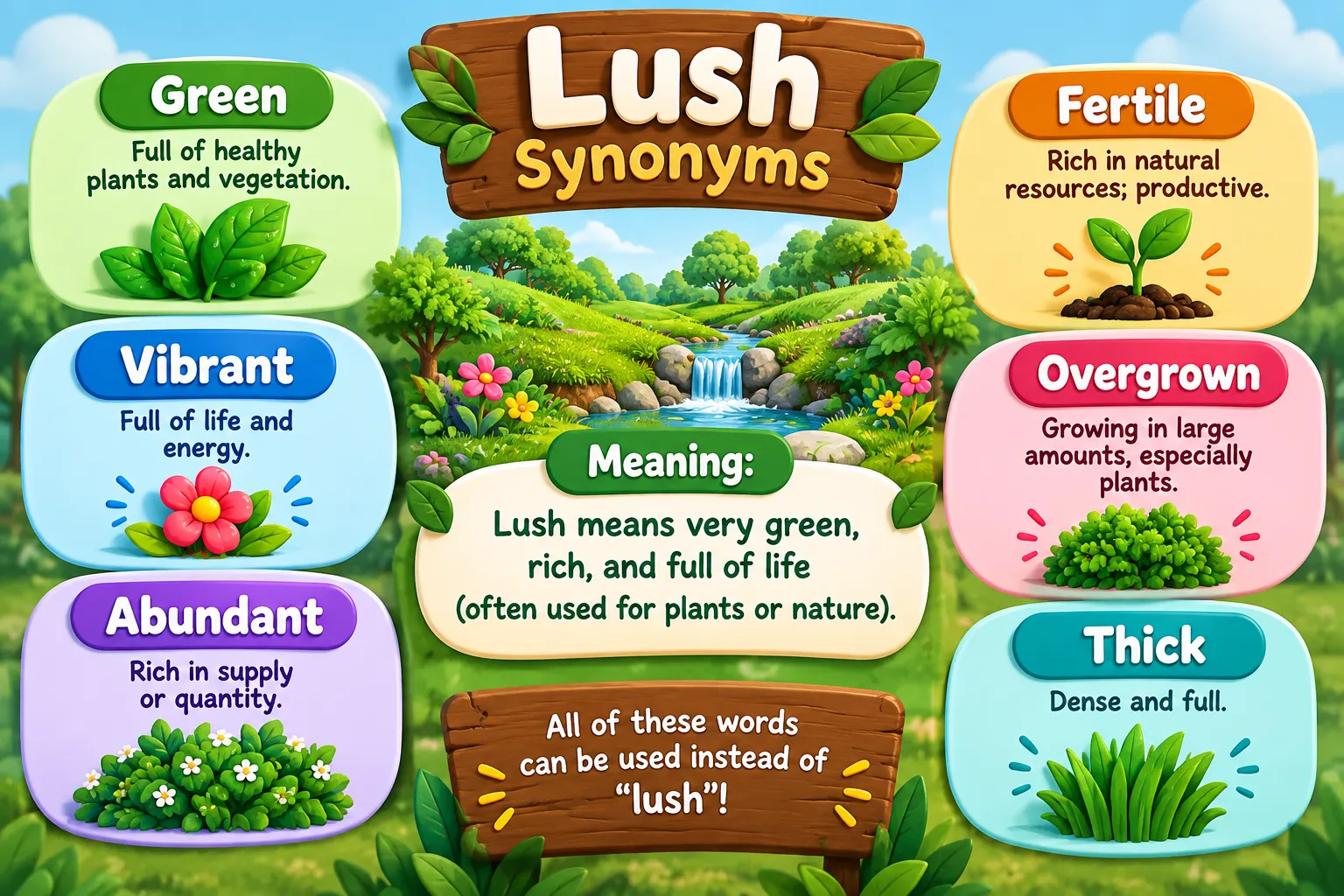
Useful synonyms include verdant, green, fertile, luxuriant, abundant, rich, dense, thriving, flourishing, lavish, sumptuous, and opulent. The best synonym depends on the context. For example, verdant works well for green landscapes, while lavish is better for generous amounts or luxurious things.
Lush is a common word used to describe something rich, healthy, full, and attractive. Imagine walking through a garden after heavy rain. The grass is bright green, flowers are blooming, and thick plants cover the ground. You might describe the garden as lush. The word is often used for nature, forests, gardens, landscapes, food, hair, and even luxurious experiences. Learning synonyms for lush helps English learners describe things with more detail and variety. It also helps writers avoid repeating the same word in articles, stories, and descriptions. In this guide, we will explore the meaning of lush, its grammar, history, pronunciation, word formation, and 25 useful synonyms. We will also group these words by meaning so you can choose the best synonym for each situation.
Meaning of Lush
Definition
Lush (Adjective):
Lush means rich, green, healthy, and growing strongly, or very rich, abundant, or luxurious.
Examples
- The garden looked lush after the summer rain.
- They walked through a lush green forest.
Connotative Meaning
The word lush often creates a strong image of richness, beauty, and abundance.
- Positive tone: Green, healthy, beautiful, abundant, luxurious.
- Negative tone: Sometimes it can suggest excess or something overly rich.
- Neutral tone: Rich or abundant in growth, quality, or quantity.
(Connotation means the feeling or idea that a word suggests beyond its basic meaning.)
Etymology
The exact early history of lush is uncertain. The adjective meaning “luxuriant” or “abundant” became established in English later than the Old English period. It is also associated with older senses connected with richness and abundance.
| English Period | Development |
| Old English (450–1100) | The modern adjective lush was not used in its present sense. Similar ideas were expressed with words meaning rich, fertile, flourishing, or abundant. |
| Middle English (1100–1500) | Related forms and senses developed in English, while words describing richness, fertility, and abundance became more common. |
| Modern English (1500–Present) | Lush developed and became widely used for rich vegetation, abundant growth, luxurious qualities, and attractive richness. |
Pronunciation (IPA)
- IPA: /lʌʃ/
- Syllables: lush
Affixation Pattern of Lush
- Root: lush
- Prefix: None
- Suffix: None
- Word formations:
- Lush — adjective
- Lushly — adverb
- Lushness — noun
- Lusher — comparative adjective
- Lushest — superlative adjective
25 Synonyms of Lush With Meaning & Examples
1. Verdant (Adjective)
Meaning: Covered with fresh, green plants and vegetation.
Examples:
- We walked across the verdant hills.
- The valley was surrounded by verdant forests.
2. Luxuriant (Adjective)
Meaning: Growing thickly, strongly, and abundantly.
Examples:
- The region has luxuriant vegetation.
- Luxuriant plants covered the garden wall.
3. Green (Adjective)
Meaning: Covered with healthy plants or grass.
Examples:
- The hills looked green after the rain.
- We admired the green fields.
4. Fertile (Adjective)
Meaning: Able to produce healthy plants and crops.
Examples:
- Farmers depend on fertile soil.
- The fertile valley produces many crops.
5. Abundant (Adjective)
Meaning: Existing in large amounts.
Examples:
- Fresh water was abundant in the area.
- The garden has abundant flowers.
6. Rich (Adjective)
Meaning: Full of valuable, useful, or attractive qualities.
Examples:
- The soil is rich in nutrients.
- The region has a rich variety of plants.
7. Dense (Adjective)
Meaning: Closely packed together.
Examples:
- We entered a dense forest.
- Dense vegetation covered the hillside.
8. Thriving (Adjective)
Meaning: Growing or developing in a healthy way.
Examples:
- The plants are thriving in the warm weather.
- A thriving garden surrounded the house.
9. Flourishing (Adjective)
Meaning: Growing or developing successfully.
Examples:
- The flowers are flourishing in the garden.
- The village has a flourishing agricultural industry.
10. Bountiful (Adjective)
Meaning: Producing or containing a large amount.
Examples:
- The farmers enjoyed a bountiful harvest.
- The land provides a bountiful supply of fruit.
11. Opulent (Adjective)
Meaning: Very rich, luxurious, and impressive.
Examples:
- They stayed in an opulent hotel.
- The palace had an opulent interior.
12. Lavish (Adjective)
Meaning: Very generous, rich, or elaborate.
Examples:
- The family held a lavish celebration.
- The hotel offered a lavish dinner.
13. Sumptuous (Adjective)
Meaning: Very rich, comfortable, or luxurious.
Examples:
- We enjoyed a sumptuous meal.
- The room had sumptuous furniture.
14. Luxurious (Adjective)
Meaning: Extremely comfortable, expensive, or high in quality.
Examples:
- They booked a luxurious room.
- The resort offers luxurious facilities.
15. Plentiful (Adjective)
Meaning: Available in large quantities.
Examples:
- Fresh vegetables were plentiful at the market.
- Rainfall is plentiful in this region.
16. Profuse (Adjective)
Meaning: Existing or appearing in a large amount.
Examples:
- The plant produces profuse flowers.
- Profuse vegetation covered the area.
17. Copious (Adjective)
Meaning: Existing in a large quantity.
Examples:
- The region receives copious rainfall.
- The plants need copious amounts of water.
18. Productive (Adjective)
Meaning: Able to produce a large amount of something.
Examples:
- The fertile land is highly productive.
- The farm has productive fields.
19. Buxom (Adjective)
Meaning: Full and healthy in appearance, especially when describing a person.
Examples:
- The character was described as buxom and cheerful.
- The old painting showed a buxom woman.
20. Plump (Adjective)
Meaning: Full and rounded in shape.
Examples:
- The farmer picked plump tomatoes.
- The plump berries looked fresh.
21. Overgrown (Adjective)
Meaning: Covered with plants that have grown too much or without control.
Examples:
- The old path was overgrown with weeds.
- An overgrown garden surrounded the house.
22. Leafy (Adjective)
Meaning: Having many leaves or trees.
Examples:
- They live on a quiet, leafy street.
- We walked through a leafy park.
23. Blooming (Adjective)
Meaning: Producing flowers or developing well.
Examples:
- The blooming garden attracted visitors.
- We enjoyed the blooming roses.
24. Flourid (Adjective)
Meaning: Full of growth or rich development.
Examples:
- The landscape looked full and flourishing.
- The region showed rich plant growth.
25. Exuberant (Adjective)
Meaning: Very lively, energetic, rich, or abundant.
Examples:
- The garden had exuberant plant growth.
- Her exuberant style filled the room with energy.
Prototype Meaning
The most typical meaning of lush is rich, green, and full of healthy plant life. When people hear the word, they often imagine a thick forest, green valley, beautiful garden, or fresh landscape after rain. The word creates a strong picture of natural growth and beauty. It can also describe something luxurious or rich, but its strongest everyday image is usually healthy and abundant vegetation.
Prototype Categorization
The 25 synonyms can be grouped into meaningful semantic categories:
- Green and natural growth: verdant, green, luxuriant, leafy, blooming, richly vegetated, well-watered. These words are best for forests, gardens, fields, and landscapes.
- Abundance and quantity: abundant, bountiful, plentiful, profuse, copious, overabundant, generous. These words focus on having a large amount of something.
- Healthy growth: fertile, thriving, flourishing, productive, exuberant. These words work well when describing strong natural or economic growth.
- Luxury and richness: opulent, lavish, sumptuous, luxurious, rich. These are useful when lush describes wealth, comfort, decoration, food, or an experience.
- Thickness or excessive growth: dense, overgrown. These words are useful when plants or vegetation are packed closely together or have grown beyond control.
- Full appearance and decoration: plump, buxom, ornate. These are more context-specific and should not always replace lush.
This categorization helps writers select the synonym that matches the exact meaning they want instead of using lush in every situation.
Antonyms of Lush
| Antonym | Part of Speech | Meaning |
| Barren | Adjective | Unable to support much plant growth. |
| Arid | Adjective | Very dry and lacking water. |
| Dry | Adjective | Having little or no moisture. |
| Sparse | Adjective | Existing in small numbers or widely spread apart. |
| Scant | Adjective | Present in a very small amount. |
| Dreary | Adjective | Dull, gloomy, or lacking beauty. |
| Desolate | Adjective | Empty, lonely, and lacking life. |
| Sterile | Adjective | Unable to produce healthy growth. |
| Unproductive | Adjective | Not producing much growth or useful output. |
| Meager | Adjective | Small or lacking in amount. |
Short Questions and Answers
What does lush mean?
Lush usually means rich, green, healthy, and full of plants. It can also mean abundant or luxurious.
When should lush be used?
Use lush when describing thick vegetation, green landscapes, rich growth, or something that feels abundant and luxurious.
Is lush positive or negative?
Lush is usually positive. It often suggests beauty, health, richness, and abundance. In some contexts, it can suggest too much growth or excess.
How is it different from similar words?
Lush is broad and often suggests beauty and richness. Verdant focuses on green vegetation, fertile focuses on productive soil, dense focuses on thickness, and lavish focuses more on luxury or abundance.
Conclusion
Learning lush and its synonyms can make your English more colorful and precise. Words such as verdant, luxuriant, fertile, abundant, thriving, flourishing, leafy, lavish, and luxurious help you describe different forms of richness and growth. Some alternatives are best for nature, while others work better for luxury, quantity, or healthy development. Understanding these small differences helps you choose the right word for your sentence. It also prevents repetition and makes your writing more interesting. English learners can use these words in daily conversations, essays, stories, and online content. Content writers can use them to create stronger descriptions and more engaging articles. Practice a few synonyms each day and write your own examples. With regular practice, your vocabulary, writing, speaking, and English confidence will continue to grow.
Read More:
Synonyms for certainty: 26 Strong Words to Use

I’m Falak Naaz, an SEO writer at SynonymsInstant.com focused on creating clear, engaging, and search-friendly English content. I specialize in vocabulary, synonyms, antonyms, word usage, and language guides. I combine careful research with practical writing to deliver trustworthy content that helps readers choose the right words and improve their English with confidence.