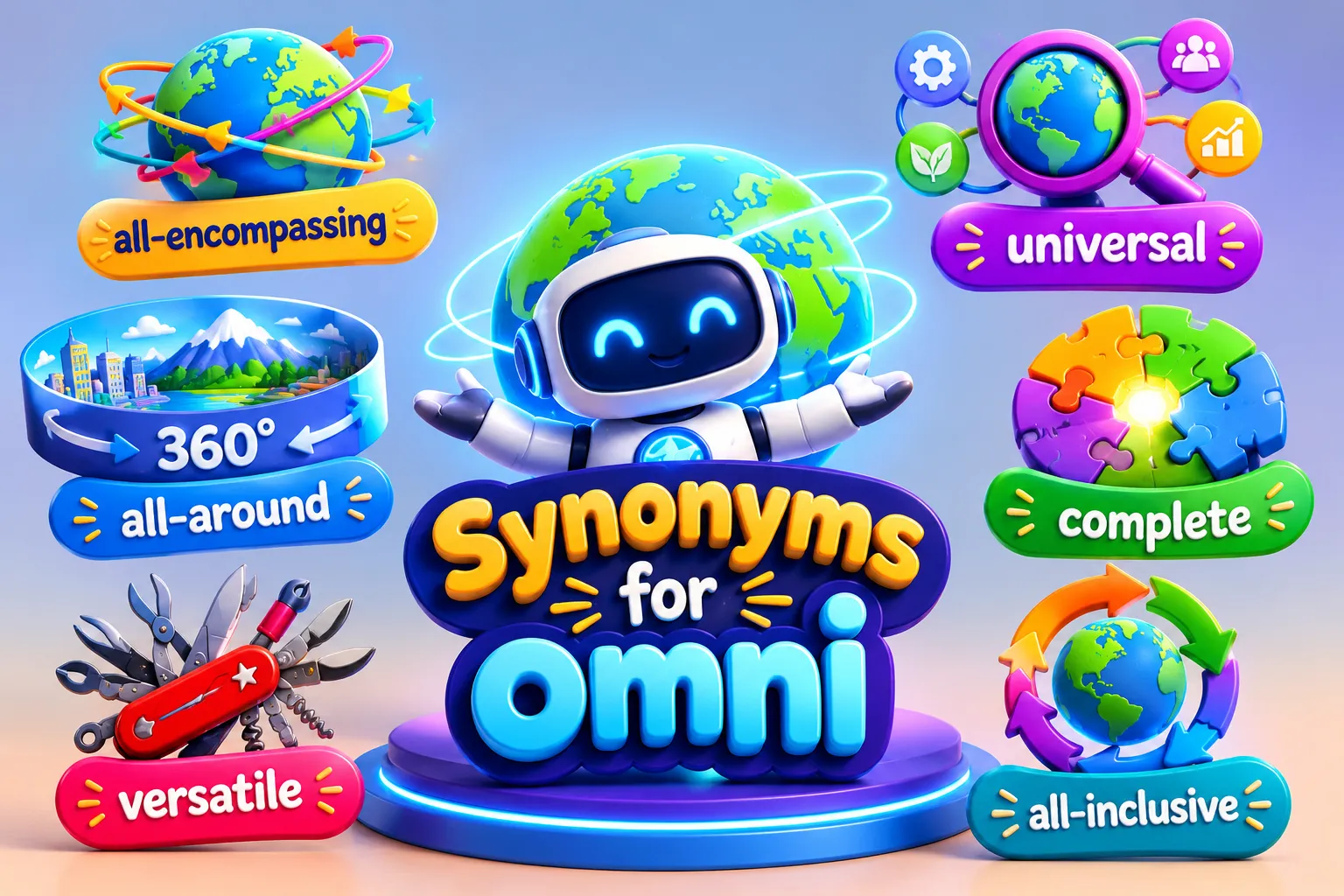
Common alternatives and related words include all, every, entire, whole, total, universal, complete, comprehensive, unlimited, all-inclusive, all-encompassing, and ubiquitous. Since omni is usually a word-forming element rather than a standalone word, the best synonym depends on the word or idea it modifies.
Omni is a short form that carries the idea of all, every, or everything. You may see it in words such as omnipresent, omniscient, and omnipotent. For example, when someone says that a being is omniscient, the word means that the being knows everything. The element omni- is useful because it adds the idea of total or complete coverage to another word. Learning words related to omni can help English learners understand complex vocabulary more easily. It can also help content writers choose clearer alternatives such as universal, complete, or all-encompassing. This article explains the meaning, history, pronunciation, word formation, related synonyms, semantic groups, and antonyms of omni with simple examples.
Meaning of Omni
Definition
Omni (Combining Form/Prefix): A word-forming element meaning all, every, or everything.
It is usually used before another word rather than as an independent word.
Examples
- Omnipresent means present everywhere.
- Omniscient describes someone or something that knows everything.
Connotative Meaning
Positive tone: Omni can suggest completeness, great power, wide reach, or total knowledge.
Negative tone: In some contexts, ideas of being everywhere or knowing everything may feel overwhelming or excessive.
Neutral tone: It can simply mean all, every, or universal.
(Connotation means the feeling or idea that a word suggests beyond its basic dictionary meaning.)
Etymology
Omni- comes from the Latin word omnis, meaning “all” or “every.” It entered English mainly through learned and scientific vocabulary.
| Period | Development |
| Old English (450–1100) | English did not commonly use omni- as a native word-forming element. Ideas such as “all” and “every” were expressed with native words. |
| Middle English (1100–1500) | Latin-based vocabulary continued to enter English through French and scholarly writing. The Latin element omni- remained associated with learned terms. |
| Modern English (1500–Present) | Omni- became widely used in formal, religious, philosophical, scientific, and modern technical vocabulary, including omnipresent, omniscient, and omnipotent. |
Pronunciation (IPA)
- IPA: /ˈɒmni/ (British English), /ˈɑːmni/ (American English)
- Syllables: om-ni
Affixation Pattern of Omni
- Root: Latin omnis, meaning “all” or “every”
- Prefix: omni-
- Suffix: None
- Word formations:
- Omnipresent — adjective
- Omniscient — adjective
- Omnipotent — adjective
- Omnivorous — adjective
- Omnidirectional — adjective
- Omnipresence — noun
- Omniscience — noun
- Omnipotence — noun
- Omnisciently — adverb
- Omnivore — noun
- Omnidirectional — adjective
- Omnicompetent — adjective
27 Synonyms of Omni With Meaning & Examples
Note: Because omni- is a combining form, the following list contains close synonyms, semantic alternatives, and related words. They are not all interchangeable with the prefix omni- in every sentence.
1. All (Determiner/Pronoun)
Meaning: Every person or thing in a particular group.
Examples:
- All students completed the task.
- She checked all the documents.
2. Every (Determiner)
Meaning: Each person or thing in a group.
Examples:
- Every student received a book.
- He visits the library every week.
3. Entire (Adjective)
Meaning: Including the whole of something.
Examples:
- She read the entire book.
- The entire team attended the meeting.
4. Whole (Adjective/Noun)
Meaning: Complete and not divided into parts.
Examples:
- He spent the whole day studying.
- She ate the whole apple.
5. Total (Adjective)
Meaning: Complete or including everything.
Examples:
- The total cost was higher than expected.
- They showed total commitment to the project.
6. Universal (Adjective)
Meaning: Relating to everyone or everything.
Examples:
- The right to education is considered a universal value.
- The theory has universal applications.
7. Complete (Adjective)
Meaning: Having all necessary parts.
Examples:
- We need a complete report.
- The project is now complete.
8. Comprehensive (Adjective)
Meaning: Including many or all important parts.
Examples:
- The teacher gave us a comprehensive guide.
- They conducted a comprehensive review.
9. Inclusive (Adjective)
Meaning: Including everyone or everything relevant.
Examples:
- The school promotes an inclusive environment.
- The price is inclusive of taxes.
10. All-Inclusive (Adjective)
Meaning: Including everything or nearly everything needed.
Examples:
- We booked an all-inclusive holiday.
- The course provides an all-inclusive learning package.
11. All-Encompassing (Adjective)
Meaning: Covering everything within a particular area.
Examples:
- The report gives an all-encompassing view of the problem.
- They created an all-encompassing plan.
12. Universalized (Adjective/Verb)
Meaning: Made applicable to everyone or all situations.
Examples:
- The idea was universalized across the organization.
- The policy was designed for universalized access.
13. Ubiquitous (Adjective)
Meaning: Present or found almost everywhere.
Examples:
- Smartphones are ubiquitous today.
- Advertising is ubiquitous in modern cities.
14. Pervasive (Adjective)
Meaning: Spread widely throughout something.
Examples:
- Technology has a pervasive influence on daily life.
- The problem is pervasive across the industry.
15. Global (Adjective)
Meaning: Relating to the whole world.
Examples:
- Climate change is a global issue.
- The company has a global audience.
16. Worldwide (Adjective/Adverb)
Meaning: Existing or happening throughout the world.
Examples:
- The product is available worldwide.
- The event attracted worldwide attention.
17. Boundless (Adjective)
Meaning: Without clear limits or boundaries.
Examples:
- Her boundless energy impressed everyone.
- The internet provides boundless opportunities for learning.
18. Unlimited (Adjective)
Meaning: Without a fixed limit.
Examples:
- The plan offers unlimited access.
- Members have unlimited use of the service.
19. Exhaustive (Adjective)
Meaning: Covering all or nearly all possibilities or details.
Examples:
- The researchers made an exhaustive study.
- The guide contains an exhaustive list of examples.
20. All-Pervading (Adjective)
Meaning: Present throughout everything or a whole area.
Examples:
- The story has an all-pervading sense of hope.
- Technology has an all-pervading effect on modern life.
21. Omnipresent (Adjective)
Meaning: Present everywhere.
Examples:
- Digital devices seem omnipresent in modern life.
- The company’s advertisements are omnipresent online.
22. Omniscient (Adjective)
Meaning: Knowing everything.
Examples:
- The novel uses an omniscient narrator.
- The character appears omniscient because he knows every detail.
23. Omnipotent (Adjective)
Meaning: Having unlimited power.
Examples:
- The story describes an omnipotent being.
- The character believes the ruler is omnipotent.
24. Omnidirectional (Adjective)
Meaning: Moving, operating, or directed in all directions.
Examples:
- The device uses an omnidirectional microphone.
- The antenna provides omnidirectional coverage.
25. Omnivorous (Adjective)
Meaning: Able to eat both plants and animals.
Examples:
- Humans are generally considered omnivorous.
- The bear is an omnivorous animal.
26. All-Powerful (Adjective)
Meaning: Having complete or unlimited power.
Examples:
- The myth describes an all-powerful deity.
- The fictional character appears all-powerful.
27. All-Knowing (Adjective)
Meaning: Knowing everything.
Examples:
- The story has an all-knowing narrator.
- The character acts as an all-knowing guide.
Prototype Meaning
The most typical meaning of omni is “all” or “every.” When people see omni- at the beginning of a word, they can often expect the word to describe something that covers everything or has a very wide range. For example, omnipresent means present everywhere, while omniscient means knowing everything. The central idea is complete or unlimited coverage.
Prototype Categorization
- Totality and completeness: all, every, entire, whole, total, complete, totality — these words focus on the whole of something.
- Wide coverage: universal, comprehensive, inclusive, all-inclusive, all-encompassing, exhaustive — these emphasize covering many or all parts.
- Everywhere or widespread presence: ubiquitous, pervasive, global, worldwide, omnipresent, all-pervading — these describe something spread across places or areas.
- Unlimited range: boundless, unlimited, all-around — these suggest few or no clear limits.
- Special omni concepts: omniscient, omnipotent, omnidirectional, omnivorous, all-knowing, all-seeing, all-powerful — these words use the idea of “all” in specific ways.
This categorization helps writers choose a word based on the exact idea they want to express instead of using omni for every situation.
Antonyms of Omni
| Antonym | Part of Speech | Meaning |
| Some | Determiner/Pronoun | Referring to part of a group, not all. |
| Few | Determiner/Adjective | A small number of people or things. |
| Partial | Adjective | Involving only part of something. |
| Limited | Adjective | Restricted in amount, range, or extent. |
| Specific | Adjective | Referring to one particular thing or group. |
| Individual | Adjective/Noun | Relating to one person or thing. |
| Narrow | Adjective | Limited in range or scope. |
| Restricted | Adjective | Limited by rules, boundaries, or conditions. |
Short Questions and Answers
What does omni mean?
Omni means all, every, or everything. It is usually used as a prefix or combining form.
When should omni be used?
Use omni- when forming or explaining words that describe an idea involving all things, all places, all directions, or complete knowledge or power.
Is omni positive or negative?
Omni is neutral by itself. Its emotional meaning depends on the word in which it appears and the context.
How is it different from similar words?
Omni is mainly a combining form, while words such as all, every, universal, and complete can normally function as independent English words. Also, words like omnipresent and omniscient have specific meanings that ordinary synonyms do not always express.
Conclusion
Learning omni and its related words can make English vocabulary easier to understand. The basic idea behind omni- is all, every, or everything. Words such as universal, comprehensive, complete, all-encompassing, ubiquitous, omnipresent, and omniscient show how this idea changes across different contexts. Understanding these differences helps learners read complex English words with greater confidence. It also helps writers choose precise words instead of repeating simple terms such as “all” or “everything.” Remember that omni- is mainly a prefix or combining form, so it is not always interchangeable with its related words. Practice by learning one omni-based word each day and using it in a sentence. Regular vocabulary practice can strengthen your writing, speaking, reading, and overall English confidence.
Read More:
Synonyms for guided: 29 Powerful Alternatives

I’m Ayesha Haram, an English content and SEO writer at SynonymsInstant.com. I focus on creating helpful vocabulary resources, word guides, and practical English content that readers can understand quickly. I combine language research, clear explanations, and SEO-focused writing to produce reliable content that supports learners, writers, and everyday English users.