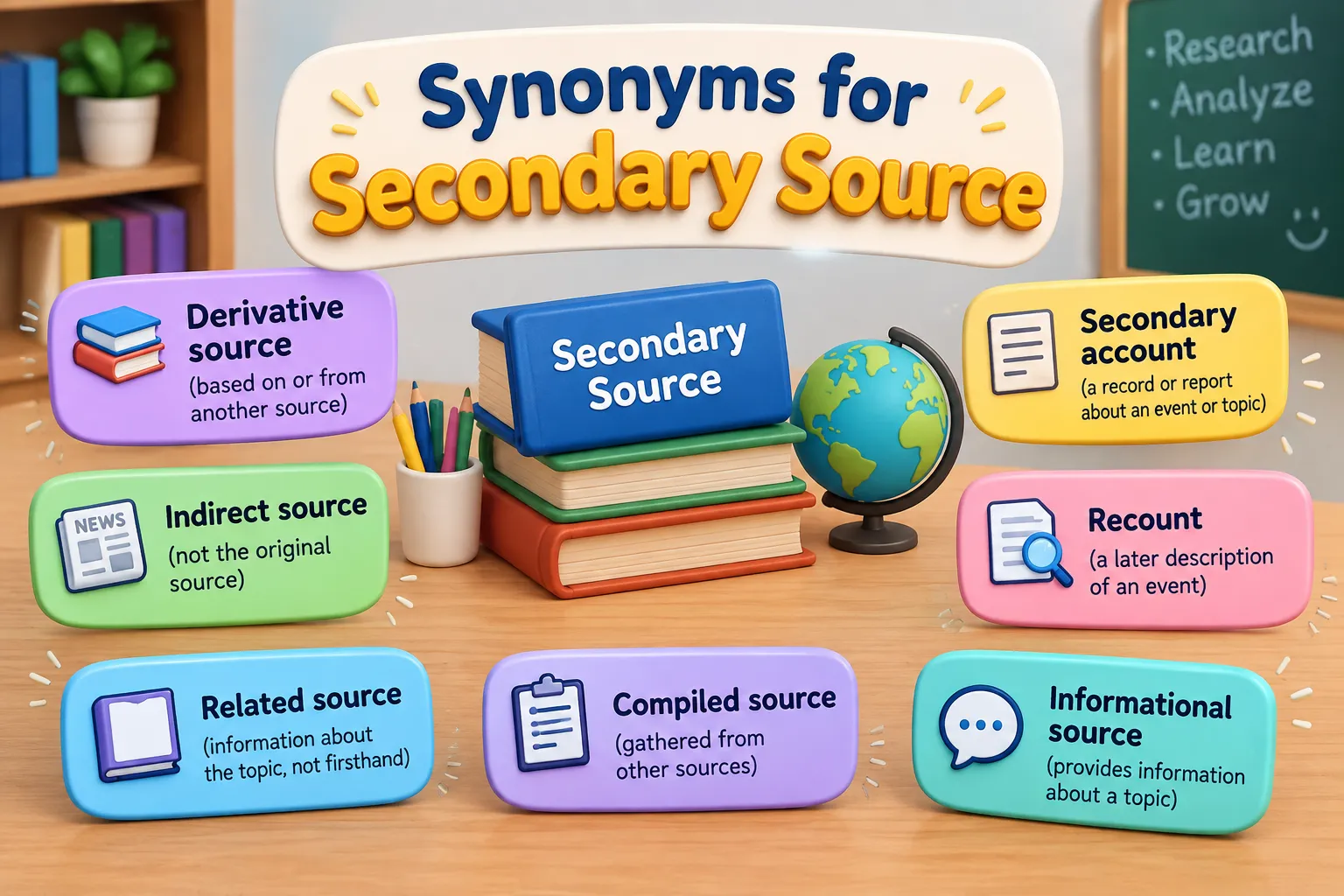
Common alternatives include review articles, scholarly analysis, critical study, research review, commentary, interpretation, historical account, literature review, and academic overview. These terms are not always exact synonyms, because the best choice depends on the type of secondary source. For example, a literature review summarizes existing research, while a critical analysis examines and evaluates an existing work or idea.
A secondary source is a source that discusses, explains, or analyzes information created by another source. Imagine a student researching a historical event. A diary written by a person who witnessed the event is a primary source, while a history book that studies and explains that diary is a secondary source. The term is common in academic writing, research, history, journalism, and education. Learning alternatives for secondary sources helps students and writers describe research materials more precisely. It also prevents repetition in essays, reports, and academic articles. Some alternatives focus on analysis, while others focus on review, interpretation, or summary. In this article, we explore the meaning, grammar, history, pronunciation, word formation, and 29 useful alternatives to secondary sources, with simple examples and semantic categories.
Meaning of Secondary Source
Definition
Secondary source (Noun Phrase):
A secondary source is a source that analyzes, explains, interprets, or summarizes information from primary or original sources.
Examples
- The student used a history book as a secondary source.
- This journal article is a useful secondary source for the research project.
Connotative Meaning
The phrase secondary source usually has an academic and research-based tone.
- Positive tone: It can suggest useful analysis, expert knowledge, and scholarly research.
- Negative tone: In some contexts, it may suggest information that is less direct than a primary source.
- Neutral tone: It simply identifies a source that discusses or analyzes original information.
(Connotation means the feeling or idea that a word suggests beyond its basic meaning.)
Etymology
The phrase secondary source is made from secondary and source. Secondary comes through Old French from Latin secundarius, meaning “second” or “following.” Source comes through Old French from Latin surgere, meaning “to rise” or “spring up.” The research meaning of secondary source developed as scholars began distinguishing original evidence from later analysis and interpretation.
| English Period | Development |
| Old English (450–1100) | The modern phrase secondary source did not exist. Ideas of something being second or following were expressed through native English words. |
| Middle English (1100–1500) | Words related to secondary and source entered and developed in English through French and Latin influences. |
| Modern English (1500–Present) | Secondary source became an established research term for material that analyzes, interprets, summarizes, or discusses primary sources. |
Pronunciation (IPA)
- IPA: /ˈsekənˌderi sɔːrs/
- Syllables: sec-on-dary source
Affixation Pattern of Secondary Source
- Root: second / surg- — the words have Latin roots connected with “second” and “rise.”
- Prefix: second- in secondary reflects the idea of “second” or following.
- Suffix: -ary — forms an adjective meaning related to or connected with something.
- Word formations:
- Second — noun/adjective/verb
- Secondary — adjective/noun
- Source — noun/verb
- Sourcing — noun/verb form
- Resourcing — noun/verb form
- Sourced — adjective/verb form
- Secondarily — adverb
- Secondary source — noun phrase
29 Synonyms of Secondary Source With Meaning & Examples
Note: There are few perfect one-to-one synonyms for the academic term secondary source. The alternatives below include close research terms and context-specific equivalents. Writers should choose the term that matches the exact type of source.
1. Review Article (Noun Phrase)
Meaning: An academic article that examines and summarizes existing research.
Examples:
- I found a useful review article about climate research.
- The review article compares several earlier studies.
2. Scholarly Analysis (Noun Phrase)
Meaning: An academic examination of existing information, evidence, or ideas.
Examples:
- The book provides a detailed scholarly analysis.
- Her paper is based on scholarly analysis of historical records.
3. Critical Study (Noun Phrase)
Meaning: A detailed examination that evaluates an existing work or idea.
Examples:
- The professor recommended a critical study of the novel.
- This critical study examines the author’s main arguments.
4. Research Review (Noun Phrase)
Meaning: A source that examines and summarizes previous research.
Examples:
- The research review covers studies from the last decade.
- I used a research review to understand the topic.
5. Literature Review (Noun Phrase)
Meaning: A structured summary and analysis of existing research on a topic.
Examples:
- The thesis begins with a literature review.
- Her literature review identifies important research gaps.
6. Academic Analysis (Noun Phrase)
Meaning: A detailed examination of a subject using academic methods.
Examples:
- The article offers an academic analysis of the issue.
- Students should support their claims with academic analysis.
7. Scholarly Commentary (Noun Phrase)
Meaning: An expert discussion or explanation of an existing work or issue.
Examples:
- The book includes scholarly commentary on the historical documents.
- His scholarly commentary helped explain the theory.
8. Critical Commentary (Noun Phrase)
Meaning: A detailed discussion that explains and evaluates an existing work.
Examples:
- The student included critical commentary in the essay.
- The critical commentary examines the author’s argument.
9. Academic Commentary (Noun Phrase)
Meaning: An academic discussion that explains or evaluates information.
Examples:
- The article contains useful academic commentary.
- Her academic commentary adds context to the study.
10. Interpretive Source (Noun Phrase)
Meaning: A source that explains the meaning or importance of existing information.
Examples:
- The book is an interpretive source for the historical event.
- We used an interpretive source to understand the painting.
11. Analytical Source (Noun Phrase)
Meaning: A source that examines information and provides analysis.
Examples:
- The article is an analytical source for the research.
- Use an analytical source to compare different viewpoints.
12. Scholarly Source (Noun Phrase)
Meaning: A source produced for academic or research purposes.
Examples:
- The professor asked us to use scholarly sources.
- This scholarly source provides reliable background information.
13. Academic Source (Noun Phrase)
Meaning: A source created or used in academic research and study.
Examples:
- The student cited several academic sources.
- This academic source discusses the history of education.
14. Research Source (Noun Phrase)
Meaning: Material used to support or develop research.
Examples:
- The library has many useful research sources.
- We need another research source for this claim.
15. Reference Work (Noun Phrase)
Meaning: A book or resource that provides information for research or study.
Examples:
- The encyclopedia is a useful reference work.
- She consulted a reference work before writing the report.
16. Scholarly Reference (Noun Phrase)
Meaning: An academic work used to provide information or support an argument.
Examples:
- The paper includes several scholarly references.
- This scholarly reference explains the theory clearly.
17. Historical Account (Noun Phrase)
Meaning: A description or explanation of past events.
Examples:
- The book provides a detailed historical account.
- We compared several historical accounts of the war.
18. Historical Analysis (Noun Phrase)
Meaning: An examination of historical events, evidence, and interpretations.
Examples:
- The article provides historical analysis of the conflict.
- Students read historical analysis before writing their essays.
19. Academic Overview (Noun Phrase)
Meaning: A broad academic explanation of a subject.
Examples:
- The chapter gives an academic overview of the topic.
- I read an academic overview before starting my research.
20. Research Commentary (Noun Phrase)
Meaning: Discussion that explains or evaluates research findings.
Examples:
- The report includes research commentary from experts.
- Her research commentary explains the study’s limitations.
21. Analytical Review (Noun Phrase)
Meaning: A review that examines information carefully and critically.
Examples:
- The journal published an analytical review of the study.
- His analytical review compares several theories.
22. Critical Review (Noun Phrase)
Meaning: A review that summarizes and evaluates a work.
Examples:
- She wrote a critical review of the book.
- The critical review points out several weaknesses.
23. Interpretive Analysis (Noun Phrase)
Meaning: An analysis that explains the meaning or significance of existing information.
Examples:
- The paper uses interpretive analysis of the documents.
- Her interpretive analysis offers a new perspective.
24. Explanatory Source (Noun Phrase)
Meaning: A source that helps explain information from another source.
Examples:
- The textbook is a useful explanatory source.
- We used an explanatory source to understand the theory.
25. Background Source (Noun Phrase)
Meaning: Material that provides context or general information about a topic.
Examples:
- The encyclopedia served as a background source.
- Start with a background source before studying the primary documents.
26. Contextual Source (Noun Phrase)
Meaning: A source that provides background or context for understanding information.
Examples:
- The article is useful as a contextual source.
- We used a contextual source to understand the historical setting.
27. Commentary (Noun)
Meaning: Discussion or explanation that adds meaning or opinion to existing information.
Examples:
- The documentary includes expert commentary.
- Her commentary helped explain the original document.
28. Interpretation (Noun)
Meaning: An explanation of the meaning or importance of information.
Examples:
- The book offers a new interpretation of the event.
- His interpretation differs from earlier scholars.
29. Scholarly Discussion (Noun Phrase)
Meaning: An academic discussion of a subject based on research and evidence.
Examples:
- The article contributes to scholarly discussion of the issue.
- The topic has received much scholarly discussion.
Prototype Meaning
The most typical meaning of secondary source is a source that discusses or analyzes information from a primary source. People usually imagine a textbook, research review, academic article, biography, documentary, or history book that explains information created or recorded by others. Unlike a primary source, it does not usually provide direct first-hand evidence of the event or subject. Its main role is to add explanation, context, comparison, or interpretation.
Prototype Categorization
The 29 alternatives can be grouped into meaningful semantic categories:
- Research and academic sources: scholarly source, academic source, research source, scholarly reference, reference work. These are useful when discussing academic materials in general.
- Review-based sources: review article, research review, literature review, analytical review, critical review. These terms work best when a source summarizes or evaluates existing research.
- Analysis and interpretation: scholarly analysis, critical study, academic analysis, analytical source, interpretive source, historical analysis, interpretive analysis. These emphasize examination and interpretation.
- Commentary and discussion: scholarly commentary, critical commentary, academic commentary, research commentary, commentary, scholarly discussion. These focus on expert discussion or explanation.
- Background and context: academic overview, background source, contextual source, explanatory source. These are useful when a source helps readers understand a subject or its context.
- Historical materials: historical account, historical analysis. These work especially well when discussing historical research.
- General secondary material: secondary material, interpretation. These are broad terms that can fit several research contexts.
This categorization helps writers choose a term based on what the source actually does. A literature review is more specific than a general secondary source, while historical analysis is better when the material examines past events.
Antonyms of Secondary Source
| Antonym | Part of Speech | Meaning |
| Primary source | Noun Phrase | Original or first-hand material created close to the event or subject being studied. |
| Original source | Noun Phrase | The first or direct source of information. |
| First-hand source | Noun Phrase | Information obtained directly from a person, event, or experience. |
| Direct evidence | Noun Phrase | Evidence that comes directly from the subject or event. |
| Original evidence | Noun Phrase | Direct evidence from the original event, person, or material. |
| First-hand evidence | Noun Phrase | Evidence based on direct observation or experience. |
| Contemporary record | Noun Phrase | A record created during the period or event being studied. |
| Eyewitness account | Noun Phrase | A description given by someone who directly saw an event. |
Short Questions and Answers
What does secondary source mean?
A secondary source is material that analyzes, explains, interprets, or summarizes information from primary sources.
When should a secondary source be used?
Use a secondary source when discussing research material that does not usually provide direct first-hand evidence but instead examines or explains original information.
Is the secondary source positive or negative?
It is neutral. It simply describes the relationship between a source and the original information. A secondary source can be highly reliable and valuable.
How is it different from similar words?
A secondary source is a broad research term. A literature review focuses on existing research, a critical analysis evaluates a work or idea, and a historical account describes or explains past events.
Conclusion
Learning alternatives for secondary sources can improve academic writing and research vocabulary. Terms such as review article, scholarly analysis, literature review, critical study, academic source, historical analysis, and secondary material help writers describe research materials more accurately. However, these expressions are not always exact synonyms. Each one can highlight a different purpose, such as reviewing research, explaining history, evaluating an argument, or providing background information. Understanding these differences helps students write clearer essays, reports, and research papers. It also reduces repetition and makes academic language more precise. English learners can practice these terms by using them in short sentences about books, articles, documentaries, and research papers. With regular practice, you can choose the right expression for each research situation and build stronger English vocabulary and writing confidence.
Read More:
Synonyms for lush: 25 Powerful Alternatives

I’m Pinki, an SEO writer at SynonymsInstant.com, specializing in synonyms, antonyms, vocabulary, word meanings, grammar, and English usage. I create accurate, well-researched, reader-friendly content that combines language expertise with SEO best practices. My goal is to make English vocabulary simple, useful, and accessible for students, writers, professionals, and English learners.