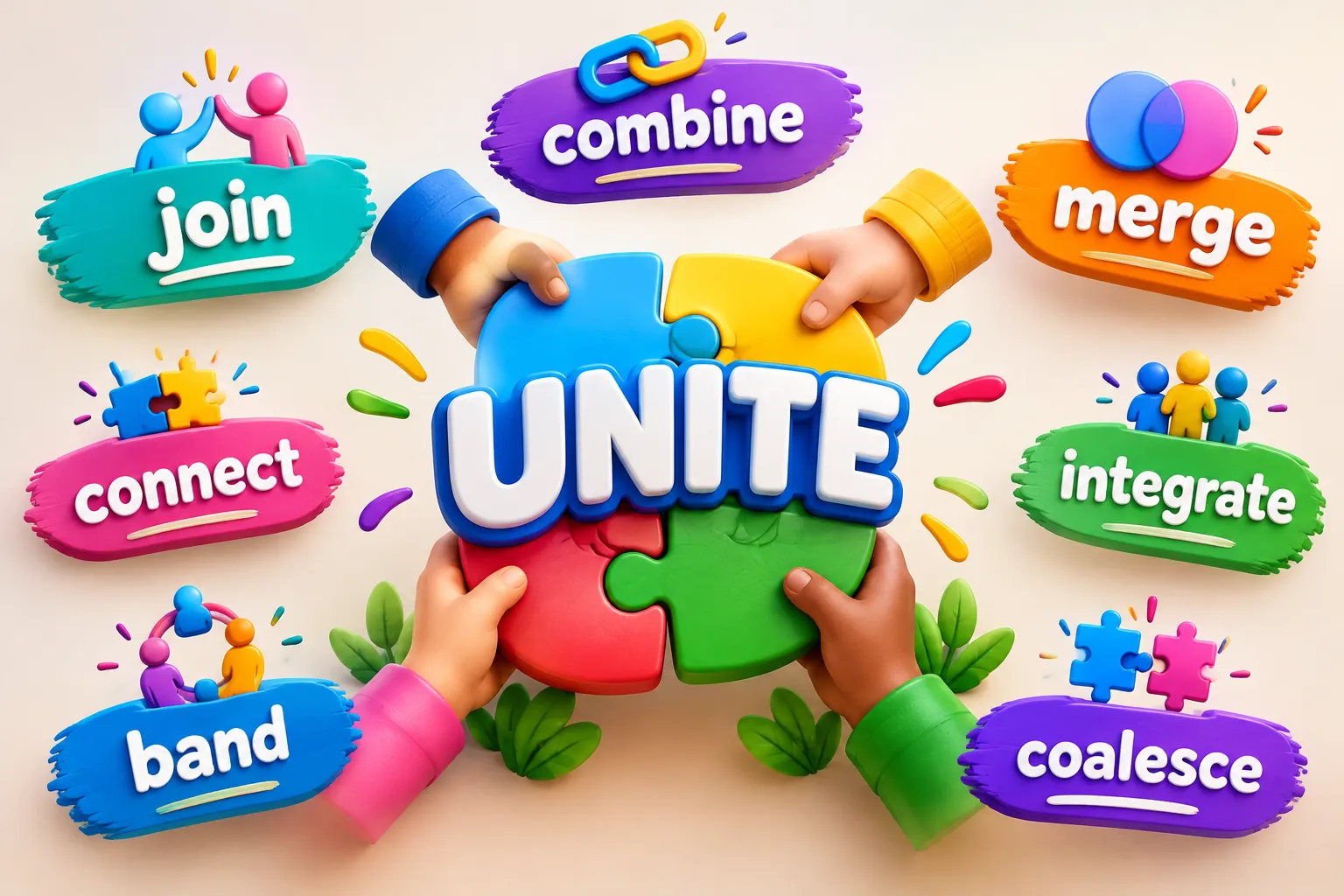
Common synonyms include join, combine, merge, connect, gather, assemble, integrate, unify, reconcile, collaborate, cooperate, bond, link, and consolidate. The best synonym depends on the context. For example, people can unite for a common goal, two companies can merge, and separate parts can combine into one whole.
Unite means to bring people, groups, or things together as one. Imagine a school team preparing for an important competition. Each student has a different role, but they unite to reach the same goal. This word is common in everyday speech, news, politics, teamwork, relationships, and formal writing. Learning synonyms for unite helps English learners express the idea of togetherness in different ways. It also helps content writers avoid using the same word again and again. Some alternatives focus on joining people, while others describe combining things, forming relationships, or working together. In this article, we will explore the meaning of unite, its grammar, history, pronunciation, word formation, and 29 useful synonyms. We will also examine examples, semantic categories, antonyms, and simple questions to help you use each word correctly.
Meaning of Unite
Definition
Unite (Verb):
To bring people, groups, things, or ideas together so that they form one whole or work toward a common purpose.
Examples
- The community united to help families after the flood.
- The two teams united for a common cause.
Connotative Meaning
- Positive tone: Often suggests cooperation, friendship, strength, and shared purpose.
- Negative tone: It can sometimes describe groups joining together against another group.
- Neutral tone: It can simply mean joining separate people or things into one.
(Connotation means the feeling or idea that a word suggests beyond its basic meaning.)
Etymology
Unite comes from Latin unire, meaning “to make one” or “join together.” It entered English through French.
| Period | Development |
| Old English (450–1100) | The modern word unite was not commonly used in Old English. The idea of joining was expressed through native words such as gaderian, meaning “to gather.” |
| Middle English (1100–1500) | Latin-derived forms entered English through Anglo-French and Old French, carrying the sense of joining or making one. |
| Modern English (1500–Present) | Unite became established as a common verb meaning “to join together,” “combine,” or “make one.” |
Pronunciation (IPA)
- IPA: /juːˈnaɪt/
- Syllables: u-nite
Affixation Pattern of Unite
- Root: unit — related to the idea of “one.”
- Prefix: u- is not a productive English prefix here; the word comes from Latin unire.
- Suffix: No productive suffix in unite itself.
- Word formations:
- unite — verb
- united — adjective / past participle
- uniting — verb / present participle
- unity — noun
- unification — noun
- unifier — noun
- unitedly — adverb, uncommon
- reunite — verb
- reunification — noun
- disunite — verb
29 Synonyms of Unite With Meaning & Examples
1. Join (Verb)
Meaning: To connect or bring two or more people or things together.
Examples:
- Please join the two pieces together.
- Several students joined the campaign.
2. Combine (Verb)
Meaning: To put separate things together to form a single result.
Examples:
- Combine the ingredients in a large bowl.
- The teams combined their resources.
3. Merge (Verb)
Meaning: To join two or more things into one.
Examples:
- The two companies decided to merge.
- The roads merge near the bridge.
4. Unify (Verb)
Meaning: To bring separate people or groups together as one.
Examples:
- The leader worked to unify the community.
- Music can unify people.
5. Integrate (Verb)
Meaning: To combine separate parts so they work together as a whole.
Examples:
- The school wants to integrate new technology.
- The program helps integrate different groups.
6. Connect (Verb)
Meaning: To link people or things together.
Examples:
- The bridge connects two towns.
- Shared interests connected the friends.
7. Link (Verb)
Meaning: To connect two or more things or people.
Examples:
- The road links the villages.
- The project links several local groups.
8. Gather (Verb)
Meaning: To bring people or things together in one place.
Examples:
- Families gathered for dinner.
- The teacher gathered the students in the hall.
9. Assemble (Verb)
Meaning: To bring people or parts together into one group or whole.
Examples:
- The workers assembled the equipment.
- Volunteers assembled outside the building.
10. Consolidate (Verb)
Meaning: To combine separate parts into a stronger or more effective whole.
Examples:
- The company plans to consolidate its offices.
- They consolidated their resources.
11. Reconcile (Verb)
Meaning: To restore friendly relations between people who have disagreed.
Examples:
- The friends decided to reconcile.
- The mediator helped reconcile the two sides.
12. Cooperate (Verb)
Meaning: To work together toward a shared goal.
Examples:
- The neighbors cooperated to clean the street.
- Both teams agreed to cooperate.
13. Collaborate (Verb)
Meaning: To work together on a project or task.
Examples:
- The writers collaborated on a new book.
- Scientists collaborate across countries.
14. Coordinate (Verb)
Meaning: To organize people or activities so they work together effectively.
Examples:
- We need to coordinate our efforts.
- The managers coordinated the event.
15. Ally (Verb)
Meaning: To join with another person or group for a shared purpose.
Examples:
- Several groups allied to support the plan.
- The countries allied against a common threat.
16. Associate (Verb)
Meaning: To connect or join with another person, group, or idea.
Examples:
- The organization associated with local charities.
- Many people associate the brand with quality.
17. Bond (Verb)
Meaning: To form a close connection or relationship.
Examples:
- The children bonded during the trip.
- Shared experiences bond people together.
18. Couple (Verb)
Meaning: To connect or join two things together.
Examples:
- The engineer coupled the two machines.
- The system couples energy production with storage.
19. Attach (Verb)
Meaning: To connect one thing to another.
Examples:
- Attach the file to your email.
- She attached the label to the box.
20. Tie (Verb)
Meaning: To connect or link people or things together.
Examples:
- The agreement ties the two companies together.
- Shared goals tie the community together.
21. Bring Together (Phrase)
Meaning: To cause separate people or things to come together.
Examples:
- The festival brought together people from many towns.
- The project brought together different experts.
22. Pool (Verb)
Meaning: To combine resources, money, knowledge, or efforts.
Examples:
- The families pooled their money.
- The researchers pooled their knowledge.
23. Amalgamate (Verb)
Meaning: To combine separate organizations or things into one.
Examples:
- The two departments amalgamated last year.
- The groups agreed to amalgamate their operations.
24. Incorporate (Verb)
Meaning: To include something as part of a larger whole.
Examples:
- The designer incorporated new ideas into the plan.
- The course incorporates practical activities.
25. Fuse (Verb)
Meaning: To join things closely so they become one.
Examples:
- Heat caused the materials to fuse.
- The artist fused traditional and modern styles.
26. Centralize (Verb)
Meaning: To bring separate activities or control under one central system.
Examples:
- The company decided to centralize its operations.
- The government plans to centralize some services.
27. Synthesize (Verb)
Meaning: To combine different ideas or information into a new whole.
Examples:
- Students must synthesize information from several sources.
- The researcher synthesized the main findings.
28. Reunite (Verb)
Meaning: To bring people together again after separation.
Examples:
- The family reunited after many years.
- The event reunited old classmates.
29. Cohere (Verb)
Meaning: To fit or stay together as a united whole.
Examples:
- The ideas cohere into a clear argument.
- The team began to cohere after several meetings.
Prototype Meaning
The most typical meaning of unite is to bring separate people or groups together for a common purpose. When people hear this word, they often imagine people standing together, working as a team, or supporting the same goal. It can also describe physical objects, ideas, organizations, or systems becoming one.
Prototype Categorization
- Joining and connecting: join, connect, link, attach, couple, tie — useful when separate people or objects are physically or conceptually connected.
- Combining into one: combine, merge, unify, integrate, amalgamate, fuse — best when separate parts become one whole.
- Working together: cooperate, collaborate, coordinate, pool, ally — useful when people or groups share efforts, resources, or goals.
- Building relationships: bond, reconcile, associate, reunite — useful for social and personal connections.
- Creating an organized whole: consolidate, centralize, incorporate, synthesize, harmonize, cohere — useful in business, academic, technical, or formal writing.
- Bringing people together: gather, assemble, bring together — best when people are collected in one place or group.
This categorization helps writers choose a synonym based on the exact type of unity, connection, cooperation, or combination they want to describe.
Antonyms of Unite
| Antonym | Part of Speech | Meaning |
| Separate | Verb | To move or keep people or things apart. |
| Divide | Verb | To split something into different parts or groups. |
| Disunite | Verb | To cause people or things to stop being united. |
| Split | Verb | To break a group or whole into parts. |
| Disconnect | Verb | To break a connection between people or things. |
| Disperse | Verb | To scatter people or things in different directions. |
| Isolate | Verb | To keep someone or something apart from others. |
| Detach | Verb | To separate something from what it was connected to. |
| Fragment | Verb | To break something into smaller separate parts. |
| Divide | Verb | To cause disagreement or separation within a group. |
Short Questions and Answers
What does unite mean?
Unite means to bring people, groups, things, or ideas together as one or to make them work toward a shared goal.
When should unite be used?
Use unite when you want to describe people or things coming together, especially for a common purpose or shared goal.
Is unite positive or negative?
Unite is usually positive because it suggests teamwork and cooperation. However, the context can make it neutral or negative if groups unite against someone.
How is unite different from similar words?
Unite is a broad word for bringing things together. Merge usually means two things become one, cooperate focuses on working together, and reconcile focuses on ending conflict and restoring a relationship.
Conclusion
Learning unite and its synonyms gives English learners more ways to describe connection, teamwork, and togetherness. Words such as join, combine, merge, unify, integrate, cooperate, collaborate, reconcile, and harmonize can make your speaking and writing more precise. However, each word has its own use and meaning. For example, companies may merge, friends may reconcile, teams may collaborate, and communities may unite around a shared goal. Knowing these differences helps you avoid repetition and choose stronger vocabulary. Regular practice can improve your writing, speaking, reading, and overall English confidence. Try learning a few synonyms each day and use them in your own sentences. Over time, this simple habit will help you communicate ideas about cooperation and connection more clearly and naturally.
Read More:
Synonyms for upcoming: 26 Empowering Words and Phrases

I am Rubab content specialist focused on creating accurate, user-friendly, and search-optimized language resources. Through Synonyminstant, I help readers find synonyms, antonyms, meanings, and vocabulary with ease. Every article is carefully researched and optimized to provide reliable information, clear explanations, and an excellent user experience.