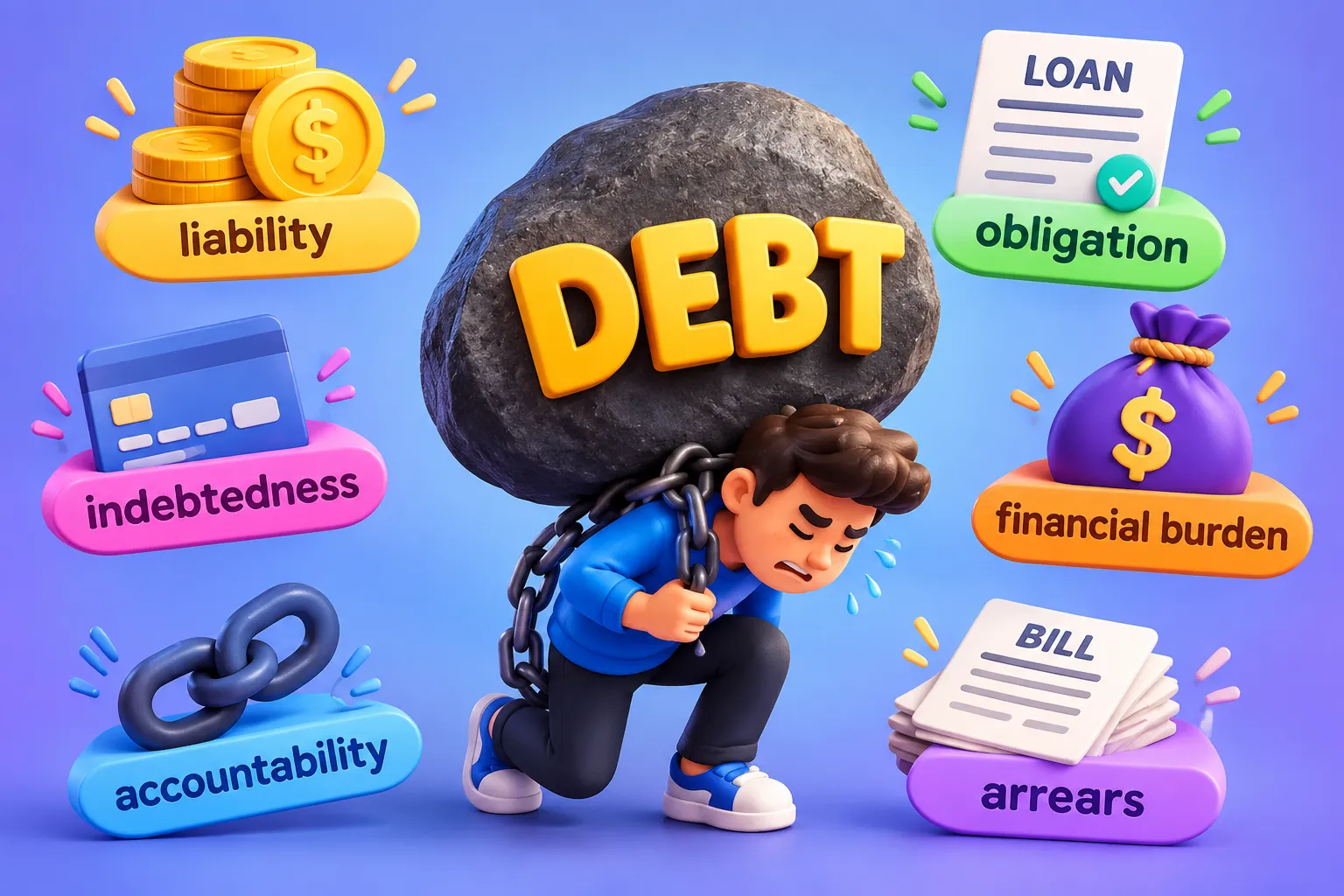
Common synonyms for debt include loan, liability, borrowing, obligation, indebtedness, arrears, balance, and money owed. Each word has a slightly different meaning. A loan is money borrowed from a lender, while a liability is a financial responsibility. Arrears refers to payments that are overdue.
Debt is money that a person, business, or government owes to someone else. For example, if you borrow money to buy a car, you must repay the lender over time. The amount you still owe is your debt.
Debt is a common topic in banking, business, and personal finance. Learning synonyms for debt helps you understand financial terms and improve your vocabulary. It also makes your writing clearer and reduces repetition. Some alternatives describe borrowed money, while others refer to unpaid bills or financial responsibilities.
In this guide, you will learn the meaning of debt, its pronunciation, history, and word forms. You will also discover 30 related words, their meanings, and simple examples. Finally, you will explore their categories, antonyms, and common uses.
Meaning of Debt
Definition
Debt (Noun): Money that a person, business, or organization owes and is usually required to repay.
Examples
- She is working hard to pay off her debt.
- The company took on debt to expand its business.
- He borrowed money and now has to repay his debt.
Connotative Meaning
Connotation refers to the feelings or ideas associated with a word beyond its basic meaning.
- Positive: Debt can help people buy homes, pay for education, or start businesses.
- Negative: Too much debt can cause financial stress and make repayment difficult.
- Neutral: In financial writing, debt simply refers to money that must be repaid.
Etymology of Debt
The word debt comes from Old French dete and Latin debitum, meaning something owed. The letter b was added to the English spelling because of its Latin origin. However, the b is silent in modern English.
| Period | Development |
|---|---|
| Old English (450–1100) | People used native English words related to owing and financial obligations. |
| Middle English (1100–1500) | The word debt developed from Old French forms referring to something owed. |
| Modern English (1500–Present) | The spelling debt became established, and the word came to be widely used in financial contexts. |
Pronunciation of Debt
- IPA: /det/
- Syllables: One syllable
- Part of speech: Noun
Pronunciation tip: The letter b is silent. Pronounce debt like det.
Word Formation of Debt
The word debt has several related forms. These words describe a person who owes money or the state of owing money.
| Word | Part of Speech | Meaning |
|---|---|---|
| Debt | Noun | Money that must be repaid |
| Debtor | Noun | A person or organization that owes money |
| Debtless | Adjective | Free from debt |
| Indebted | Adjective | Owing money or feeling grateful |
| Indebtedness | Noun | The state of owing money |
| Debt-free | Adjective | Having no debt |
Root: Debt
Prefix: None in the basic word.
Related forms: Debtor, indebted, indebtedness, and debt-free.
30 Synonyms for Debt With Meanings and Examples
Not every word below is an exact synonym for debt. Some describe borrowed money, while others refer to unpaid amounts, financial responsibilities, or specific financial situations.
1. Liability (Noun)
Meaning: A financial obligation that a person or business must pay.
Examples:
- The company has several financial liabilities.
- The accountant recorded the loan as a liability.
2. Loan (Noun)
Meaning: Money borrowed from a person or organization that must be repaid.
Examples:
- She took out a loan to buy a house.
- He is paying back his student loan.
3. Borrowing (Noun)
Meaning: The act or amount of obtaining money that must later be repaid.
Examples:
- The company reduced its borrowing this year.
- Excessive borrowing can create financial problems.
4. Obligation (Noun)
Meaning: A duty or responsibility that someone must fulfill.
Examples:
- The company has several financial obligations.
- He met his payment obligations on time.
5. Indebtedness (Noun)
Meaning: The state of owing money.
Examples:
- The business is trying to reduce its indebtedness.
- High indebtedness can make expansion difficult.
6. Arrears (Noun)
Meaning: Payments that should have been made but are overdue.
Examples:
- He fell into arrears on his rent.
- The company paid its overdue tax arrears.
7. Dues (Noun)
Meaning: Money that must be paid, often as a fee or regular payment.
Examples:
- Members must pay their annual dues.
- The business settled its outstanding dues.
8. Balance (Noun)
Meaning: The amount of money still owed on an account or loan.
Examples:
- I still have a balance on my credit card.
- She paid the remaining balance yesterday.
9. Amount Owed (Noun Phrase)
Meaning: The total money that a person or business must pay.
Examples:
- The amount owed must be paid by Friday.
- We calculated the total amount owed.
10. Credit (Noun)
Meaning: An arrangement that allows someone to borrow money or pay later.
Examples:
- The store allows customers to buy goods on credit.
- Using too much credit can lead to financial difficulties.
11. Financing (Noun)
Meaning: Money provided to pay for a purchase, project, or business activity.
Examples:
- The company arranged financing for its new factory.
- The family obtained financing to buy a home.
12. Mortgage (Noun)
Meaning: A loan used to buy property, usually secured by that property.
Examples:
- They took out a mortgage to buy their house.
- She pays her mortgage every month.
13. Credit Balance (Noun Phrase)
Meaning: A balance shown on a credit account. Depending on the account, it may represent money owed or money available.
Examples:
- He checked the balance on his credit account.
- She reviewed her credit balance before making a payment.
14. Payment Obligation (Noun Phrase)
Meaning: A payment that someone is required to make.
Examples:
- The contract created a new payment obligation.
- He fulfilled his monthly payment obligations.
15. Financial Obligation (Noun Phrase)
Meaning: A financial responsibility that requires payment.
Examples:
- Rent is a regular financial obligation.
- The company must meet its financial obligations.
16. Liability Balance (Noun Phrase)
Meaning: The amount recorded for a financial liability.
Examples:
- The accountant reviewed the liability balance.
- The business reduced the balance of its outstanding liability.
17. Outstanding Balance (Noun Phrase)
Meaning: Money that remains unpaid.
Examples:
- Please pay the outstanding balance by Monday.
- The bank sent a reminder about the outstanding balance.
18. Outstanding Payment (Noun Phrase)
Meaning: A payment that has not yet been made.
Examples:
- We need to settle the outstanding payment.
- The supplier contacted us about an outstanding payment.
19. Unpaid Bill (Noun Phrase)
Meaning: A bill that has not been paid.
Examples:
- He received a reminder about an unpaid bill.
- The business cleared several unpaid bills.
20. Tab (Noun)
Meaning: An amount owed for goods or services, especially at a restaurant or bar.
Examples:
- The customer paid the restaurant tab.
- He asked the waiter to add the drinks to his tab.
21. Accounts Payable (Noun)
Meaning: Money a business owes to its suppliers or other creditors.
Examples:
- The accountant reviewed the company’s accounts payable.
- The business paid its accounts payable on time.
22. Financial Burden (Noun Phrase)
Meaning: A financial responsibility that causes pressure or difficulty.
Examples:
- The large loan became a financial burden.
- The family worked together to reduce its financial burden.
23. Financial Commitment (Noun Phrase)
Meaning: An agreement or responsibility to make payments in the future.
Examples:
- Buying a house is a major financial commitment.
- Consider your monthly financial commitments carefully.
24. Deficit (Noun)
Meaning: A situation in which spending or expenses exceed available income or funds.
Examples:
- The government reported a budget deficit.
- The organization is working to reduce its deficit.
25. Overdraft (Noun)
Meaning: An amount spent from a bank account beyond the available balance, usually through an overdraft arrangement.
Examples:
- The bank charged him an overdraft fee.
- She used an overdraft to cover an unexpected expense.
26. Default (Noun)
Meaning: Failure to make a required payment or meet a financial agreement.
Examples:
- The borrower went into default after missing several payments.
- The bank took action after the loan default.
27. Encumbrance (Noun)
Meaning: A claim, restriction, or financial obligation that affects property or another asset.
Examples:
- The property has a financial encumbrance.
- The lawyer checked for encumbrances on the land.
28. Mortgage Debt (Noun Phrase)
Meaning: Money still owed on a mortgage.
Examples:
- They are trying to reduce their mortgage debt.
- His mortgage debt will take years to repay.
29. Consumer Debt (Noun Phrase)
Meaning: Money individuals owe from personal borrowing or purchases.
Examples:
- Many families are trying to reduce consumer debt.
- Credit card spending can increase consumer debt.
30. Money Owed (Noun Phrase)
Meaning: Money that must be paid to another person or organization.
Examples:
- The money owed must be paid soon.
- She kept a record of the money owed to the bank.
Quick tip: Use loan for borrowed money, liability for a financial responsibility, and arrears for overdue payments. Choose outstanding balance when referring to the amount still unpaid.
Prototype Meaning of Debt
The most common meaning of debt is money that has been borrowed and must be repaid. People often associate debt with loans, credit cards, mortgages, and unpaid bills.
For example, someone who borrows money from a bank to buy a house has a debt to repay. The amount still owed remains a debt until it is paid off.
Debt can also refer to financial obligations that arise from business activities or unpaid expenses. In each case, the central idea is the same: money is owed and must be paid.
Prototype Categorization of Debt Synonyms
The synonyms and related terms for debt can be divided into groups based on their meanings.
- General financial obligations: liability, indebtedness, obligation, borrowing — useful for discussing money owed in general.
- Borrowed money: loan, credit, financing, mortgage — used when discussing money obtained from a lender.
- Unpaid amounts: arrears, dues, balance, outstanding balance, unpaid bill, money owed — describe payments that remain due.
- Business and accounting terms: liability, accounts payable, financial obligation, deficit — common in business and financial reports.
- Financial pressure: financial burden, financial commitment — emphasize the effect of financial responsibilities.
- Specific financial situations: overdraft, default, encumbrance, consumer debt, mortgage debt — describe particular types of debt or related circumstances.
Understanding these categories helps you choose the most accurate word for your sentence.
Antonyms of Debt
There is no single perfect antonym for debt in every context. However, the following words describe contrasting financial situations.
| Antonym or Related Contrast | Part of Speech | Meaning |
|---|---|---|
| Assets | Noun | Valuable things a person or business owns |
| Savings | Noun | Money kept for future use |
| Wealth | Noun | The money and valuable property someone owns |
| Solvency | Noun | The ability to meet financial obligations |
| Surplus | Noun | An amount remaining after expenses are covered |
| Profit | Noun | Money gained after costs are deducted from income |
| Equity | Noun | The value of an asset after related debts are subtracted |
| Financial independence | Noun phrase | The ability to meet financial needs without depending heavily on others |
| Ownership | Noun | The state of owning something |
| Debt-free status | Noun phrase | The state of having no outstanding debt |
Note: These words are related contrasts rather than exact antonyms. For example, a person can own valuable assets and still have debt.
Frequently Asked Questions
What does debt mean?
Debt means money that a person, business, or organization owes and is required to repay.
What are the most common synonyms for debt?
Common alternatives include loan, liability, borrowing, obligation, indebtedness, arrears, and outstanding balance. The best choice depends on the context.
When should you use the word debt?
Use debt when discussing borrowed money, unpaid bills, loans, or other financial obligations that must be repaid.
Is debt a positive or negative word?
Debt is a neutral word. Borrowing can help people buy homes, fund education, or grow businesses. However, excessive debt can cause financial difficulties.
What is the difference between debt, loan, and liability?
Debt is a general term for money owed. A loan is money borrowed under an agreement, while a liability is a financial obligation that a person or business must meet.
What is the difference between debt and arrears?
Debt refers to money owed in general. Arrears refers specifically to payments that have not been made by their due dates.
Conclusion
Learning synonyms for debt helps you understand financial terms and express your ideas more clearly. Words such as loan, liability, borrowing, obligation, indebtedness, arrears, and outstanding balance are useful in different situations. However, each term has its own meaning, so choosing the right word is important.
Some words describe borrowed money, while others refer to unpaid bills, overdue payments, or financial responsibilities. Understanding these differences can improve your writing in business, banking, education, and everyday communication.
Start by learning a few synonyms and using them in your own sentences. With regular practice, you can build your vocabulary, understand financial discussions more easily, and communicate with greater confidence.
Read More
Synonyms for Unite: 30 Useful Alternatives and Their Meanings

I’m Ayesha Haram, an English content and SEO writer at SynonymsInstant.com. I focus on creating helpful vocabulary resources, word guides, and practical English content that readers can understand quickly. I combine language research, clear explanations, and SEO-focused writing to produce reliable content that supports learners, writers, and everyday English users.