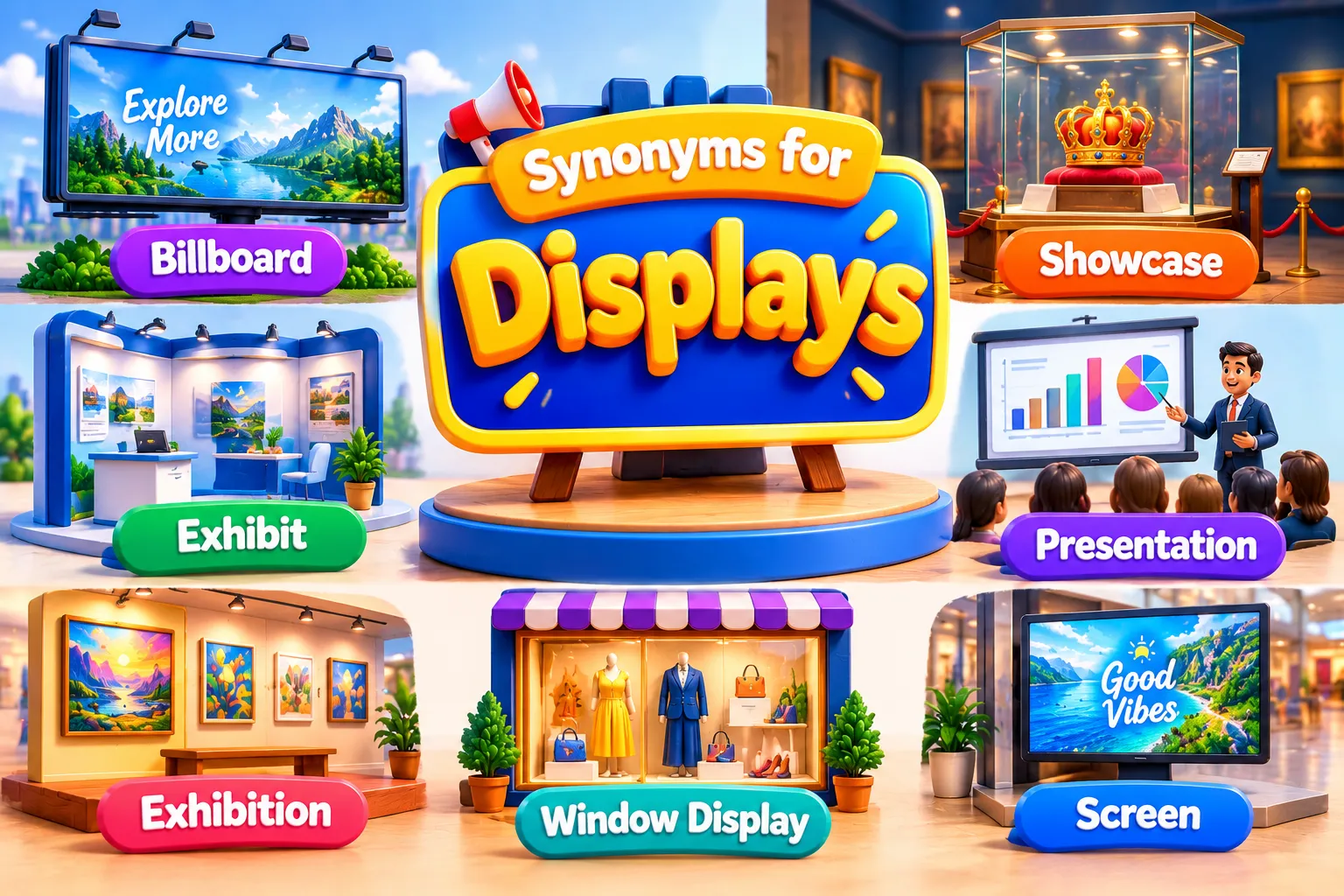
Synonyms for displays include shows, presents, exhibits, demonstrates, reveals, illustrates, portrays, expresses, and showcases. The best alternative depends on the context. For example, a museum displays art, a teacher demonstrates a skill, and a person shows their feelings. Learning these words helps you improve your English vocabulary and avoid repetition in speaking and writing.
Displays means shows, presents, or makes something easy to see. For example, a shop may display new clothes in its window to attract customers. A teacher may display a chart to help students understand a lesson. The word is common in daily life, business, education, art, and technology. However, using the same word too often can make writing sound repetitive. Learning synonyms helps English learners express ideas in different ways. It also helps content writers choose words that fit their message and audience. In this article, you will learn the meaning of displays, its pronunciation, word forms, and history. You will also explore 25 related words with simple meanings and examples. These alternatives will help you write and speak with greater clarity and confidence.
Meaning of Displays
Definition
Displays (Verb or Noun): As a verb, displays means shows, presents, or makes something visible. As a plural noun, displays means presentations or arrangements of things that people can see.
The verb displays is the third-person singular form of display. It is used with subjects such as he, she, it, or a singular noun.
Examples
- The shop displays new shoes in its front window.
- The screen displays the time and date.
- The museum has several beautiful art displays.
Connotative Meaning
Connotation is the feeling or idea that a word suggests beyond its basic meaning.
- Positive tone: Displays can suggest pride, beauty, skill, or achievement. For example, the team displays great talent.
- Negative tone: Displays can suggest showing off or making a scene. For example, he displays too much pride.
- Neutral tone: Displays can simply mean showing information or objects. For example, the screen displays the temperature.
The tone depends on the situation and the words around it.
Etymology of Displays
The word displays comes from the verb display. It entered English through Anglo-French and Old French, with roots in the Latin word displicare, meaning to unfold or spread out.
| Period | Development |
| Old English (450–1100) | Display was not a common Old English word. English used other words to express the idea of showing or revealing something. |
| Middle English (1100–1500) | The display entered English through Anglo-French and Old French forms. It carried the sense of unfolding, spreading out, or showing something. |
| Modern English (1500–Present) | Display developed its common modern meanings, including showing objects, presenting information, and expressing feelings or qualities. Displays is now used as both a verb form and a plural noun. |
Pronunciation (IPA)
- IPA: /dɪˈspleɪz/
- Syllables: dis-plays
- Number of syllables: 2
- Stress: The second syllable, plays, receives the main stress.
Affixation Pattern of Displays
- Root/base word: Display
- Prefix: None in the word displays. The beginning dis- is part of the historical word formation and is not a productive negative prefix in this word.
- Suffix: -s, which marks the third-person singular present-tense verb or forms the plural noun.
Word Formations
- Display (noun): A presentation or arrangement of things.
- Display (verb): To show or present something.
- Displays (verb): Shows or presents something.
- Displays (noun): More than one presentation or arrangement.
- Displayed (verb): Showed or presented something in the past.
- Displaying (verb): Showing something now or over a period.
- Displayable (adjective): Able to be shown or presented.
- Display case (noun): A glass case used to show objects.
- Display screen (noun): A screen that shows text, images, or information.
25 Synonyms of Displays With Meaning and Examples
Note: The word displays has more than one meaning. Some alternatives below fit the verb meaning of showing something, while others fit the noun meaning of a presentation or arrangement. Choose a word that matches your sentence.
1. Shows (Verb)
Meaning: Makes something visible or lets people see it.
Examples:
- The screen shows the current temperature.
- She shows her paintings to her friends.
2. Presents (Verb)
Meaning: Shows or offers something for people to see, consider, or learn about.
Examples:
- The teacher presents the results to the class.
- The website presents useful information about health.
3. Exhibits (Verb)
Meaning: Shows something publicly, often in a museum, gallery, or exhibition.
Examples:
- The museum exhibits ancient tools.
- The artist exhibits her work every year.
4. Demonstrates (Verb)
Meaning: Shows how something works or proves a point through actions or evidence.
Examples:
- The teacher demonstrates how to solve the problem.
- The experiment demonstrates the power of heat.
5. Reveals (Verb)
Meaning: Makes something known or visible that was hidden or unknown.
Examples:
- The report reveals new facts about the project.
- His face reveals his surprise.
6. Shows Off (Verb)
Meaning: Displays something proudly to attract attention or admiration.
Examples:
- He shows off his new car to his friends.
- The athlete shows off her skills during the match.
7. Showcases (Verb)
Meaning: Presents something in a way that highlights its best features.
Examples:
- The event showcases local artists.
- The website showcases the company’s latest products.
8. Illustrates (Verb)
Meaning: Explains or makes an idea clear through examples, pictures, or evidence.
Examples:
- The diagram illustrates how the machine works.
- Her story illustrates the value of kindness.
9. Exhibits (Noun)
Meaning: Items or objects shown to the public, especially in a museum or exhibition.
Examples:
- The museum’s exhibits attract many visitors.
- The science center has interactive exhibits for children.
10. Presentations (Noun)
Meaning: Organized displays of information, ideas, or work.
Examples:
- The students prepared presentations about climate change.
- The company’s presentations included charts and images.
11. Demonstrations (Noun)
Meaning: Events or examples that show how something works or what it can do.
Examples:
- The shop offers demonstrations of its new products.
- The science lesson included demonstrations of simple machines.
12. Exhibitions (Noun)
Meaning: Public events where objects, art, or products are displayed.
Examples:
- We visited an exhibition of modern paintings.
- The school held an exhibition of student projects.
13. Showcases (Noun)
Meaning: Events or settings that highlight the best qualities of something.
Examples:
- The festival is a showcase for local music.
- The competition became a showcase of young talent.
14. Reveals (Verb)
Meaning: Makes facts, feelings, or details clear.
Examples:
- The study reveals a link between sleep and learning.
- Her smile reveals her happiness.
15. Portrays (Verb)
Meaning: Shows or describes a person, event, or idea in a particular way.
Examples:
- The film portrays life in a small village.
- The painting portrays a peaceful landscape.
16. Depicts (Verb)
Meaning: Shows something through a picture, drawing, or description.
Examples:
- The mural depicts scenes from local history.
- The book depicts the struggles of a young family.
17. Expresses (Verb)
Meaning: Shows a feeling, thought, or idea through words or actions.
Examples:
- She expresses her feelings through music.
- His speech expresses strong support for education.
18. Manifests (Verb)
Meaning: Shows a quality, feeling, or condition through clear signs or actions.
Examples:
- The child manifests great curiosity.
- Stress sometimes manifests as poor sleep.
19. Reflects (Verb)
Meaning: Shows or represents a quality, idea, or situation.
Examples:
- Her work reflects years of practice.
- The report reflects changes in the local economy.
20. Signals (Verb)
Meaning: Gives a sign or message that communicates something.
Examples:
- The red light signals danger.
- His actions signal a change in attitude.
21. Indicates (Verb)
Meaning: Shows that something is likely to be true or present.
Examples:
- The results indicate steady progress.
- Dark clouds indicate that rain may be near.
22. Features (Verb)
Meaning: Includes or highlights someone or something as an important part.
Examples:
- The magazine features young writers.
- The website features a new collection of books.
23. Highlights (Verb)
Meaning: Draws attention to the most important parts of something.
Examples:
- The report highlights the main problems.
- The teacher highlights key points on the board.
24. Displays (Noun: Arrangements)
Meaning: Organized groups of objects or information shown for people to see.
Examples:
- The store has colorful displays near the entrance.
- The library created displays about famous writers.
25. Arrays (Noun)
Meaning: Impressive or organized groups of things arranged for viewing or use.
Examples:
- The shop offers an array of colorful fabrics.
- The gallery presents an array of modern artworks.
Prototype Meaning
The most common meaning of displays is to show something so that other people can see, understand, or notice it. People may imagine a shop window filled with products, a screen showing information, or a museum presenting valuable objects. The word can also describe how people show feelings, skills, or qualities. For example, a student displays confidence during a speech. In other situations, displays refers to several arrangements or presentations, such as art displays in a gallery. The exact meaning depends on the sentence. Understanding the context helps readers choose the right synonym.
Prototype Categorization
The synonyms and related terms can be grouped by their main meanings. These categories help writers select a word that fits the situation.
- Showing something: Shows, presents, exhibits, showcases. Use these when making an object, product, or idea visible to others.
- Explaining or proving: Demonstrates, illustrates, indicates, reveals. Use these when evidence, examples, or actions make something clear.
- Expressing feelings or qualities: Expresses, manifests, reflects, projects. Use these when describing emotions, behavior, or personal qualities.
- Describing pictures or ideas: Portrays, depicts, features, highlights. Use these when discussing art, stories, reports, or important details.
- Public presentations and events: Exhibitions, presentations, demonstrations, showcases. Use these nouns when talking about organized events or ways of presenting work.
- Arrangements and groups: Displays, arrays, collections, exhibits. Use these when referring to objects gathered or arranged for people to view.
- Sharing information with an audience: Advertises, broadcasts, signals. Use these when describing promotion, communication, or the sending of messages.
- Showing an attitude or behavior: Shows off, projects, exhibits. Use these when describing how someone presents their abilities, personality, or image.
Grouping words by meaning helps writers avoid awkward substitutions. For example, demonstrating works well for a practical lesson, while exhibitions is suitable for public events. Not every word in the list can replace displays in every sentence.
Antonyms of Displays
Antonyms are words with opposite or contrasting meanings. Since displays can mean showing something or presenting information, its opposite depends on the context.
| Antonym | Part of Speech | Meaning |
| Hides | Verb | Keeps something out of sight. |
| Conceals | Verb | Prevents something from being seen or known. |
| Covers | Verb | Places something over an object so it cannot be seen clearly. |
| Masks | Verb | Hides the true nature of something. |
| Suppresses | Verb | Holds back or prevents something from being expressed. |
| Withholds | Verb | Keeps information or something else from being shared. |
| Obscures | Verb | Makes something difficult to see or understand. |
| Disguises | Verb | Changes the appearance of something to hide its true identity. |
| Removes | Verb | Takes something away from its place of display. |
| Withdraws | Verb | Takes something back or removes it from view. |
Short Questions and Answers
What does displays mean?
Displays means shows, presents, or makes something visible. As a noun, it can refer to presentations or arrangements of objects.
When should displays be used?
Use displays when a person, object, screen, or place shows something. For example, a screen displays information, and a shop displays products.
Is it positive or negative?
The word is usually neutral. It can have a positive tone when it refers to talent or kindness, or a negative tone when it suggests showing off.
How are displays different from similar words?
Displays is a general word for showing something. Demonstrates often means showing how something works, reveals means making hidden information known, and showcases means presenting something to highlight its best features.
Conclusion
Learning synonyms for displays can help you build a stronger English vocabulary. Words such as shows, presents, exhibits, and demonstrates let you express ideas in different ways. Other words, such as reveals, reflects, and expresses, are useful when describing feelings, qualities, or information. Choosing the right synonym makes your writing clearer and helps you avoid repeating the same word. It can also improve your speaking skills and make your ideas easier to understand. Remember that not every synonym fits every sentence, so always consider the context. Try using one new word each day in a sentence, a short paragraph, or a conversation. With regular practice, you can write more naturally and speak with greater confidence.
Read More:
Synonyms for Potato: 30 Names and Related Terms

I’m Pinki, an SEO writer at SynonymsInstant.com, specializing in synonyms, antonyms, vocabulary, word meanings, grammar, and English usage. I create accurate, well-researched, reader-friendly content that combines language expertise with SEO best practices. My goal is to make English vocabulary simple, useful, and accessible for students, writers, professionals, and English learners.