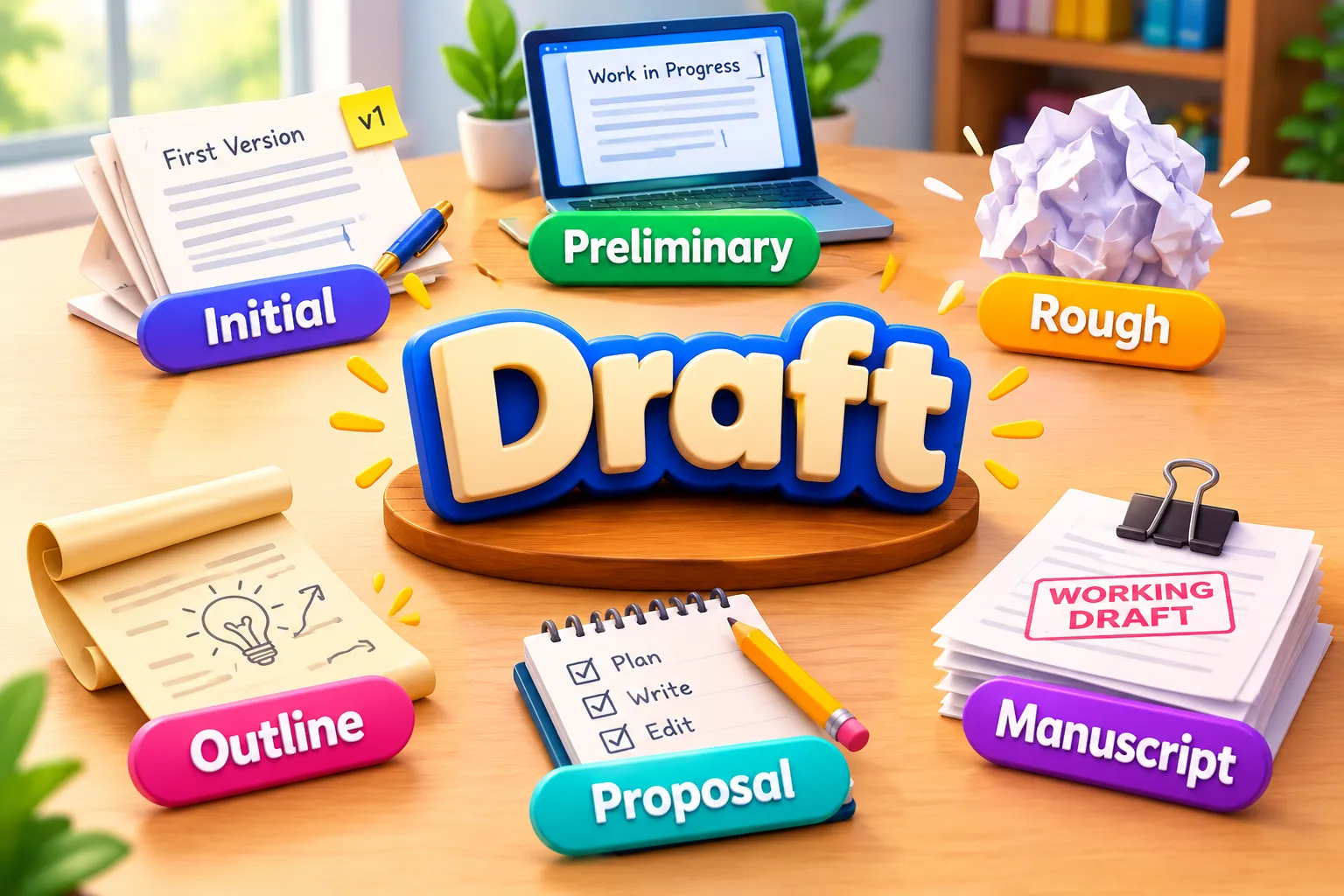
Synonyms for draft include outline, sketch, version, copy, manuscript, proposal, plan, rough copy, preliminary version, and first attempt. The word draft has several meanings depending on the context. It can refer to an early version of a piece of writing, a plan for a project, or a flow of air. It can also mean selecting someone for a team or military service. For example, a writer prepares a draft before finishing an article, while a designer makes a sketch before creating a final product.
A draft is an early version of a piece of writing, a plan, or a work that may need changes before it is complete. Imagine a student writing an essay. The student first prepares a draft, checks for mistakes, and then creates a final copy. This process helps improve the work before submission. The word draft is common in schools, offices, publishing, business, and creative work. Learning its synonyms helps English learners express ideas more clearly and avoid repeating the same word. It also helps content writers choose words that match their exact meaning. In this guide, you will explore the meaning, pronunciation, history, and word forms of draft. You will also learn 27 synonyms with simple meanings and examples, along with semantic categories, antonyms, and useful answers to common questions.
Meaning of Draft
Definition
Draft (Noun/Verb): As a noun, draft means an early version of a document or plan that may be changed. As a verb, it means to prepare a preliminary version of something or select someone for a particular role or service.
Examples
- I finished the first draft of my essay last night.
- She will draft a letter to the school principal.
Connotative Meaning
Connotation (the feelings or ideas a word suggests beyond its basic meaning) depends on how draft is used.
- Positive tone: A draft can suggest creativity, planning, progress, and the beginning of a useful project.
- Negative tone: It may suggest unfinished work, errors, or something that needs improvement.
- Neutral tone: It can simply refer to an early version of a document or a plan without expressing an opinion.
Etymology of Draft
The word draft developed from the idea of drawing or pulling. It entered English through Middle English, influenced by Old English and related Germanic words. Over time, it gained meanings connected with writing, planning, air currents, and selecting people for service.
| Period | Language Development | Explanation |
| Old English (450–1100) | Related Germanic roots | Earlier Germanic words related to drawing or pulling helped shape the word’s history. |
| Middle English (1100–1500) | Draft and related forms | The word developed meanings connected with drawing, pulling, and written plans. |
| Modern English (1500–Present) | Draft | It came to mean an early version of writing, a plan, a flow of air, and the selection of people for service. |
Pronunciation of Draft (IPA)
- IPA: /dræft/
- Syllables: draft
- Syllable count: One
- Word stress: The word has one syllable, so the whole word is stressed.
Affixation Pattern of Draft
- Root/base word: Draft
- Prefix: None in the basic word.
- Suffix: No suffix in the basic word.
- Word formation: The word can take common grammatical endings to form related words.
Related Word Forms
- Draft (noun): An early version of a document.
- Draft (verb): To prepare a preliminary version of something.
- Drafted (verb/adjective): Prepared in an early form or selected for service.
- Drafting (noun/verb): The process of preparing a document or technical drawing.
- Drafter (noun): A person who prepares technical drawings or drafts.
- Redraft (noun/verb): A revised version or the act of writing something again.
- Redrafted (verb/adjective): Rewritten or revised.
- Redrafting (noun/verb): The process of revising a draft.
27 Synonyms of Draft With Meaning and Examples
The best synonym for draft depends on its use. Some alternatives describe early writing, while others refer to plans, outlines, or preliminary work.
1. Outline (Noun)
Meaning: A short plan that shows the main ideas of a piece of writing or project.
Examples:
- She prepared an outline before writing her essay.
- The outline helped us organize the report.
2. Sketch (Noun)
Meaning: A rough drawing or simple description of an idea.
Examples:
- The artist showed me a sketch of the new building.
- He made a sketch of his story before writing it.
3. Version (Noun)
Meaning: A particular form of a document, product, or piece of work.
Examples:
- I sent my teacher the latest version of the essay.
- This version needs a few small changes.
4. Manuscript (Noun)
Meaning: A written document, especially one prepared for publication.
Examples:
- The author sent her manuscript to the publisher.
- He checked the manuscript before submitting it.
5. Copy (Noun)
Meaning: A written or printed version of a text or document.
Examples:
- Please send me a copy of the report.
- She checked the copy for spelling mistakes.
6. Preliminary Version (Noun Phrase)
Meaning: An early form of something that may be changed later.
Examples:
- The team reviewed the preliminary version of the proposal.
- I shared a preliminary version of my article.
7. Rough Copy (Noun Phrase)
Meaning: An early piece of writing that has not been fully corrected.
Examples:
- The student showed her rough copy to the teacher.
- I finished the rough copy of my letter.
8. First Attempt (Noun Phrase)
Meaning: The first effort to create or complete something.
Examples:
- My first attempt at the essay was too short.
- She improved her first attempt after receiving feedback.
9. Proposal (Noun)
Meaning: A plan or suggestion presented for others to consider.
Examples:
- He prepared a proposal for the new project.
- The manager approved our proposal.
10. Plan (Noun)
Meaning: A set of ideas or steps for doing something.
Examples:
- We created a plan for the school event.
- Her plan included a clear schedule.
11. Blueprint (Noun)
Meaning: A detailed plan that shows how something should be built or developed.
Examples:
- The architect prepared a blueprint for the house.
- The team used the blueprint to guide its work.
12. Framework (Noun)
Meaning: A basic structure that guides the development of something.
Examples:
- The teacher created a framework for the lesson.
- This framework will help us write the report.
13. Version One (Noun Phrase)
Meaning: The first version of a document, product, or project.
Examples:
- Version one of the website is ready for review.
- We found several errors in version one.
14. Prototype (Noun)
Meaning: An early model made to test an idea or product.
Examples:
- The company tested a prototype of the new device.
- The prototype helped the team find design problems.
15. Mock-up (Noun)
Meaning: A simple model that shows how a finished design may look.
Examples:
- The designer created a mock-up of the webpage.
- We reviewed the mock-up before building the website.
16. Working Copy (Noun Phrase)
Meaning: A version of a document used while making changes.
Examples:
- Keep a working copy of the report on your computer.
- She made changes to the working copy before printing it.
17. Working Draft (Noun Phrase)
Meaning: An unfinished version of a document that is still being developed.
Examples:
- The team shared a working draft of the policy.
- I will update the working draft tomorrow.
18. Preliminary Plan (Noun Phrase)
Meaning: An early plan that may change as more details become clear.
Examples:
- We discussed the preliminary plan for the trip.
- The manager reviewed the preliminary plan.
19. Synopsis (Noun)
Meaning: A short summary of the main points of a text or story.
Examples:
- The author wrote a synopsis of the novel.
- Please read the synopsis before the meeting.
20. Abstract (Noun)
Meaning: A brief summary of the main ideas in a report or research paper.
Examples:
- The student wrote an abstract for her research paper.
- The abstract explains the study’s main findings.
21. Rough Draft (Noun Phrase)
Meaning: An early version of writing that still needs editing.
Examples:
- I completed the rough draft of my assignment.
- The editor suggested changes to the rough draft.
22. First Draft (Noun Phrase)
Meaning: The first complete or partial version of a piece of writing.
Examples:
- She finished the first draft of her book.
- My first draft needs better examples.
23. Revision (Noun)
Meaning: A changed version of a text or the process of improving it.
Examples:
- The revision made the essay easier to understand.
- I completed a revision of the report.
24. Redraft (Noun/Verb)
Meaning: A rewritten version of a document or the act of writing it again.
Examples:
- The editor requested a redraft of the introduction.
- I will redraft the letter this evening.
25. Composition (Noun)
Meaning: A piece of writing created by putting ideas into words.
Examples:
- The student wrote a composition about nature.
- Her composition had a clear beginning and ending.
26. Text (Noun)
Meaning: Written words that form part of a document or message.
Examples:
- She checked the text before publishing the article.
- The text needs a few changes.
27. Document (Noun)
Meaning: A written or digital record that contains information.
Examples:
- He prepared a document for the meeting.
- Please review the document before signing it.
Prototype Meaning of Draft
The most common meaning of draft is an early version of a piece of writing that is not yet final. When people hear this word in school, work, or publishing, they often imagine an essay, letter, report, or book that still needs editing. A draft gives the writer a chance to organize ideas, correct mistakes, and improve the message before sharing the final version. The word also has other meanings, such as a preliminary plan, a flow of air, or the selection of people for service. The exact meaning depends on the sentence and situation.
Prototype Categorization of Draft
The 27 synonyms can be grouped by their main uses. This helps writers choose words that match the type of draft they are describing.
1. Early Writing and Documents
- Manuscript: A written work prepared for publication.
- Copy: A written or printed version of a text.
- Rough copy: An early version of writing.
- Rough draft: Writing that still needs editing.
- First draft: The first version of a piece of writing.
- Working draft: An unfinished document being developed.
- Working copy: A document used while making changes.
- Text: Written words in a document.
- Document: A written or digital record.
- Composition: A piece of writing.
These words are useful for essays, reports, letters, books, and other written work.
2. Plans and Organization
- Outline: A summary of the main ideas.
- Plan: Steps for achieving a goal.
- Proposal: A plan presented for approval.
- Blueprint: A detailed plan for building or developing something.
- Framework: A basic structure that guides work.
- Preliminary plan: An early plan that may change.
- Scheme: An organized plan.
Use these alternatives when draft refers to an early plan or the structure of a project.
3. Early Designs and Models
- Sketch: A rough drawing or simple idea.
- Prototype: An early model used for testing.
- Mock-up: A model that shows how something may look.
- Version: A particular form of something.
- Version one: The first version of a product or document.
- Preliminary version: An early form that may change.
These words fit design, engineering, website development, and product creation.
4. Summaries and Main Ideas
- Synopsis: A short summary of a story or text.
- Abstract: A brief summary of a research paper.
- Formulation: The way an idea is expressed.
These words are useful when describing a short presentation of the main ideas rather than a full draft.
5. Editing and Writing Processes
- First attempt: The first effort to create something.
- Revision: A changed or improved version.
- Redraft: A rewritten version.
- Drafting: The process of preparing an early version.
Use these words when discussing how a piece of writing is created, reviewed, and improved.
How does categorization help writers?
Grouping synonyms by purpose helps writers select accurate alternatives. For example, outline works well for the main ideas of an essay, while manuscript suits a book prepared for publication. Prototype is more suitable for a product, and revision describes changes made to improve a document. These differences make writing more precise and natural.
Antonyms of Draft
The antonyms of draft depend on its meaning. When draft means an unfinished document, its opposite is often a final or completed version. When it means a plan, the opposite may suggest a lack of planning.
| Antonym | Part of Speech | Meaning |
| Final Version | Noun Phrase | The completed version is ready for use or publication. |
| Final Copy | Noun Phrase | A finished document that is ready to submit or share. |
| Finished Product | Noun Phrase | Something that has been fully completed. |
| Completion | Noun | The state of being finished. |
| Finalization | Noun | The process of making something final. |
| Definitive Version | Noun Phrase | The version accepted as final or authoritative. |
| Unplanned Work | Noun Phrase | Work done without a prepared plan. |
| Improvisation | Noun | Creating or performing something without prior preparation. |
| Spontaneity | Noun | Acting without detailed planning. |
| Disorder | Noun | A lack of order or organization. |
| Disorganization | Noun | A lack of proper planning or arrangement. |
| Abandonment | Noun | The act of giving up or leaving something unfinished. |
Short Questions and Answers
1. What does draft mean?
A draft is usually an early version of a document, essay, letter, or plan that may need changes before it is complete.
2. When should draft be used?
Use draft when referring to unfinished writing, an early plan, a preliminary design, or the process of preparing a document.
3. Is the draft positive or negative?
The word draft is neutral. It can suggest progress and planning, but it may also indicate that something is not yet complete.
4. How is draft different from similar words?
A draft is an early version of a piece of work. An outline shows the main ideas, a sketch presents a rough drawing, and a final copy is ready to use or submit.
Conclusion
Learning synonyms for draft can improve your vocabulary and help you describe writing and planning more accurately. Words such as outline, manuscript, rough copy, proposal, and revision have different meanings, so choosing the right word makes your message clearer. These alternatives also help you avoid repetition in essays, articles, reports, and business documents. For English learners, studying synonyms is a useful way to build confidence in writing and speaking. Try using a new word in a sentence each day and notice how writers use these terms in books, websites, and school assignments. With regular practice, you will learn to choose words that fit each situation and express your ideas in a more natural and effective way.
Read More:
Synonyms for Designs: 28 Beautiful Alternatives to Learn

I’m Pinki, an SEO writer at SynonymsInstant.com, specializing in synonyms, antonyms, vocabulary, word meanings, grammar, and English usage. I create accurate, well-researched, reader-friendly content that combines language expertise with SEO best practices. My goal is to make English vocabulary simple, useful, and accessible for students, writers, professionals, and English learners.