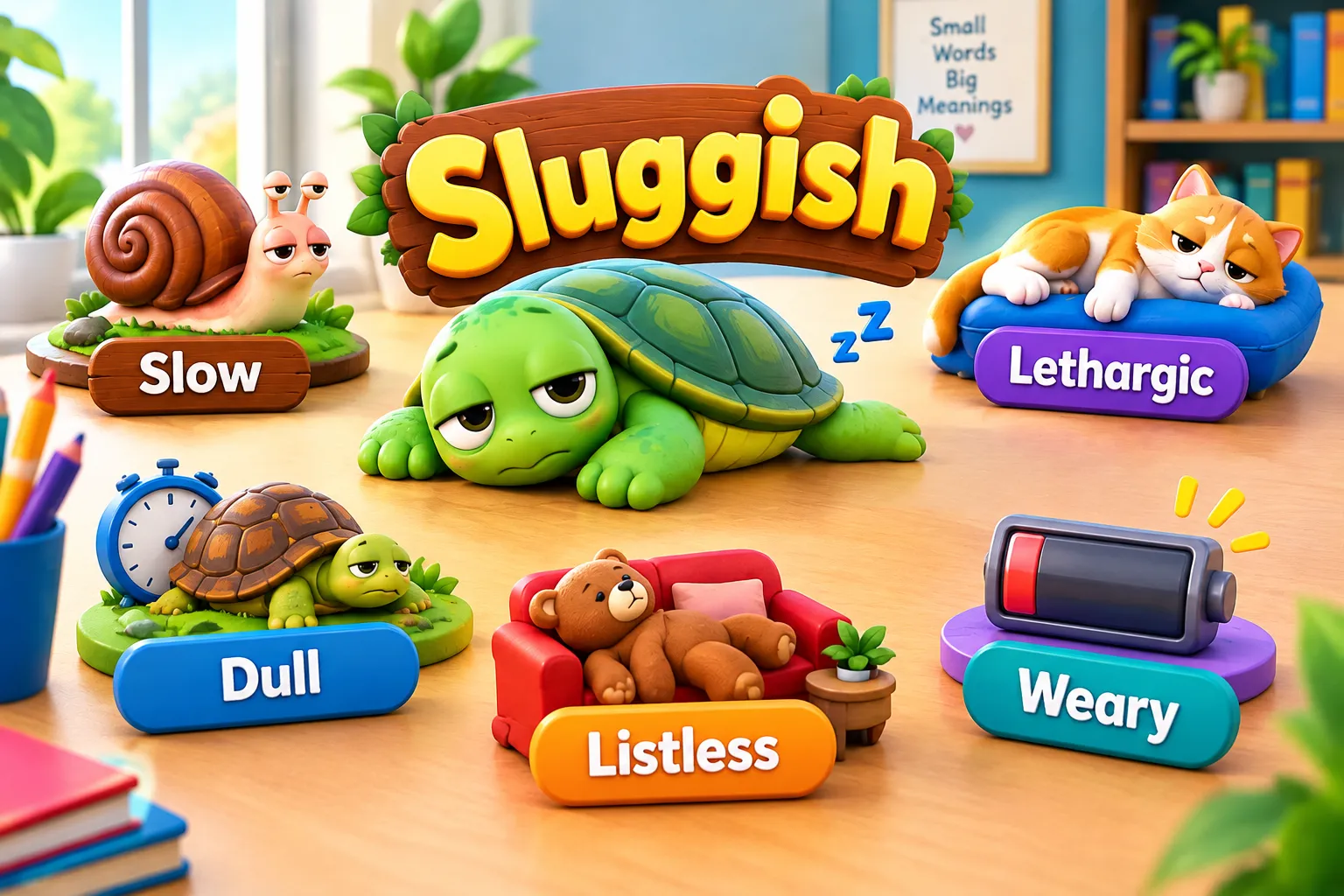
Synonyms for sluggish include slow, lazy, inactive, lethargic, sluggish, drowsy, idle, and listless. These words describe a person, animal, process, or movement that lacks speed, energy, or activity. For example, you might feel sluggish after a poor night’s sleep, or a sluggish computer may take too long to open a program. The best synonym depends on the context. Words like lethargic and listless describe low energy, while slow and unhurried focus more on speed.
Sluggish means slow, inactive, or low in energy. Imagine waking up after a poor night’s sleep. You feel tired, move slowly, and find it hard to focus. You might say, “I feel sluggish today.” The word is also used for machines, businesses, and systems that do not work or respond quickly. Learning synonyms for sluggish helps English learners express ideas in more precise ways. It also helps writers avoid repeating the same word in essays, stories, and online content. Some alternatives describe physical tiredness, while others focus on slow movement or poor performance. In this guide, you will learn the meaning, pronunciation, history, and word forms of sluggish. You will also explore 25 synonyms with simple meanings and examples to help you choose the right word for each situation.
Meaning of Sluggish
Definition
Sluggish (Adjective): Moving, working, or responding slowly, often because of low energy or a lack of activity.
Examples
- I felt sluggish after staying up late last night.
- The old computer is sluggish and takes several minutes to start.
Connotative Meaning
Connotation (the feeling or idea a word suggests beyond its basic meaning) can change with context.
- Positive tone: Sluggish is rarely positive, but a slow pace may sometimes suggest calmness or a lack of pressure.
- Negative tone: It often suggests laziness, tiredness, poor performance, or a lack of energy.
- Neutral tone: It can describe something that moves or responds slowly without judging it, such as a sluggish river current.
Etymology of Sluggish
The word sluggish comes from slug, a word associated with slow movement and later with a lazy or inactive person. The suffix -ish helps form an adjective meaning “having the qualities of.”
| Period | Historical Development |
| Old English (450–1100) | The modern word sluggish was not in use in its current form. Related historical word forms developed later. |
| Middle English (1100–1500) | The word slug came into use for a slow-moving creature and was also associated with a lazy or inactive person. |
| Modern English (1500–Present) | Sluggish developed as an adjective meaning slow, inactive, or lacking energy. It is now used for people, animals, machines, markets, and processes. |
Pronunciation (IPA)
- IPA: /ˈslʌɡ.ɪʃ/
- Syllables: slug-gish
- Part of speech: Adjective
Affixation Pattern of Sluggish
- Root: Slug
- Prefix: None
- Suffix: -ish, meaning “having the qualities of” or “somewhat like.”
- Word formation: Slug + -ish = sluggish.
Related Word Forms
- Sluggish (adjective): Moving or working slowly.
- Sluggishly (adverb): In a slow or inactive manner.
- Sluggishness (noun): The state of being slow or lacking energy.
- Slug (noun): A slow-moving, soft-bodied creature; informally, a lazy or inactive person.
- Slug (verb): To hit someone hard, especially with a punch; this meaning is unrelated to the slow-movement sense of sluggish.
25 Synonyms of Sluggish With Meaning & Examples
These synonyms have similar meanings, but they are not all interchangeable. Some describe low energy, while others describe slow movement, delayed responses, or inactivity.
1. Slow (Adjective)
Meaning: Moving, acting, or happening at a low speed.
Examples:
- The bus was slow because of heavy traffic.
- My computer is slow when I open large files.
2. Lethargic (Adjective)
Meaning: Feeling very tired and having little energy.
Examples:
- I felt lethargic after a long day at work.
- The hot weather made everyone feel lethargic.
3. Lazy (Adjective)
Meaning: Unwilling to work or make an effort.
Examples:
- He felt too lazy to clean his room.
- Do not be lazy when preparing for your exams.
4. Inactive (Adjective)
Meaning: Not moving, working, or taking part in activity.
Examples:
- The machine remained inactive for several hours.
- An inactive lifestyle can affect your fitness.
5. Idle (Adjective)
Meaning: Not being used or not doing anything.
Examples:
- The workers stood idle while the machine was repaired.
- The car sat idle in the garage.
6. Drowsy (Adjective)
Meaning: Feeling sleepy and finding it hard to stay alert.
Examples:
- I felt drowsy after taking my medicine.
- The warm room made the students drowsy.
7. Listless (Adjective)
Meaning: Having little energy, interest, or enthusiasm.
Examples:
- She felt listless after a sleepless night.
- The listless team struggled to finish the game.
8. Torpid (Adjective)
Meaning: Very inactive or slow in movement or thought.
Examples:
- The cold weather left the animals torpid.
- He felt torpid after eating a heavy meal.
9. Inert (Adjective)
Meaning: Unable to move or act, or showing little activity.
Examples:
- The object remained inert on the floor.
- The team seemed inert during the first half.
10. Plodding (Adjective)
Meaning: Moving or progressing slowly and with effort.
Examples:
- The tired hikers made a plodding journey uphill.
- The story had a plodding pace.
11. Tardy (Adjective)
Meaning: Late or slower than expected.
Examples:
- His tardy response delayed the project.
- The student received a warning for being tardy.
12. Lagging (Adjective)
Meaning: Falling behind or progressing more slowly than others.
Examples:
- Our team is lagging behind the competition.
- Sales are lagging this month.
13. Unhurried (Adjective)
Meaning: Happening or moving without haste.
Examples:
- They enjoyed an unhurried walk through the park.
- She took an unhurried approach to the task.
14. Dull (Adjective)
Meaning: Lacking energy, excitement, or liveliness.
Examples:
- The meeting felt dull and slow.
- His dull performance disappointed the audience.
15. Tired (Adjective)
Meaning: Having little energy because of work, effort, or lack of rest.
Examples:
- I was too tired to finish my homework.
- The tired runner slowed down near the finish line.
16. Weary (Adjective)
Meaning: Very tired, especially after a long period of effort.
Examples:
- The weary travelers stopped to rest.
- She looked weary after working all day.
17. Exhausted (Adjective)
Meaning: Extremely tired and having almost no energy left.
Examples:
- He felt exhausted after running five miles.
- The exhausted workers went home early.
18. Feeble (Adjective)
Meaning: Weak and lacking strength or power.
Examples:
- The patient gave a feeble smile.
- A feeble wind moved the leaves slightly.
19. Weak (Adjective)
Meaning: Lacking physical strength, force, or power.
Examples:
- I felt weak after being ill.
- The engine made a weak attempt to start.
20. Slothful (Adjective)
Meaning: Habitually lazy or unwilling to make an effort.
Examples:
- The slothful worker avoided his duties.
- He became slothful during the long holiday.
21. Heavy (Adjective)
Meaning: Slow and difficult to move or perform with energy.
Examples:
- My legs felt heavy after the long walk.
- His heavy steps showed how tired he was.
22. Stagnant (Adjective)
Meaning: Not flowing, growing, or developing.
Examples:
- The stagnant water had an unpleasant smell.
- The company faced stagnant growth for months.
23. Delayed (Adjective)
Meaning: Happening later than expected or planned.
Examples:
- The delayed train arrived after midnight.
- A delayed response caused confusion.
24. Unresponsive (Adjective)
Meaning: Not reacting or responding as expected.
Examples:
- The unresponsive computer needed a restart.
- The customer service team was unresponsive to our emails.
25. Poky (Adjective)
Meaning: Informally, slow or moving at an irritating pace.
Examples:
- The poky old computer took ages to load.
- We waited behind a poky driver on the road.
Prototype Meaning of Sluggish
The most typical meaning of sluggish is slow movement or a lack of energy. People may imagine someone who feels tired and walks slowly, a computer that takes too long to respond, or a business that is not growing quickly. The word often suggests that something is working below its usual speed or level of activity. It can describe both living things and non-living things. For example, a sluggish person may need rest, while a sluggish internet connection may need troubleshooting. The exact meaning depends on the situation.
Prototype Categorization of Sluggish Synonyms
The 25 synonyms can be grouped by the kind of slowness or inactivity they describe. These groups help writers choose words that fit their intended meaning.
- Slow movement or progress: Slow, plodding, lagging, tardy, delayed, poky. These words focus on low speed or falling behind.
- Low energy or tiredness: Lethargic, drowsy, listless, tired, weary, exhausted, unenergetic. Use these words to describe someone who needs rest or lacks energy.
- Lack of activity or effort: Lazy, inactive, idle, torpid, inert, slothful. These words suggest little action, movement, or effort.
- Weakness or poor force: Feeble, weak, heavy. These words describe a lack of strength or a slow, difficult movement.
- Lack of interest or enthusiasm: Dull, apathetic, halfhearted. These words focus on low interest, excitement, or effort.
- Slow response or poor performance: Unresponsive, sluggish, stagnant. These words can describe machines, services, businesses, or systems that do not respond or develop well.
- Calm or relaxed pace: Unhurried, leisurely, placid. These words may describe a peaceful pace rather than a problem.
- General lack of energy or activity: Sluggish and some uses of inert or torpid. These words can apply to people, animals, processes, and systems.
Why does categorization matter? Choosing the right synonym makes your writing clearer. For example, exhaustion describes extreme tiredness, while lagging means falling behind. Unhurried often sounds relaxed, while lazy can sound critical. Think about the situation before choosing a replacement.
Antonyms of Sluggish
Antonyms are words with opposite or nearly opposite meanings.
| Antonym | Part of Speech | Meaning |
| Fast | Adjective | Moving at high speed. |
| Quick | Adjective | Doing something in a short time. |
| Swift | Adjective | Moving or happening very quickly. |
| Speedy | Adjective | Moving or acting at a high speed. |
| Active | Adjective | Taking part in activity or movement. |
| Energetic | Adjective | Having a lot of energy. |
| Lively | Adjective | Full of energy and activity. |
| Alert | Adjective | Awake, aware, and ready to respond. |
| Vigorous | Adjective | Strong, active, and full of energy. |
| Dynamic | Adjective | Showing energy, change, or progress. |
| Efficient | Adjective | Working well without wasting time or effort. |
| Responsive | Adjective | Reacting or replying quickly and suitably. |
| Industrious | Adjective | Working hard and with care. |
| Brisk | Adjective | Quick and active. |
| Sprightly | Adjective | Lively, energetic, and cheerful. |
Short Questions and Answers
What does sluggish mean?
Sluggish means slow, inactive, or lacking energy. It can describe a tired person, a slow machine, or a process that makes little progress.
When should sluggish be used?
Use sluggish when someone or something moves, works, or responds more slowly than usual. For example, you might describe a sluggish computer, a sluggish economy, or a sluggish feeling after poor sleep.
Is sluggish positive or negative?
Sluggish usually has a negative tone because it suggests low energy, slow progress, or poor performance. However, it can be neutral when used to describe movement or a process without judgment.
How is sluggish different from similar words?
Sluggishness can describe both slow movement and low energy. Lethargic focuses more on tiredness, lazy suggests unwillingness to make an effort, and lagging means falling behind. Unhurried usually suggests a relaxed pace rather than poor performance.
Conclusion
Learning sluggish and its synonyms can improve your English vocabulary and help you express ideas more clearly. Words such as lethargic, inactive, lagging, and unresponsive describe different types of slowness. Choosing the right word makes your writing more accurate and helps you avoid repetition. These words are useful in daily conversations, school assignments, business writing, and online content. Remember that similar words may have different meanings and emotional tones. For example, being lazy can sound critical, while being unhurried often sounds calm and relaxed. To build your vocabulary, learn a few synonyms each day and use them in your own sentences. Regular practice will help you speak with greater confidence and write in a more natural way
Read more:
Synonyms for Draft: 27 Powerful Alternatives

I am Rubab content specialist focused on creating accurate, user-friendly, and search-optimized language resources. Through Synonyminstant, I help readers find synonyms, antonyms, meanings, and vocabulary with ease. Every article is carefully researched and optimized to provide reliable information, clear explanations, and an excellent user experience.