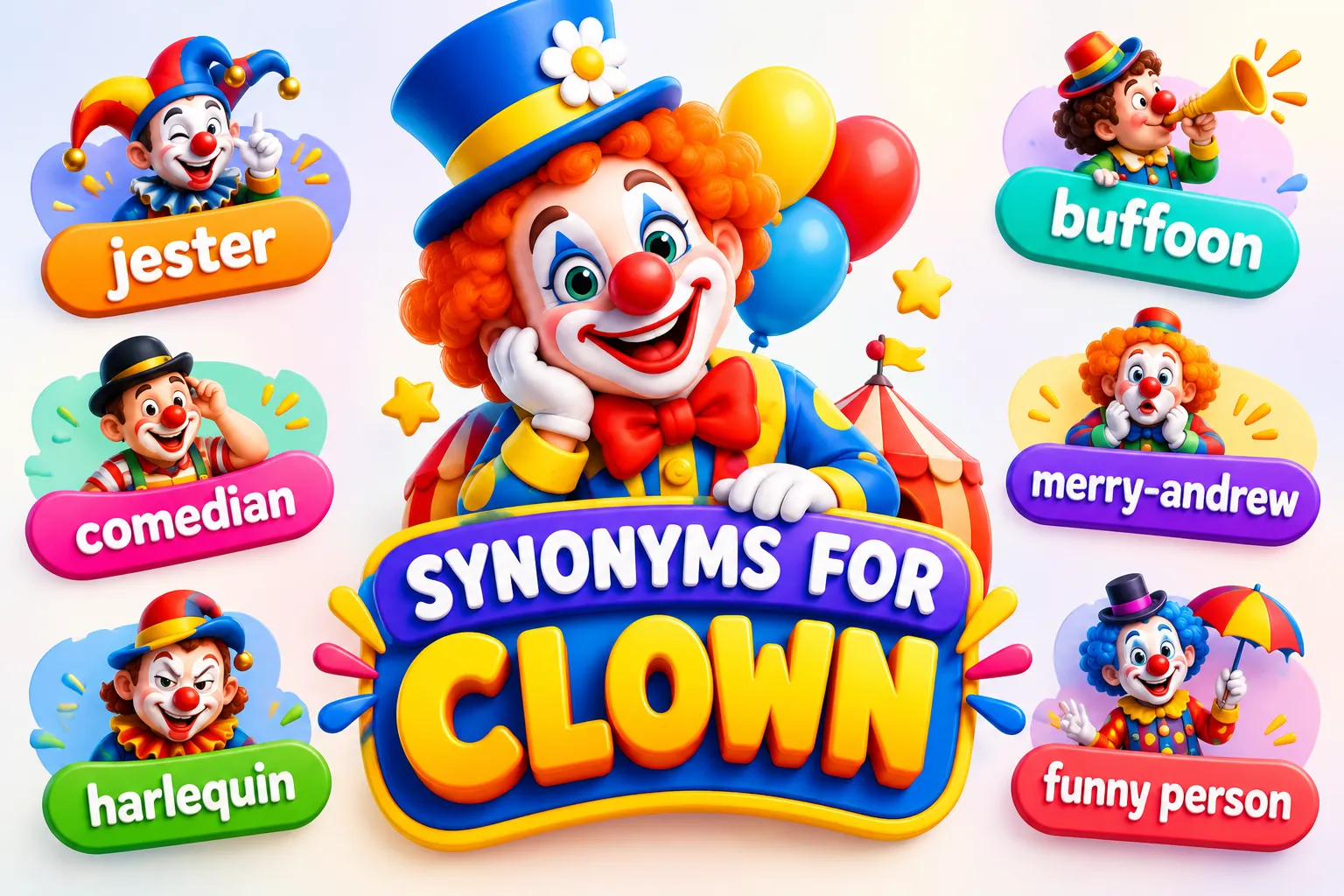
Useful synonyms include comedian, entertainer, jester, buffoon, fool, joker, prankster, humorist, performer, goofball, and showman. The best synonym depends on the context. For example, a professional circus clown is an entertainer, while a person acting foolishly may be called a buffoon or fool.
Clown usually means a performer who makes people laugh through jokes, funny actions, costumes, and physical comedy. Imagine a child visiting a circus and seeing a colorful performer with a red nose, large shoes, and a funny costume. The clown makes silly movements, tells jokes, and entertains the crowd. In everyday English, however, clown can also describe a person who acts foolishly or does not behave seriously. The word is common in conversations, stories, entertainment, and informal writing. Learning synonyms for clown helps English learners describe humor, foolish behavior, and entertainment more clearly. It also helps writers avoid repetition. This guide explains the meaning, examples, pronunciation, history, word formation, synonyms, semantic groups, antonyms, and practical uses of clown.
Meaning of Clown
Definition
Clown (Noun):
A person who entertains others by acting funny, telling jokes, or behaving in a silly way.
Clown (Verb):
To behave in a silly or foolish way, often for amusement.
Examples
- The clown entertained the children at the circus.
- Stop clowning around and finish your homework.
Connotative Meaning
- Positive tone: It can suggest fun, humor, entertainment, and joy.
- Negative tone: It can describe someone who behaves foolishly or lacks seriousness.
- Neutral tone: It can simply refer to a professional comic performer.
(Connotation: the feeling or idea that a word suggests beyond its basic meaning.)
Etymology
The exact origin of clown is uncertain. It appeared in English in the 16th century and was first used for a rustic or country person, later developing the meaning of a foolish person and then a comic performer.
| Period | Development |
| Old English (450–1100) | The modern word clown was not used in Old English. Similar ideas were expressed through words for country people, fools, or simple persons. |
| Middle English (1100–1500) | The exact source is uncertain, but related European forms may have influenced the word. The idea of a rustic or unsophisticated person became associated with clown. |
| Modern English (1500–Present) | Clown developed meanings such as a foolish person and later a comic stage or circus performer. Today, it can be used both literally and informally. |
Pronunciation (IPA)
- IPA: /klaʊn/
- Syllables: clown
Affixation Pattern of Clown
- Root: clown
- Prefix: None
- Suffix: None
- Word formations:
- clown — noun
- clown — verb
- clownish — adjective
- clownishly — adverb
- clownishness — noun
- clowned — verb, past tense
- clowning — noun/verb form
- clowns — plural noun/verb form
30 Synonyms of Clown With Meaning & Examples
1. Comedian (Noun)
Meaning: A person who entertains people by making them laugh.
Examples:
- The comedian made the audience laugh.
- She hopes to become a professional comedian.
2. Jester (Noun)
Meaning: A person who entertains others with jokes and funny behavior, especially in the past.
Examples:
- The king’s jester entertained the court.
- The jester made everyone smile.
3. Buffoon (Noun)
Meaning: A person who behaves in a very foolish or ridiculous way.
Examples:
- Everyone thought he was acting like a buffoon.
- The character was a loud and silly buffoon.
4. Fool (Noun)
Meaning: A person who acts without good sense or judgment.
Examples:
- Only a fool would ignore the warning.
- He felt like a fool after making the mistake.
5. Joker (Noun)
Meaning: A person who likes making jokes or playing tricks.
Examples:
- My brother is always the joker in the group.
- The class joker made everyone laugh.
6. Prankster (Noun)
Meaning: A person who plays practical jokes on others.
Examples:
- The prankster hid his friend’s shoes.
- Everyone knew him as a harmless prankster.
7. Entertainer (Noun)
Meaning: A person who performs to amuse or interest an audience.
Examples:
- The entertainer performed for the children.
- She is a talented stage entertainer.
8. Humorist (Noun)
Meaning: A person who creates or uses humor, especially in writing or performance.
Examples:
- The famous humorist wrote several funny books.
- He became known as a clever humorist.
9. Performer (Noun)
Meaning: A person who entertains an audience through a performance.
Examples:
- The performer received loud applause.
- She is an excellent stage performer.
10. Comical Person (Noun)
Meaning: A person whose actions or behavior make people laugh.
Examples:
- He became a comical person in the story.
- The actor played a comical person.
11. Goofball (Noun)
Meaning: A person who behaves in a silly or funny way.
Examples:
- My friend is a lovable goofball.
- That goofball made everyone laugh.
12. Nitwit (Noun)
Meaning: A person who is considered foolish or not very intelligent.
Examples:
- Don’t act like a nitwit.
- The character was portrayed as a harmless nitwit.
13. Simpleton (Noun)
Meaning: A person who is easily fooled or lacks good judgment.
Examples:
- The story presents him as a simpleton.
- He was treated like a simpleton by his friends.
14. Duffer (Noun)
Meaning: A person who is clumsy, foolish, or not very skilled.
Examples:
- He felt like a duffer while learning the sport.
- The comic character was a lovable duffer.
15. Nincompoop (Noun)
Meaning: A humorous word for a foolish person.
Examples:
- You silly nincompoop!
- The character acted like a complete nincompoop.
16. Dope (Noun)
Meaning: An informal word for a foolish or stupid person.
Examples:
- Don’t be a dope and forget your keys.
- He felt like a dope after the mistake.
17. Dullard (Noun)
Meaning: A person who is considered slow to understand things.
Examples:
- The novel describes him as a dullard.
- Nobody wanted to call their friend a dullard.
18. Sap (Noun)
Meaning: An informal word for a foolish or easily deceived person.
Examples:
- He felt like a sap after believing the joke.
- Don’t let anyone make you look like a sap.
19. Loon (Noun)
Meaning: An informal word for someone who behaves in a strange or foolish way.
Examples:
- That loon was dancing in the street.
- Everyone thought the character was a funny loon.
20. Nut (Noun)
Meaning: An informal word for a person who behaves in a strange or eccentric way.
Examples:
- His friends call him a harmless nut.
- The funny character is a lovable nut.
21. Oddball (Noun)
Meaning: A person who behaves differently from what is considered normal.
Examples:
- He is known as the oddball of the group.
- The movie features an amusing oddball.
22. Character (Noun)
Meaning: An unusual or amusing person.
Examples:
- Your uncle is quite a character.
- The old man was a colorful character.
23. Showman (Noun)
Meaning: A person who is skilled at entertaining an audience.
Examples:
- The singer was a natural showman.
- The circus performer was a brilliant showman.
24. Comic (Noun)
Meaning: A person who performs or creates material intended to make people laugh.
Examples:
- The comic performed for a large audience.
- She became a popular comic.
25. Satirist (Noun)
Meaning: A person who uses humor to criticize people, ideas, or society.
Examples:
- The satirist criticized politics through humor.
- The writer became a famous satirist.
26. Trickster (Noun)
Meaning: A person who uses tricks or clever actions to amuse, deceive, or manipulate others.
Examples:
- The story features a clever trickster.
- The trickster played a joke on the villagers.
27. Mountebank (Noun)
Meaning: A person who attracts attention through showy behavior and may deceive others.
Examples:
- The character was portrayed as a dishonest mountebank.
- The old tale featured a traveling mountebank.
28. Scallywag (Noun)
Meaning: An informal word for a mischievous or badly behaved person.
Examples:
- The little scallywag hid his sister’s toy.
- That scallywag was always playing tricks.
29. Rascal (Noun)
Meaning: A person or child who behaves mischievously but is often liked.
Examples:
- The little rascal stole a cookie.
- He is a playful rascal.
30. Buffoonish Person (Noun)
Meaning: A person whose behavior is silly, ridiculous, or foolish.
Examples:
- The character acts like a buffoonish person.
- His buffoonish behavior made the audience laugh.
Prototype Meaning
The most typical meaning of clown is a comic performer who entertains people with funny clothes, makeup, jokes, physical comedy, and silly actions. Many people picture a circus clown with colorful clothing, a painted face, oversized shoes, and a bright red nose. In informal English, however, clown can also mean a foolish or unserious person.
Prototype Categorization
- Professional entertainment: comedian, entertainer, performer, comic, showman describe people whose main role is to entertain an audience.
- Traditional comic figures: jester, buffoon, clown are strongly linked with theatrical or exaggerated humor.
- Foolish behavior: fool, buffoon, nitwit, simpleton, duffer, nincompoop, dope, dullard focus on poor judgment or lack of sense.
- Funny or silly personalities: goofball, loon, nut, oddball, character describe people who behave in amusing or unusual ways.
- Practical jokes and tricks: joker, prankster, trickster, rascal, scallywag suggest playful or mischievous behavior.
- Humor and criticism: humorist, satirist are better choices when humor is created through writing, commentary, or social criticism.
- Showy or deceptive behavior: mountebank describes someone who uses performance or showmanship, often with deception.
This categorization helps writers choose the right word. A comedian is usually a professional entertainer, while a buffoon is more negative and focuses on foolish behavior.
Antonyms of Clown
| Antonym | Part of Speech | Meaning |
| Serious person | Noun | A person who behaves in a thoughtful and serious way. |
| Professional | Noun | A person who behaves responsibly and competently. |
| Sensible person | Noun | A person who uses good judgment. |
| Responsible person | Noun | Someone who can be trusted to act properly. |
| Adult | Noun | A mature person who behaves in a responsible way. |
| Sage | Noun | A wise and thoughtful person. |
| Realist | Noun | A person who thinks about situations in a practical way. |
| Scholar | Noun | A person who is serious about learning and study. |
Short Questions and Answers
What does clown mean?
Clown means a comic performer or, informally, a person who behaves in a foolish or silly way.
When should clown be used?
Use clown when talking about a comic performer or when informally describing someone who is acting foolishly.
Is clown positive or negative?
It depends on the context. It can be positive when describing an entertainer, but it can be insulting when used for someone who behaves foolishly.
How is it different from similar words?
A clown can be a professional comic performer or a foolish person. A comedian mainly focuses on making people laugh, while a buffoon strongly suggests foolish or ridiculous behavior.
Conclusion
Learning clown and its synonyms can add variety and precision to your English. Words such as comedian, jester, entertainer, joker, prankster, and buffoon describe different types of humor, performance, or foolish behavior. Understanding their differences helps you choose the right word for each sentence. For example, comedian is suitable for a professional performer, while buffoon often has a negative meaning. These useful alternatives can strengthen both writing and speaking. They also help you avoid repeating the word clown in stories, articles, and everyday conversations. Try learning a few synonyms each day and use them in your own sentences. With regular practice, you can improve your vocabulary, express ideas more clearly, and build greater confidence in English.
Read More:
Synonyms for emergence: 25 Beautiful Alternatives to Learn

I’m Pinki, an SEO writer at SynonymsInstant.com, specializing in synonyms, antonyms, vocabulary, word meanings, grammar, and English usage. I create accurate, well-researched, reader-friendly content that combines language expertise with SEO best practices. My goal is to make English vocabulary simple, useful, and accessible for students, writers, professionals, and English learners.