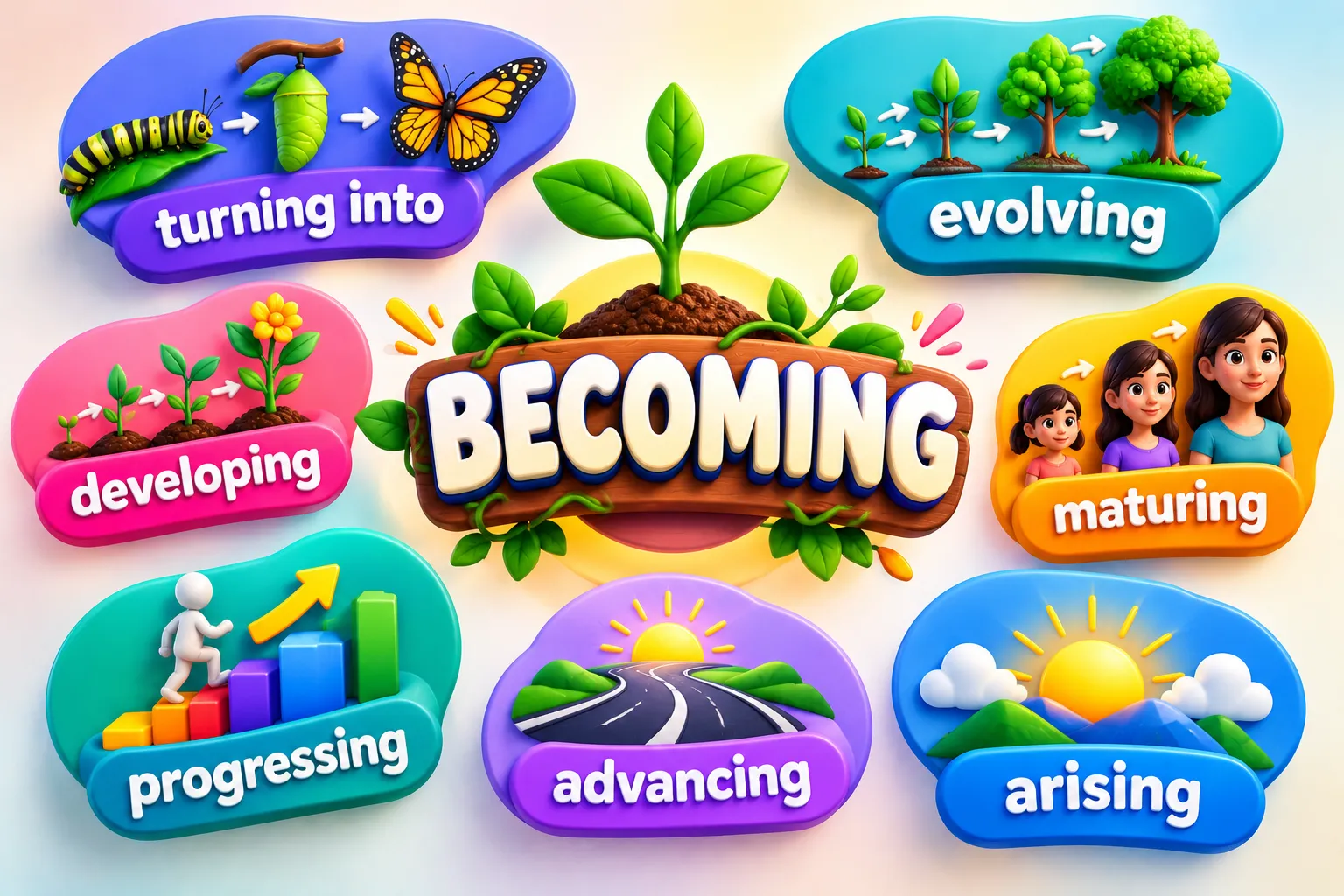
Depending on the context, useful synonyms include turning into, growing, developing, changing, transforming, evolving, progressing, emerging, attaining, reaching, and suiting. For example, “She is becoming stronger” can mean “She is growing stronger,” while “That color is becoming on you” means “That color suits you.”
Becoming describes a change from one state, condition, or identity to another. Imagine a student who starts the year feeling shy but slowly becomes confident after speaking in class every day. This gradual change is a good example of becoming. The word is common because people often talk about personal growth, changes, new roles, and development. It can also describe something that looks attractive or suitable, as in “That dress is becoming on her.” Learning synonyms for becoming helps English learners describe change with greater accuracy. It also helps content writers make their work more varied and natural. In this guide, we explore the meaning of becoming, its examples, grammar, history, pronunciation, word formation, and 27 useful alternatives. We also examine semantic categories and antonyms.
Meaning of Becoming
Definition
Becoming (Verb/Present Participle):
The process of changing into a particular state, condition, or role.
Becoming (Adjective):
Attractive, suitable, or flattering in appearance.
Examples
- She is becoming more confident every day.
- The young plant is becoming taller.
- That blue dress is very becoming on her.
Connotative Meaning
- Positive tone: It can suggest growth, improvement, progress, or attractive appearance.
- Negative tone: It can describe an unwanted or harmful change depending on the context.
- Neutral tone: It can simply describe a change from one state to another.
(Connotation: the feeling or idea that a word suggests beyond its basic meaning.)
Etymology
Becoming comes from the verb become, which developed from Old English becuman, meaning “to come to” or “to happen.” Over time, it gained the sense of entering a new state or condition.
| Period | Development |
| Old English (450–1100) | Become came from Old English becuman, meaning “to come to,” “arrive,” or “happen.” |
| Middle English (1100–1500) | The form developed into become and gained the meaning “to come to be” or “enter a state.” |
| Modern English (1500–Present) | Becoming is used for a process of change and also as an adjective meaning attractive or suitable. |
Pronunciation (IPA)
- IPA: /bɪˈkʌmɪŋ/
- Syllables: be-com-ing
Affixation Pattern of Becoming
- Root: come
- Prefix: be-
- Suffix: -ing
- Word formations:
- become — verb
- becoming — verb/adjective
- became — verb, past tense
- becomes — verb
- becomingly — adverb, rare
- becomingness — noun, rare
27 Synonyms of Becoming With Meaning & Examples
1. Changing (Verb)
Meaning: Moving from one state, condition, or form to another.
Examples:
- The weather is changing quickly.
- She is changing into a more confident person.
2. Growing (Verb)
Meaning: Gradually developing or becoming something.
Examples:
- He is growing more patient.
- The child is growing into a responsible adult.
3. Developing (Verb)
Meaning: Gradually becoming more advanced, mature, or complete.
Examples:
- She is developing new skills.
- The town is developing rapidly.
4. Transforming (Verb)
Meaning: Changing greatly into a different form or condition.
Examples:
- Technology is transforming education.
- The old building is transforming into a modern center.
5. Evolving (Verb)
Meaning: Gradually changing and developing over time.
Examples:
- Language is constantly evolving.
- Her career is evolving in an exciting direction.
6. Turning (Verb)
Meaning: Changing into a different state or condition.
Examples:
- The leaves are turning yellow.
- The weather is turning colder.
7. Progressing (Verb)
Meaning: Moving forward or developing toward a better or later stage.
Examples:
- Her English is progressing well.
- The project is progressing quickly.
8. Advancing (Verb)
Meaning: Moving forward or reaching a higher stage.
Examples:
- He is advancing in his career.
- The technology is advancing rapidly.
9. Emerging (Verb)
Meaning: Starting to appear, develop, or become known.
Examples:
- A new leader is emerging.
- She is emerging as a talented writer.
10. Maturing (Verb)
Meaning: Becoming more mature or fully developed.
Examples:
- The young athlete is maturing quickly.
- His ideas are maturing with experience.
11. Developing Into (Verb Phrase)
Meaning: Gradually changing into a particular type or form.
Examples:
- The small business is developing into a major company.
- The child is developing into a skilled musician.
12. Turning Into (Verb Phrase)
Meaning: Changing from one thing or state into another.
Examples:
- The caterpillar is turning into a butterfly.
- The discussion is turning into an argument.
13. Converting (Verb)
Meaning: Changing something from one form, use, or state to another.
Examples:
- They are converting the building into offices.
- The company is converting waste into useful materials.
14. Altering (Verb)
Meaning: Changing something, usually partly rather than completely.
Examples:
- We are altering the design.
- The teacher is altering the lesson plan.
15. Modifying (Verb)
Meaning: Making small changes to improve or adapt something.
Examples:
- They are modifying the machine.
- She is modifying her study routine.
16. Shifting (Verb)
Meaning: Moving or changing from one position, condition, or idea to another.
Examples:
- Public opinion is shifting.
- The focus is shifting toward education.
17. Adapting (Verb)
Meaning: Changing to suit a new situation or environment.
Examples:
- Children are adapting to the new school.
- Businesses are adapting to new technology.
18. Progressing (Verb)
Meaning: Developing or moving forward over time.
Examples:
- The student is progressing well.
- The work is progressing according to plan.
19. Attaining (Verb)
Meaning: Reaching or achieving a particular state, level, or goal.
Examples:
- She is attaining a higher level of skill.
- He worked hard toward attaining success.
20. Reaching (Verb)
Meaning: Arriving at a particular state, level, or condition.
Examples:
- The company is reaching a new stage.
- She is reaching her full potential.
21. Acquiring (Verb)
Meaning: Gradually gaining a quality, skill, or position.
Examples:
- He is acquiring valuable experience.
- She is acquiring new skills.
22. Assuming (Verb)
Meaning: Taking on a role, position, or quality.
Examples:
- She is assuming a leadership role.
- The building is assuming a new purpose.
23. Attuning (Verb)
Meaning: Adjusting or becoming suited to something.
Examples:
- He is attuning himself to the new environment.
- The team is attuning its methods to changing needs.
24. Improving (Verb)
Meaning: Becoming better in quality, skill, or condition.
Examples:
- Her writing is improving every week.
- His health is improving steadily.
25. Strengthening (Verb)
Meaning: Becoming stronger or making something stronger.
Examples:
- Their friendship is strengthening.
- The team is strengthening its skills.
26. Flourishing (Verb)
Meaning: Growing or developing successfully.
Examples:
- The small business is flourishing.
- Her career is flourishing after years of effort.
27. Molding (Verb)
Meaning: Developing or shaping something into a particular form.
Examples:
- Education is molding young minds.
- Experience is molding his character.
Prototype Meaning
The most typical meaning of becoming is changing into a new state or condition. People often imagine gradual growth or development when they hear the word. For example, a child is becoming an adult, a student is becoming more confident, or a small company is becoming successful. The word focuses on the process of change rather than only the final result.
Prototype Categorization
- General change: changing, altering, modifying, shifting describe movement from one state or form to another.
- Growth and development: growing, developing, evolving, maturing, progressing focus on gradual change over time.
- Major transformation: transforming, converting, turning into, developing into suggest a stronger or more noticeable change.
- Progress and achievement: advancing, attaining, reaching, acquiring, improving focus on gaining a higher level, quality, or state.
- Adjustment: adapting, attuning describe becoming suitable for a new situation.
- Success and positive development: strengthening, flourishing suggest improvement or successful growth.
- Appearance and suitability: suiting, flattering, befitting relate to the adjective sense of becoming, meaning attractive or appropriate.
This grouping helps writers choose a synonym based on the exact type of change they want to describe.
Antonyms of Becoming
| Antonym | Part of Speech | Meaning |
| Remaining | Verb | Continuing to stay in the same state. |
| Staying | Verb | Continuing to be in the same condition or place. |
| Stopping | Verb | Ending an action or process. |
| Declining | Verb | Becoming weaker, lower, or less successful. |
| Worsening | Verb | Becoming worse in quality or condition. |
| Deteriorating | Verb | Gradually becoming worse. |
| Disappearing | Verb | Ceasing to be visible or present. |
| Reverting | Verb | Returning to an earlier state or condition. |
Short Questions and Answers
What does becoming mean?
Becoming means changing into a new state, condition, role, or form. It can also mean attractive or suitable.
When should it be used?
Use becoming when describing an ongoing change or development. It can also describe something that looks attractive or appropriate.
Is becoming positive or negative?
It is usually neutral, but the meaning depends on the change. “Becoming stronger” is positive, while “becoming weaker” is negative.
How is it different from similar words?
Becoming is a broad term for entering a new state. Growing often suggests gradual development, transforming suggests major change, and evolving emphasizes gradual change over time.
Conclusion
Learning becoming and its synonyms can improve your English vocabulary and help you describe change more clearly. Words such as growing, developing, evolving, transforming, progressing, and advancing each show a slightly different type of change. Other words, such as suiting, flattering, and befitting, relate to the less common adjective sense of becoming. Knowing these differences helps you select the right word for your sentence. These alternatives can make your writing more natural and prevent repeated use of the same word. They are useful in school work, articles, conversations, and professional writing. Try learning a few synonyms each day and use them in your own sentences. With regular practice, you can strengthen your vocabulary, improve your speaking and writing, and build greater confidence in English.
Read More:
Synonyms for clown: 30 Funny Alternatives
I’m Ayesha Haram, an English content and SEO writer at SynonymsInstant.com. I focus on creating helpful vocabulary resources, word guides, and practical English content that readers can understand quickly. I combine language research, clear explanations, and SEO-focused writing to produce reliable content that supports learners, writers, and everyday English users.