
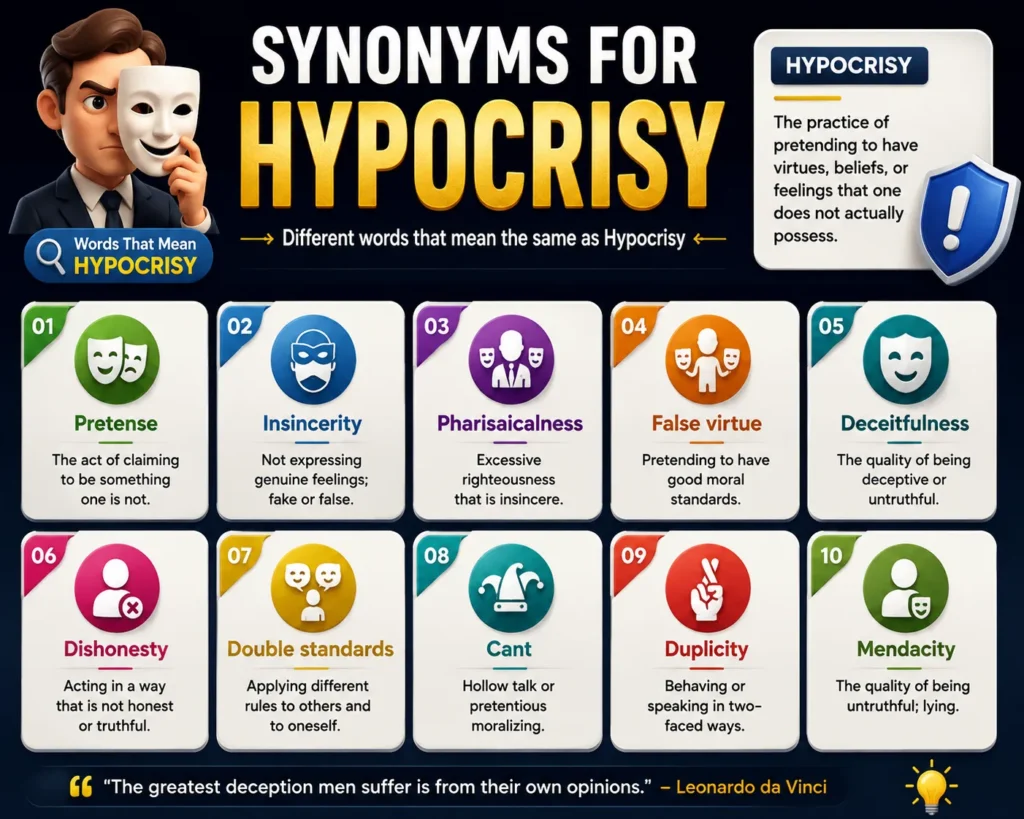
Synonyms for Hypocricy are Insincerity ,Deceit,Dishonesty,Pretence,Pretense,Duplicity,Deception,Double-dealing,Double standards,Falsehood,Phoniness and Two-facedness.
Hypocrisy is the act of pretending to have moral standards, beliefs, or virtues that one does not actually follow. For example, a person may publicly preach honesty but behave dishonestly in private. Such behavior is described as hypocrisy. The word is widely used in politics, religion, social commentary, and everyday conversations when someone’s actions do not match their words.
Learning synonyms for hypocrisy helps English learners and writers express criticism more precisely and avoid repetition. However, not all synonyms carry the same emotional weight—some are formal, some are literary, and others are strongly negative or informal. In this guide, we will explore the meaning, examples, connotation, pronunciation, etymology, and 30 useful synonyms of hypocrisy, along with categories and antonyms.
Meaning of Hypocrisy
Definition
Hypocrisy (noun): The behavior of claiming to have moral standards or beliefs to which one’s own behavior does not conform; pretending to be virtuous while acting otherwise.
Examples
- His hypocrisy was exposed when he broke the very rules he defended.
- The politician was accused of hypocrisy after changing his stance.
Connotative Meaning
Connotation (the emotional or implied meaning of a word beyond its dictionary definition) helps us understand how a word feels in context.
- Negative tone: Almost always negative, suggesting dishonesty, deceit, or moral failure.
- Critical tone: Often used in arguments, debates, or accusations.
- Moral tone: Highlights inconsistency between words and actions.
Etymology
The word hypocrisy has ancient roots connected to performance and acting.
- Ancient Greek (before 300 BCE): hypokrisis meaning “acting on a stage” or “playing a part”
- Latin (Classical period): hypocrisis adopted from Greek
- Middle English (1100–1500): Entered English through Old French as ypocrisie
- Modern English (1500–Present): Developed the meaning of pretending to have virtues or beliefs one does not truly hold
Originally, the word referred to stage acting, but over time it evolved into a moral and ethical concept.
Pronunciation (IPA)
- IPA: /hɪˈpɒk.rɪ.si/
- Syllables: hy-poc-ri-sy
Word Formation of Hypocrisy
- Root: Greek hypokritēs meaning “actor” or “one who answers”
- Prefix: hypo- (under, beneath) in Greek origin context
- Suffix: -crisy / -crite / -crisy forming abstract nouns
- Related forms:
- Hypocrite (noun): a person who behaves hypocritically
- Hypocritical (adjective): showing hypocrisy
- Hypocritically (adverb): in a hypocritical manner
30 Synonyms of Hypocrisy With Meaning & Examples
1. Pretense (Noun)
Meaning: A false display of feelings, beliefs, or intentions.
Examples:
- His kindness was just pretense.
- She dropped the pretense of agreement.
2. Insincerity (Noun)
Meaning: Lack of genuine feeling or honesty.
Examples:
- The speech was full of insincerity.
- People noticed his insincerity immediately.
3. Deceit (Noun)
Meaning: The act of misleading or lying.
Examples:
- The scandal involved financial deceit.
- Her deceit shocked everyone.
4. Dishonesty (Noun)
Meaning: Lack of truthfulness or integrity.
Examples:
- He was accused of dishonesty in business.
- Dishonesty damages trust.
5. Double-dealing (Noun)
Meaning: Acting dishonestly by supporting two opposing sides.
Examples:
- The politician was guilty of double-dealing.
- His double-dealing was exposed.
6. Duplicity (Noun)
Meaning: Deceitfulness in speech or conduct.
Examples:
- She was shocked by his duplicity.
- The case revealed political duplicity.
7. Falseness (Noun)
Meaning: Lack of truth or sincerity.
Examples:
- There was a sense of falseness in his apology.
- Her smile felt like falseness.
8. Sanctimony (Noun)
Meaning: Pretended moral superiority.
Examples:
- His speech was full of sanctimony.
- People disliked her sanctimony.
9. Moral hypocrisy (Noun Phrase)
Meaning: Pretending to have moral values that one does not follow.
Examples:
- The article exposed his moral hypocrisy.
- The debate focused on moral hypocrisy in leadership.
10. Virtue signaling (Noun Phrase)
Meaning: Publicly expressing opinions to appear morally good rather than sincere.
Examples:
- Critics called it virtue signaling.
- The post was seen as virtue signaling.
11. Phoniness (Noun)
Meaning: Lack of genuineness; artificial behavior.
Examples:
- People disliked the phoniness of the event.
- His friendliness felt like phoniness.
12. Pretension (Noun)
Meaning: Claiming importance or virtue without justification.
Examples:
- The speech was full of pretension.
- She saw through his pretension.
13. Sham (Noun)
Meaning: Something false or not genuine.
Examples:
- The charity was a sham.
- Their concern turned out to be a sham.
14. Fraudulence (Noun)
Meaning: The quality of being fraudulent or deceptive.
Examples:
- The investigation revealed fraudulence.
- His actions showed clear fraudulence.
15. Bluff (Noun)
Meaning: A false display intended to deceive.
Examples:
- His confidence was a bluff.
- The threat was just a bluff.
16. Masking (Noun)
Meaning: Hiding true intentions or feelings.
Examples:
- There was emotional masking in his behavior.
- The speech involved masking of real intentions.
17. Acting (Noun)
Meaning: Pretending or performing a role dishonestly.
Examples:
- Her kindness was just acting.
- He was accused of political acting.
18. Posturing (Noun)
Meaning: Behaving in a way intended to impress others falsely.
Examples:
- The debate was full of posturing.
- His confidence was mere posturing.
19. Moral duplicity (Noun Phrase)
Meaning: Contradicting moral claims through behavior.
Examples:
- The leader’s moral duplicity was criticized.
- The report highlighted moral duplicity.
20. False virtue (Noun Phrase)
Meaning: Pretended moral goodness.
Examples:
- The speech was an example of false virtue.
- People rejected his false virtue.
21. Hypocritical behavior (Noun Phrase)
Meaning: Actions that contradict stated beliefs.
Examples:
- His hypocritical behavior was obvious.
- The article described hypocritical behavior in society.
22. Deception (Noun)
Meaning: The act of misleading others.
Examples:
- The case involved deception.
- She felt betrayed by his deception.
23. Falsehood (Noun)
Meaning: A false statement or idea.
Examples:
- The report was full of falsehoods.
- He was accused of spreading falsehoods.
24. Conceit (Noun)
Meaning: Excessive pride or self-importance, often masking hypocrisy.
Examples:
- His conceit annoyed everyone.
- The speech showed moral conceit.
25. Moral pretense (Noun Phrase)
Meaning: Pretending to be morally superior.
Examples:
- The article exposed moral pretense.
- His moral pretense was criticized.
26. Two-facedness (Noun)
Meaning: Acting differently in different situations to deceive.
Examples:
- She was accused of two-facedness.
- His two-facedness hurt relationships.
27. Untruthfulness (Noun)
Meaning: Lack of truth or honesty.
Examples:
- The statement showed untruthfulness.
- His untruthfulness was clear.
28. Moral inconsistency (Noun Phrase)
Meaning: Failure to act according to stated moral beliefs.
Examples:
- The report highlighted moral inconsistency.
- His moral inconsistency was criticized.
29. False appearance (Noun Phrase)
Meaning: A misleading outward display.
Examples:
- The kindness was a false appearance.
- The calm was only a false appearance.
30. Hypocrite’s behavior (Noun Phrase)
Meaning: Actions typical of a hypocrite.
Examples:
- The article described hypocrite’s behavior.
- His actions reflected hypocrite’s behavior.
Note: Some synonyms are formal (e.g., duplicity), some are modern (e.g., virtue signaling), and others are informal or descriptive (e.g., two-facedness). Choose based on tone and context.
Prototype Meaning
The core meaning of hypocrisy is pretending to have moral beliefs or virtues that one does not actually follow. It usually involves a gap between words and actions, especially in moral, social, or political contexts.
Prototype Categorization
The synonyms can be grouped as follows:
- General dishonesty: deceit, dishonesty, deception, falsehood
- Pretending behavior: pretense, sham, acting, masking
- Moral criticism: sanctimony, moral hypocrisy, moral pretense
- Behavioral inconsistency: double-dealing, duplicity, two-facedness
- Modern expressions: virtue signaling
- Emotional insincerity: insincerity, phoniness, falseness
Antonyms of Hypocrisy
- Honesty (Noun): Being truthful and sincere
- Integrity (Noun): Strong moral principles and consistency
- Sincerity (Noun): Genuine and honest behavior
- Authenticity (Noun): Being real and true to oneself
- Transparency (Noun): Openness and lack of deception
- Genuineness (Noun): Real and not fake
- Truthfulness (Noun): Commitment to truth
- Consistency (Noun): Alignment between words and actions
- Frankness (Noun): Open and honest communication
- Candor (Noun): Honest and straightforward expression
Short Questions and Answers
What does hypocrisy mean?
Hypocrisy means pretending to have moral beliefs or values that one does not actually follow.
Is hypocrisy always negative?
Yes, it is generally negative because it involves dishonesty or inconsistency between words and actions.
What is the difference between hypocrisy and deception?
Hypocrisy focuses on moral inconsistency, while deception refers broadly to any act of misleading others.
Who is called a hypocrite?
A person who behaves in a way that contradicts their stated beliefs or moral standards is called a hypocrite.
Conclusion
Understanding hypocrisy and its synonyms helps you express criticism and moral judgment more precisely in English. Words like duplicity, insincerity, and pretense highlight different shades of meaning, while modern terms like virtue signaling reflect current usage. Choosing the right synonym depends on tone, context, and intensity. By practicing these words in sentences and conversations, you can improve both your vocabulary and your ability to analyze behavior critically in English.
Read More:
Synonyms for Canvas: 30 Powerful Alternatives

I’m Ayesha Haram, an English content and SEO writer at SynonymsInstant.com. I focus on creating helpful vocabulary resources, word guides, and practical English content that readers can understand quickly. I combine language research, clear explanations, and SEO-focused writing to produce reliable content that supports learners, writers, and everyday English users.