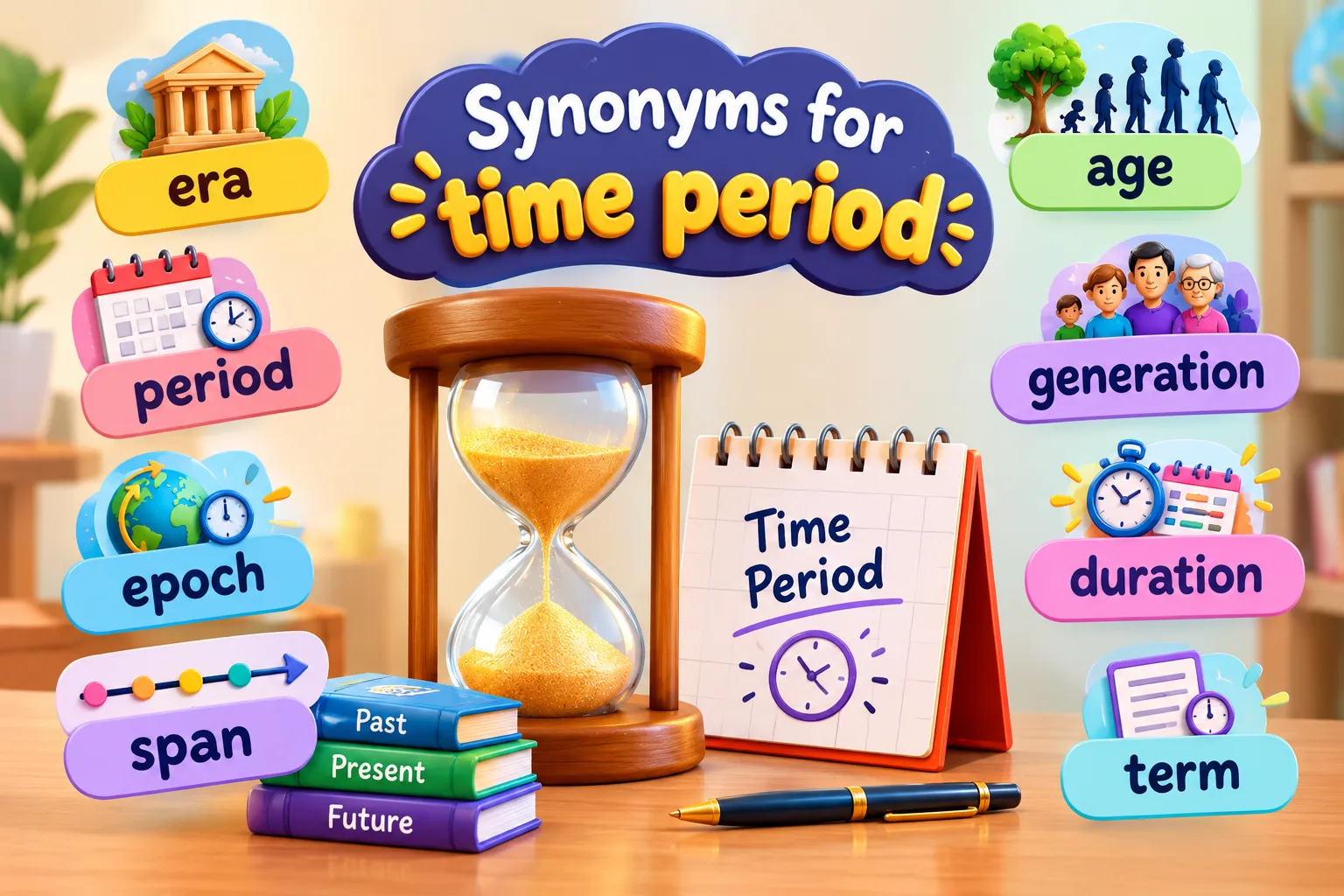
Common synonyms include period, timeframe, duration, span, interval, phase, era, epoch, age, stage, term, stretch, cycle, season, moment, while, interval of time, timespan, timeframe, and length of time. The best choice depends on context. For example, duration focuses on how long something lasts, era usually refers to a long historical period, interval suggests a gap between events, and phase describes one part of a process or development.
Time period refers to a particular amount or section of time. For example, a student may have a two-week time period to finish a project, while a historian may study a time period in which a major event took place. The phrase is common because it can describe short, long, past, present, or future sections of time. Learning synonyms for time period helps English learners express time more clearly and gives content writers more ways to avoid repetition. However, these words are not always exact substitutes. Duration focuses on length, era often describes history, and phase usually describes a stage in a process. This guide explains the meaning, grammar, history, pronunciation, 28 useful alternatives, semantic categories, antonyms, and examples of time period in simple English.
Meaning of Time Period
Definition
Time period (Noun): A particular length or section of time during which something happens or exists.
Examples
- The study covered a time period of five years.
- During this time period, many changes took place.
Connotative Meaning
Time period is usually a neutral phrase that simply identifies a section or length of time.
- Positive tone: It may suggest an important or successful period when used in a positive context.
- Negative tone: It may describe a difficult or troubled period in a negative context.
- Neutral tone: It simply refers to a specific amount or section of time.
(Connotation: the feeling or idea associated with a word beyond its basic meaning.)
Etymology
The phrase time period combines the words time and period. Both have long histories in English.
| Period | Development |
| Old English (450–1100) | Time came from Old English tīma, meaning a period, occasion, or time. |
| Middle English (1100–1500) | Time continued in forms close to the modern word. Period entered English through Old French from Latin periodus, referring to a complete cycle or interval. |
| Modern English (1500–Present) | Time period became a common phrase for a defined section or length of time, especially in academic, scientific, historical, and everyday writing. |
Pronunciation (IPA)
- IPA: /taɪm ˈpɪəriəd/
- Syllables: time pe-ri-od
Affixation Pattern of Time Period
Root
- Time: the main noun referring to measured or experienced existence.
- Period: a noun meaning a section or interval of time.
Prefix
- None: time period has no prefix.
Suffix
- None: The basic phrase does not contain a productive suffix.
Word Formations
- Time — noun/verb
- Timed — adjective/verb
- Timing — noun
- Timely — adjective/adverb
- Period — noun
- Periodic — adjective
- Periodically — adverb
- Periodicity — noun
- Timeframe — noun
- Timespan — noun
28 Synonyms of Time Period With Meaning & Examples
1. Period (Noun)
Meaning: A particular section or length of time.
Examples:
- The museum was built during this period.
- She lived abroad for a short period.
2. Duration (Noun)
Meaning: The amount of time that something lasts.
Examples:
- The course has a six-month duration.
- The duration of the meeting was two hours.
3. Timeframe (Noun)
Meaning: A particular period in which something is expected to happen.
Examples:
- The work must be completed within this timeframe.
- We have a short timeframe for the project.
4. Timespan (Noun)
Meaning: The total length of time during which something happens.
Examples:
- The study covers a ten-year timespan.
- The story takes place over a long timespan.
5. Span (Noun)
Meaning: A length or range of time.
Examples:
- The project lasted over a short span of time.
- The book covers a wide historical span.
6. Interval (Noun)
Meaning: A period between two events or points in time.
Examples:
- There was a short interval between the meetings.
- The medicine should be taken at regular intervals.
7. Phase (Noun)
Meaning: One stage of a process or period of development.
Examples:
- The project is entering a new phase.
- This phase lasted several months.
8. Era (Noun)
Meaning: A long and distinct period, especially in history.
Examples:
- The building comes from the Victorian era.
- The invention changed the modern era.
9. Epoch (Noun)
Meaning: A long and important period in history or development.
Examples:
- The discovery marked a new epoch.
- Scientists study this geological epoch.
10. Age (Noun)
Meaning: A historical period connected with particular events or features.
Examples:
- The castle was built during the Middle Ages.
- We live in the digital age.
11. Stage (Noun)
Meaning: A particular point in a process or development.
Examples:
- The project has reached its final stage.
- Children develop skills at different stages.
12. Term (Noun)
Meaning: A fixed period of time, especially for study or work.
Examples:
- The school term begins in September.
- Students have exams at the end of the term.
13. Stretch (Noun)
Meaning: A continuous period of time.
Examples:
- He worked for a long stretch.
- We had a difficult stretch during the project.
14. Cycle (Noun)
Meaning: A period in which a series of events happens and may repeat.
Examples:
- The business follows a yearly cycle.
- The machine completes one cycle every hour.
15. Season (Noun)
Meaning: A period associated with a particular activity or condition.
Examples:
- The football season begins soon.
- It was a busy season for the company.
16. Moment (Noun)
Meaning: A very short period of time.
Examples:
- Wait here for a moment.
- For a moment, everything became quiet.
17. While (Noun)
Meaning: A period of time, usually not precisely measured.
Examples:
- We stayed there for a while.
- It took a while to finish the work.
18. Interval of Time (Noun Phrase)
Meaning: A particular amount of time between events or points.
Examples:
- There was a long interval of time between the two visits.
- The experiment was repeated after a fixed interval of time.
19. Length of Time (Noun Phrase)
Meaning: The amount of time something lasts.
Examples:
- The length of time depends on the task.
- We measured the length of time needed to complete it.
20. Passage of Time (Noun Phrase)
Meaning: The process of time moving forward.
Examples:
- The passage of time changed the old building.
- Memories can change with the passage of time.
21. Duration of Time (Noun Phrase)
Meaning: The amount of time that an event or activity lasts.
Examples:
- The duration of time varies by activity.
- We recorded the duration of time for each test.
22. Historical Period (Noun Phrase)
Meaning: A section of history with particular features or events.
Examples:
- The museum focuses on an important historical period.
- This historical period saw major changes.
23. Timeframe (Noun)
Meaning: A set period allowed for an activity or event.
Examples:
- The company gave us a three-month timeframe.
- The project has a strict timeframe.
24. Interval (Noun)
Meaning: A space of time separating two events.
Examples:
- The doctor asked about the interval between symptoms.
- Take the tablets at a regular interval.
25. Chapter (Noun)
Meaning: A distinct period or stage in someone’s life or history.
Examples:
- Moving abroad began a new chapter in her life.
- The invention opened a new chapter in science.
26. Milestone Period (Noun Phrase)
Meaning: A period connected with an important achievement or change.
Examples:
- The decade was a major milestone period for the company.
- This was an important milestone period in his career.
27. Window (Noun)
Meaning: A limited period when something can happen.
Examples:
- We have a short window to finish the repair.
- The team found a window for the launch.
28. Run (Noun)
Meaning: A continuous period during which something operates or continues.
Examples:
- The show had a successful run.
- The machine had a long run without problems.
Prototype Meaning
The most typical meaning of time period is a defined section or length of time. People usually imagine a period with a beginning and an end, such as a week, month, year, decade, school term, or historical era. The phrase can describe both the length of time something lasts and the section of time when something happens.
Prototype Categorization
- General time sections: period, span, timespan, stretch, while — useful when referring to a section or length of time.
- Measured duration: duration, length of time, duration of time — focus on how long something lasts.
- Historical periods: era, epoch, age, historical period, historical era — useful for history and long periods of development.
- Stages and development: phase, stage, chapter, cycle — useful when time is connected to progress or change.
- Fixed periods: term, season, timeframe, window — useful when a period has a set limit or purpose.
- Short periods: moment, interval — useful for brief periods or gaps between events.
- Continuous activity: run, passage of time — useful when describing something that continues over time.
This categorization helps writers select the most precise synonym. For example, use era for history, duration for length, phase for development, and timeframe for a planned period.
Antonyms of Time Period
| Antonym | Part of Speech | Meaning |
| Eternity | Noun | Endless time with no beginning or end |
| Timelessness | Noun | A state outside normal time limits |
| Instant | Noun | An extremely brief point in time |
| Now | Adverb/Noun | The present moment |
| Moment | Noun | A very short point or period of time |
| Continuity | Noun | An unbroken state without a defined section |
| Permanence | Noun | A state of lasting indefinitely |
| Endlessness | Noun | A condition with no end |
| Immediacy | Noun | The quality of happening at once or in the present |
| Timeless state | Noun Phrase | A condition not limited to a particular period |
Short Questions and Answers
What does time period mean?
Time period means a particular section or length of time during which something happens or exists.
When should time period be used?
Use time period when you need to describe a specific section or amount of time, especially when the exact length or dates are important.
Is time period positive or negative?
Time period is neutral. Its emotional meaning depends on what happened during that period.
How is it different from similar words?
Time period is a broad phrase. Duration focuses on how long something lasts, era usually refers to a major historical period, interval describes a gap between events, and phase describes one stage of a process.
Conclusion
Learning time period and its synonyms can make English vocabulary more flexible and precise. Words such as period, duration, timeframe, span, interval, phase, era, epoch, age, and stage are related to time, but each has a slightly different use. Some focus on length, some describe historical periods, and others refer to stages, gaps, or fixed periods. Understanding these differences helps English learners speak and write with greater accuracy. It also helps content writers avoid repeating time period throughout an article. A good way to build vocabulary is to learn synonyms in groups and use each one in your own sentences. Practice a few words every day, read them in real contexts, and notice how their meanings change with different situations. Regular practice can strengthen your English vocabulary, writing, and confidence.
Read More:
Synonyms for paint: 26 Colorful Alternative

I’m Ayesha Haram, an English content and SEO writer at SynonymsInstant.com. I focus on creating helpful vocabulary resources, word guides, and practical English content that readers can understand quickly. I combine language research, clear explanations, and SEO-focused writing to produce reliable content that supports learners, writers, and everyday English users.