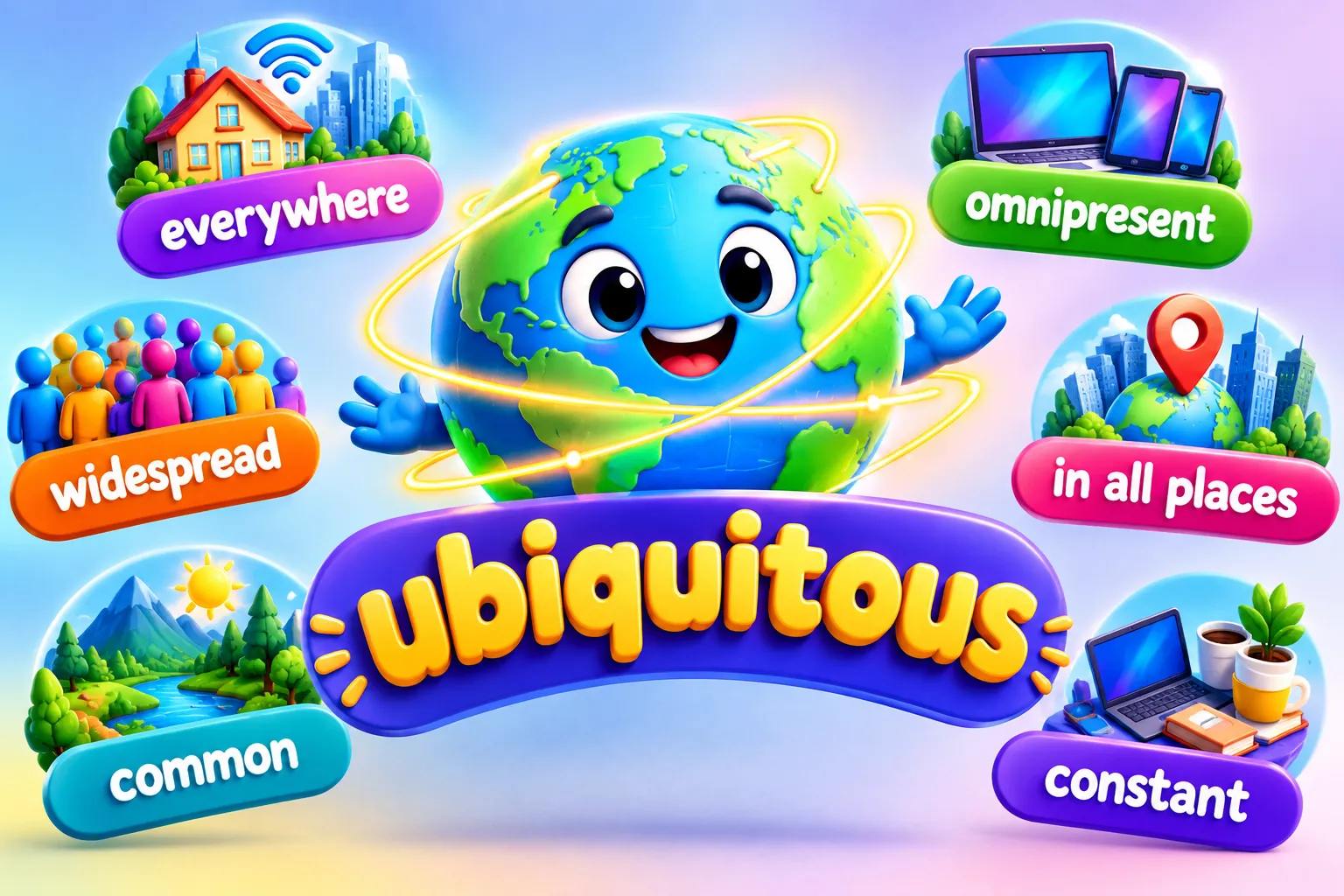
Useful synonyms include omnipresent, universal, widespread, pervasive, prevalent, common, abundant, plentiful, extensive, global, worldwide, all-around, ever-present, pervasive, omnipresent, and far-reaching. The best synonym depends on context. For example, omnipresent suggests being everywhere, widespread means found across a large area, prevalent means common, and pervasive suggests something that spreads widely through a place, group, or system.
Ubiquitous means something is found or seen almost everywhere. Think about smartphones today. You may see them at home, at school, at work, on buses, and in shops. In this sense, smartphones are ubiquitous in modern life. The word is common in formal writing, technology, science, business, and social discussions because it gives a clear way to describe something that is widespread. Learning synonyms for ubiquitous helps English learners understand small differences between words such as universal, prevalent, widespread, and pervasive. It also helps content writers avoid repeating the same word. This guide explains the meaning, grammar, history, pronunciation, word formation, 30 useful synonyms, semantic categories, antonyms, and examples of ubiquitous in simple and clear English.
Meaning of Ubiquitous
Definition
Ubiquitous (Adjective): Present, found, or seen everywhere or in many places.
Examples
- Smartphones have become ubiquitous in modern society.
- Coffee shops are ubiquitous in large cities.
Connotative Meaning
Ubiquitous is usually neutral, but its tone can change with context.
- Positive tone: It can suggest easy access, wide availability, or broad usefulness.
- Negative tone: It can suggest that something is too common or difficult to escape.
- Neutral tone: It simply describes something that is present in many places.
(Connotation: the feeling or idea associated with a word beyond its basic dictionary meaning.)
Etymology
Ubiquitous comes from Latin ubique, meaning “everywhere.” It entered English in the 19th century and developed from the idea of being present everywhere.
| Period | Development |
| Old English (450–1100) | The modern word ubiquitous was not used. English used other expressions to describe things found everywhere. |
| Middle English (1100–1500) | Ubiquitous was still not part of ordinary English vocabulary. The idea was expressed with phrases meaning “everywhere” or “in all places.” |
| Modern English (1500–Present) | Ubiquitous entered English in the 19th century from Latin ubique, meaning “everywhere.” It came to describe something that seems to be present everywhere. |
Pronunciation (IPA)
- IPA: /juːˈbɪkwɪtəs/
- Syllables: u-biq-ui-tous
Affixation Pattern of Ubiquitous
Root
- Ubi- / ubiqu-: Related to Latin ubique, meaning “everywhere.”
Prefix
- None: Ubiquitous does not have a productive English prefix.
Suffix
- -ous: An adjective-forming suffix meaning “characterized by” or “full of.”
Word Formations
- Ubiquitous — adjective
- Ubiquitously — adverb
- Ubiquitousness — noun
- Ubiquity — noun
- Ubiquitousness — noun describing the quality of being ubiquitous
30 Synonyms of Ubiquitous With Meaning & Examples
1. Omnipresent (Adjective)
Meaning: Present everywhere at the same time.
Examples:
- Technology seems omnipresent in modern life.
- Advertising is omnipresent in major cities.
2. Universal (Adjective)
Meaning: Existing or happening everywhere or among all people in a group.
Examples:
- Music has a universal appeal.
- The need for communication is nearly universal.
3. Widespread (Adjective)
Meaning: Found over a large area or among many people.
Examples:
- The new app has become widespread.
- The practice is widespread across the country.
4. Pervasive (Adjective)
Meaning: Spread widely throughout a place, group, or system.
Examples:
- Digital technology has a pervasive influence.
- The smell was pervasive throughout the building.
5. Prevalent (Adjective)
Meaning: Very common or frequently found.
Examples:
- Online learning is prevalent today.
- The problem is prevalent in large cities.
6. Common (Adjective)
Meaning: Found often or in many places.
Examples:
- Smartphones are common among young people.
- This type of plant is common in the region.
7. Abundant (Adjective)
Meaning: Existing in large quantities.
Examples:
- Fresh water is abundant in this area.
- Information is abundant on the internet.
8. Plentiful (Adjective)
Meaning: Available in large amounts or numbers.
Examples:
- Food was plentiful during the festival.
- Job opportunities are plentiful in the city.
9. Extensive (Adjective)
Meaning: Covering a large area or involving many parts.
Examples:
- The company has an extensive network.
- The disease caused extensive damage.
10. Global (Adjective)
Meaning: Existing or affecting the whole world.
Examples:
- Climate change is a global concern.
- The brand has a global presence.
11. Worldwide (Adjective/Adverb)
Meaning: Existing or happening throughout the world.
Examples:
- The product has worldwide popularity.
- The news was reported worldwide.
12. Ever-Present (Adjective)
Meaning: Always present or constantly noticeable.
Examples:
- The ever-present sound of traffic filled the city.
- Technology is an ever-present part of daily life.
13. All-Pervading (Adjective)
Meaning: Spread throughout every part of a place or situation.
Examples:
- There was an all-pervading sense of excitement.
- The all-pervading influence of media is hard to ignore.
14. All-Encompassing (Adjective)
Meaning: Including or covering almost everything.
Examples:
- The company created an all-encompassing service.
- The report gives an all-encompassing view of the issue.
15. Far-Reaching (Adjective)
Meaning: Affecting or extending over a large area or many people.
Examples:
- The invention had far-reaching effects.
- The policy produced far-reaching changes.
16. Broad (Adjective)
Meaning: Covering a large area, range, or group.
Examples:
- The campaign received broad support.
- The idea has broad influence.
17. Extensive (Adjective)
Meaning: Large in size, range, or coverage.
Examples:
- The company has an extensive online presence.
- The research provides extensive information.
18. Prevalent (Adjective)
Meaning: Commonly found or seen in a particular place or group.
Examples:
- Social media use is prevalent among teenagers.
- The belief was prevalent at the time.
19. Dominant (Adjective)
Meaning: More noticeable, powerful, or common than others.
Examples:
- English is a dominant language in many international settings.
- The brand has a dominant position in the market.
20. Frequent (Adjective)
Meaning: Happening or appearing often.
Examples:
- Power cuts were frequent during the summer.
- His visits became more frequent.
21. Constant (Adjective)
Meaning: Happening or existing continuously.
Examples:
- The city has a constant flow of traffic.
- She heard the constant sound of machines.
22. Continuous (Adjective)
Meaning: Existing or happening without stopping.
Examples:
- The system provides continuous service.
- There was a continuous flow of information.
23. Universalized (Adjective)
Meaning: Made applicable or available to everyone or everywhere.
Examples:
- The program was universalized across the country.
- The system became widely universalized.
24. Globalized (Adjective)
Meaning: Spread or connected across many countries or the world.
Examples:
- Business has become increasingly globalized.
- The economy is highly globalized.
25. Nationwide (Adjective/Adverb)
Meaning: Existing or happening throughout an entire country.
Examples:
- The service is available nationwide.
- The company launched a nationwide campaign.
26. Region-Wide (Adjective)
Meaning: Existing or happening throughout a whole region.
Examples:
- The company launched a region-wide program.
- A region-wide campaign was introduced.
27. Omnipresently (Adverb)
Meaning: In a way that is present everywhere.
Examples:
- Digital media is omnipresently connected to modern life.
- The influence appears omnipresently across the system.
28. All-Over (Adjective/Adverb)
Meaning: Spread across or present in many parts of an area.
Examples:
- Posters were placed all over the city.
- The design appeared all over the building.
29. Inescapable (Adjective)
Meaning: Impossible or very difficult to avoid.
Examples:
- Advertising is often inescapable online.
- The sound of traffic was inescapable in the busy area.
30. Everywhere (Adverb)
Meaning: In or to every place.
Examples:
- You can find smartphones everywhere.
- Signs for the event were everywhere in the city.
Prototype Meaning
The most typical meaning of ubiquitous is present or found everywhere. When people hear this word, they often imagine something that appears in many places and has become hard to miss. Modern examples can include smartphones, internet access, advertising, or digital technology. The word is especially useful when ordinary words such as common or widespread do not fully express the idea of being present almost everywhere.
Prototype Categorization
- Everywhere and constant: omnipresent, ever-present, everywhere, all-pervading — these suggest that something is found in nearly every place.
- Widely distributed: widespread, extensive, broad, far-reaching, region-wide, nationwide — these focus on large geographic or social coverage.
- Common or frequent: common, prevalent, frequent, abundant, plentiful — these emphasize how often something appears or how much of it exists.
- Global reach: global, worldwide, globalized, universal — these are useful when something extends across countries or the world.
- Strong influence: pervasive, dominant, inescapable, all-encompassing — these suggest that something has a strong or difficult-to-avoid presence.
- Continuous presence: constant, continuous — these focus more on ongoing presence than physical distribution.
This categorization helps writers choose the right synonym. For example, widespread works well for a practice, pervasive for an influence, global for worldwide reach, and omnipresent when the idea of being everywhere is strongest.
Antonyms of Ubiquitous
| Antonym | Part of Speech | Meaning |
| Rare | Adjective | Not commonly found |
| Uncommon | Adjective | Not often seen or experienced |
| Scarce | Adjective | Available in very small amounts |
| Limited | Adjective | Available only in a small area or amount |
| Localized | Adjective | Restricted to a particular place |
| Restricted | Adjective | Limited to certain people or areas |
| Isolated | Adjective | Separated from other places or things |
| Occasional | Adjective | Happening only sometimes |
| Infrequent | Adjective | Not happening often |
| Unique | Adjective | One of a kind or unlike others |
| Unusual | Adjective | Not common or typical |
| Absent | Adjective | Not present |
| Scarce | Adjective | Difficult to find or obtain |
Short Questions and Answers
What does ubiquitous mean?
Ubiquitous means present, found, or seen everywhere or in many places.
When should ubiquitous be used?
Use ubiquitous when something is extremely widespread or seems to be present almost everywhere.
Is ubiquitous positive or negative?
Ubiquitous is neutral. It can have a positive or negative tone depending on what is being described.
How is it different from similar words?
Ubiquitous strongly suggests being present everywhere. Widespread means found across a large area, common means frequently found, prevalent means common in a particular group or place, and pervasive suggests something spreads throughout a system or environment.
Conclusion
Learning ubiquitous and its synonyms can make your English vocabulary stronger and more precise. Words such as omnipresent, widespread, pervasive, prevalent, universal, global, and ever-present share the idea of wide presence, but each has a slightly different use. Some focus on geographic spread, while others highlight frequency, influence, or continuous presence. Understanding these differences helps English learners choose words that fit their exact meaning. It also helps content writers create clear and varied articles without repeating the same term. Daily vocabulary practice is a simple way to improve both writing and speaking. Try learning a few synonyms each day and make your own sentences with them. Over time, this habit can improve vocabulary, communication skills, sentence variety, and confidence in English.
Read More:
Synonyms for time period: 28 Words to Boost Your Writing

I’m Falak Naaz, an SEO writer at SynonymsInstant.com focused on creating clear, engaging, and search-friendly English content. I specialize in vocabulary, synonyms, antonyms, word usage, and language guides. I combine careful research with practical writing to deliver trustworthy content that helps readers choose the right words and improve their English with confidence.