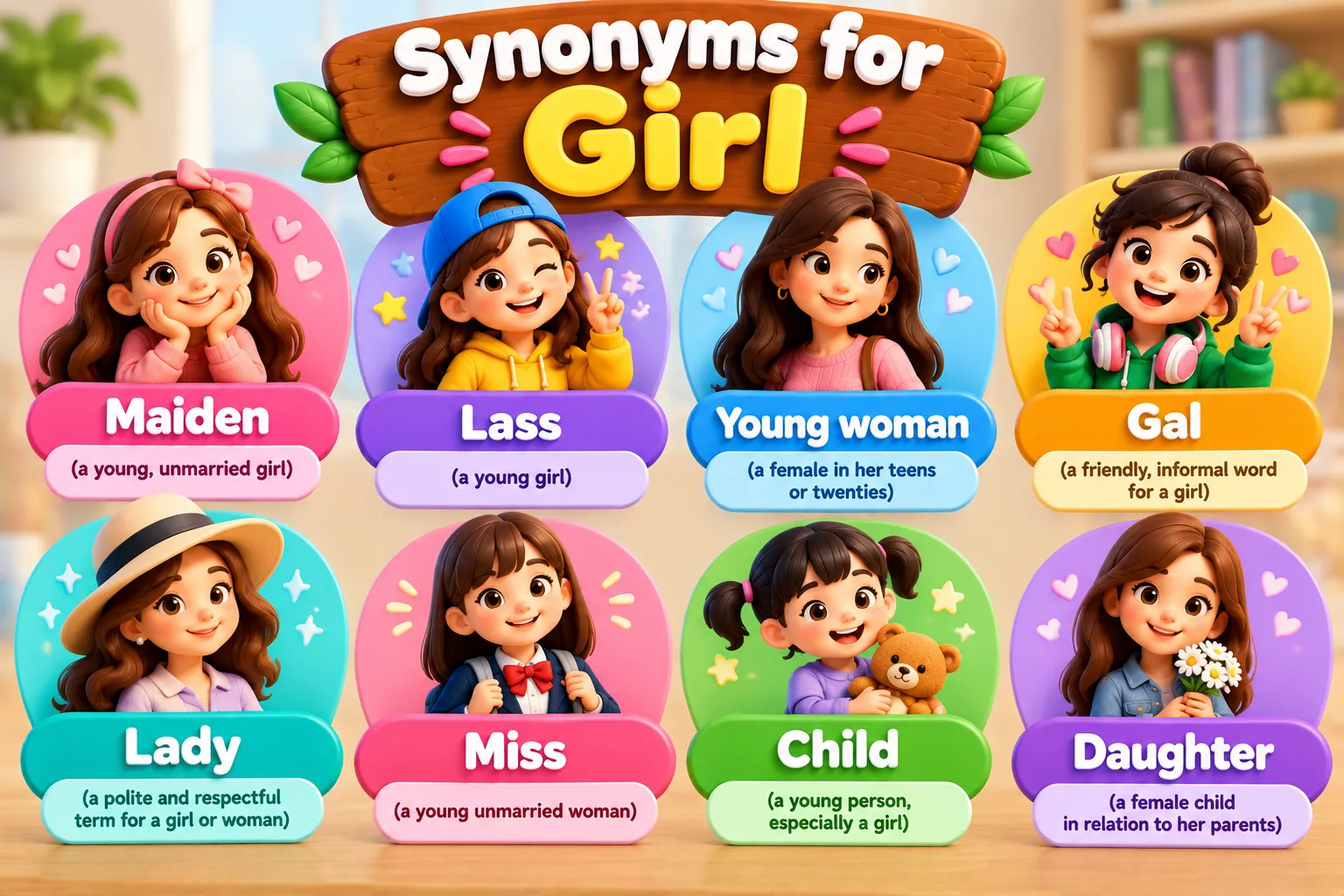
A girl is a female child or young female person. Common synonyms and related words include young lady, lass, maiden, daughter, youngster, child, and female. Some words describe age, while others show a family relationship or a particular style of speech. For example, lass is common in some British and Scottish contexts, while maiden often sounds old-fashioned or literary. The best alternative depends on the person’s age, the setting, and the tone you want. Learning these words can help you improve your English vocabulary and write with greater variety.
A girl is a female child or young female person. For example, when a child joins a new school, people may say, “The girl in the blue dress is my classmate.” The word is common in daily speech, books, news, and conversations. However, using the same word too often can make writing sound repetitive. Learning synonyms for girls gives you more ways to describe people in different situations. Some alternatives are warm and friendly, while others are formal, regional, or old-fashioned. English learners and content writers can use these words to make their writing clearer and more natural. This guide explains the meaning, pronunciation, history, and word forms of girls. It also shares 28 alternatives with simple meanings and examples to help you choose the right word for each context.
Meaning of Girl
Definition
Girl (Noun): A female child or young female person.
The word is also used informally for a woman in some settings, but this use may not suit every person or situation.
Examples
- The girl is reading a book in the garden.
- A young girl helped her teacher carry the books.
- Their daughter is a cheerful and curious girl.
Connotative Meaning
Connotation is the feeling or idea that a word suggests beyond its basic meaning.
- Positive tone: Girl can suggest youth, joy, kindness, or energy in a suitable context.
- Negative tone: In some situations, calling an adult woman a girl may sound dismissive or disrespectful.
- Neutral tone: The word is usually neutral when referring to a female child.
The tone depends on the speaker, the context, and the age of the person being described.
Etymology of Girl
The history of girl is unusual because its earliest known meaning was not limited to females.
- Old English (450–1100): The modern word girl was not part of standard Old English in its current form.
- Middle English (1100–1500): The word appeared as girl or related spellings. In its early use, it could refer to a child or young person of either sex.
- Modern English (1500–Present): Over time, girl became mainly associated with a female child or young female person. It is now a common word in everyday English.
Pronunciation (IPA)
- IPA: /ɡɜːl/ in British English; /ɡɝːl/ in American English
- Syllables: Girl — one syllable
Affixation Pattern of Girl
- Root: Girl
- Prefix: There is no common prefix in the basic word girl.
- Suffix: Common forms include -hood, -ish, and -y in related words, though not all are used in the same way.
Word Formations
| Word | Grammatical Category | Meaning |
| Girl | Noun | A female child or young female person |
| Girls | Plural noun | More than one girl |
| Girlhood | Noun | The period when someone is a girl |
| Girlish | Adjective | Having qualities often associated with girls or youth |
| Girlishly | Adverb | In a girlish manner |
| Girlishness | Noun | The quality of being girlish |
| Girly | Adjective | Informally associated with girls or traditionally feminine styles |
Note: These words are related forms, not all direct synonyms of girl.
28 Synonyms of Girl With Meaning and Examples
Important: English has few exact synonyms for girl. The alternatives below include close synonyms, age-related terms, regional words, and context-specific descriptions. Words such as daughter and schoolgirl have more specific meanings, so they cannot replace girl in every sentence.
1. Young Female (Noun Phrase)
Meaning: A female person who is young.
Examples:
- The young female joined the art class.
- The report described a young female who had found the lost dog.
2. Young Lady (Noun Phrase)
Meaning: A polite expression for a girl or young woman.
Examples:
- The young lady greeted everyone at the door.
- A young lady asked the librarian for help.
3. Lass (Noun)
Meaning: A girl or young woman; common in some British and Scottish contexts.
Examples:
- The lass walked through the village with her friends.
- An old Scottish song tells the story of a young lass.
4. Maiden (Noun)
Meaning: A girl or young woman, especially in old-fashioned or literary language.
Examples:
- The tale follows a maiden who lives near a castle.
- The poet wrote about a maiden waiting by the sea.
5. Female Child (Noun Phrase)
Meaning: A child who is female.
Examples:
- The female child played with building blocks.
- The clinic welcomed the newborn female child and her family.
6. Child (Noun)
Meaning: A young person who has not reached adulthood.
Examples:
- The child drew a picture of her family.
- Every child in the class received a notebook.
Usage note: A child can be male or female, so this word is broader than girl.
7. Youngster (Noun)
Meaning: A young person, often a child or teenager.
Examples:
- The youngster enjoyed her first day at school.
- Every youngster took part in the sports event.
8. Youth (Noun)
Meaning: A young person or the period of being young.
Examples:
- The youth volunteered at the community center.
- The program gives local youth a chance to learn new skills.
Usage note: Youth is often collective or formal and does not specifically mean a girl.
9. Adolescent (Noun)
Meaning: A young person who is developing from childhood into adulthood.
Examples:
- The adolescent joined a school science club.
- The book explores the challenges faced by an adolescent.
10. Teenager (Noun)
Meaning: A person aged 13 to 19.
Examples:
- The teenager entered a writing competition.
- A teenager from our town won the art prize.
Usage note: A teenager may be male or female.
11. Schoolgirl (Noun)
Meaning: A girl who attends school.
Examples:
- The schoolgirl answered the teacher’s question.
- A schoolgirl won first place in the spelling contest.
12. Student (Noun)
Meaning: A person who studies at a school, college, or other learning center.
Examples:
- The student finished her homework early.
- Each student received a certificate.
Usage note: Student describes a role, not age or gender.
13. Daughter (Noun)
Meaning: A female child in relation to her parents.
Examples:
- Their daughter enjoys painting and reading.
- His daughter helped prepare dinner.
14. Sister (Noun)
Meaning: A female sibling.
Examples:
- My sister and I walked to the park.
- Her younger sister loves drawing animals.
15. Granddaughter (Noun)
Meaning: The daughter of someone’s son or daughter.
Examples:
- Their granddaughter visited them on Sunday.
- His granddaughter learned to bake a cake.
16. Niece (Noun)
Meaning: The daughter of someone’s brother or sister.
Examples:
- My niece is learning to play the piano.
- Her niece brought a handmade card to the party.
17. Lassie (Noun)
Meaning: A girl or young woman in some Scottish and regional uses.
Examples:
- The old story tells of a lassie who lived by the hills.
- The song describes a cheerful lassie dancing at a fair.
Usage note: Lassie is regional and can sound old-fashioned.
18. Miss (Noun)
Meaning: A title used for a girl or woman, especially when a surname or name follows it.
Examples:
- Miss Ahmed teaches our English class.
- The teacher asked the young miss to read the next line.
Usage note: Miss is usually a title, not a direct synonym for girl.
19. Young Woman (Noun Phrase)
Meaning: A female person who is in the early stage of adulthood.
Examples:
- The young woman started her first job.
- A young woman spoke at the school event.
20. Woman (Noun)
Meaning: An adult female person.
Examples:
- The woman helped the child cross the street.
- A woman stood near the entrance.
Usage note: Woman generally refers to an adult, so it should not replace girl when the person’s age matters.
21. Female (Noun)
Meaning: A person or animal of the sex that can produce eggs.
Examples:
- The study included female participants.
- The female was identified by the research team.
Usage note: When referring to people, female as a noun can sound clinical or impersonal. In everyday writing, use girl or woman when appropriate.
22. Lassie Girl (Noun Phrase)
Meaning: A nonstandard phrase sometimes used to describe a girl in a regional or playful style.
Examples:
- The character was described as a cheerful lassie.
- The writer used regional language to describe the young girl.
Usage note: “Lassie girl” is not a standard synonym. Use lass or lassie instead.
23. Chick (Noun, Informal Slang)
Meaning: An informal slang term for a girl or young woman.
Examples:
- The old comedy used the word chick for a young woman.
- The character called her friend a chick in casual conversation.
Usage note: Chick can sound disrespectful or objectifying. Avoid it in formal or professional writing.
24. Gal (Noun, Informal)
Meaning: An informal word for a girl or woman, used in some varieties of English.
Examples:
- The gal at the counter helped us find the right size.
- She is a friendly gal who knows everyone in town.
Usage note: Gal is informal and may sound dated in some settings.
25. Girlie (Noun, Informal)
Meaning: An informal term for a girl, often used in a familiar or playful way.
Examples:
- The old story follows a girlie who dreams of becoming a singer.
- The character used the word girlie while talking to her friend.
Usage note: Girlie can sound patronizing, especially when used for an adult.
26. Little Girl (Noun Phrase)
Meaning: A young female child.
Examples:
- The little girl held her mother’s hand.
- A little girl gave flowers to her teacher.
27. Youngster Girl (Noun Phrase)
Meaning: A nonstandard phrase intended to mean a young girl.
Examples:
- The writer described the young girl playing in the garden.
- A young girl took part in the school play.
Usage note: “Youngster girl” is not natural standard English. Use young girl or youngster, depending on the meaning.
28. Female Youth (Noun Phrase)
Meaning: A young female person, usually in formal or research-related writing.
Examples:
- The program offers support to female youth in the area.
- The report studied the needs of female youth.
Prototype Meaning of Girl
The most typical meaning of girl is a female child or young female person. People often imagine a young person who is growing up, learning, playing, or attending school. The word is common in everyday speech and is usually neutral when used for a child. In some contexts, it can refer informally to an adult woman, such as in the phrase “girls’ night out.” However, this use depends on the relationship and setting. In formal writing, young woman, female student, or woman may be more suitable when describing an adult.
Prototype Categorization of Girl Synonyms
The alternatives for girl can be grouped by age, relationship, social setting, and tone.
- General terms for young people: Child, youngster, youth, adolescent, and teenager describe young people but do not always specify gender.
- Terms for young females: Young female, female child, little girl, and young lady focus more directly on gender or age.
- Family relationships: Daughter, sister, granddaughter, and niece describe a girl through her relationship with family members.
- Education-related terms: Schoolgirl, student, and female student are useful when the person is in an educational setting.
- Regional and literary terms: Lass, lassie, and maiden can add a regional, traditional, or literary tone.
- Informal expressions: Gal, chick, and girlie are casual terms. Some may sound dated, patronizing, or disrespectful, so use them with care.
- Adult female terms: Young woman and woman are more suitable when referring to adults, depending on their age and the context.
These categories help writers choose words that fit their meaning. For example, use schoolgirl when school attendance matters, daughter when describing a family relationship, and young woman for an adult. Choosing a precise term improves clarity and avoids using a word that may sound rude or unsuitable.
Antonyms of Girl
There is no exact antonym for girl because it describes age and gender together. The following terms contrast with it in different ways.
| Word | Part of Speech | Meaning | Type of Contrast |
| Boy | Noun | A male child or young male person | Gender |
| Man | Noun | An adult male person | Gender and age |
| Adult | Noun/Adjective | A person who has reached adulthood | Age |
| Grown-up | Noun/Adjective | A person who is no longer a child | Age |
| Male child | Noun phrase | A child who is male | Gender |
| Young man | Noun phrase | A male person in the early stage of adulthood | Gender and age |
Note: Boy is the closest everyday contrast to girl when both words refer to children. Man is more suitable when contrasting adult women and adult men.
Short Questions and Answers
What does girl mean?
A girl is a female child or young female person. The word is common in daily speech, stories, and school settings.
When should girl be used?
Use girl when referring to a female child or young female person. When describing an adult, consider whether a woman or young woman is more accurate and respectful.
Is a girl positive or negative?
The word is usually neutral when used for a child. Its tone can be positive in a warm context, but calling an adult woman a girl may sound dismissive in some situations.
How is girl different from similar words?
A girl is female and usually young. A child can be of any gender, a daughter describes a family relationship, and a schoolgirl is a girl who attends school. A young woman usually refers to an adult.
Conclusion
Learning synonyms for girls can improve your vocabulary and help you express ideas more clearly. Words such as young lady, lass, schoolgirl, and young woman can fit different situations, but they do not all have the same meaning. Some describe age, while others show family ties, education, or regional speech. It is important to choose words that match the person’s age and the tone of your writing. This helps you avoid repetition and communicate with respect. To build your English skills, learn a few new words each day and use them in your own sentences. Pay attention to how people use each word in books, conversations, and formal writing. With practice, you can speak and write with greater confidence.
Read More:
Synonyms for Spy: 30 Best Alternatives to Know

I am Rubab content specialist focused on creating accurate, user-friendly, and search-optimized language resources. Through Synonyminstant, I help readers find synonyms, antonyms, meanings, and vocabulary with ease. Every article is carefully researched and optimized to provide reliable information, clear explanations, and an excellent user experience.