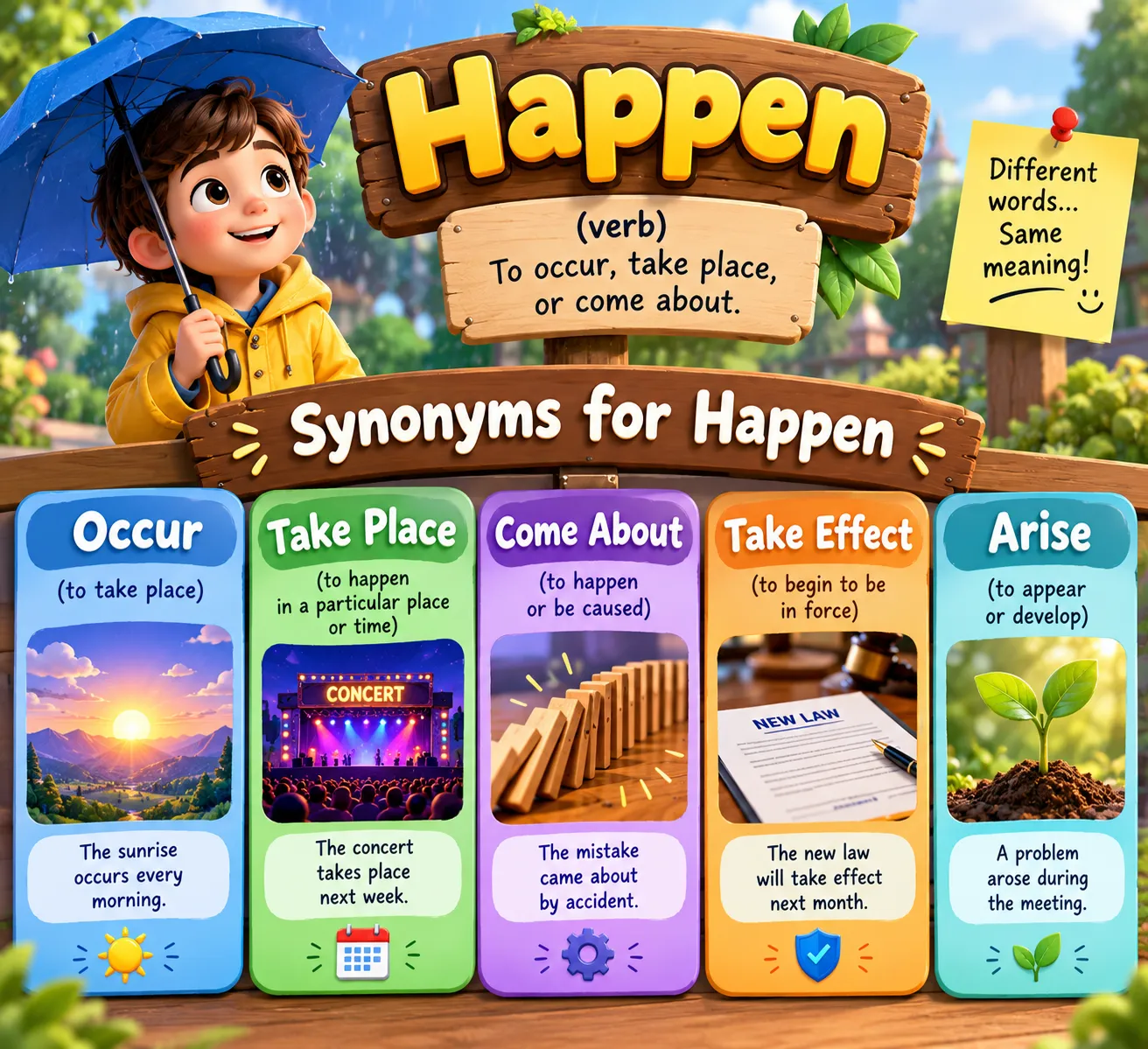
Happen means to take place or occur. Common synonyms for happen include occur, take place, arise, unfold, transpire, develop, and come about. Some words describe events that take place naturally, while others suggest that a problem or situation has started. For example, occur often suits formal writing, while come up is common in everyday speech. The best synonym depends on the sentence and the type of event. Learning these alternatives can help you improve your vocabulary, avoid repetition, and express ideas more clearly in English.
The word happen means to take place or occur. Imagine that you are waiting for a bus, but it does not arrive on time. You might say, “Something unexpected happened on the road.” This common word is useful when talking about events, changes, problems, and daily experiences. However, using happen in every sentence can make your writing sound repetitive. Learning synonyms gives you more ways to explain what takes place and how a situation develops. English learners, students, and content writers can use these alternatives to make their sentences clearer and more natural. In this guide, you will learn the meaning, pronunciation, history, and word forms of happen. You will also explore 30 alternatives with meanings and examples, along with antonyms and semantic categories to help you choose the right word.
Meaning of Happen
Definition
Happen (Verb): To take place, occur, or come about, often without being planned.
The word can describe an event, a change, an experience, or something that takes place by chance.
Examples
- Accidents can happen when drivers do not pay attention.
- What will happen if we miss the train?
- A strange thing happened on my way home.
Connotative Meaning
Connotation is the feeling or idea that a word suggests beyond its basic meaning.
- Positive tone: Happen can describe a good or exciting event, such as winning a prize.
- Negative tone: It can describe an unwanted event, such as an accident or mistake.
- Neutral tone: It can simply describe something that takes place, without showing whether it is good or bad.
The word itself is neutral. The surrounding sentence gives it a positive or negative tone.
Etymology of Happen
The word happen entered English through Old French and is linked to the idea of chance or fortune.
- Old English (450–1100): The modern word happen was not used in its current form in Old English. English speakers used other words to describe events and things that took place.
- Middle English (1100–1500): Happen developed from the Old French hap, meaning chance or fortune, with a verb form that came to mean occurring by chance.
- Modern English (1500–Present): The word grew to mean taking place or occurring, whether by chance or through a known cause. Today, it is widely used in everyday speech and writing.
Pronunciation (IPA)
- IPA: /ˈhæp.ən/
- Syllables: Hap-pen — two syllables
Affixation Pattern of Happen
- Root: Happen
- Prefix: No common prefix appears in the basic word.
- Suffix: The endings -s, -ed, and -ing form common verb forms.
Word Formations
| Word | Grammatical Category | Meaning |
| Happen | Verb | To take place or occur |
| Happens | Verb | Takes place; third-person singular form |
| Happened | Verb | Took place in the past |
| Happening | Present participle/gerund | Taking place or occurring |
| Happening | Noun | An event or occurrence, sometimes unusual |
| Happenstance | Noun | A chance event or coincidence |
| Happeningness | Noun, rare | The quality or state of happening; uncommon usage |
Note: Happenstance is a related word, not a regular grammatical form of happen. Happeningness is rare and is not useful in most everyday writing.
30 Synonyms of Happen With Meaning and Examples
The best synonym depends on the context. Some words mean that an event takes place, while others describe a problem beginning, a situation changing, or an event developing.
1. Occur (Verb)
Meaning: To take place or happen.
Examples:
- Power cuts often occur during storms.
- The meeting will occur at noon.
2. Take Place (Verb Phrase)
Meaning: To happen at a particular time or location.
Examples:
- The concert will take place on Friday.
- The meeting took place in the main hall.
3. Come About (Verb Phrase)
Meaning: To happen or develop, often through a series of events.
Examples:
- How did this change come about?
- The agreement came about after long talks.
4. Transpire (Verb)
Meaning: To happen or become known, often in formal language.
Examples:
- Several unexpected events transpired that evening.
- It later transpired that the report was wrong.
5. Arise (Verb)
Meaning: To begin or appear, often when a problem or need develops.
Examples:
- Problems may arise during the project.
- A new opportunity arose after the meeting.
6. Develop (Verb)
Meaning: To grow or change over time.
Examples:
- A problem began to develop during the trip.
- The situation developed more quickly than expected.
7. Unfold (Verb)
Meaning: To happen or develop gradually, often in a way people can observe.
Examples:
- The story began to unfold after the first interview.
- Events unfolded over several days.
8. Take Effect (Verb Phrase)
Meaning: To begin to produce a result or have an impact.
Examples:
- The new rules will take effect next month.
- The medicine began to take effect after an hour.
Usage note: This phrase means that something starts to work, not simply that any event happens.
9. Break Out (Phrasal Verb)
Meaning: To begin suddenly, especially when referring to a fight, fire, disease, or conflict.
Examples:
- A fire broke out in the kitchen.
- Fighting broke out near the stadium.
10. Come Up (Phrasal Verb)
Meaning: To arise or appear, often unexpectedly.
Examples:
- An urgent issue came up at work.
- Something important came up during the discussion.
11. Crop Up (Phrasal Verb)
Meaning: To appear unexpectedly, often referring to a problem or task.
Examples:
- A few problems cropped up during the move.
- New questions cropped up after the lesson.
12. Befall (Verb)
Meaning: To happen to someone, often something unpleasant.
Examples:
- No one knew what might befall the travelers.
- Trouble befell the family during the storm.
13. Ensue (Verb)
Meaning: To happen as a result of an earlier event.
Examples:
- A heated argument ensued after the announcement.
- Confusion ensued when the lights went out.
14. Emerge (Verb)
Meaning: To become known, visible, or clear.
Examples:
- New details emerged after the investigation.
- A clear pattern emerged from the results.
Usage note: Emerge often describes something becoming known rather than an event simply taking place.
15. Materialize (Verb)
Meaning: To happen or appear, especially when something expected finally occurs.
Examples:
- The promised help never materialized.
- A chance to travel materialized at the last moment.
16. Transpire (Verb)
Meaning: To occur or become known.
Examples:
- Nobody expected what transpired after the vote.
- It transpired that the tickets had been sold twice.
Note: This word repeats an earlier synonym because it has two common uses. For a more varied list, consider eventuate in formal writing, though it is uncommon.
17. Eventuate (Verb)
Meaning: To happen as the final result of a process or series of events.
Examples:
- The talks eventually resulted in a new agreement.
- Their efforts resulted in a successful project.
18. Result (Verb)
Meaning: To happen as an outcome of something else.
Examples:
- Delays may result from bad weather.
- The error resulted from a simple mistake.
19. Follow (Verb)
Meaning: To happen after something else.
Examples:
- A short break followed the first session.
- More questions followed the announcement.
20. Ensue (Verb)
Meaning: To happen as a consequence of something.
Examples:
- A long debate ensued after the proposal.
- Silence ensued when the teacher entered.
Note: This repeats an earlier word. It is included here to show another common use, but it is not a distinct synonym.
21. Commence (Verb)
Meaning: To begin.
Examples:
- The ceremony will commence at ten.
- Work commenced after the final approval.
Usage note: Commence means “begin,” not “happen” in every context.
22. Begin (Verb)
Meaning: To start.
Examples:
- The class will begin in five minutes.
- The rain began just before sunset.
Usage note: Begin is suitable when an event starts, rather than when it simply occurs.
23. Start (Verb)
Meaning: To begin or set something in motion.
Examples:
- The match will start at three.
- A new problem started during the test.
24. Occur to (Phrasal Verb)
Meaning: To come into someone’s mind as a thought or idea.
Examples:
- A better solution occurred to me later.
- It never occurred to him that she might be right.
Usage note: This phrase has a special meaning and does not replace “happen” in ordinary event sentences.
25. Befall (Verb)
Meaning: To happen to a person, often in an unfortunate way.
Examples:
- The travelers wondered what might befall them.
- A great misfortune befell the town.
Note: This repeats an earlier word; it is a context-specific alternative.
26. Transpire (Verb)
Meaning: To take place, especially in formal or literary writing.
Examples:
- Much happened during the final week of the project.
- Several changes transpired before the launch.
Note: This repeats an earlier word and is best used selectively.
27. Materialize (Verb)
Meaning: To become real or actually happen after being expected.
Examples:
- Their plans did not materialize.
- The opportunity finally materialized.
Note: This repeats an earlier word but highlights the meaning of an expected event becoming real.
28. Unfurl (Verb)
Meaning: To open or spread out; figuratively, to begin to reveal itself.
Examples:
- The flag unfurled in the wind.
- The story unfurled slowly through a series of letters.
Usage note: Unfurl is not a direct synonym for happen; it can describe how a story or process develops.
29. Play Out (Phrasal Verb)
Meaning: To develop or happen over time, often until the outcome is clear.
Examples:
- We waited to see how the situation would play out.
- The final scene played out just as she expected.
30. Go On (Phrasal Verb)
Meaning: To happen or continue.
Examples:
- What is going on outside?
- Several changes went on during the summer.
Usage note: “Go on” is informal and can mean either “happen” or “continue,” depending on context.
Prototype Meaning of Happen
The most common meaning of happen is to take place or occur. People use it to talk about events, experiences, changes, and unexpected situations. For example, a meeting can happen at a planned time, while an accident may happen without warning. The word does not always suggest that an event is random; it can describe planned or unplanned events. People often choose what happens because it is simple and works in many everyday situations. In more formal writing, words such as occur or transpire may fit better, while come up and crop up are useful for unexpected issues.
Prototype Categorization of Happen Synonyms
These words can be grouped by the kind of event or change they describe.
- General occurrence: Occur, take place, and come about are useful when you simply want to say that something happened.
- Unexpected events or problems: Come up, crop up, arise, and break out describe situations that appear, often without warning.
- Events that develop over time: Unfold, develop, play out, and go on to describe how a situation changes or continues.
- Consequences and results: Ensue, result, and follow show that one event happens after or because of another.
- Beginning of an event: Begin, start, and commence are best when you mean that an event starts.
- Expected events becoming real: Materialize and eventuate are useful when a plan, opportunity, or process leads to an actual result.
- Events affecting someone: Befall is often used for an event that happens to a person, especially an unpleasant one.
- Thoughts and information: Occur to describe an idea entering someone’s mind, while emerging often means that facts become known.
Choosing a synonym from the right group helps you keep the original meaning. For example, use occurs for a general event, arises for a new problem, and ensues when one event follows another.
Antonyms of Happen
There is no single antonym that fits every use of happen. The best opposite depends on whether you mean an event taking place, an event beginning, or a planned event failing to occur.
| Antonym | Part of Speech | Meaning | Example |
| Not happen | Verb phrase | To fail to take place | The planned meeting did not happen. |
| Fail to occur | Verb phrase | To not take place as expected | The predicted storm failed to occur. |
| Prevent | Verb | To stop something from happening | Quick action helped prevent an accident. |
| Stop | Verb | To bring an event or action to an end | The staff stopped the show because of the storm. |
| Cancel | Verb | To decide that a planned event will not take place | They canceled the match due to rain. |
| Avoid | Verb | To keep away from an event or situation | Careful planning can help avoid delays. |
| Cease | Verb | To stop happening or continuing | The noise ceased after midnight. |
| Remain unchanged | Verb phrase | To stay the same rather than develop or change | The situation remained unchanged all day. |
Short Questions and Answers
What does happen mean?
Happen means to take place or occur. It can describe events, changes, experiences, or unexpected situations.
When should it happen to be used?
Use happens in everyday speech and writing when you want to say that an event takes place. Choose a more specific alternative when you want to explain how it began, developed, or resulted from something else.
Is it positive or negative?
What happens is usually neutral. The event it describes gives the sentence a positive or negative tone. A celebration can happen, and an accident can happen.
How is it different from similar words?
Occur is often more formal than happen. Arise usually describes a problem or need that begins, while ensue means that something happens as a result of an earlier event. Take place often refers to a planned event or one with a known time or location.
Conclusion
Learning synonyms can improve your English vocabulary and help you express events more clearly. Words such as occur, take place, arise, and unfold each fit different situations. Some describe an event in general, while others show that a problem began or that one event led to another. Choosing the right word makes your writing more natural and helps you avoid repetition. These alternatives are useful in school assignments, stories, articles, and everyday conversations. To build your vocabulary, practise a few words each day and write your own example sentences. Pay attention to how each synonym is used so you can choose the best word with confidence.
Read More:
Synonyms for Girl: 28 Smart Alternatives to Explore

I’m Ayesha Haram, an English content and SEO writer at SynonymsInstant.com. I focus on creating helpful vocabulary resources, word guides, and practical English content that readers can understand quickly. I combine language research, clear explanations, and SEO-focused writing to produce reliable content that supports learners, writers, and everyday English users.