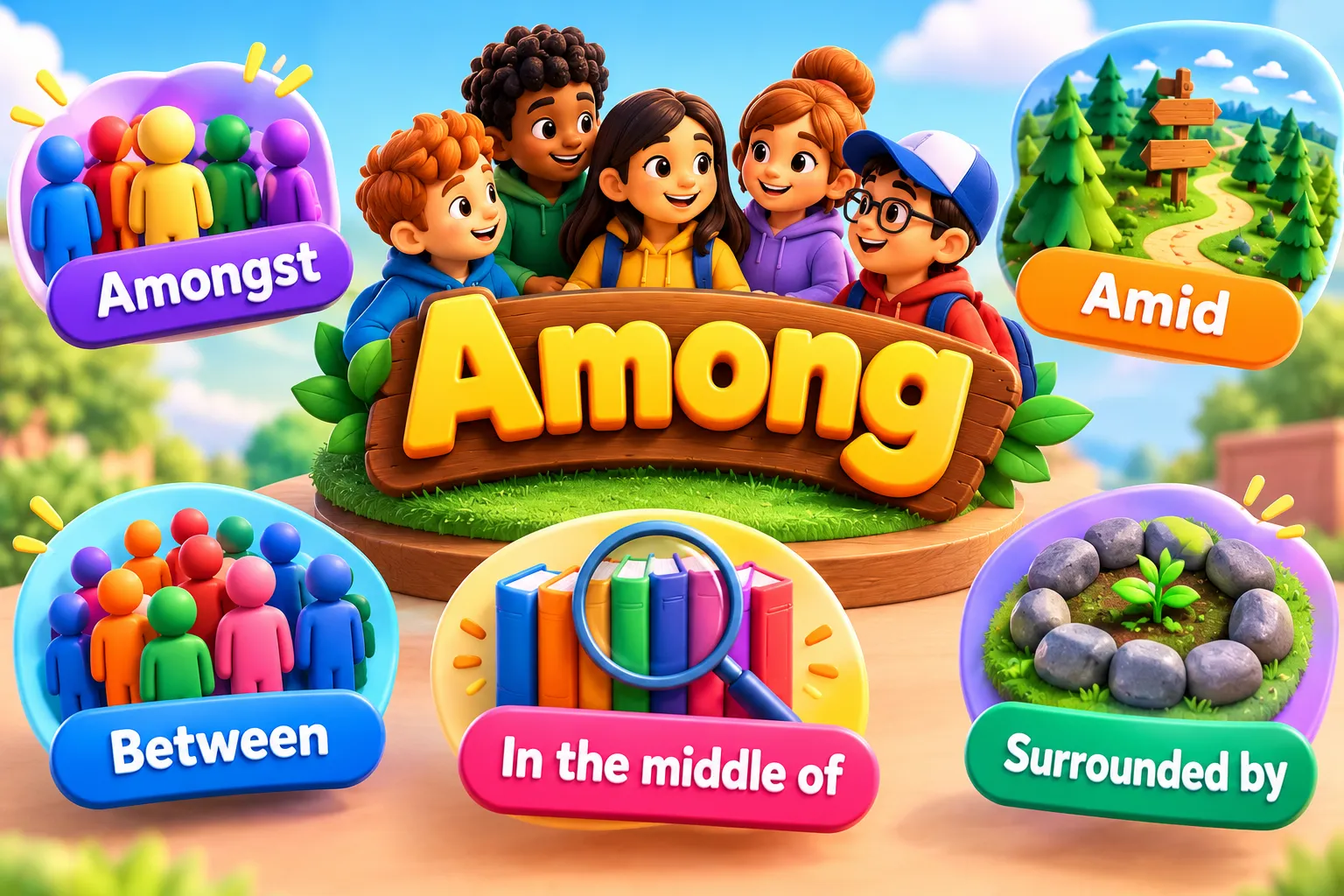
Synonyms for among include amid, amidst, within, surrounded by, in the midst of, alongside, and in the company of. The best alternative depends on the sentence. Use amid for a situation, within for something inside a group or boundary, and alongside when people or things are together. For example, “She felt happy among her friends” can become “She felt happy in the company of her friends.” Choosing the right synonym helps you write clearly, avoid repetition, and express relationships more accurately.
The word among is commonly used to describe people or things that are part of a group. For example, you might sit among your friends, walk among tall trees, or notice excitement among a crowd. It is a useful word, but repeating it too often can make your writing sound less natural.
Learning synonyms for among can help you express your ideas in different ways. Words such as amid, within, and surrounded by have similar meanings, but they are not always interchangeable. Some describe physical locations, while others emphasize group membership, relationships, or shared experiences.
In this guide, you will discover 25 alternatives to among, along with their meanings and example sentences. You will also learn the word’s pronunciation, origin, grammatical features, and antonyms. These simple explanations will help you expand your vocabulary and choose the most suitable expression for everyday conversations, academic writing, and professional communication.
Meaning of Among
Definition of Among
Among (preposition): Used to describe someone or something as being within a group, surrounded by several people or things, or included as part of a larger collection.
Examples:
- She sat among her classmates during lunch.
- Excitement spread among the fans before the match.
- The small cottage stood among the trees.
In these examples, among shows a relationship between a person or thing and a larger group.
Connotative Meaning of Among
The word among usually has a neutral meaning. However, its emotional tone depends on the context in which it appears.
Positive connotation: It can suggest friendship, belonging, or unity.
Example: She felt comfortable among her friends.
Negative connotation: It can describe fear, confusion, or conflict within a group.
Example: Panic spread among the crowd.
Neutral connotation: It can simply describe the position of something or its relationship to a group.
Example: The house stood among the trees.
Understanding these different uses helps you choose words that communicate the right meaning and tone.
Etymology of Among
The word among developed from an Old English expression associated with being in a crowd or mixed with others. Over time, its spelling and usage changed, but its central meaning remained connected to inclusion within a group.
| Historical Period | Development |
|---|---|
| Old English (approximately 450–1100) | Earlier forms expressed the idea of being in a crowd or mixed with others. |
| Middle English (approximately 1100–1500) | The word developed toward the spelling among, with variations appearing in written English. |
| Modern English (1500–present) | Among commonly describes inclusion in a group, a position within a collection, or something shared by several people. |
Today, among remains an important preposition in spoken and written English.
Pronunciation of Among
- Word: Among
- IPA pronunciation: /əˈmʌŋ/
- Syllables: A-mong (2 syllables)
- Part of speech: Preposition
The stress falls on the second syllable: mong.
Word Formation and Affixation of Among
The word among does not use a productive prefix or suffix in modern English. It functions as a complete word.
| Word Element | Explanation |
|---|---|
| Root | Among is a complete preposition with historical roots in Old English. |
| Prefix | It has no commonly recognized productive prefix in modern English. |
| Suffix | It has no commonly recognized productive suffix in modern English. |
| Related variant | Amongst is a variant of among, often associated with British English. |
Common Expressions With Among
Although among does not commonly form new words through affixation, it appears in several useful expressions.
Among other things: Used to introduce one or more items from a larger list.
Example: The report discusses climate change, education, and, among other things, public health.
Among themselves: Used when members of a group interact with one another.
Example: The students discussed the project among themselves.
Among the first: Used to describe someone or something included near the beginning of a group or sequence.
Example: She was among the first students to complete the assignment.
These expressions help you use among naturally in different situations.
25 Synonyms for Among With Meanings and Examples
The following alternatives can help you express the meaning of among more precisely. However, some are direct alternatives only in particular contexts, while others are related phrases. Always consider the meaning of the original sentence before replacing the word.
1. Amid
Meaning: In the middle of or surrounded by something, especially a situation or environment.
Examples:
- She remained calm amid the confusion.
- The cottage stood amid green fields.
Best use: Describing a situation, environment, or surrounding conditions.
2. Amidst
Meaning: In the middle of or surrounded by something.
Examples:
- The children played amidst the trees.
- Hope remained amidst the difficulties.
Best use: Describing a surrounding environment or situation. Amidst has the same basic meaning as amid and can sound slightly more literary.
3. In the Midst of
Meaning: In the middle of a place, group, activity, or situation.
Examples:
- He stood in the midst of the crowd.
- We were in the midst of a busy week.
Best use: Describing someone or something positioned within a group or involved in an ongoing situation.
4. Surrounded By
Meaning: Having people or things on all sides.
Examples:
- The house was surrounded by tall trees.
- She felt safe surrounded by her family.
Best use: Emphasizing that people or objects are all around someone or something.
5. In the Company of
Meaning: Being with another person or a group of people.
Examples:
- He enjoyed walking in the company of friends.
- She felt relaxed in the company of her family.
Best use: Describing companionship or the presence of other people.
6. Within
Meaning: Inside a particular area, group, system, or boundary.
Examples:
- Trust is important within a team.
- The message spread quickly within the community.
Best use: Emphasizing inclusion inside a defined group or boundary.
7. Inside
Meaning: In the inner part of something.
Examples:
- The keys were hidden inside the box.
- The children waited inside the building.
Best use: Describing a physical location. When referring to a group, inside can suggest membership or access, depending on the context.
8. In
Meaning: Used to show that someone or something belongs to, exists in, or forms part of a place or group.
Examples:
- She is popular in her class.
- There is great talent in this team.
Best use: Describing membership, location, or the presence of something within a group.
9. Between
Meaning: In the space separating people or things, or involving distinct individuals or parties.
Examples:
- The village lies between two hills.
- An agreement was reached between the two teams.
Best use: Describing relationships or positions involving distinct parties.
Important: Between is not limited to two people or things. It can also refer to more than two when the individuals or items are considered separately.
10. Throughout
Meaning: In every part of a place or across an entire period.
Examples:
- The news spread throughout the school.
- The festival was celebrated throughout the country.
Best use: Emphasizing something that extends across an entire area or period rather than simply existing within a group.
11. Across
Meaning: From one side to another or throughout different parts of an area.
Examples:
- The news spread across the community.
- People across the country supported the campaign.
Best use: Describing distribution, movement, or reach across a place or population.
12. In the Company of Others
Meaning: Being together with other people.
Examples:
- She enjoyed reading in the company of others.
- He felt more confident in the company of others.
Best use: Emphasizing social interaction or companionship.
13. Part of a Group
Meaning: Belonging to or forming one section of a larger group.
Examples:
- He was part of a group selected for the project.
- She became part of a team of experienced volunteers.
Best use: Describing membership or inclusion.
14. Included In
Meaning: Made part of a group, list, collection, or activity.
Examples:
- Her name was included in the final list.
- The new topic was included in the course.
Best use: Emphasizing that someone or something has been added to a collection or group.
15. Part Of
Meaning: Belonging to or forming one section of something larger.
Examples:
- She is part of a talented team.
- This chapter is part of the main course.
Best use: Showing membership, connection, or inclusion.
16. Within the Ranks of
Meaning: As a member of a particular organization, team, or professional group.
Examples:
- The organization found new leaders within its ranks.
- Several experts within the ranks of the team offered advice.
Best use: Formal writing about organizations, teams, or professional groups.
17. In the Ranks of
Meaning: Included among the members of an organization or group.
Examples:
- She is respected in the ranks of experienced teachers.
- The team has several skilled players in its ranks.
Best use: Describing membership or status within an organization.
18. Alongside
Meaning: Beside someone or something, or working together with another person or group.
Examples:
- She worked alongside experienced teachers.
- The new policy was introduced alongside other changes.
Best use: Emphasizing cooperation, companionship, or things existing together.
19. Together With
Meaning: In the company of someone or something, or combined with it.
Examples:
- He arrived together with his classmates.
- The report was submitted together with the application.
Best use: Showing that people or things are present or included together.
20. In Association With
Meaning: Connected with or working together with a person, organization, or group.
Examples:
- The event was organized in association with a local school.
- She completed the research in association with her colleagues.
Best use: Formal or professional writing about partnerships and collaboration.
21. In the Presence of
Meaning: When someone or something is present in a particular place.
Examples:
- He spoke politely in the presence of his teachers.
- The award was presented in the presence of the whole team.
Best use: Emphasizing that people are present during an event or activity.
22. Amongst
Meaning: Within or surrounded by a group of people or things.
Examples:
- She felt at home amongst her friends.
- The old building stood amongst modern houses.
Best use: Replacing among when the sentence structure allows it. This variant is often more common in British English.
23. Scattered Among
Meaning: Spread or placed at different points within a group or area.
Examples:
- Small houses were scattered among the hills.
- A few errors were scattered among the pages.
Best use: Describing things distributed irregularly throughout a larger area or collection.
24. Mixed With
Meaning: Combined or blended with other people or things.
Examples:
- The red flowers were mixed with white ones.
- Her excitement was mixed with nervousness.
Best use: Emphasizing a combination of different things, qualities, or feelings.
25. Interspersed With
Meaning: Distributed among other things at intervals.
Examples:
- The garden was interspersed with small fountains.
- The speech was interspersed with funny stories.
Best use: Describing things placed at intervals among other elements.
How to Choose the Best Synonym for Among
Choosing the right synonym depends on what you want to communicate. Although several alternatives have similar meanings, each emphasizes a different relationship.
| Intended Meaning | Best Alternative | Example |
|---|---|---|
| During a situation | Amid | She remained calm amid the chaos. |
| Surrounded on all sides | Surrounded by | The house was surrounded by trees. |
| Inside a group or boundary | Within | Trust is important within a team. |
| In someone’s company | In the company of | He relaxed in the company of friends. |
| Working beside someone | Alongside | She worked alongside her colleagues. |
| Across an entire area | Throughout | The news spread throughout the school. |
| Included as a member | Part of | She is part of the team. |
| Positioned between distinct parties | Between | The agreement was made between the teams. |
| Combined with something | Mixed with | The colors were mixed with white. |
| Spread at intervals | Interspersed with | The speech was interspersed with stories. |
Writing tip: Do not replace among with another word just to avoid repetition. Choose an alternative that preserves the original meaning and fits the grammar of your sentence.
Prototype Meaning of Among
The prototype meaning of among is being within a group of people or things. For example, imagine someone standing among friends, a house located among trees, or a name appearing among the winners.
The word also describes situations that are not physical. Feelings, ideas, responsibilities, and qualities can exist among members of a group. For instance, trust can develop among colleagues, while excitement can spread among students.
The key idea is inclusion within a larger group or collection. However, the exact meaning depends on the sentence. Understanding this central meaning makes it easier to choose the right synonym.
Prototype Categorization of Among Synonyms
Synonyms and related expressions for among can be organized into groups according to their meanings. This makes it easier to understand when each alternative is appropriate.
1. Location and Surroundings
These expressions describe a person or thing positioned within or around other things.
Examples: Amid, amidst, in the midst of, surrounded by.
Example: The cottage stood amid green fields.
2. Membership and Inclusion
These expressions show that someone or something belongs to a group or forms part of a larger collection.
Examples: Within, in, part of, included in.
Example: Her name was included in the final list.
3. Companionship and Cooperation
These expressions emphasize being together or working with others.
Examples: In the company of, alongside, together with, in association with.
Example: She worked alongside experienced teachers.
4. Distribution Across an Area
These expressions describe something spread across different parts of a place or collection.
Examples: Throughout, across, scattered among, interspersed with.
Example: Small houses were scattered among the hills.
5. Combination and Connection
These expressions describe things that are combined or connected.
Examples: Mixed with, in association with.
Example: Her excitement was mixed with nervousness.
6. Membership in an Organization
These expressions are useful when discussing teams, institutions, and professional groups.
Examples: Within the ranks of, in the ranks of.
Example: Several talented players were found within the ranks of the team.
Why does categorization matter?
Categorization helps you understand the small differences between similar expressions. For example, amid is useful for situations, alongside emphasizes cooperation, and within highlights inclusion inside a group or boundary. By understanding these differences, you can select words that make your writing clearer and more natural.
Antonyms of Among
The word among does not have one exact opposite in every context. Its antonyms depend on whether you are describing location, inclusion, or membership.
| Antonym or Opposite Expression | Part of Speech | Meaning |
|---|---|---|
| Outside | Preposition/Adverb | Not inside or within something. |
| Excluded from | Phrase | Not allowed to be part of a group. |
| Separate from | Phrase | Not joined or connected with something else. |
| Away from | Prepositional phrase | At a distance from someone or something. |
| Isolated | Adjective | Separated from others. |
| Alone | Adjective/Adverb | Without other people. |
| Detached | Adjective | Separate or disconnected from something. |
| Beyond | Preposition/Adverb | Farther than a particular point or limit. |
| Independent of | Phrase | Not dependent on or controlled by something else. |
| Apart from | Prepositional phrase | Separate from something, or except for something, depending on context. |
Examples of Antonyms in Sentences
- Outside: The children waited outside the classroom.
- Excluded from: He was excluded from the final selection.
- Separate from: Keep the clean clothes separate from the dirty ones.
- Alone: She preferred to study alone.
- Isolated: The village remained isolated during the storm.
These words express ideas that contrast with certain meanings of among, but they are not interchangeable in every sentence.
Frequently Asked Questions About Among
What does among mean?
Among means being within a group, surrounded by several people or things, or included as part of a larger collection.
Example: She sat among her friends.
What are the most common synonyms for among?
Common alternatives include amid, amidst, within, in the midst of, surrounded by, and in the company of. The best choice depends on the sentence.
When should I use among?
Use among when describing someone or something as part of a group or collection.
Example: The teacher distributed the books among the students.
Is among positive or negative?
Among is usually neutral. Its emotional tone depends on the surrounding words and context. It can describe friendship and belonging or fear and confusion.
What is the difference between among and between?
Among usually emphasizes inclusion within a group or collection. Between often describes a relationship or position involving distinct people or things. However, between can also refer to more than two when the individuals or items are considered separately.
Examples:
- She sat among her classmates.
- The agreement was made between the three organizations.
What is the difference between among and amid?
Among usually emphasizes inclusion within a group, while amid often describes being in the middle of a situation or surrounding environment.
Examples:
- She was sitting among her friends.
- She remained calm amid the confusion.
Is amongst a synonym for among?
Yes. Amongst is a variant of among with the same basic meaning. It is often more common in British English, although both forms are correct.
Can within replace among?
Sometimes. Within emphasizes being inside a defined group, area, or boundary. Among more often emphasizes being part of a group or surrounded by several people or things.
Example: Trust is important within a team.
How can I improve my vocabulary using synonyms for among?
Start by learning a few alternatives and using them in your own sentences. Practice choosing amid for situations, within for boundaries, and alongside for cooperation. Reading different types of English writing can also help you understand how these expressions are used naturally.
Conclusion
Learning synonyms for among can improve your vocabulary and help you express ideas more clearly. Alternatives such as amid, within, surrounded by, and in the company of allow you to describe locations, relationships, and group membership in different ways. However, these expressions do not always have exactly the same meaning.
Use amid when describing a situation, within when emphasizing a boundary, and alongside when focusing on cooperation. Choose throughout when something extends across an entire area and interspersed with when describing elements placed at intervals.
The best way to master these alternatives is to practice them in meaningful sentences. Pay attention to their grammar and context instead of replacing words automatically. With regular practice, you can avoid unnecessary repetition, improve your writing style, and communicate more confidently in everyday English and academic work.
Read more:
Synonyms for Bar: 30 Meaningful Alternatives to Know

I’m Ayesha Haram, an English content and SEO writer at SynonymsInstant.com. I focus on creating helpful vocabulary resources, word guides, and practical English content that readers can understand quickly. I combine language research, clear explanations, and SEO-focused writing to produce reliable content that supports learners, writers, and everyday English users.