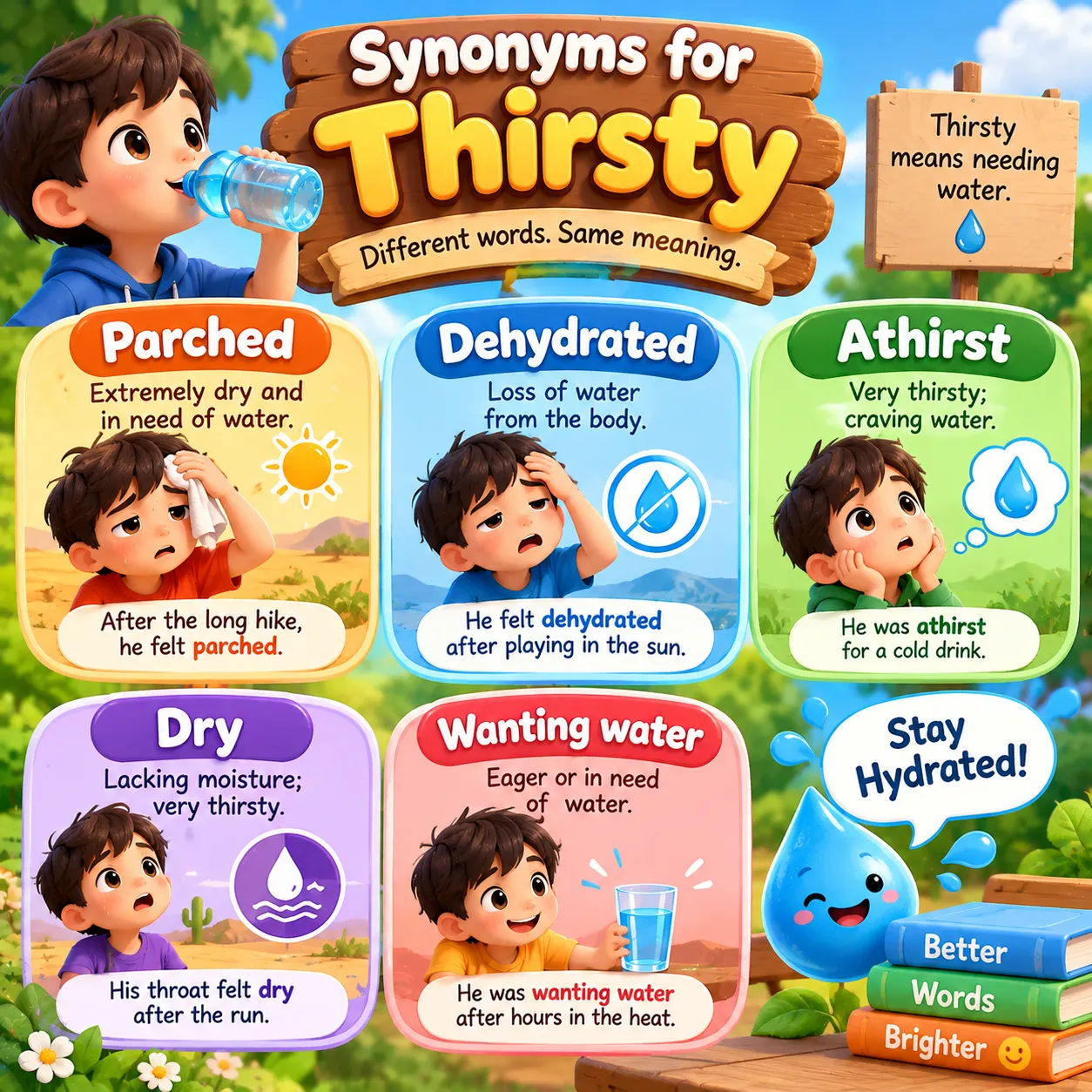
Common synonyms include parched, dehydrated, dry, thirsty, and in need of water.
Some words describe a strong need for water, while others describe a dry mouth or body.
Parched suggests extreme thirst, while dehydrated refers to a lack of water in the body.
The word thirsty can also describe a strong desire for success, attention, or love.
Learning these alternatives can improve your vocabulary and help you choose the right word for each situation.
Thirsty means needing or wanting water or another drink. Imagine playing outside on a hot day. After running for a long time, you may feel thirsty and look for a glass of cold water. The word is common in daily speech, stories, and health discussions. It can also describe a strong desire for something, such as success, knowledge, or attention. Learning synonyms helps English learners express these feelings in different ways. It also helps writers avoid repeating the same word in every sentence. However, not all alternatives have the same meaning. Parched describes extreme dryness, while dehydration often refers to a lack of water in the body. This guide explains the meaning, history, pronunciation, and word forms of thirsty. It also explores 30 alternatives with meanings, examples, and usage tips.
Meaning of Thirsty
Definition
Thirsty (Adjective): Feeling a need or desire to drink water or another liquid. It can also mean having a strong desire for something.
Examples
- I felt thirsty after walking in the hot sun.
- She was thirsty for knowledge and wanted to learn new things.
Connotative Meaning
Connotation (the feeling or idea linked to a word beyond its basic meaning) depends on context.
- Positive tone: Thirsty can suggest a strong desire to learn, grow, or succeed.
- Negative tone: It can suggest desperation or a strong need for attention, especially in informal speech.
- Neutral tone: It simply describes someone who needs a drink.
Etymology of Thirsty
The word thirsty comes from Old English and is linked to the noun thirst.
| Period | Development |
| Old English (450–1100) | Old English þurstig meant thirsty or experiencing thirst. It came from þurst, meaning “thirst.” |
| Middle English (1100–1500) | The word developed into forms such as thursti and thirsty, keeping its basic meaning. |
| Modern English (1500–Present) | Thirsty continued to mean needing a drink. It also gained figurative uses, such as being thirsty for knowledge, success, or attention. |
Pronunciation (IPA)
- IPA: /ˈθɜːr.sti/ (common American English); /ˈθɜː.sti/ (British English)
- Syllables: thirst-y (two syllables)
Affixation Pattern of Thirsty
- Root: Thirst
- Prefix: None
- Suffix: -y, which forms an adjective meaning “having” or “characterized by” something.
Word Formations
| Word | Part of Speech | Meaning |
| Thirst | Noun / Verb | The need for a drink; to feel a need for liquid |
| Thirsty | Adjective | Needing a drink or strongly wanting something |
| Thirstier | Adjective | More thirsty |
| Thirstiest | Adjective | Most thirsty |
| Thirstily | Adverb | In a thirsty or eager way |
| Thirstiness | Noun | The state of being thirsty |
| Thirsting | Verb / Adjective | Feeling or showing a strong desire |
| Thirsted | Verb | Felt thirst or a strong desire |
| Thirst trap | Noun | Informal term for content designed to attract attention, often sexual attention |
| Thirst-quenching | Adjective | Helping to satisfy thirst |
30 Synonyms of Thirsty With Meaning and Examples
Note: Some words below are close synonyms, while others are related descriptions or figurative alternatives. Use each word according to its context.
1. Parched (Adjective)
Meaning: Extremely thirsty or very dry.
Examples:
- We were parched after hiking in the desert.
- The parched traveler quickly drank a glass of water.
2. Dehydrated (Adjective)
Meaning: Having lost more water than the body needs to function well.
Examples:
- The runner felt weak because he was dehydrated.
- Drink water regularly to avoid becoming dehydrated.
3. Dry (Adjective)
Meaning: Lacking moisture or liquid.
Examples:
- My mouth felt dry after the long speech.
- The dry weather made everyone want a cold drink.
4. Dried Out (Adjective Phrase)
Meaning: Having lost much of its moisture.
Examples:
- My mouth dried out during the long walk.
- The plant dried out because it had not been watered.
5. In Need of Water (Phrase)
Meaning: Needing water to drink or to stay healthy.
Examples:
- The hikers were in need of water after climbing the hill.
- The thirsty dog was in need of water.
6. Needing a Drink (Phrase)
Meaning: Wanting water or another liquid to drink.
Examples:
- I am needing a drink after this workout.
- The children were tired and needing a drink.
7. Parched-Mouthed (Adjective)
Meaning: Having an extremely dry mouth.
Examples:
- The nervous speaker felt parched-mouthed before the talk.
- After running, he felt parched-mouthed and uncomfortable.
8. Dry-Mouthed (Adjective)
Meaning: Having little moisture in the mouth.
Examples:
- I felt dry-mouthed after waking up.
- The medicine sometimes left her dry-mouthed.
9. Cotton-Mouthed (Adjective)
Meaning: Having a very dry mouth, as if it were full of cotton.
Examples:
- He felt cotton-mouthed after speaking for an hour.
- The nervous student became cotton-mouthed before the exam.
10. Thirsting (Verb / Adjective)
Meaning: Feeling a strong need for liquid or a strong desire for something.
Examples:
- The travelers were thirsting for water.
- She was thirsting for knowledge and new experiences.
11. Dehydrated-Looking (Adjective Phrase)
Meaning: Appearing to lack enough water in the body.
Examples:
- The tired athlete looked dehydrated after the race.
- The doctor checked the dehydrated-looking patient.
12. Water-Starved (Adjective)
Meaning: Lacking enough water to meet a need.
Examples:
- The water-starved animals searched for a stream.
- Water-starved plants began to wilt in the heat.
13. Moisture-Deprived (Adjective)
Meaning: Lacking the moisture needed to remain healthy or comfortable.
Examples:
- Moisture-deprived skin may feel tight and rough.
- The moisture-deprived soil needed rain.
14. Dry-Throated (Adjective)
Meaning: Having a dry throat, often because of thirst or speaking.
Examples:
- The singer felt dry-throated after the concert.
- I became dry-throated after talking for hours.
15. Thirsty for Knowledge (Phrase)
Meaning: Eager to learn new facts or skills.
Examples:
- The student was thirsty for knowledge.
- Curious children are often thirsty for knowledge.
16. Eager (Adjective)
Meaning: Very interested in doing or learning something.
Examples:
- She was eager to learn a new language.
- The eager students asked many questions.
17. Keen (Adjective)
Meaning: Very interested in or enthusiastic about something.
Examples:
- He is keen to improve his writing.
- She has a keen interest in science.
18. Hungry (Adjective)
Meaning: Having a strong desire for something; it can also mean needing food.
Examples:
- The young athlete was hungry for success.
- She was hungry for new ideas and challenges.
19. Desirous (Adjective)
Meaning: Wanting or wishing for something.
Examples:
- He was desirous of learning new skills.
- The team was desirous of a better result.
20. Yearning (Adjective)
Meaning: Having a deep and strong desire for something.
Examples:
- She felt a yearning for adventure.
- He had a yearning to understand the world.
21. Longing (Noun / Adjective)
Meaning: A strong desire for something that is missing or far away.
Examples:
- He felt a longing for home.
- Her longing for knowledge led her to read more books.
22. Craving (Noun / Verb)
Meaning: A strong desire or need for something.
Examples:
- I was craving a cold drink after the run.
- She was craving more information about the topic.
23. Avid (Adjective)
Meaning: Showing great interest or enthusiasm.
Examples:
- He is an avid reader who enjoys learning.
- The avid learner practiced English every day.
24. Passionate (Adjective)
Meaning: Showing strong feelings or enthusiasm for something.
Examples:
- She is passionate about teaching.
- He is passionate about gaining new knowledge.
25. Ambitious (Adjective)
Meaning: Having a strong desire to achieve success.
Examples:
- The ambitious student wanted to earn a scholarship.
- She is ambitious and works hard to reach her goals.
26. Driven (Adjective)
Meaning: Strongly motivated to reach a goal.
Examples:
- He is driven to improve his skills.
- The driven team worked hard to finish the project.
27. Aspiring (Adjective)
Meaning: Hoping to achieve a particular goal or become something.
Examples:
- The aspiring teacher studied every evening.
- Aspiring writers often practice by keeping a journal.
28. Attention-Seeking (Adjective)
Meaning: Trying hard to get other people’s attention.
Examples:
- The post seemed attention-seeking to some readers.
- His attention-seeking behavior distracted the group.
29. Desperate (Adjective)
Meaning: Having a very strong need or desire, often with a sense of urgency.
Examples:
- The thirsty hikers were desperate for water.
- She was desperate to find a solution.
30. Thirst-Quenching (Adjective)
Meaning: Helping to satisfy thirst.
Examples:
- Cold water is refreshing and thirst-quenching.
- They served a thirst-quenching drink after the game.
Prototype Meaning of Thirsty
The most common meaning of thirsty is needing a drink. People often imagine someone who has been exercising, walking in hot weather, or spending time outdoors without enough water. The word can also describe a strong desire for something that is not a drink. For example, a person may be thirsty for knowledge or thirsty for success. In informal speech, thirsty can describe someone who seems too eager for attention or approval. The context helps readers understand which meaning is intended.
Prototype Categorization
Grouping the alternatives by meaning helps writers choose the best word for each situation.
- Strong physical thirst: Parched, dehydrated, water-starved, in need of water. Use these when someone needs water or has gone without enough liquid. Note that dehydration is a physical condition, not just a feeling of thirst.
- Dry mouth or throat: Dry, dry-mouthed, cotton-mouthed, dry-throated, parched-mouthed. These terms describe dryness in the mouth or throat.
- General need for a drink: Needing a drink, thirsting, dried out. These phrases work in everyday descriptions, although dried out often describes an object or surface rather than a person.
- Desire to learn or achieve: Eager, keen, hungry, desirous, yearning, longing, craving, avid, passionate, ambitious, driven, aspiring. These words describe a strong desire for knowledge, success, or new experiences.
- Strong or urgent desire: Desperate, thirsty for knowledge. These expressions emphasize an intense need or wish.
- Attention and refreshment: Attention-seeking, thirst-quenching. These terms apply to informal social situations or drinks that help satisfy thirst.
These categories help you avoid using a word in the wrong way. For example, parched is useful for extreme physical thirst, while eager or avid may work when describing a person who wants to learn.
Antonyms of Thirsty
An antonym is a word with an opposite or contrasting meaning. The best antonym depends on whether thirsty describes a physical need for water or a strong desire for something.
| Antonym | Part of Speech | Meaning |
| Hydrated | Adjective | Having enough water in the body |
| Quenched | Adjective | Having had thirst satisfied |
| Satisfied | Adjective | Having a need or desire fulfilled |
| Refreshed | Adjective | Feeling renewed or less tired, often after drinking |
| Moist | Adjective | Slightly wet or containing moisture |
| Damp | Adjective | Slightly wet |
| Watered | Adjective | Supplied with water; often used for plants |
| Uninterested | Adjective | Not showing interest or desire |
| Indifferent | Adjective | Having little or no interest or concern |
| Content | Adjective | Feeling satisfied with what one has |
Short Questions and Answers
What does thirsty mean?
Thirsty means needing or wanting a drink. It can also describe a strong desire for something, such as knowledge or success.
When should thirsty be used?
Use thirsty when someone needs a drink or when you want to describe a strong desire. For example, “I am thirsty” describes a physical need, while “She is thirsty for knowledge” describes eagerness to learn.
Is thirsty positive or negative?
The word is usually neutral when it describes physical thirst. It can sound positive when it means eager to learn or succeed. In informal speech, it can sound negative when it describes someone who seems desperate for attention.
How is thirsty different from similar words?
Thirsty is a general word for needing a drink. Parched suggests extreme thirst, dehydrated refers to a lack of water in the body, and eager describes a strong interest or desire rather than a physical need for water.
Conclusion
Learning thirsty and its synonyms can improve your vocabulary and help you express needs and desires clearly. Words such as parched, dry-mouthed, and dehydrated describe physical thirst in different ways. Words such as eager, keen, and ambitious can describe a strong desire to learn or succeed. These alternatives help you avoid repetition in writing and make your meaning more precise. However, some words describe related ideas rather than exact synonyms, so context matters. Practice using one new word each day in a sentence. Read it aloud and check whether it fits the situation. With regular practice, you can strengthen your English writing and speaking skills and feel more confident when choosing the right word.
Read More:
Synonyms for Geothermal: 28 Common Words to Discover

I’m Pinki, an SEO writer at SynonymsInstant.com, specializing in synonyms, antonyms, vocabulary, word meanings, grammar, and English usage. I create accurate, well-researched, reader-friendly content that combines language expertise with SEO best practices. My goal is to make English vocabulary simple, useful, and accessible for students, writers, professionals, and English learners.