
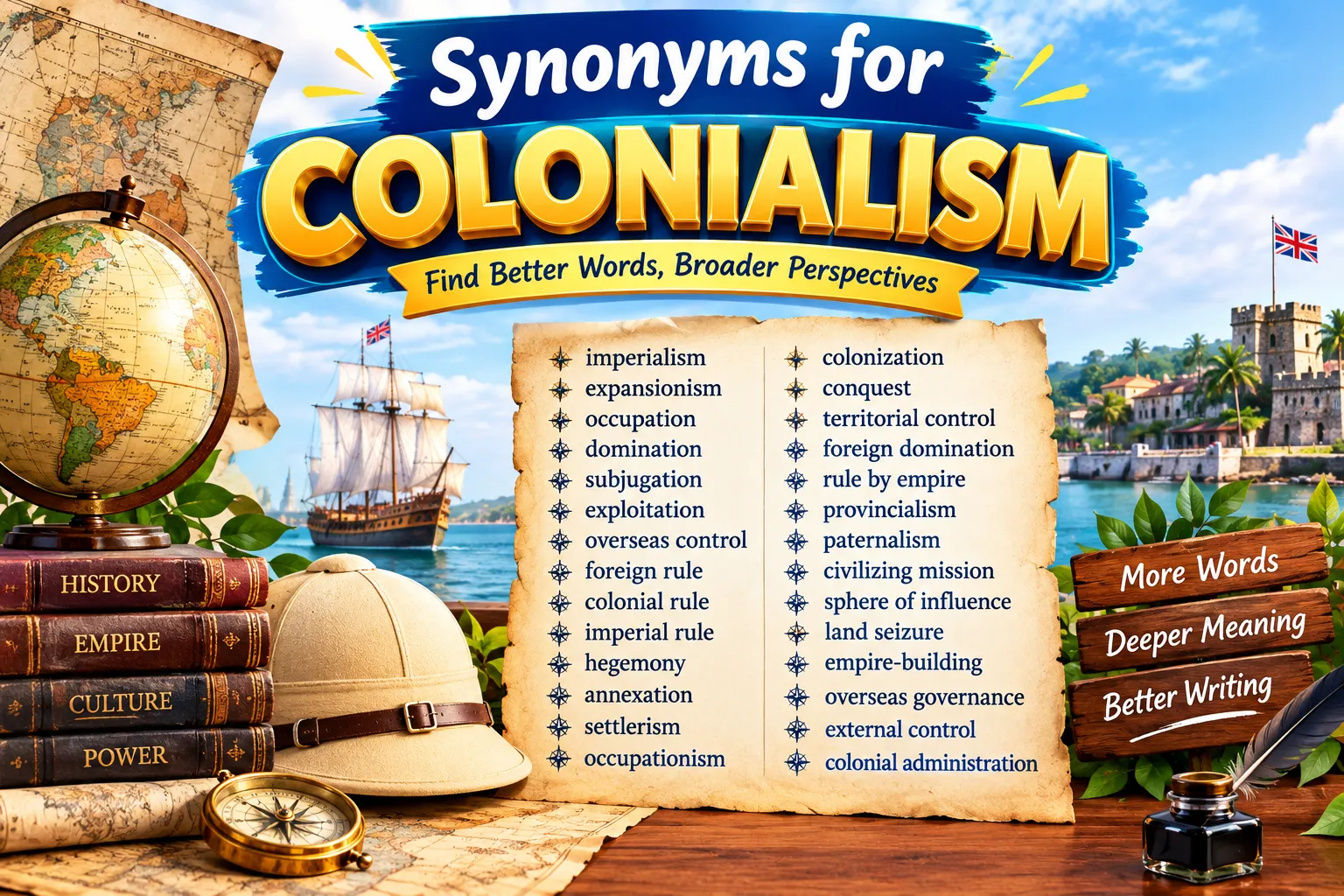
Synonyms for colonialism include imperialism, colonization, expansionism, domination, occupation, conquest, subjugation, territorial control, foreign rule, and exploitation. The best choice depends on context: imperialism emphasizes extending power over other territories, while colonization focuses on establishing control or settlements in another region.
Colonialism is a historical, political, and economic system in which a powerful country takes control of another territory, often by occupying it, exploiting its resources, and governing its people. It usually involves domination, settlement, and long-term control over the colonized region. For example, many countries in Africa, Asia, and the Americas experienced colonialism under European powers.
However, the word colonialism can sometimes feel repetitive or too technical in writing. Learning synonyms and related terms helps you express historical, political, and academic ideas more precisely. It also allows you to describe different aspects of colonial systems such as domination, expansion, occupation, and imperial control. In this guide, we will explore the meaning of colonialism and 30 useful synonyms and related expressions with examples and categories.
| Synonym | Meaning | Best Used When |
| Imperialism | Extending political or economic power over other territories | Discussing expansion of power |
| Colonization | Establishing control, settlements, or colonies in another territory | Discussing the process of creating colonies |
| Expansionism | Policy of expanding a country’s territory or influence | Discussing territorial growth |
| Domination | Exercising strong control over another group or territory | Emphasizing control |
| Occupation | Taking and maintaining control of a place, often by force | Discussing military or territorial control |
| Conquest | Taking control of a territory through force | Historical or military contexts |
| Subjugation | Bringing people or territories under control | Emphasizing loss of independence |
| Foreign rule | Government or control by an outside power | Simple, neutral explanations |
| Territorial control | Authority over a particular geographical area | Academic or political writing |
| Exploitation | Using people or resources for another power’s benefit | Discussing economic or social consequences |
Meaning of Colonialism
Definition
Colonialism (noun): A system in which a country establishes control over foreign territories, exploiting their resources and governing their people, often through settlement and political domination.
Examples
- European colonialism reshaped many parts of the world.
- The effects of colonialism are still visible today.
Connotative Meaning
Connotation (the emotional or implied meaning of a word):
- Negative tone: Exploitation, oppression, inequality, and cultural destruction.
- Historical tone: Refers to past global expansion and empire-building.
- Political tone: Power imbalance between colonizer and colonized.
- Academic tone: Used in history, sociology, and postcolonial studies.
Etymology
- Latin: colonia meaning “farm” or “settlement”
- Latin verb: colere meaning “to cultivate” or “to inhabit”
- French influence: colonialisme developed in modern political discourse
- English (18th–19th century): The term colonialism became widely used during the age of European empires
Pronunciation (IPA)
- IPA: /kəˈloʊ.ni.əˌlɪz.əm/
- Syllables: co-lo-ni-al-ism
Word Function
- Type: Noun
- Related forms:
- Colonial (adjective)
- Colony (noun)
- Colonize (verb)
- Colonization (noun)
- Colonialist (noun/adjective)
30 Synonyms and Related Terms for Colonialism With Meaning & Examples
Note: Some words are direct synonyms, while others are closely related concepts used in history, politics, and postcolonial studies.
1. Imperialism
Meaning: A system where a powerful country extends its control over other regions through force or influence.
Example:
- European imperialism expanded across Asia and Africa.
2. Empire-building
Meaning: The process of expanding a nation’s power and territory.
Example:
- Ancient Rome was known for its empire-building.
3. Expansionism
Meaning: A policy of expanding a country’s territory or influence.
Example:
- 19th-century expansionism shaped global politics.
4. Occupation
Meaning: Control of a territory by foreign military or political forces.
Example:
- The occupation lasted for decades.
5. Domination
Meaning: Controlling or ruling over another group or territory.
Example:
- The region suffered under foreign domination.
6. Subjugation
Meaning: The act of bringing people under control, often by force.
Example:
- The subjugation of native populations was widespread.
7. Conquest
Meaning: The act of taking control of a territory through force.
Example:
- The conquest of new lands changed world history.
8. Annexation
Meaning: The formal addition of a territory to a country.
Example:
- The annexation of the region caused conflict.
9. Imperial rule
Meaning: Governance by an empire over foreign lands.
Example:
- Many countries lived under imperial rule.
10. Foreign rule
Meaning: Control of a country by outsiders.
Example:
- The people resisted foreign rule.
11. Settler colonialism
Meaning: A form of colonialism where settlers replace indigenous populations.
Example:
- Settler colonialism reshaped indigenous societies.
12. Territorial expansion
Meaning: Growth of a country’s land or control.
Example:
- The empire pursued territorial expansion.
13. Hegemony
Meaning: Dominance of one group or country over others.
Example:
- Cultural hegemony influenced local traditions.
14. Control system
Meaning: A structured way of governing dominated regions.
Example:
- The control system enforced strict rules.
15. Exploitation system
Meaning: A system that takes advantage of people or resources.
Example:
- The economy functioned as an exploitation system.
16. Imperial expansion
Meaning: Growth of an empire’s power and territory.
Example:
- Imperial expansion reached its peak in the 19th century.
17. Colonial rule
Meaning: Governance by a colonial power.
Example:
- The country was under colonial rule for decades.
18. Overseas domination
Meaning: Control of distant territories.
Example:
- Overseas domination shaped global trade routes.
19. Political control
Meaning: Authority over governance and decision-making.
Example:
- The region was under strict political control.
20. Economic exploitation
Meaning: Using another region’s resources for profit.
Example:
- Economic exploitation benefited the colonizers.
21. Cultural imperialism
Meaning: Imposing one culture over another.
Example:
- Cultural imperialism affected local languages.
22. Resource extraction system
Meaning: System focused on taking natural resources from colonies.
Example:
- The resource extraction system enriched the empire.
23. Dependency system
Meaning: A system where colonies depend on the colonizer.
Example:
- The dependency system limited local development.
24. Imperial control
Meaning: Direct authority of an empire over territories.
Example:
- The region remained under imperial control.
25. Colonial expansion
Meaning: Growth of colonial territories.
Example:
- Colonial expansion changed global borders.
26. Foreign domination
Meaning: Rule by external powers.
Example:
- The people resisted foreign domination.
27. Empire system
Meaning: A political structure based on empires.
Example:
- The empire system governed vast regions.
28. Colonial occupation
Meaning: Military or political presence in a colony.
Example:
- The colonial occupation lasted many years.
29. Imperialism system
Meaning: Structured global dominance by powerful nations.
Example:
- The imperialism system shaped world history.
30. Global domination
Meaning: Control over multiple regions worldwide.
Example:
- The empire aimed for global domination.
Prototype Meaning
The core meaning of colonialism is:
A system of political, economic, and cultural control in which one country dominates and exploits another territory and its people.
Prototype Categorization
The synonyms and related terms can be grouped as follows:
- Direct political control: colonial rule, imperial rule, foreign rule, occupation
- Expansion and conquest: imperialism, expansionism, conquest, annexation
- Power and dominance: domination, hegemony, global domination
- Economic systems: economic exploitation, resource extraction system, dependency system
- Cultural influence: cultural imperialism
- Historical structures: empire-building, empire system, imperial expansion
- Colonial forms: settler colonialism, colonial occupation, colonial expansion
Antonyms (Opposite Ideas)
- Independence
- Self-determination
- Sovereignty
- Freedom
- Decolonization
- Autonomy
- Liberation
- Self-rule
- Emancipation
- National independence
Short Questions and Answers
What does colonialism mean?
It refers to the control and exploitation of one country by another, often involving settlement and political domination.
Is colonialism the same as imperialism?
They are related, but imperialism is broader, while colonialism specifically involves settlement and direct control of territories.
Why is colonialism important in history?
It shaped global borders, economies, cultures, and political systems that still influence the world today.
What is the opposite of colonialism?
The opposite is decolonization, which refers to the process of gaining independence from colonial rule.
Conclusion
Understanding synonyms for colonialism helps you describe historical and political systems with greater precision. Words like imperialism, occupation, and domination highlight power structures, while terms like economic exploitation and cultural imperialism focus on specific impacts. More neutral terms such as expansionism or empire-building are useful in academic writing, while decolonization represents the opposite process. By learning these terms, you can better understand world history, write more accurately, and discuss global power systems with clarity and depth.
Read More:
Synonyms for historic: 28 Powerful Alternatives & Meanings

I am Rubab content specialist focused on creating accurate, user-friendly, and search-optimized language resources. Through Synonyminstant, I help readers find synonyms, antonyms, meanings, and vocabulary with ease. Every article is carefully researched and optimized to provide reliable information, clear explanations, and an excellent user experience.