Synonyms for historic include important, significant, momentous, landmark, notable, memorable, groundbreaking, influential, and consequential. These words describe something important because of its lasting impact or connection to a major event. For example, you can call a historic decision a landmark decision, a historic event a momentous event, or a historic achievement a groundbreaking achievement. The best synonym depends on the context and the level of importance you want to express.
Historic is a word we use to describe something very important in history. It can be an event, a place, or a moment that people remember for a long time. For example, the first moon landing is a historic event because it changed human history. We also say a building is historic when it has great cultural or past value.
The word historic is common in news, books, and education because it helps us highlight important moments from the past. Writers and speakers use it to show that something is not ordinary but meaningful in history. Learning synonyms for historic helps English learners and writers avoid repetition and express ideas more clearly. In this article, you will learn the meaning, usage, pronunciation, origin, structure, and 30 simple synonyms of historic with easy examples and clear categories.
Meaning of Historic
Definition
Historic (Adjective):
Something that is important in history or has a strong impact on the past or future.
Examples
- The signing of the treaty was a historic moment.
- We visited a historic castle in Europe.
Connotative Meaning
Connotation means the feeling or idea a word gives beyond its basic meaning.
- Positive tone: Important, memorable, respected, and meaningful.
- Negative tone: Rarely negative, but can feel serious or tied to conflict.
- Neutral tone: Simply related to past events or history.
Etymology
The word historic comes from Greek and Latin roots.
- Old English (450–1100): No direct form; ideas expressed through “story” or “tale”
- Middle English (1100–1500): From Latin historicus, meaning “related to history”
- Modern English (1500–Present): Became historic, meaning something important in history or related to historical events
Pronunciation (IPA)
- IPA: /hɪˈstɒr.ɪk/
- Syllables: his-tor-ic
Affixation Pattern of Historic
- Root: history (from Greek historia)
- Prefix: None
- Suffix: -ic (meaning “related to”)
Word formations
- historic — adjective
- historical — adjective (related to history in general)
- historically — adverb
- history — noun
- historiography — noun (study of writing history)
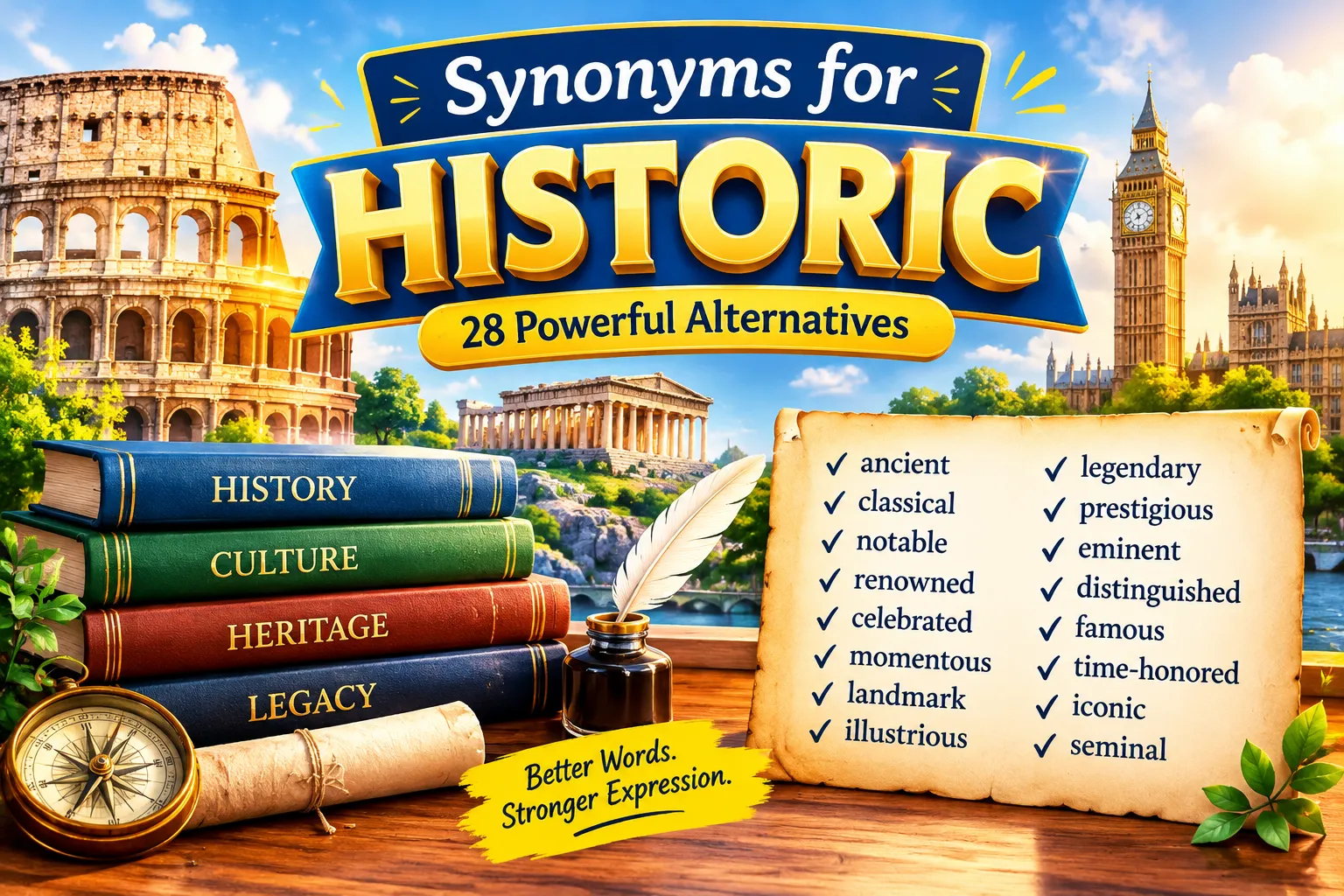
28 Synonyms of Historic With Meaning & Examples
1. Important (Adjective)
Meaning: Having great value or significance.
Examples:
- It was an important event in world history.
- The discovery is important for science.
2. Significant (Adjective)
Meaning: Very meaningful or influential.
Examples:
- The speech was a significant moment.
- This is a significant change in history.
3. Momentous (Adjective)
Meaning: Extremely important and likely to change history.
Examples:
- The decision was momentous.
- It was a momentous day for the country.
4. Memorable (Adjective)
Meaning: Worth remembering for a long time.
Examples:
- The event was memorable for everyone.
- It was a memorable night in history.
5. Landmark (Adjective)
Meaning: Very important and marking a major change.
Examples:
- The agreement was a landmark decision.
- It was a landmark achievement in science.
6. Notable (Adjective)
Meaning: Worth attention because of importance.
Examples:
- The battle was a notable event.
- She made a notable contribution to history.
7. Remarkable (Adjective)
Meaning: Unusual and worthy of attention.
Examples:
- It was a remarkable discovery.
- The event was remarkable in many ways.
8. Epic (Adjective)
Meaning: Very large, impressive, or heroic in scale.
Examples:
- The battle was an epic struggle.
- It was an epic moment in history.
9. Legendary (Adjective)
Meaning: Famous and remembered for a long time.
Examples:
- The king became a legendary figure.
- It was a legendary event in sports history.
10. Famous (Adjective)
Meaning: Well known by many people.
Examples:
- The historic site is famous worldwide.
- The event became famous in history books.
11. Iconic (Adjective)
Meaning: Widely recognized and symbolically important.
Examples:
- The building is an iconic landmark.
- It was an iconic moment in history.
12. Pivotal (Adjective)
Meaning: Very important in changing the course of events.
Examples:
- The battle was a pivotal moment.
- It was a pivotal decision in history.
13. Crucial (Adjective)
Meaning: Extremely important for a result.
Examples:
- The meeting was crucial for peace.
- It was a crucial point in history.
14. Defining (Adjective)
Meaning: Showing the most important features of something.
Examples:
- It was a defining moment of the era.
- The event was defining for the nation.
15. Revolutionary (Adjective)
Meaning: Causing major change.
Examples:
- The invention was revolutionary.
- It was a revolutionary moment in history.
16. Groundbreaking (Adjective)
Meaning: New and very important in development.
Examples:
- The discovery was groundbreaking.
- It was a groundbreaking event in science.
17. Milestone (Adjective)
Meaning: A very important stage or event.
Examples:
- The treaty was a milestone in peace.
- It was a milestone in human progress.
18. Record-breaking (Adjective)
Meaning: Setting a new record in importance or achievement.
Examples:
- The event was record-breaking.
- It was a record-breaking moment in sports.
19. Influential (Adjective)
Meaning: Having a strong effect on people or events.
Examples:
- The leader was influential in history.
- It was an influential moment.
20. Transformative (Adjective)
Meaning: Causing major change or improvement.
Examples:
- The policy was transformative.
- It was a transformative event in history.
21. Classical (Adjective)
Meaning: Belonging to ancient or traditional history.
Examples:
- The building has classical importance.
- It is a classical historic site.
22. Ancient (Adjective)
Meaning: Very old and from long ago.
Examples:
- The ancient ruins are historic.
- It is an ancient historic city.
23. Traditional (Adjective)
Meaning: Related to long-established customs or history.
Examples:
- The festival has traditional value.
- It is a traditional historic event.
24. Heritage (Adjective)
Meaning: Related to cultural or historical value.
Examples:
- The site is a heritage landmark.
- It is a heritage historic place.
25. Cultural (Adjective)
Meaning: Related to culture and history.
Examples:
- The museum has cultural importance.
- It is a cultural historic event.
26. Time-honored (Adjective)
Meaning: Respected because it has existed for a long time.
Examples:
- It is a time-honored tradition.
- The site is time-honored and historic.
27. Age-old (Adjective)
Meaning: Very old and long established.
Examples:
- It is an age-old historic site.
- The tradition is age-old.
28. Long-standing (Adjective)
Meaning: Existing for a long time.
Examples:
- The conflict is long-standing.
- It is a long-standing historic issue.
Prototype Meaning
The most common idea of historic is something that is very important in history and remembered for a long time. People usually think of major events like wars, discoveries, speeches, or agreements that changed the world. It can also describe old buildings or places that carry cultural and historical value.
Prototype Categorization
The synonyms of historic can be grouped into clear categories:
- Importance and impact: important, significant, crucial, pivotal, defining — used for events that changed history.
- Fame and recognition: famous, iconic, legendary, notable, remarkable — used for well-known or widely remembered events.
- Change and innovation: revolutionary, groundbreaking, transformative, milestone — used for events that created change.
- Time and age: ancient, age-old, long-standing, classical — used for old or traditional history.
- Cultural and heritage value: heritage, cultural, traditional, time-honored — used for historical and cultural importance.
- Scale and impact: monumental, epic, record-breaking — used for large and powerful historical events.
This grouping helps writers choose the right synonym depending on whether they want to show importance, age, fame, or change.
Antonyms of Historic
1. Modern (Adjective)
Meaning: Belonging to the present time.
2. Recent (Adjective)
Meaning: Happening in the near past.
3. Ordinary (Adjective)
Meaning: Not special or important.
4. Unimportant (Adjective)
Meaning: Not having significance.
5. Common (Adjective)
Meaning: Frequently seen or normal.
6. Forgettable (Adjective)
Meaning: Not worth remembering.
7. Insignificant (Adjective)
Meaning: Too small or unimportant to matter.
8. Contemporary (Adjective)
Meaning: Belonging to the present time.
Short Questions and Answers
What does historic mean?
Historic means something very important in history or something that has a strong impact on the past or future.
When should historic be used?
It is used when describing important events, places, or moments that are remembered in history.
Is historic positive or negative?
It is usually positive or neutral, depending on the event being described.
How is it different from similar words?
Historical refers to anything related to history in general, while historic refers to something especially important in history.
Conclusion
Learning historic and its synonyms helps you describe important events in a more powerful and flexible way. Instead of repeating the same word, you can use alternatives like significant, landmark, pivotal, monumental, iconic, or revolutionary depending on the meaning. These words help you write better essays, stories, and reports by making your language richer and more precise. Understanding the differences between these synonyms also improves your speaking skills and confidence. With regular practice, you will be able to choose the right word naturally and express historical ideas more clearly and effectively.

I’m Ayesha Haram, an English content and SEO writer at SynonymsInstant.com. I focus on creating helpful vocabulary resources, word guides, and practical English content that readers can understand quickly. I combine language research, clear explanations, and SEO-focused writing to produce reliable content that supports learners, writers, and everyday English users.