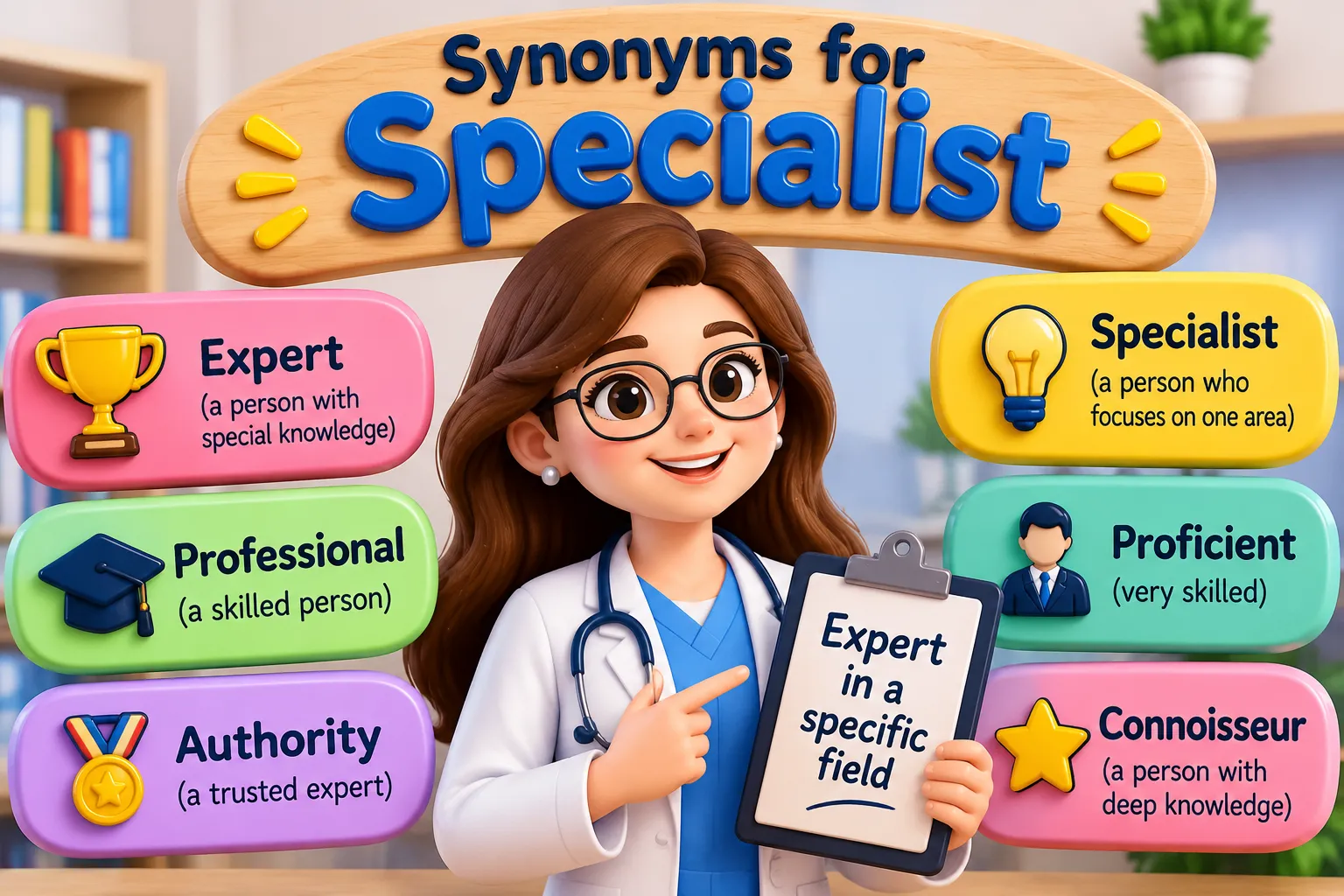
A specialist is someone with advanced knowledge, training, or skills in a particular field. Common synonyms for specialist include expert, professional, consultant, authority, practitioner, and technician. However, each word has a slightly different meaning. An expert has deep knowledge, while a consultant provides professional advice. A technician focuses on practical or technical tasks. Choosing the right synonym helps you describe a person’s skills accurately, avoid repetition, and make your writing more effective.
Specialists work in many fields, including healthcare, education, science, business, and technology. For example, a heart specialist treats heart-related conditions, while a computer specialist helps solve technical problems. Similarly, a language specialist may help improve translation, communication, or language learning.
Learning synonyms for specialist can strengthen your English vocabulary and improve your professional writing. These alternatives also help you explain different roles more precisely. In this guide, you will discover 30 synonyms for specialist, along with their meanings, examples, pronunciation, word forms, and antonyms. You will also learn how to choose the most appropriate word for different situations.
Meaning of Specialist and Its Synonyms
What Does Specialist Mean?
Specialist (noun): A person who has detailed knowledge, training, or skill in a particular subject, activity, or profession.
A specialist usually focuses on one area and develops deeper knowledge of it. For example, a heart specialist focuses on heart health, while an education specialist may work on teaching methods or student learning.
Examples of Specialist in Sentences
- The hospital referred the patient to a heart specialist.
- We contacted a computer specialist to resolve the network issue.
- The company hired a marketing specialist to improve its online presence.
- She is a language specialist with experience in translation and editing.
Connotation of Specialist
Connotation refers to the feelings or ideas a word suggests beyond its basic meaning.
- Positive connotation: The word often suggests expertise, experience, and professional ability.
Example: The specialist provided clear advice and an effective solution. - Negative connotation: In some contexts, it may suggest an overly narrow focus or limited knowledge outside one field.
Example: He understood his specialty well but struggled with broader issues. - Neutral connotation: The word can simply describe someone’s professional focus.
Example: She works as a computer specialist.
Overall, specialist is usually neutral or positive. Its meaning depends on the context in which it appears.
Etymology and History of Specialist
The word specialist is formed from special and the suffix -ist. The suffix often identifies a person associated with a particular subject, activity, or profession. The word special ultimately comes from the Latin specialis, meaning particular or distinct.
| Period | Development |
|---|---|
| Old English (450–1100) | The modern word specialist was not yet in use. Related ideas were expressed through words meaning particular, distinct, or separate. |
| Middle English (1100–1500) | The word special entered English through French, with roots in Latin specialis. It described something particular or distinct. |
| Modern English (1500–present) | Specialist developed as a term for a person with focused knowledge or skill. It is now widely used in healthcare, education, science, business, and technology. |
Pronunciation of Specialist
Correct pronunciation helps you use the word confidently in conversation.
- IPA: /ˈspɛʃ.əl.ɪst/
- Syllables: spe-cial-ist
- Syllable count: Three
- Word stress: The first syllable receives the main stress.
Practice saying specialist slowly before using it in a complete sentence.
Affixation and Word Forms of Specialist
The word specialist contains the base word special and the suffix -ist. It has no prefix.
The suffix -ist often refers to a person who works in, studies, or has a connection to a particular field.
Word Formation Table
| Word | Part of Speech | Meaning |
|---|---|---|
| Special | Adjective | Particular or different from others |
| Specialize | Verb | To focus on a specific subject or skill |
| Specializes | Verb | Focuses on a particular field |
| Specialized | Adjective / Verb | Focused on a specific area or adapted for a particular purpose |
| Specializing | Verb | Focusing on a particular subject or activity |
| Specialization | Noun | The process of focusing on one field |
| Specialist | Noun | A person with focused knowledge or skill |
| Specialists | Plural noun | More than one specialist |
| Specialistic | Adjective | Related to specialists or specialization; uncommon in everyday English |
30 Synonyms for Specialist With Meanings and Examples
Several words have meanings related to specialist, but they are not always interchangeable. Some emphasize knowledge, others describe professional roles, and a few refer to people with specific technical or academic skills. The following list explains their differences so you can choose the most accurate word.
1. Expert
Meaning: A person with extensive knowledge or advanced skills in a particular subject.
Examples:
- We asked an expert to review the research findings.
- She is an expert in early childhood education.
Best use: When emphasizing deep knowledge or proven ability.
2. Professional
Meaning: A person who has the training or experience required for a particular occupation.
Examples:
- We hired a professional to redesign the website.
- He is an experienced healthcare professional.
Best use: When referring to someone who works in a trained or skilled occupation.
3. Authority
Meaning: A person widely respected for their knowledge of a particular subject.
Examples:
- She is an authority on modern literature.
- The professor is a leading authority in environmental science.
Best use: When emphasizing a person’s reputation and recognized knowledge.
4. Consultant
Meaning: A professional who provides advice or recommendations to individuals or organizations.
Examples:
- The company hired a business consultant to review its strategy.
- We consulted a marketing specialist about our campaign.
Best use: When describing someone who advises others or helps solve professional problems.
5. Practitioner
Meaning: A person who actively works in a profession or applies a particular skill.
Examples:
- She is a medical practitioner with years of experience.
- The practitioner explained the available treatment options.
Best use: In professional fields, particularly healthcare and other applied disciplines.
6. Technician
Meaning: A trained person who works with technical equipment, systems, or processes.
Examples:
- The technician repaired the office computer.
- A laboratory technician prepared the samples for testing.
Best use: For practical, technical, or equipment-related work.
7. Advisor
Meaning: A person who provides guidance or recommendations about a particular subject.
Examples:
- The financial advisor explained the investment options.
- She met with an academic advisor to discuss her courses.
Best use: When someone helps others make informed decisions.
8. Adviser
Meaning: Another standard spelling of advisor, referring to someone who gives advice.
Examples:
- The adviser helped the team understand the new policy.
- He spoke with a career adviser before choosing a profession.
Best use: In education, business, career planning, and personal guidance. Both advisor and adviser are correct.
9. Master
Meaning: A person who has exceptional control or skill in a particular activity.
Examples:
- She is a master of classical piano.
- The chess master taught students advanced strategies.
Best use: When highlighting exceptional ability in a skill or discipline.
10. Scholar
Meaning: A person who studies a subject deeply, often through academic research.
Examples:
- The scholar published a book on ancient history.
- She is a respected scholar of English literature.
Best use: In academic and research contexts.
11. Authority Figure
Meaning: A person recognized for leadership, power, or influence in a particular setting.
Examples:
- The authority figure explained the safety procedures.
- She became an important authority figure within the organization.
Best use: When describing leadership or influence. This is not a direct synonym for specialist, because a person can hold authority without specialized knowledge.
12. Connoisseur
Meaning: A person with detailed knowledge and refined judgment in an area such as art, food, or music.
Examples:
- She is a connoisseur of classical art.
- The connoisseur recognized the painting’s historical style.
Best use: When discussing expert appreciation or informed judgment.
13. Savant
Meaning: A person with exceptional knowledge or ability in a particular area.
Examples:
- The documentary featured a musical savant.
- The young savant demonstrated an extraordinary ability with numbers.
Best use: When describing exceptional abilities. Use the term carefully because it can carry specific associations with unusual cognitive abilities.
14. Whiz
Meaning: An informal word for someone who is especially skilled at something.
Examples:
- She is a computer whiz who solves difficult technical problems.
- Ask Daniel for help; he is a math whiz.
Best use: In casual conversations about impressive skills.
15. Ace
Meaning: An informal term for someone who performs exceptionally well at a particular activity.
Examples:
- He is an ace mechanic.
- The company hired an ace programmer to improve its software.
Best use: In informal writing when praising someone’s ability.
16. Analyst
Meaning: A person who examines information carefully to identify patterns, understand problems, or support decisions.
Examples:
- The financial analyst reviewed the latest market data.
- A data analyst identified a pattern in the survey results.
Best use: In finance, business, research, and data-related professions.
17. Researcher
Meaning: A person who investigates a subject to discover information or develop new knowledge.
Examples:
- The researcher studied how children develop language skills.
- Researchers tested the method before publishing their findings.
Best use: When describing someone who conducts research.
18. Scientist
Meaning: A person who studies the natural world through observation, experiments, or scientific methods.
Examples:
- The scientist examined the water samples.
- A climate scientist explained the latest findings.
Best use: In scientific fields. A scientist may be a specialist, but the words do not always mean the same thing.
19. Engineer
Meaning: A trained professional who designs, builds, tests, or maintains machines, structures, or systems.
Examples:
- The engineer designed a safer bridge.
- A software engineer improved the application’s performance.
Best use: For engineering and technical professions.
20. Clinician
Meaning: A trained healthcare professional who works directly with patients.
Examples:
- The clinician discussed the patient’s symptoms.
- A clinician explained the treatment options to the family.
Best use: In healthcare settings, especially when referring to patient care.
21. Physician
Meaning: A medical doctor who diagnoses and treats illnesses.
Examples:
- The physician examined the patient.
- She visited a physician for a routine health check.
Best use: When referring to a medical doctor. A physician may provide general care or specialize in a particular area.
22. Surgeon
Meaning: A medical doctor trained to perform surgical operations.
Examples:
- The surgeon explained the procedure before the operation.
- An experienced surgeon performed the surgery.
Best use: When describing a doctor who performs operations.
23. Educator
Meaning: A person who teaches or supports learning.
Examples:
- The educator developed a new reading program.
- She is an experienced educator who supports struggling students.
Best use: In education and teaching. An educator may specialize in a subject, age group, or teaching method.
24. Instructor
Meaning: A person who teaches a subject or practical skill.
Examples:
- The driving instructor explained the road rules.
- Our instructor showed us how to use the software.
Best use: For formal lessons, practical instruction, and skills training.
25. Trainer
Meaning: A person who teaches others how to perform a task or improve a skill.
Examples:
- The trainer helped employees learn the new system.
- She works as a fitness trainer.
Best use: In workplace training, fitness, and practical skill development.
26. Craftsman
Meaning: A skilled person who makes or repairs objects, often by hand.
Examples:
- The craftsman made a beautiful wooden chair.
- We hired a skilled craftsman to restore the old door.
Best use: For skilled manual work, traditional crafts, and restoration.
27. Virtuoso
Meaning: A person with exceptional skill, especially in music or the performing arts.
Examples:
- The pianist is a virtuoso.
- The concert featured a violin virtuoso.
Best use: When describing outstanding artistic or musical ability.
28. Technician Specialist
Meaning: A technician who focuses on a particular type of equipment, system, or technical process.
Examples:
- The network technician specialist resolved the connectivity issue.
- A specialist technician inspected the laboratory equipment.
Best use: When emphasizing technical specialization. In most writing, specialist technician or a more specific job title sounds more natural.
29. Subject-Matter Expert
Meaning: A person with detailed knowledge of a specific topic, process, or professional area.
Examples:
- The subject-matter expert reviewed the training materials.
- We invited a subject-matter expert to explain the new regulations.
Best use: In professional, academic, and business writing.
30. Consultant Specialist
Meaning: A specialist who provides professional advice within a particular field.
Examples:
- The company brought in a specialist consultant to assess its operations.
- A specialist consultant helped the team improve its procedures.
Best use: In professional contexts. In natural English, specialist consultant is generally more common than consultant specialist.
Prototype Meaning of Specialist
The central meaning of specialist is a person with detailed knowledge, training, or skill in a particular area. A person might think of a doctor who treats a specific condition, a technician who maintains computer systems, or a consultant who advises a company.
A specialist usually focuses on one field and develops a deeper understanding of it. The word often suggests professional knowledge and experience. However, the most suitable alternative depends on the person’s role.
For example, expert emphasizes knowledge, consultant highlights advice, and technician refers to practical technical work. In academic settings, researcher or scholar may be more accurate. Choosing the right word makes your writing clearer and more precise.
Categories of Synonyms for Specialist
Specialist synonyms and related terms can be grouped by the knowledge, skills, or professional roles they describe. These categories make it easier to choose the right word for your sentence.
1. Words for Knowledge and Expertise
These words emphasize a person’s understanding or ability.
- Expert: Someone with advanced knowledge or skill.
- Professional: Someone trained or experienced in a particular occupation.
- Master: Someone with exceptional ability in a skill.
- Subject-matter expert: Someone with detailed knowledge of a specific topic.
- Authority: Someone respected for their knowledge of a subject.
- Connoisseur: Someone with refined knowledge and judgment in a particular area.
2. Words for Advice and Guidance
These terms describe people who help others understand problems or make decisions.
- Consultant: Provides professional advice and recommendations.
- Advisor: Offers guidance about a particular subject.
- Adviser: Another spelling of advisor.
3. Words for Research and Analysis
These words describe people who investigate questions, examine evidence, or develop knowledge.
- Researcher: Investigates a topic to discover information.
- Scientist: Uses scientific methods to study the natural world.
- Scholar: Studies a subject in depth, often through academic work.
- Analyst: Examines information to identify patterns or support decisions.
4. Words for Technical and Practical Skills
These terms describe people who apply practical or technical knowledge.
- Technician: Works with equipment, systems, or technical processes.
- Engineer: Designs, builds, tests, or maintains systems and structures.
- Craftsman: Makes or repairs objects using skilled techniques.
5. Words for Healthcare Professionals
These terms describe different roles in medical care.
- Practitioner: Works in a professional field, including healthcare.
- Clinician: Provides direct care to patients.
- Physician: Diagnoses and treats illnesses as a medical doctor.
- Surgeon: Performs surgical operations.
These words are not interchangeable. Each refers to a particular role or qualification.
6. Words for Teaching and Training
These terms describe people who help others develop knowledge or skills.
- Educator: Supports teaching and learning.
- Instructor: Teaches a subject or skill.
- Trainer: Helps people improve their abilities through practice or instruction.
Understanding these categories can improve your word choice. For example, use consultant for someone who advises a business, researcher for someone who investigates a question, and technician for someone who works with technical equipment.
Antonyms of Specialist
There is no single perfect antonym for specialist. However, several words describe people who have broad knowledge, limited experience, or no specialized training.
| Antonym | Part of Speech | Meaning |
|---|---|---|
| Generalist | Noun | A person with knowledge across several different areas |
| Amateur | Noun | A person who does an activity without being a trained professional |
| Novice | Noun | A person who is new to a subject or activity |
| Beginner | Noun | Someone who is just starting to learn something |
| Layperson | Noun | Someone without specialized knowledge of a particular subject |
| Nonexpert | Noun | A person who is not an expert in a field |
| Jack-of-all-trades | Noun phrase | A person with skills in many different areas |
| Dilettante | Noun | Someone who takes an interest in a subject without studying it deeply |
| Inexperienced person | Noun phrase | Someone with little experience in a particular field |
| General practitioner | Noun | A doctor who provides general medical care rather than focusing on a narrow specialty |
Note: Generalist is often the closest opposite because a generalist works across a broad range of areas, while a specialist focuses on one field. Words such as novice and beginner describe experience rather than breadth of knowledge.
Frequently Asked Questions About Specialist Synonyms
1. What does specialist mean?
A specialist is a person with advanced knowledge, training, or skill in a particular subject, activity, or profession.
2. What are the most common synonyms for specialist?
Common alternatives include expert, professional, consultant, authority, practitioner, and technician. The best choice depends on the person’s job and area of expertise.
3. Is specialist a positive or negative word?
The word is usually neutral or positive. It often suggests professional knowledge and skill, although it can sometimes imply a narrow focus.
4. What is the difference between a specialist and an expert?
A specialist focuses on a particular field, while an expert has a high level of knowledge or skill. A person can be both a specialist and an expert.
5. What is the difference between a specialist and a consultant?
A specialist has focused knowledge or skills in a particular area. A consultant provides advice to individuals or organizations. A consultant may also be a specialist.
6. What is the opposite of specialist?
Generalist is often the closest opposite because a generalist works across several areas. Other contrasting terms include novice, beginner, and nonexpert, depending on the context.
7. Can technician be used as a synonym for specialist?
Sometimes. A technician may specialize in equipment, systems, or technical processes. However, technician describes a particular job role, so it cannot replace specialist in every sentence.
8. How can I use specialist synonyms in professional writing?
Choose a word that accurately describes the person’s work. Use expert for advanced knowledge, consultant for professional advice, researcher for investigation, and technician for technical tasks.
Conclusion: Choosing the Right Synonym for Specialist
Learning synonyms for specialist helps you describe professional knowledge, skills, and responsibilities more accurately. Words such as expert, consultant, technician, and researcher are related, but they do not always have the same meaning.
For example, use expert when emphasizing advanced knowledge, consultant when describing someone who provides advice, and technician when referring to practical technical work. In academic writing, researcher or scholar may be more suitable.
Choosing the right word improves clarity, reduces repetition, and makes your writing sound more natural. English learners can build confidence by learning new vocabulary and using each word in original sentences. With regular practice, you can express ideas more precisely in everyday conversations, professional communication, and academic writing.
Read More:
Synonyms for Step: 28 Related Words Explained

I am Rubab content specialist focused on creating accurate, user-friendly, and search-optimized language resources. Through Synonyminstant, I help readers find synonyms, antonyms, meanings, and vocabulary with ease. Every article is carefully researched and optimized to provide reliable information, clear explanations, and an excellent user experience.