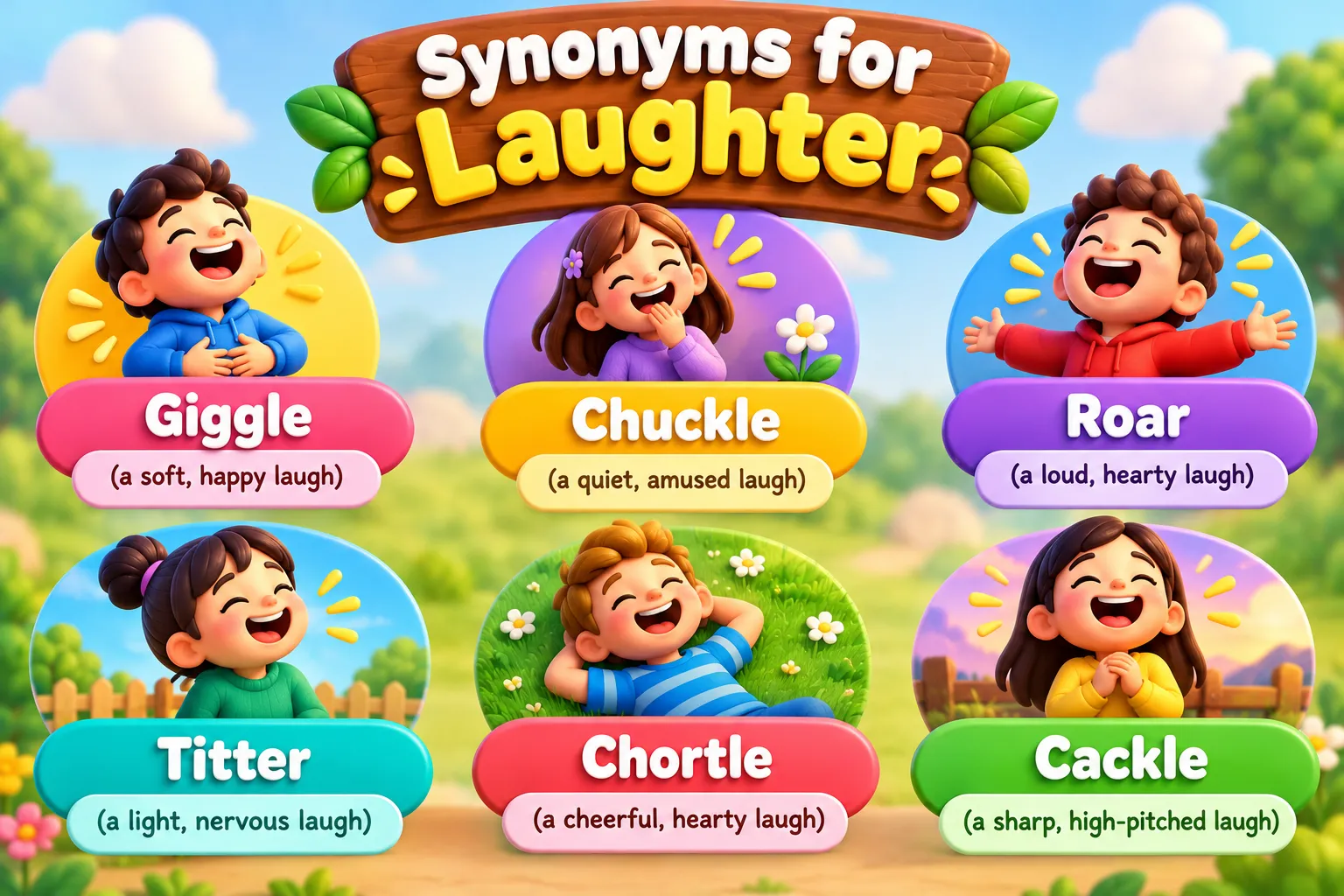
Laughter is the sound or act of showing happiness, amusement, or joy by laughing. Common synonyms and related words include chuckle, giggle, guffaw, cackle, snicker, and roar. Each word describes a different kind of laughter. A chuckle is quiet and soft, while a guffaw is loud and sudden. A giggle is often light and playful. Learning these alternatives helps you describe feelings more clearly, improve your English vocabulary, and make your writing more vivid and engaging.
Laughter is the sound or act of laughing when something feels funny, joyful, or amusing. Imagine sitting with friends and hearing a funny joke. Everyone starts to laugh, and the room fills with happiness. This simple moment shows how laughter can bring people together and make them feel relaxed. Laughter is common in daily conversations, stories, books, and social situations.
Learning synonyms for laughter helps English learners describe different sounds and feelings. For example, giggle suggests light, playful laughter, while guffaw describes a loud burst of laughter. These small differences help writers paint a clearer picture for readers. They also make it easier to avoid repeating the same word. In this guide, you will explore the meaning, history, pronunciation, and word forms of laughter. You will also learn 25 related words, their meanings, examples, and antonyms.
Meaning of Laughter
Definition
Laughter (Noun): The sound or act of laughing, often caused by humor, happiness, surprise, or amusement.
Laughter can be quiet or loud, gentle or uncontrollable. It may also express nervousness or embarrassment.
Examples
- Her laughter filled the room during the funny story.
- We shared laughter and happy memories at the family dinner.
Connotative Meaning
Connotation is the feeling or idea that a word suggests beyond its basic meaning.
- Positive tone: Laughter often suggests joy, friendship, fun, and happiness.
Example: Their laughter made the party feel warm and welcoming. - Negative tone: Laughter can suggest mockery, cruelty, or disrespect when someone laughs at another person.
Example: His laughter made the nervous student feel embarrassed. - Neutral tone: Laughter can simply describe the sound or act of laughing.
Example: We heard laughter coming from the next room.
The word laughter is usually positive, but its tone depends on the situation.
Etymology of Laughter
The word laughter developed from the Old English word hleahtor, meaning the act or sound of laughing. It is related to the Old English verb hliehhan, meaning to laugh.
- Old English (450–1100): Hleahtor referred to laughter or the sound made when laughing. The related verb hliehhan meant to laugh.
- Middle English (1100–1500): The word appeared in forms such as laughter and laghter. Its spelling and pronunciation changed over time as English developed.
- Modern English (1500–Present): Laughter became the standard noun for the sound or act of laughing. It is now used to describe amusement, joy, nervous reactions, and even mockery.
Pronunciation of Laughter (IPA)
- IPA: /ˈlæf.tər/ (common British pronunciation: /ˈlɑːf.tə/)
- Syllables: laugh-ter
- Syllable count: 2
- Word stress: The first syllable, laugh, is stressed.
Affixation Pattern of Laughter
- Root: Laugh is the base word.
- Prefix: There is no prefix in laughter.
- Suffix: -ter is part of the historical formation of the noun; it is not a productive suffix that speakers normally add to verbs today.
Word Formations
| Word | Part of Speech | Meaning |
| Laugh | Verb/Noun | To make sounds that show amusement; an act of laughing |
| Laughs | Verb/Noun | Laughs; acts or sounds of laughing |
| Laughed | Verb | Made sounds of amusement in the past |
| Laughing | Verb/Adjective/Noun | Making sounds of amusement |
| Laughter | Noun | The sound or act of laughing |
| Laughable | Adjective | So silly or unreasonable that it may cause laughter |
| Laughably | Adverb | In a way that is silly or deserving of ridicule |
| Laughingstock | Noun | A person or thing that others make fun of |
25 Synonyms of Laughter With Meaning and Examples
The words below describe different types of laughter, sounds, or reactions associated with amusement. Some are direct alternatives in certain sentences, while others describe a particular way of laughing rather than laughter itself.
1. Chuckle (Noun/Verb)
Meaning: A quiet, gentle laugh.
Examples:
- He gave a small chuckle at the joke.
- She chuckled when she saw the funny picture.
2. Giggle (Noun/Verb)
Meaning: A light, often playful laugh that may be hard to control.
Examples:
- The children began to giggle during the game.
- She let out a nervous giggle.
3. Guffaw (Noun/Verb)
Meaning: A loud, sudden burst of laughter.
Examples:
- His loud guffaw surprised everyone.
- The audience guffawed at the comedian’s joke.
4. Cackle (Noun/Verb)
Meaning: A loud, sharp laugh that may sound rough or uncontrolled.
Examples:
- The witch gave a strange cackle in the story.
- They cackled at the silly mistake.
5. Snicker (Noun/Verb)
Meaning: A quiet, often disrespectful or hidden laugh.
Examples:
- The boys snickered at the awkward comment.
- She tried not to snicker during the serious talk.
6. Snigger (Noun/Verb)
Meaning: A quiet laugh, often made to show amusement at someone else’s embarrassment.
Examples:
- A few students sniggered at his mistake.
- They sniggered when the actor forgot his line.
7. Roar (Noun/Verb)
Meaning: A very loud burst of laughter.
Examples:
- The audience gave a roar of laughter.
- Everyone roared when he told the story.
8. Howl (Noun/Verb)
Meaning: To laugh very loudly and for a long time.
Examples:
- We howled with laughter at the comedy show.
- The children howled when the dog chased its tail.
9. Titter (Noun/Verb)
Meaning: A short, quiet, nervous, or restrained laugh.
Examples:
- A titter spread through the classroom.
- The audience tittered at the awkward joke.
10. Belly Laugh (Noun)
Meaning: A deep, hearty laugh that comes from strong amusement.
Examples:
- His silly story gave me a belly laugh.
- We shared a belly laugh over dinner.
11. Chortle (Noun/Verb)
Meaning: A happy, partly muffled laugh that shows amusement or satisfaction.
Examples:
- Grandpa chortled at the cartoon.
- She gave a little chortle when she read the message.
12. Cackle of Laughter (Noun Phrase)
Meaning: A loud, sharp burst of laughter.
Examples:
- A cackle of laughter came from the kitchen.
- His cackle of laughter echoed down the hall.
13. Burst of Laughter (Noun Phrase)
Meaning: A sudden and often strong period of laughing.
Examples:
- A burst of laughter filled the room.
- Her comment caused a burst of laughter.
14. Fit of Laughter (Noun Phrase)
Meaning: A period when someone laughs so much that it is hard to stop.
Examples:
- We fell into a fit of laughter over the mistake.
- He had a fit of laughter during the show.
15. Peal of Laughter (Noun Phrase)
Meaning: A loud, clear, ringing sound of laughter.
Examples:
- A peal of laughter came from the garden.
- Her peal of laughter made everyone smile.
16. Roar of Laughter (Noun Phrase)
Meaning: A very loud sound made by many people laughing together.
Examples:
- A roar of laughter followed the comedian’s joke.
- The room erupted in a roar of laughter.
17. Snort (Noun/Verb)
Meaning: A sudden, rough sound made through the nose, sometimes while laughing.
Examples:
- He snorted with laughter at the unexpected joke.
- She let out a snort when she tried to hold back her laugh.
18. Tittering (Noun/Verb)
Meaning: Quiet, repeated laughter that may show nervousness or amusement.
Examples:
- The tittering stopped when the teacher entered.
- We heard tittering at the back of the hall.
19. Merriment (Noun)
Meaning: Fun, happiness, and cheerful enjoyment, often with laughter.
Examples:
- The room was full of merriment.
- Music and merriment filled the wedding hall.
20. Mirth (Noun)
Meaning: Happiness or amusement that makes people want to laugh.
Examples:
- His speech caused great mirth among the guests.
- She could not hide her mirth at the funny scene.
21. Amusement (Noun)
Meaning: The feeling of finding something funny or entertaining.
Examples:
- His face showed amusement as he listened.
- The children watched the clown with great amusement.
22. Hearty Laughter (Noun Phrase)
Meaning: Warm, full, and sincere laughter.
Examples:
- His hearty laughter made everyone feel welcome.
- We enjoyed the evening with food and hearty laughter.
23. Light Laughter (Noun Phrase)
Meaning: Soft, gentle laughter that is not loud or intense.
Examples:
- Light laughter passed around the table.
- Their light laughter made the meeting feel relaxed.
24. Uncontrollable Laughter (Noun Phrase)
Meaning: Laughter that is so strong that a person finds it hard to stop.
Examples:
- The funny video caused uncontrollable laughter.
- They broke into uncontrollable laughter during the game.
25. Nervous Laughter (Noun Phrase)
Meaning: Laughter caused by worry, tension, or embarrassment rather than true amusement.
Examples:
- He gave a nervous laugh before his speech.
- Her nervous laughter showed that she felt uncomfortable.
Prototype Meaning of Laughter
The most typical meaning of laughter is the sound or act of laughing because something is funny or brings joy. People often imagine friends sharing a joke, children playing, or an audience laughing at a comedian. Laughter can be soft and gentle or loud and uncontrollable. It can also express nervousness, embarrassment, or mockery. The surrounding situation helps us understand its meaning. For example, a giggle often sounds light and playful, while a guffaw is loud and sudden. These differences help people describe laughter more clearly.
Prototype Categorization
The synonyms and related expressions for laughter can be grouped by sound, intensity, feeling, and purpose.
- Quiet and gentle laughter: Chuckle, giggle, snicker, snigger, and titter describe soft or restrained laughter. Use giggle for playful laughter and snicker or snigger when the laugh may be disrespectful.
- Loud and strong laughter: Guffaw, cackle, roar, howl, belly laugh, and roar of laughter describe loud or powerful reactions. Use guffaw for a sudden loud laugh and belly laugh for deep, hearty amusement.
- Short bursts of laughter: Burst of laughter, fit of laughter, peal of laughter, and cackle of laughter describe moments when laughter suddenly starts or continues for a while.
- Positive feelings and joy: Merriment, mirth, amusement, and hearty laughter describe cheerful feelings and enjoyment. Use these words when you want to create a warm, happy mood.
- Nervous or uncomfortable reactions: Nervous laughter and snort may describe reactions caused by tension or an attempt to hold back laughter.
- Mockery and disrespect: Mocking laughter, sneer, and sometimes snicker describe reactions that may hurt or embarrass another person. Use these terms when the laughter is unkind.
- Related facial expressions and celebration: Smile, grin, and roistering are connected with happiness or lively fun, but they are not exact synonyms for laughter.
These categories help writers choose words that fit the scene. For example, use giggle for a child’s playful reaction, roar of laughter for a crowd, and nervous laughter for an uneasy moment.
Antonyms of Laughter
Laughter has no single perfect antonym in every situation. Depending on the context, its opposite may be sadness, crying, silence, or a serious expression.
| Antonym | Part of Speech | Meaning |
| Crying | Noun/Verb | The act of shedding tears, often due to sadness or pain |
| Weeping | Noun/Verb | Crying, often with tears and strong emotion |
| Sobbing | Noun/Verb | Crying with uneven breaths and sounds |
| Wailing | Noun/Verb | Crying or making a loud sound of grief |
| Sorrow | Noun | A feeling of deep sadness |
| Sadness | Noun | The feeling of being unhappy |
| Grief | Noun | Deep sadness, often after a serious loss |
| Gloom | Noun | A state of sadness or low spirits |
| Silence | Noun | A lack of sound |
| Seriousness | Noun | The state of being thoughtful or not playful |
| Frowning | Noun/Verb | Showing displeasure or worry with the face |
| Tears | Noun | Drops of liquid from the eyes, often linked to sadness |
Short Questions and Answers
What does laughter mean?
Laughter is the sound or act of laughing. It often shows happiness or amusement, but it can also express nervousness or mockery.
When should laughter be used?
Use laughter when describing the sound or act of laughing. For a more precise description, use a word such as giggle for a light laugh or guffaw for a loud one.
Is laughter positive or negative?
Laughter is often positive because it shows joy and connection. However, nervous laughter may show discomfort, and mocking laughter may hurt someone’s feelings.
How is laughter different from similar words?
Laughter is the general term for the act or sound of laughing. A chuckle is quiet, a giggle is light and playful, and a guffaw is loud. Mirth and amusement describe feelings that may cause laughter rather than the sound itself.
Conclusion
Learning synonyms for laughter helps you describe emotions, sounds, and social moments more clearly. Words such as chuckle, giggle, guffaw, and cackle show different types of laughter, while mirth and merriment describe feelings of joy and fun. Some related words, such as smile and grin, describe facial expressions rather than laughter itself. Knowing these differences helps you choose the right word and avoid repetition in your writing. It also strengthens your reading, speaking, and vocabulary skills. Try learning a few new words each day and using them in your own sentences. With regular practice, you can make your English more natural, vivid, and engaging.
Read More:
Synonyms for Specialist: 30 Words and Their Meanings

I am Rubab content specialist focused on creating accurate, user-friendly, and search-optimized language resources. Through Synonyminstant, I help readers find synonyms, antonyms, meanings, and vocabulary with ease. Every article is carefully researched and optimized to provide reliable information, clear explanations, and an excellent user experience.