
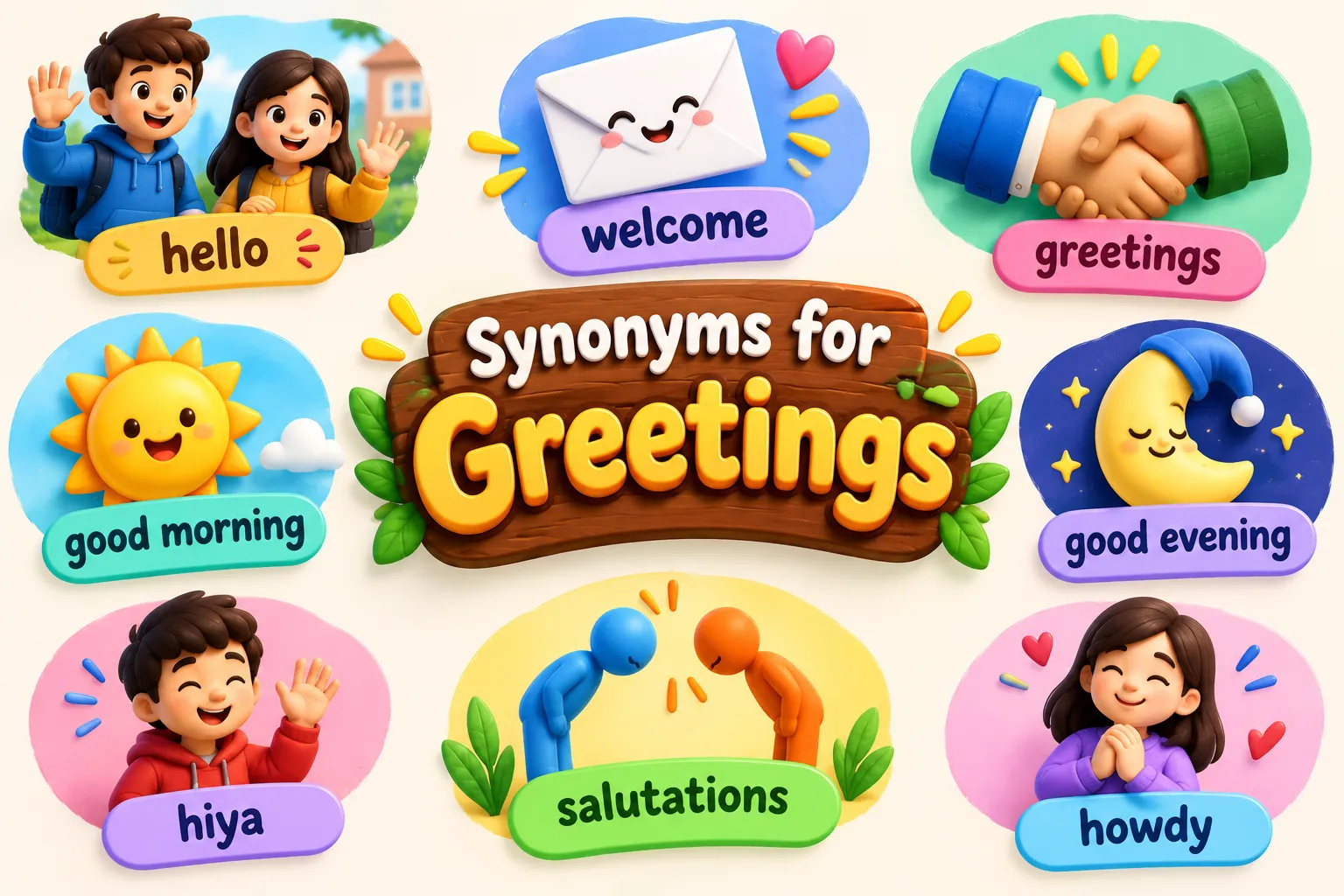
Greetings are words or expressions we use to welcome people, start conversations, and show politeness. Common synonyms for greetings include salutations, hellos, welcomes, acknowledgments, and good wishes. Depending on the situation, you can choose a formal greeting for a business meeting or a casual expression for a conversation with friends.
For example, you might say “Good morning” when arriving at work or “Hey!” when meeting a friend. Similarly, “Welcome” is useful when someone arrives at an event.
Learning different ways to greet people can improve your English vocabulary and communication skills. Moreover, using a variety of greetings makes your conversations sound more natural and engaging.
In this guide, you will discover 29 synonyms for greetings, along with their meanings and examples. You will also learn when to use formal, informal, professional, and friendly greetings.
Meaning of Greetings
Greetings (noun): Words, expressions, or gestures that people use when meeting someone, welcoming a person, or beginning a conversation.
Greetings help people establish friendly relationships and show respect. For example, a student might greet a teacher with “Good morning,” while friends might simply say “Hi!”
The right greeting depends on the situation, the relationship between the speakers, and the level of formality.
Examples of Greetings in Sentences
- She greeted her teacher with a warm smile.
- Good morning, everyone. Welcome to our meeting.
- He exchanged greetings with his neighbors.
These examples show how greetings can begin conversations, welcome groups, and acknowledge people politely.
Connotative Meaning of Greetings
Connotation refers to the feelings or ideas that a word suggests beyond its basic meaning. Greetings can express warmth, respect, excitement, or professionalism.
- Positive tone: “It’s wonderful to see you!” expresses happiness and warmth.
- Formal tone: “Good afternoon. How may I assist you?” communicates professionalism and respect.
- Casual tone: “Hey! What’s up?” creates a relaxed and friendly atmosphere.
Therefore, choose a greeting that suits the people and the situation. A casual expression may work well with friends, while a polite greeting is usually better in a professional setting.
Etymology of Greetings
The word greeting comes from the verb greet, which has Germanic roots. Historically, the word referred to addressing someone or acknowledging their presence.
Over time, greetings developed into many forms, including spoken expressions, written messages, and gestures.
Today, people use greetings in everyday conversations, business communication, letters, emails, and public events. For example, “Hello” works in many situations, while “Dear” often introduces a formal letter or email.
Pronunciation of Greetings
- Word: Greetings
- IPA: /ˈɡriːtɪŋz/
- Syllables: Two
- Part of speech: Noun, plural
To pronounce greetings, say “GREE-tings.” Place the stress on the first syllable.
Affixation Pattern of Greetings
The word greetings comes from the verb greet.
- Root: Greet — to address or welcome someone.
- Prefix: None.
- Suffixes: -ing forms greeting, while -s makes it plural.
Word Forms of Greet
| Word | Part of Speech | Meaning |
|---|---|---|
| Greet | Verb | To welcome or acknowledge someone |
| Greets | Verb | Welcomes or acknowledges someone |
| Greeted | Verb | Welcomed or acknowledged someone in the past |
| Greeting | Noun / Verb | An expression of welcome or the act of welcoming |
| Greetings | Plural noun | Expressions used to welcome or acknowledge people |
| Greeting card | Noun phrase | A card sent to express a message or good wishes |
29 Synonyms for Greetings With Meanings and Examples
The following words and expressions can replace greetings in different contexts. However, not every option has exactly the same meaning. Some describe a welcome, while others refer to a polite acknowledgment or a message of goodwill.
1. Salutations (Noun)
Meaning: Formal expressions used when greeting someone.
Examples:
- The letter began with formal salutations.
- The host offered warm salutations to the guests.
When to use it: Use salutations in formal writing, speeches, or ceremonial situations. It sounds more formal than “hello.”
2. Hellos (Noun)
Meaning: Expressions used to greet people.
Examples:
- She exchanged hellos with her neighbors.
- We shared cheerful hellos before the meeting.
When to use it: Choose hellos when describing friendly, everyday greetings.
3. Welcomes (Noun)
Meaning: Expressions or actions that make someone feel accepted.
Examples:
- The visitors received warm welcomes from the staff.
- The community gave the new family friendly welcomes.
When to use it: Use welcomes when emphasizing hospitality or acceptance.
4. Acknowledgments (Noun)
Meaning: Expressions or gestures that show you have noticed someone.
Examples:
- He gave a brief acknowledgment to his colleague.
- She exchanged acknowledgments with people in the hallway.
When to use it: Choose acknowledgments when someone recognizes another person’s presence. It can be more formal or restrained than a warm greeting.
5. Good Wishes (Noun Phrase)
Meaning: Expressions that communicate hope for someone’s happiness or success.
Examples:
- She sent good wishes to her friend on the new job.
- We shared good wishes before the ceremony.
When to use it: Use good wishes when expressing kindness or hoping for a positive outcome. Unlike a simple greeting, it often communicates goodwill.
6. Salutes (Noun / Verb)
Meaning: Gestures or expressions that show respect or recognition.
Examples:
- The officer exchanged salutes with a colleague.
- The audience saluted the visiting speaker.
When to use it: Choose salutes in military, ceremonial, or respectful contexts. It does not replace an everyday greeting in every situation.
7. Hails (Noun / Verb)
Meaning: Calls or expressions used to attract attention or greet someone.
Examples:
- The sailor hailed the crew from the deck.
- She hailed her friend from across the street.
When to use it: Use hail when someone calls out to another person, often from a distance.
8. Introductions (Noun)
Meaning: Acts or expressions used when people meet each other for the first time.
Examples:
- The host made introductions before the discussion.
- The introductions helped everyone learn each other’s names.
When to use it: Choose introductions when a greeting involves presenting people to one another.
9. Opening Remarks (Noun Phrase)
Meaning: Words spoken at the beginning of a meeting, event, or speech.
Examples:
- The speaker began with welcoming opening remarks.
- Her opening remarks set a friendly tone for the event.
When to use it: Use this phrase for speeches, presentations, meetings, and formal gatherings.
10. Expressions of Welcome (Noun Phrase)
Meaning: Words or actions that make someone feel welcome.
Examples:
- The host offered expressions of welcome to the visitors.
- Their expressions of welcome made the new members feel comfortable.
When to use it: Choose this phrase when you want to emphasize hospitality and acceptance.
11. Good Evening (Greeting Expression)
Meaning: A polite greeting used in the evening.
Examples:
- Good evening, everyone. Welcome to our event.
- He said good evening to his neighbors.
When to use it: Use good evening when meeting people later in the day, especially in formal or polite situations.
12. Good Morning (Greeting Expression)
Meaning: A greeting used in the morning.
Examples:
- Good morning, everyone. Let’s begin the lesson.
- She wished her coworkers good morning.
When to use it: Choose good morning when greeting people early in the day. It works well at home, school, and work.
13. Good Afternoon (Greeting Expression)
Meaning: A polite greeting used during the afternoon.
Examples:
- Good afternoon, everyone. Thank you for joining us.
- The receptionist greeted the visitor with “Good afternoon.”
When to use it: Use this expression in professional settings, formal meetings, and polite everyday conversations.
14. Hi (Greeting Expression)
Meaning: A short, friendly greeting.
Examples:
- Hi! How are you today?
- She said hi to her friend in the hallway.
When to use it: Choose hi for casual conversations with friends, classmates, and familiar coworkers.
15. Hey (Greeting Expression)
Meaning: An informal way to greet someone or attract attention.
Examples:
- Hey! It’s great to see you.
- He said hey as he entered the room.
When to use it: Use hey in relaxed situations. However, a more formal greeting may suit a business letter or an important meeting.
16. Howdy (Greeting Expression)
Meaning: A casual greeting, especially associated with American English.
Examples:
- Howdy! Welcome to our town.
- He greeted his friend with a cheerful “Howdy!”
When to use it: Choose howdy for a playful, informal, or regional style of greeting.
17. Welcome (Noun / Verb / Interjection)
Meaning: An expression that makes someone feel accepted or invited.
Examples:
- Welcome to our school!
- The manager welcomed the new employees.
When to use it: Use welcome when someone arrives at a place, joins a group, or attends an event.
18. What’s Up? (Greeting Expression)
Meaning: An informal expression used to greet someone or ask how things are going.
Examples:
- What’s up? Are you ready for the game?
- He asked his friend, “What’s up?”
When to use it: Choose this expression for relaxed conversations with friends or people you know well.
19. How Are You? (Greeting Expression)
Meaning: A common expression used to greet someone and ask about their well-being.
Examples:
- Hello, Maria. How are you?
- The teacher asked the students how they were doing.
When to use it: Use this expression in both casual and polite conversations. People often respond briefly, even when they do not intend to discuss their feelings in detail.
20. Pleased to Meet You (Greeting Expression)
Meaning: A polite expression used when meeting someone for the first time.
Examples:
- Pleased to meet you. I’ve heard a lot about your work.
- She smiled and said, “Pleased to meet you.”
When to use it: Choose this phrase during introductions, interviews, networking events, or professional meetings.
21. Nice to Meet You (Greeting Expression)
Meaning: A friendly and polite expression used when meeting someone for the first time.
Examples:
- Nice to meet you. I’m glad you could join us.
- He introduced himself and said, “Nice to meet you.”
When to use it: Use this phrase in everyday introductions. It sounds natural in both professional and casual settings.
22. Long Time No See (Greeting Expression)
Meaning: An informal expression used when meeting someone after a long time apart.
Examples:
- Long time no see! How have you been?
- She laughed and said, “Long time no see!”
When to use it: Choose this phrase when reconnecting with a friend, relative, or familiar person.
23. Greetings and Salutations (Expression)
Meaning: A playful or formal-sounding way to greet people.
Examples:
- Greetings and salutations, everyone!
- He began his humorous speech with “Greetings and salutations!”
When to use it: Use this expression for a playful, theatrical, or deliberately formal tone.
24. Best Wishes (Noun Phrase)
Meaning: Words expressing hope for someone’s happiness or success.
Examples:
- Best wishes on your new job.
- She sent her best wishes to the newly married couple.
When to use it: Choose best wishes for cards, messages, celebrations, and farewells. It expresses goodwill rather than simply saying hello.
25. Regards (Noun)
Meaning: An expression of respect or goodwill, often used in written communication.
Examples:
- Please send my regards to your family.
- She ended her email with “Kind regards.”
When to use it: Use regards in professional emails, letters, or messages sent through another person.
26. Compliments (Noun)
Meaning: Expressions of praise, respect, or goodwill.
Examples:
- Please give my compliments to the host.
- She sent her compliments to the organizing team.
When to use it: Choose compliments in formal expressions of appreciation. However, it does not usually replace “hello” in everyday conversations.
27. Courtesies (Noun)
Meaning: Polite words or actions that show respect for others.
Examples:
- The visitors exchanged the usual courtesies.
- Simple courtesies helped everyone feel comfortable.
When to use it: Use courtesies when describing polite social behavior, including greetings and respectful exchanges.
28. Welcome Remarks (Noun Phrase)
Meaning: Words spoken to greet and welcome people at an event.
Examples:
- The principal delivered welcome remarks at the ceremony.
- Her welcome remarks made the audience feel appreciated.
When to use it: Choose this phrase for formal events, conferences, ceremonies, and public gatherings.
29. Words of Greeting (Noun Phrase)
Meaning: Spoken or written expressions used to acknowledge or welcome someone.
Examples:
- He offered a few words of greeting before the presentation.
- Her words of greeting helped start the conversation.
When to use it: Use this phrase when discussing greetings generally, especially in formal writing or explanations of communication.
Categories of Greetings
Different situations call for different greetings. Grouping them by purpose makes it easier to choose the right expression.
1. Formal Greetings
Examples: Salutations, good morning, good afternoon, good evening, pleased to meet you, and opening remarks.
These expressions work well in business meetings, interviews, ceremonies, and formal introductions. Moreover, they help establish a respectful tone.
2. Informal Greetings
Examples: Hi, hey, howdy, what’s up, and long time no see.
These expressions suit conversations with friends, relatives, and familiar people. However, they may sound too casual in some formal situations.
3. Welcoming Expressions
Examples: Welcome, expressions of welcome, welcome remarks, and opening remarks.
Use these expressions when someone arrives at an event, joins a group, or visits a place. They emphasize hospitality and inclusion.
4. Respectful and Written Greetings
Examples: Salutations, regards, best wishes, compliments, and courtesies.
These expressions often appear in letters, emails, ceremonies, and formal conversations. Nevertheless, each has a different purpose: regards often closes a message, while salutations refers to greetings.
5. Friendly and Personal Greetings
Examples: Hellos, how are you, nice to meet you, and long time no see.
These phrases help people begin conversations and build connections. Similarly, they can make social interactions feel warmer and more comfortable.
How to Choose the Right Greeting
First, consider the situation. A business meeting usually calls for a polite expression, while a conversation with a friend allows a more relaxed greeting.
Next, think about your relationship with the person. For example, “Good afternoon” may suit a customer, while “Hey!” may work well with a close friend.
Finally, consider the purpose of your message. Use “Welcome” to receive guests, “Nice to meet you” during a first introduction, and “Best wishes” when expressing goodwill.
As a result, you can communicate naturally while showing respect for the people you address.
Antonyms of Greetings
The word greetings does not have one exact opposite in every context. However, several words describe actions that contrast with greeting or welcoming someone.
| Word | Part of Speech | Meaning |
|---|---|---|
| Farewell | Noun / Interjection | An expression used when parting |
| Goodbye | Noun / Interjection | A word used when leaving |
| Dismissal | Noun | The act of sending someone away |
| Rejection | Noun | Refusal to accept someone or something |
| Snub | Noun / Verb | An act of deliberately ignoring someone |
| Ignoring | Verb | Paying no attention to someone |
| Avoidance | Noun | The act of staying away from someone |
| Silence | Noun | The absence of spoken words |
| Dismissiveness | Noun | A lack of interest or respect |
| Unfriendliness | Noun | A lack of warmth or friendliness |
For example, welcome expresses acceptance, while rejection expresses refusal. Similarly, greeting someone acknowledges their presence, whereas deliberately ignoring them does the opposite.
Remember that farewell and goodbye are not exact antonyms of greetings. They are related expressions used when people part rather than meet.
Frequently Asked Questions About Greetings
1. What does greetings mean?
Greetings are words, expressions, or gestures people use to welcome or acknowledge others. Common examples include “Hello,” “Hi,” and “Good morning.”
2. What are the most common synonyms for greetings?
Common alternatives include salutations, hellos, welcomes, and acknowledgments. You can also use expressions such as “Good morning” and “Nice to meet you,” depending on the situation.
3. Which greetings are suitable for professional settings?
“Good morning,” “Good afternoon,” “Pleased to meet you,” and “Hello” work well in most professional settings. Additionally, “Dear” is common when beginning a formal letter or email.
4. Which greetings are best for friends?
“Hi,” “Hey,” “What’s up?” and “Long time no see” are common informal greetings. Choose one that feels natural for your relationship and situation.
5. Are greetings and salutations the same?
They have similar meanings, but their usage differs. Greetings is a common general term, while salutations often sounds more formal or ceremonial.
6. What is the opposite of greetings?
There is no single exact opposite. Words such as farewell, goodbye, rejection, and snub express different ideas related to parting, refusing, or ignoring someone.
Conclusion
Learning synonyms for greetings helps you communicate more clearly and confidently. Expressions such as hello, salutations, welcome, good morning, and pleased to meet you serve different purposes in daily life and professional communication.
For example, use “Good afternoon” in a polite workplace conversation, “Hey!” with a friend, and “Welcome, everyone” when addressing a group. Similarly, choose “Best wishes” when expressing goodwill rather than beginning a conversation.
By understanding the differences between these expressions, you can choose the right words for every situation. Moreover, practising different greetings will help you improve your English vocabulary and develop more natural communication skills.
Read More:
Synonyms for Baloney: 30 Useful Alternatives

I’m Falak Naaz, an SEO writer at SynonymsInstant.com focused on creating clear, engaging, and search-friendly English content. I specialize in vocabulary, synonyms, antonyms, word usage, and language guides. I combine careful research with practical writing to deliver trustworthy content that helps readers choose the right words and improve their English with confidence.