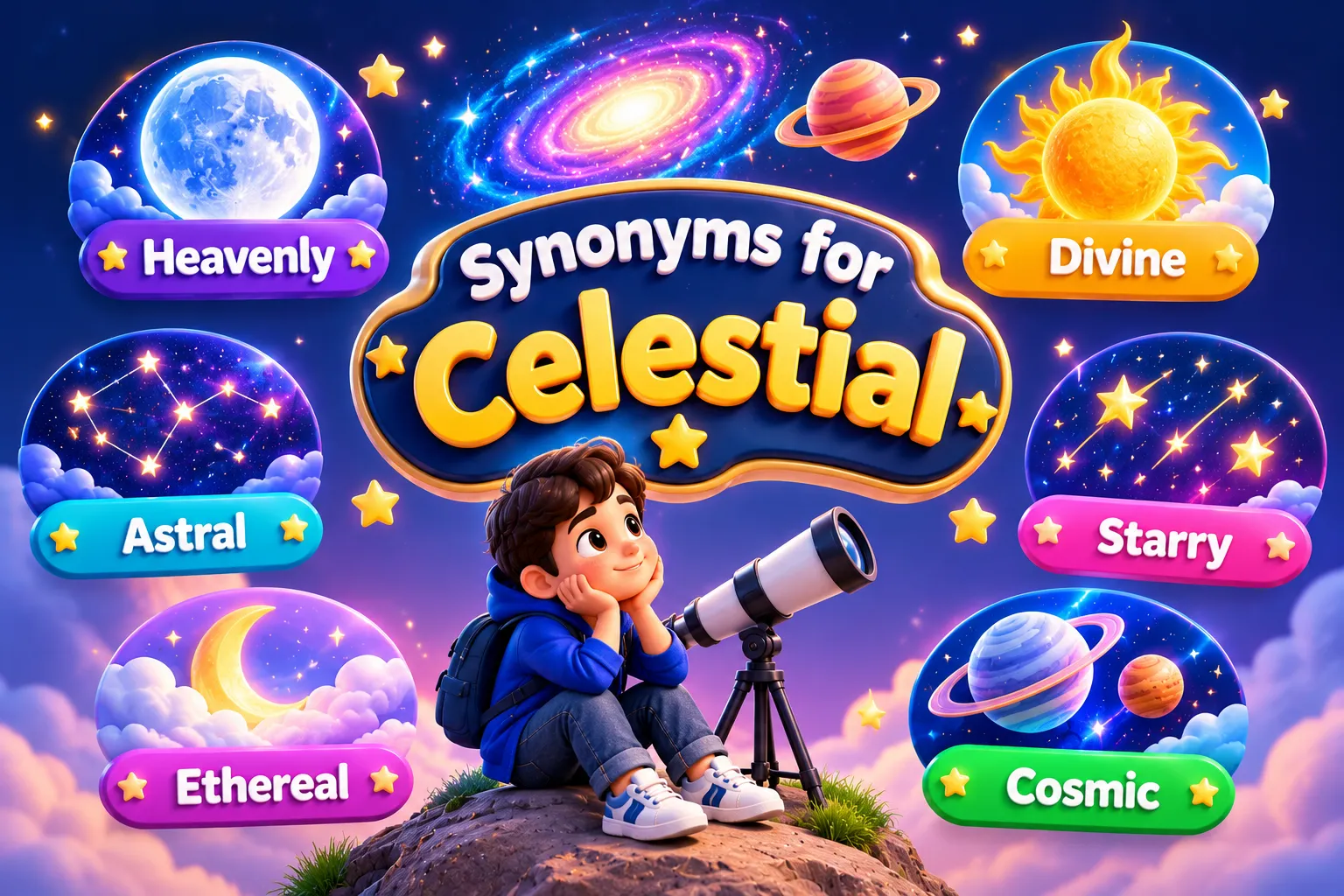
Celestial means relating to the sky, outer space, or heaven. Common synonyms include heavenly, cosmic, astronomical, astral, stellar, divine, and otherworldly. The best alternative depends on the context. For example, cosmic often relates to the universe, while divine refers to a god or a holy power. Stellar usually relates to stars or can mean excellent in informal use. Learning these synonyms helps you describe space, beauty, spiritual ideas, and the wonders of the universe with greater detail and accuracy.
The word celestial describes things related to the sky, stars, outer space, or heaven. Imagine looking up at the night sky and seeing thousands of stars shining above you. You might describe the view as celestial because it seems vast, beautiful, and almost magical. The word is often used in astronomy, poetry, literature, and spiritual writing. It can describe planets, stars, heavenly beings, or things that seem beyond the ordinary world.
Learning synonyms for celestial helps English learners build a richer vocabulary. It also helps writers create vivid descriptions without repeating the same word. However, not every synonym has the same meaning. Some words relate to outer space, while others suggest holiness, beauty, or mystery. This guide explains the meaning, history, pronunciation, and word forms of celestial. It also provides 30 related alternatives with examples, semantic categories, antonyms, and answers to common questions.
Meaning of Celestial
Definition
Celestial (Adjective): Relating to the sky, outer space, stars, or heaven.
Examples
- The telescope revealed a beautiful celestial object.
- The poet described the moon as a celestial light in the dark sky.
Connotative Meaning
Connotation is the feeling or idea a word suggests beyond its basic meaning.
- Positive tone: Celestial can suggest beauty, wonder, peace, perfection, or spiritual greatness.
- Negative tone: In some contexts, it may suggest something distant, unreachable, or beyond human understanding.
- Neutral tone: In astronomy, it simply describes objects or events related to space and the sky.
Etymology of Celestial
The word celestial comes from Latin and has long been linked to the sky and heavens.
- Old English (450–1100): Celestial was not a common Old English word. English speakers used other words, including terms related to heaven and the sky.
- Middle English (1100–1500): The word entered English through Old French celestial, from Latin caelestis, meaning “heavenly” or “of the sky.”
- Modern English (1500–Present): Celestial developed into a word used for the sky, stars, planets, outer space, and heaven. Today, it appears in science, religion, literature, and everyday descriptions of extraordinary beauty.
Pronunciation (IPA)
- IPA: /səˈles.tʃəl/
- Syllables: Ce-les-tial (3 syllables)
- Stress: The second syllable: ce-LES-tial.
- Pronunciation tip: Say “suh-LES-chuhl,” with the strongest stress on LES.
Affixation Pattern of Celestial
- Root: Celest-, from Latin caelestis, meaning “heavenly” or “of the sky.”
- Prefix: None in the modern word.
- Suffix: -ial, forming an adjective that means “relating to” or “connected with.”
- Word formation: The word belongs to a family of terms related to the heavens and outer space.
Word Formation Table
| Word | Grammatical Category | Meaning |
| Celestial | Adjective | Relating to the sky, space, or heaven |
| Celestially | Adverb | In a celestial or heavenly way |
| Celestialness | Noun, rare | The quality of being celestial |
| Celestial body | Noun phrase | A natural object in space, such as a star or planet |
| Celestial sphere | Noun phrase | An imagined sphere used to map objects in the sky |
| Celestial navigation | Noun phrase | Navigation using the positions of celestial bodies |
| Celestials | Plural noun | Heavenly beings in some religious, mythological, or fictional contexts |
30 Synonyms of Celestial With Meaning & Examples
Note: Celestial has several meanings, so the best synonym depends on the sentence. Some alternatives relate to space, while others describe heaven, spiritual ideas, or extraordinary beauty. Related words are identified where they are not exact synonyms.
1. Heavenly (Adjective)
Meaning: Relating to heaven or seeming wonderfully beautiful or peaceful.
Examples:
- The garden looked heavenly in the morning light.
- They watched the heavenly stars above the hills.
2. Cosmic (Adjective)
Meaning: Relating to the universe and outer space.
Examples:
- Scientists study cosmic events to learn about the universe.
- The film explored cosmic mysteries and distant galaxies.
3. Astral (Adjective)
Meaning: Relating to stars or the stars as imagined in spiritual traditions.
Examples:
- The story described an astral journey through the night sky.
- The artist painted an astral scene filled with stars.
4. Stellar (Adjective)
Meaning: Relating to stars or, informally, describing something excellent.
Examples:
- The telescope captured a stellar image.
- The team gave a stellar performance.
5. Astronomical (Adjective)
Meaning: Relating to astronomy or the study of space and celestial objects.
Examples:
- The students learned about astronomical discoveries.
- Astronomical observations help scientists study distant planets.
6. Divine (Adjective)
Meaning: Relating to a god or seeming perfect, wonderful, or holy.
Examples:
- The painting showed a divine figure surrounded by light.
- The singer’s voice sounded divine.
7. Otherworldly (Adjective)
Meaning: Seeming to belong to a world beyond ordinary human experience.
Examples:
- The glowing cave had an otherworldly beauty.
- Her voice created an otherworldly mood in the film.
8. Ethereal (Adjective)
Meaning: Extremely delicate, light, or beautiful, almost as if from another world.
Examples:
- The mist gave the forest an ethereal look.
- The dancer moved with an ethereal grace.
9. Supernatural (Adjective)
Meaning: Beyond what is explained by ordinary natural laws.
Examples:
- The novel tells a supernatural story about heavenly beings.
- They believed the strange light had a supernatural cause.
Usage note: Supernatural is related to some spiritual uses of celestial, but it is not a direct synonym in astronomy.
10. Empyrean (Adjective)
Meaning: Relating to the highest heaven, especially in older religious or poetic ideas.
Examples:
- The poem described an empyrean realm of light.
- The writer imagined an empyrean home above the clouds.
11. Astronomic (Adjective)
Meaning: Relating to astronomy or celestial objects.
Examples:
- The research team studied astronomic data.
- The article explained astronomic measurements in simple terms.
12. Starry (Adjective)
Meaning: Filled with or marked by stars.
Examples:
- We walked beneath a starry sky.
- The children watched the starry night from the garden.
13. Sidereal (Adjective)
Meaning: Relating to the stars, especially in measuring time or position.
Examples:
- The astronomer explained sidereal time.
- Sidereal measurements help track the positions of stars.
14. Interstellar (Adjective)
Meaning: Existing or occurring between stars.
Examples:
- The spacecraft traveled through interstellar space in the science-fiction story.
- Scientists study interstellar gas between stars.
15. Intergalactic (Adjective)
Meaning: Existing or occurring between galaxies.
Examples:
- The movie showed an intergalactic journey.
- Intergalactic space contains matter between galaxies.
16. Extraterrestrial (Adjective)
Meaning: Originating or existing beyond Earth.
Examples:
- The story featured extraterrestrial life.
- Scientists search for signs of extraterrestrial organisms.
Usage note: Extraterrestrial refers to things beyond Earth, not all celestial things.
17. Planetary (Adjective)
Meaning: Relating to planets.
Examples:
- The team studied planetary motion.
- The telescope recorded a planetary event.
18. Lunar (Adjective)
Meaning: Relating to the moon.
Examples:
- The astronauts prepared for a lunar mission.
- Lunar light spread across the quiet landscape.
19. Solar (Adjective)
Meaning: Relating to the sun.
Examples:
- The researchers measured solar activity.
- Solar energy comes from the sun.
20. Galactic (Adjective)
Meaning: Relating to a galaxy or galaxies.
Examples:
- The telescope captured a galactic image.
- The documentary explored galactic structures.
21. Universal (Adjective)
Meaning: Relating to the whole universe or applying everywhere.
Examples:
- The scientist discussed universal forces.
- The story explores universal questions about life.
Usage note: Universal is broader than celestial and is not always a direct synonym.
22. Heavenly-minded (Adjective)
Meaning: Focused on heaven or spiritual matters.
Examples:
- The story presents a heavenly-minded character.
- Her heavenly-minded outlook shaped her choices.
23. Sacred (Adjective)
Meaning: Considered holy or deeply important in a religious or spiritual sense.
Examples:
- The sacred text describes the heavens.
- They gathered in a sacred place for prayer.
Usage note: Sacred can overlap with the spiritual sense of celestial, but it does not mean “relating to outer space.”
24. Holy (Adjective)
Meaning: Connected with God, a deity, or religious belief.
Examples:
- The painting showed a holy figure in the clouds.
- They sang a holy song during the ceremony.
25. Seraphic (Adjective)
Meaning: Angelic, pure, or peaceful in appearance or character.
Examples:
- She had a seraphic smile.
- The painting showed a seraphic figure with bright wings.
26. Angelic (Adjective)
Meaning: Resembling an angel in goodness, beauty, or innocence.
Examples:
- The child had an angelic face.
- Her angelic voice filled the room.
27. Magical (Adjective)
Meaning: Seeming full of wonder, mystery, or extraordinary power.
Examples:
- The stars made the evening feel magical.
- The garden looked magical under the moonlight.
Usage note: Magical can describe the feeling of a celestial scene, but it is not an exact synonym.
28. Sublime (Adjective)
Meaning: So beautiful or impressive that it inspires awe.
Examples:
- The sublime night sky left us speechless.
- They watched a sublime display of northern lights.
29. Transcendent (Adjective)
Meaning: Going beyond ordinary limits or experience.
Examples:
- The music created a transcendent feeling.
- The author described a transcendent moment beneath the stars.
30. Illustrious (Adjective)
Meaning: Famous, respected, or distinguished; in older or poetic use, it can suggest brightness or glory.
Examples:
- The story celebrated an illustrious hero from ancient legend.
- The writer described the illustrious heavens in poetic language.
Usage note: Illustrious usually means distinguished or famous, so it is only loosely related to the poetic sense of celestial.
Prototype Meaning
The most typical meaning of celestial is relating to the sky, stars, planets, or outer space. People often imagine a clear night sky filled with shining stars, a bright moon, or distant planets. The word can also refer to heaven or spiritual beings in religious and literary contexts. In poetry, it may describe something that seems perfect, peaceful, or beyond the ordinary world. The exact meaning depends on the subject. In astronomy, celestial is a scientific term, while in creative writing it can add a sense of wonder, beauty, or mystery.
Prototype Categorization
Grouping these alternatives by meaning helps writers choose words that fit the subject and tone.
- Space and the universe: Cosmic, astronomical, astronomic, universal, and galactic relate to space, the universe, or astronomy. Use them in science writing and descriptions of large-scale space phenomena.
- Stars and star systems: Astral, stellar, starry, and sidereal relate to stars or their positions. They are useful in astronomy, poetry, and descriptions of the night sky.
- Space between objects: Interstellar refers to the space between stars, intergalactic to the space between galaxies, and extraterrestrial to something beyond Earth. These terms have distinct scientific meanings.
- Specific celestial bodies: Planetary, lunar, and solar refer to planets, the moon, and the sun. Choose the precise term when discussing a particular object or system.
- Heaven and spiritual ideas: Heavenly, divine, empyrean, heavenly-minded, sacred, and holy relate to heaven or religious beliefs. Their meanings depend on the spiritual or literary context.
- Angelic and supernatural qualities: Seraphic, angelic, and supernatural describe angels, spiritual beings, or things beyond ordinary natural explanations. They may be useful in stories and religious writing.
- Beauty, wonder, and mystery: Ethereal, otherworldly, magical, sublime, and transcendent describe experiences that seem extraordinary or beyond everyday life. Use them in creative writing when you want to create a feeling of awe.
- Brightness and glory: Illustrious can suggest glory in literary contexts, but it usually means famous or respected. Use it only when the intended meaning fits.
These categories help you avoid choosing a word just because it sounds impressive. For example, use lunar for the moon, interstellar for the space between stars, and ethereal to describe a delicate, dreamlike beauty.
Antonyms of Celestial
The best opposite of celestial depends on whether it refers to outer space, heaven, or an extraordinary quality. The following words are contextual antonyms rather than exact opposites in every sentence.
| Antonym | Part of Speech | Meaning |
| Terrestrial | Adjective | Relating to Earth rather than the sky or outer space |
| Earthly | Adjective | Relating to life on Earth or ordinary human concerns |
| Worldly | Adjective | Concerned with everyday life and material matters |
| Mundane | Adjective | Ordinary and lacking excitement or wonder |
| Earthbound | Adjective | Limited to Earth or ordinary physical life |
| Secular | Adjective | Not connected with religion or spiritual matters |
| Profane | Adjective | Not sacred or religious; sometimes disrespectful toward sacred things |
| Ordinary | Adjective | Common or usual rather than extraordinary |
| Mortal | Adjective | Subject to death; not immortal or divine |
| Subterranean | Adjective | Existing or occurring beneath Earth’s surface |
| Material | Adjective | Relating to physical matter rather than spiritual things |
| Grounded | Adjective | Practical and realistic; in some contexts, connected to the ground rather than the sky |
Note: Terrestrial is often the closest scientific contrast when celestial means “relating to objects in space.”
Short Questions and Answers
1. What does celestial mean?
Celestial means relating to the sky, stars, planets, outer space, or heaven.
2. When should celestial be used?
Use celestial when describing objects in space, such as stars and planets, or heavenly and spiritual ideas. For example, “The telescope revealed a distant celestial body.”
3. Is celestial positive or negative?
Celestial is usually neutral in science. In poetry or spiritual writing, it often has a positive tone because it suggests beauty, wonder, peace, or holiness.
4. How is celestial different from similar words?
Celestial is a broad term for things related to the sky, space, or heaven. Cosmic focuses on the universe, astral and stellar relate to stars, and divine relates to a god or something holy. Ethereal describes something delicate or otherworldly rather than a specific object in space.
Conclusion
Learning synonyms for celestial helps you describe space, spiritual ideas, and extraordinary beauty with greater precision. Words such as cosmic, stellar, astral, heavenly, and divine can add variety to your writing, but each has a distinct meaning. Some terms are best for science, while others fit poetry, stories, or religious topics. Choosing the right word makes your writing clearer and helps you avoid repetition. It can also improve your speaking skills and build confidence in English. Practice a few new words each day, study their example sentences, and use them in your own writing. Over time, you will learn to choose words that express your ideas accurately and naturally.
Read More:
Synonyms for Perceive: 27 Smart Alternatives to Explore

I am Rubab content specialist focused on creating accurate, user-friendly, and search-optimized language resources. Through Synonyminstant, I help readers find synonyms, antonyms, meanings, and vocabulary with ease. Every article is carefully researched and optimized to provide reliable information, clear explanations, and an excellent user experience.