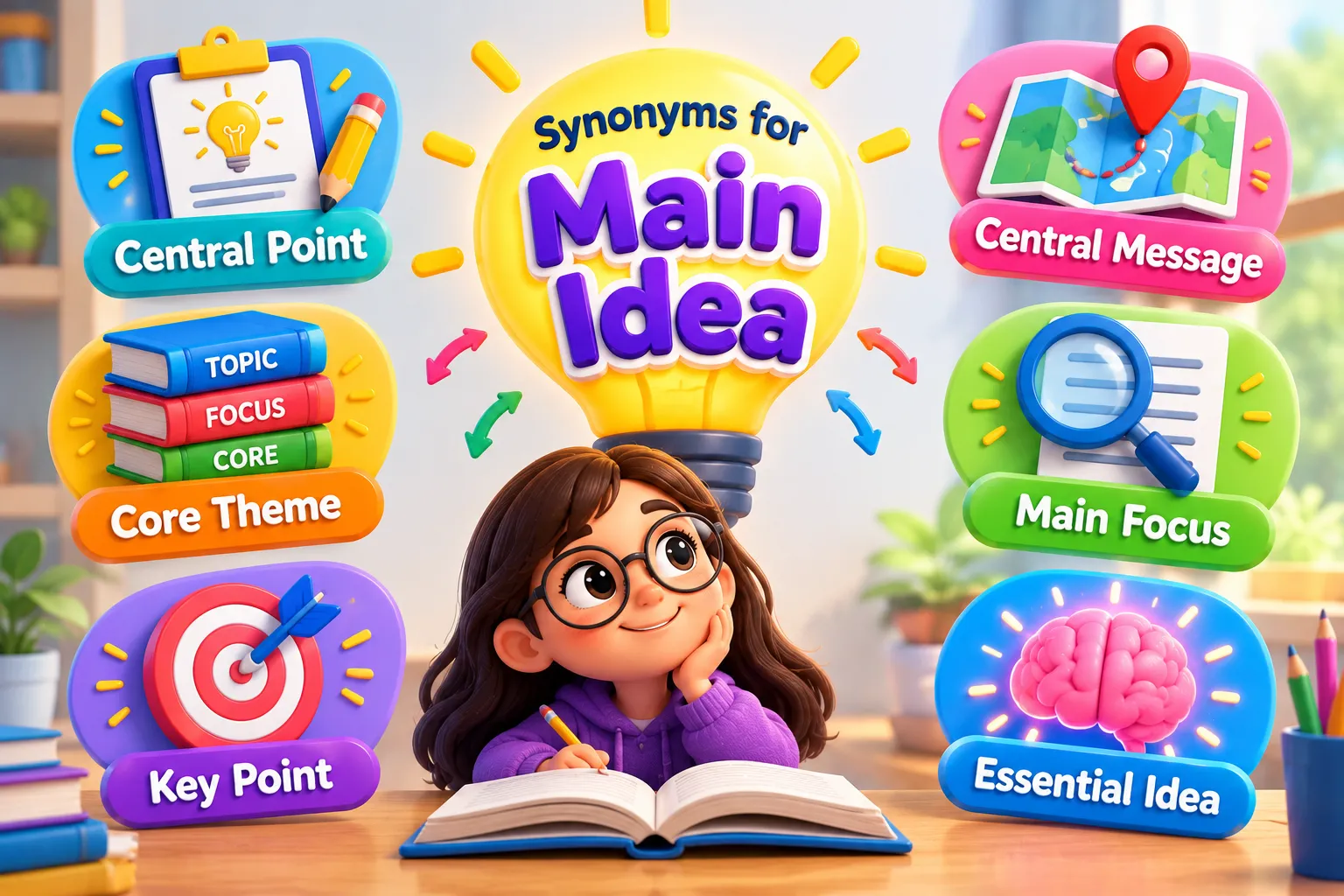
The phrase main idea means the most important thought or message in a text, speech, or discussion. Common synonyms include central idea, main point, key concept, core message, central theme, and primary argument. Each phrase has a slightly different use. For example, the central idea works well for a reading passage, while the core message often describes a lesson or message. Learning these alternatives helps you write clear essays, understand reading passages, and explain your thoughts without repeating the same words.
The main idea is the most important thought or message in a piece of writing, speech, or discussion. Imagine reading a story about a young girl who works hard to reach her goals. The main idea may be that hard work can lead to success. We use this phrase in school, work, books, and daily conversations because it helps us focus on what matters most. Learning synonyms for the main idea can help English learners improve their vocabulary and make their writing more natural. It also helps students explain texts, write better summaries, and prepare clear answers for exams. Content writers can use related phrases to avoid repetition and express ideas with greater accuracy. This guide explores the meaning, pronunciation, history, word forms, and 30 useful alternatives to the main idea, with simple definitions and examples.
Meaning of Main Idea
Definition
Main idea (Noun phrase): The most important thought, point, or message that a text, speech, or discussion communicates.
Examples
- The main idea of the story is that kindness can change lives.
- Write one sentence that explains the main idea of the passage.
Connotative Meaning
Connotation is the feeling or idea that a word or phrase suggests beyond its basic meaning.
- Positive tone: Main idea can suggest clarity, focus, understanding, and useful insight.
- Negative tone: It may suggest oversimplification if someone ignores important details to focus only on the main idea.
- Neutral tone: In most cases, it is a neutral phrase used to identify the central point of a text or discussion.
Etymology of Main Idea
The phrase main idea combines two words with different histories.
- Old English (450–1100): Main developed from Old English and related Germanic forms, with meanings linked to strength or power. Idea was not a common native Old English word.
- Middle English (1100–1500): Main came to mean chief or principal. Idea entered English through Latin and French, ultimately from Greek idea, meaning form, appearance, or concept.
- Modern English (1500–Present): The phrase main idea became a common way to describe the central thought of a text, speech, lesson, or discussion. It is now widely used in education, reading comprehension, writing, and communication.
Pronunciation (IPA)
- IPA: /ˌmeɪn aɪˈdiːə/
- Syllables: Main i-de-a (approximately four syllables: main, i, de, a)
- Pronunciation tip: Say “main eye-DEE-uh,” with the strongest stress on DEE.
Affixation Pattern of Main Idea
- Root: Main and idea are separate words that form a noun phrase.
- Prefix: Neither word has a prefix in this phrase.
- Suffix: Neither word has a suffix in the phrase main idea.
- Word formation: The phrase can be expanded into related expressions used in reading, writing, and discussion.
Word Formation Table
| Word or Phrase | Grammatical Category | Meaning |
| Main idea | Noun phrase | The most important thought or message |
| Main point | Noun phrase | The most important part of an explanation or argument |
| Central idea | Noun phrase | The core thought around which a text or discussion is built |
| Main theme | Noun phrase | The central subject or message of a work |
| Key idea | Noun phrase | An important thought or concept |
| Main argument | Noun phrase | The primary claim someone tries to support |
| Main message | Noun phrase | The most important information or lesson communicated |
| Main-idea question | Compound noun phrase | A question that asks about the central point of a text |
| Main-idea sentence | Compound noun phrase | A sentence that states the main idea |
| Idea | Noun | A thought, concept, or plan |
| Ideal | Noun/adjective | A standard of perfection or something considered most suitable |
| Ideate | Verb | To form or develop ideas |
| Ideation | Noun | The process of forming ideas |
| Idealistic | Adjective | Guided by ideals or strong beliefs about how things should be |
| Ideally | Adverb | In the best or most suitable way |
Note: These are related words and phrases, not all direct word forms of main idea.
30 Synonyms of Main Idea With Meaning & Examples
The best alternative depends on the context. Some expressions refer to the central thought of a passage, while others focus on an argument, theme, or message.
1. Central Idea (Noun Phrase)
Meaning: The main thought that connects the important parts of a text or discussion.
Examples:
- The central idea of the passage is the value of friendship.
- Students must identify the central idea before answering the questions.
2. Main Point (Noun Phrase)
Meaning: The most important point someone wants to explain or communicate.
Examples:
- The main point of the speech was the need for teamwork.
- Please explain the main point in one sentence.
3. Key Idea (Noun Phrase)
Meaning: An important thought needed to understand a topic.
Examples:
- The key idea of the lesson is that practice improves skill.
- Write down each key idea while reading the chapter.
4. Central Theme (Noun Phrase)
Meaning: The main subject or message that runs through a story, text, or discussion.
Examples:
- Hope is the central theme of the novel.
- The central theme of the film is family loyalty.
5. Core Message (Noun Phrase)
Meaning: The most important message that a person or text communicates.
Examples:
- The core message of the campaign is to protect the environment.
- The speaker repeated the core message at the end.
6. Main Message (Noun Phrase)
Meaning: The chief lesson or information that a text or speaker wants to share.
Examples:
- The main message of the story is to be honest.
- I understood the main message after reading the final paragraph.
7. Key Point (Noun Phrase)
Meaning: An important fact or thought that helps explain a subject.
Examples:
- The teacher wrote each key point on the board.
- Remember this key point when you prepare for the exam.
8. Central Point (Noun Phrase)
Meaning: The main thought around which an explanation or discussion is built.
Examples:
- The central point of the article is the need for clean water.
- She explained the central point in simple words.
9. Primary Idea (Noun Phrase)
Meaning: The first or most important idea in a text or discussion.
Examples:
- The primary idea of the essay is equal access to education.
- The writer introduces the primary idea in the opening paragraph.
10. Core Idea (Noun Phrase)
Meaning: The basic and most important thought behind something.
Examples:
- The core idea of the project is to reduce waste.
- We discussed the core idea before planning the details.
11. Main Concept (Noun Phrase)
Meaning: The most important concept needed to understand a subject.
Examples:
- The main concept in this lesson is energy.
- Students should understand the main concept before solving the problems.
12. Key Concept (Noun Phrase)
Meaning: An essential idea that helps explain a topic or subject.
Examples:
- Supply and demand are key concepts in economics.
- The teacher explained the key concept with a simple example.
13. Principal Idea (Noun Phrase)
Meaning: The chief or leading idea in a piece of writing or discussion.
Examples:
- The principal idea of the passage is the power of education.
- Summarize the principal idea in your own words.
14. Main Argument (Noun Phrase)
Meaning: The central claim that a writer or speaker tries to support with reasons or evidence.
Examples:
- The main argument is that public parks improve community life.
- The writer supports the main argument with facts.
15. Central Argument (Noun Phrase)
Meaning: The key claim around which an essay, debate, or discussion is organized.
Examples:
- The central argument of the essay concerns equal rights.
- Each paragraph supports the central argument.
16. Thesis (Noun)
Meaning: The main claim or position that an essay or academic paper develops and supports.
Examples:
- Her thesis is that regular exercise improves well-being.
- The first paragraph clearly states the thesis.
17. Thesis Statement (Noun Phrase)
Meaning: A sentence that presents the main claim of an essay or academic paper.
Examples:
- The thesis statement explains why reading matters.
- Add a clear thesis statement to the end of your introduction.
18. Central Claim (Noun Phrase)
Meaning: The main statement that a writer or speaker wants others to accept.
Examples:
- The central claim is supported by research.
- The reader should understand the central claim before judging the evidence.
19. Main Proposition (Noun Phrase)
Meaning: The main statement or idea presented for discussion or proof.
Examples:
- The main proposition of the report is easy to understand.
- The researcher tested the main proposition through experiments.
20. Governing Idea (Noun Phrase)
Meaning: The main idea that guides the development of a text, plan, or argument.
Examples:
- The governing idea of the essay is personal responsibility.
- Every paragraph relates to the governing idea.
21. Unifying Idea (Noun Phrase)
Meaning: An idea that connects different parts of a text or discussion.
Examples:
- Courage is the unifying idea of the collection of stories.
- The writer uses one unifying idea to link the chapters.
22. Overarching Idea (Noun Phrase)
Meaning: A broad idea that connects several smaller ideas or topics.
Examples:
- The overarching idea of the book is human progress.
- The teacher explained the overarching idea before discussing details.
23. Central Thought (Noun Phrase)
Meaning: The most important thought expressed in a text or conversation.
Examples:
- The central thought of the poem is the passage of time.
- Write the central thought in your notebook.
24. Main Notion (Noun Phrase)
Meaning: The chief concept or understanding behind a subject.
Examples:
- The main notion of the lesson is cooperation.
- He explained the main notion without using complex terms.
25. Key Message (Noun Phrase)
Meaning: The most important piece of information or lesson being communicated.
Examples:
- The key message of the poster is to save water.
- The speaker repeated the key message to help the audience remember it.
26. Takeaway (Noun)
Meaning: The main lesson or useful point someone remembers after an experience or discussion.
Examples:
- My main takeaway from the lecture was the value of patience.
- The article offers one clear takeaway for new writers.
27. Gist (Noun)
Meaning: The general meaning or most important point of something.
Examples:
- I understood the gist of the article after one reading.
- Tell me the gist of the meeting in two sentences.
28. Essence (Noun)
Meaning: The most important quality or central meaning of something.
Examples:
- The essence of the story is forgiveness.
- Her summary captured the essence of the speech.
29. Crux (Noun)
Meaning: The most important or difficult point of an issue or argument.
Examples:
- The crux of the problem is a lack of communication.
- The final paragraph explains the crux of the debate.
30. Bottom Line (Noun Phrase)
Meaning: The most important point or final conclusion of a discussion.
Examples:
- The bottom line is that we need a better plan.
- The report’s bottom line is that costs must be reduced.
Prototype Meaning
The typical meaning of the main idea is the central thought that explains what a text, speech, or discussion is mostly about. When people hear this phrase, they often imagine reading a passage and asking, “What is the author trying to tell me?” The answer is usually the main idea. It may be a lesson in a story, a key point in a speech, or the central claim in an essay. A main idea is broader than a small detail but more focused than the entire subject. For example, “healthy eating” is a topic, while “Eating fruit and vegetables helps people stay healthy” can be a main idea.
Prototype Categorization
Grouping these alternatives by their meaning helps writers choose a phrase that fits the type of text and the point they want to express.
- General central thoughts: Central idea, main point, key idea, central point, primary idea, and principal idea work well when explaining the main thought of a passage or lesson.
- Themes and messages: Central theme, core message, main message, key message, and unifying idea are useful for stories, films, speeches, and lessons that communicate a message.
- Concepts and broad ideas: Main concept, key concept, core idea, main notion, and overarching idea suit academic writing, teaching, and discussions of complex topics.
- Arguments and claims: Main argument, central argument, thesis, thesis statement, central claim, and main proposition are best for essays, research papers, debates, and persuasive writing.
- Ideas that guide a text: Governing ideas and unifying ideas describe thoughts that connect or guide different parts of a piece of writing.
- Short summaries and essential meaning: Gist, essence, crux, takeaway, and bottom line help summarize information. However, crux often refers to the most difficult or decisive point, while takeaway usually refers to what someone learns or remembers.
Choosing a phrase from the right category makes your writing more precise. For example, use a thesis statement for the main claim in an essay, central theme for a story’s recurring message, and a gist when giving a short summary.
Antonyms of Main Idea
There is no single exact antonym for main idea. However, the following words and phrases describe details or information that are less central to a text.
| Antonym or Contrast | Part of Speech | Meaning |
| Minor detail | Noun phrase | A small piece of information that is not central |
| Supporting detail | Noun phrase | Information that explains or supports the main idea |
| Side point | Noun phrase | A point that is less important than the main point |
| Tangent | Noun | A subject that moves away from the main topic |
| Digression | Noun | A section that moves away from the main subject |
| Footnote | Noun | Extra information added to a text, often at the bottom of a page |
| Example | Noun | A specific case used to explain a broader idea |
| Background detail | Noun phrase | Information that provides context but is not the central point |
| Minor issue | Noun phrase | A problem or topic of less importance |
| Peripheral point | Noun phrase | A point that is related to a topic but not central to it |
Note: These are contextual contrasts, not exact dictionary antonyms. A supporting detail can be important even though it is not the main idea.
Short Questions and Answers
1. What does the main idea mean?
Main idea means the most important thought or message in a text, speech, or discussion.
2. When should the main idea be used?
Use the main idea when explaining what a passage, story, essay, or speech is mostly about. It is especially common in schoolwork, reading comprehension, and writing.
3. Is the main idea positive or negative?
The main idea is neutral. It identifies the central thought without expressing a positive or negative judgment.
4. How is the main idea different from similar words?
A main idea is the central thought of a text. A theme is a broader subject or message, a thesis statement presents the main claim of an essay, and a gist is a brief account of the general meaning.
Conclusion
Learning synonyms for the main idea helps you explain thoughts clearly and avoid repeating the same phrase. Alternatives such as central idea, main point, key concept, core message, and central argument fit different types of writing. For example, a student may use the main idea in a reading task, while an essay writer may use a thesis statement to describe the central claim. Understanding these differences improves vocabulary, reading skills, and written communication. It also helps you choose words that fit your purpose and audience. Practice by reading short passages and writing their main ideas in your own words. Then try replacing the phrase with a suitable alternative. With daily practice, you can build stronger English skills and express your thoughts with greater confidence.
Read More:
Synonyms for Celestial: 30 Heavenly Alternatives

I’m Ayesha Haram, an English content and SEO writer at SynonymsInstant.com. I focus on creating helpful vocabulary resources, word guides, and practical English content that readers can understand quickly. I combine language research, clear explanations, and SEO-focused writing to produce reliable content that supports learners, writers, and everyday English users.