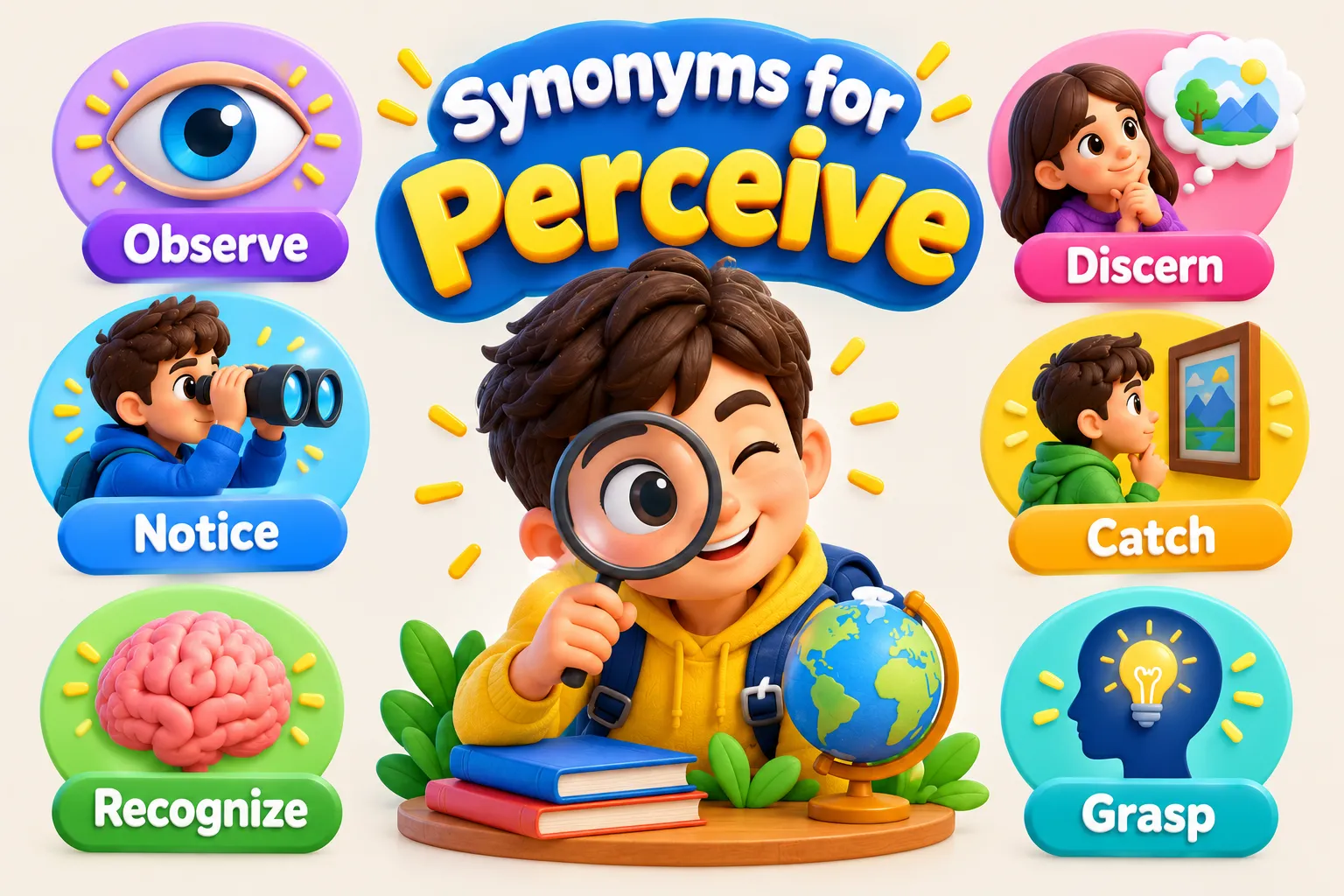
Perceive means to notice, see, hear, or understand something through your senses or mind. Common synonyms include notice, observe, detect, recognize, sense, realize, and understand. The best alternative depends on the context. For example, notice means to become aware of something, while detect often means to discover something that is not easy to see. Realize focuses on understanding a fact or situation. Learning these synonyms helps you express your thoughts clearly, improve your vocabulary, and choose more precise words in speaking and writing.
To perceive means to notice or understand something through your senses or mind. Imagine walking into a room and noticing that the lights are off and the air feels cold. You perceive that something is different. The word is common in everyday speech, education, psychology, and writing because it describes how people see, feel, and understand the world around them.
Learning synonyms for perceive helps English learners express ideas in different ways. It also helps content writers avoid repeating the same word in articles, stories, and explanations. However, each synonym has a slightly different meaning. Some words focus on seeing or hearing, while others describe awareness, discovery, or understanding. This guide explains the meaning, history, pronunciation, and word forms of perception. It also explores 27 alternatives with simple meanings and examples, along with semantic groups, antonyms, and answers to common questions.
Meaning of Perceive
Definition
Perceive (Verb): To become aware of, notice, or understand something through your senses or mind.
Examples
- I perceived a change in her voice during the conversation.
- Children may perceive the same event in different ways.
Connotative Meaning
Connotation is the feeling or idea a word suggests beyond its basic meaning.
- Positive tone: Perceive can suggest awareness, insight, understanding, or careful observation.
- Negative tone: It may suggest a mistaken impression when someone perceives a situation incorrectly.
- Neutral tone: It can simply describe noticing or understanding something without expressing an opinion.
Etymology of Perceive
The word perceive comes from Old French and Latin roots linked to receiving, taking in, or becoming aware of something.
- Old English (450–1100): The modern word perceive was not a common Old English word. English speakers used other verbs to express ideas such as noticing, seeing, and understanding.
- Middle English (1100–1500): Perceive entered English through Old French perceivre, from Latin percipere, meaning “to take in,” “to grasp,” or “to understand.”
- Modern English (1500–Present): The word developed to describe becoming aware of something through the senses or understanding it mentally. Today, it is used in everyday language and fields such as psychology, science, and philosophy.
Pronunciation (IPA)
- IPA: /pərˈsiːv/
- Syllables: Per-ceive (2 syllables)
- Stress: The second syllable: per-CEIVE.
- Pronunciation tip: Say “per” followed by “seev,” with the strongest stress on seev.
Affixation Pattern of Perceive
- Root: -ceive, historically linked to the Latin capere, meaning “to take” or “to seize.”
- Prefix: Per-, from Latin, contributing to the word’s historical formation.
- Suffix: No separate productive suffix is added to form the verb perceive.
- Word formation: Related words include perception, perceptive, and perceptible. These words share the same historical word family but have different grammatical forms.
Word Formation Table
| Word | Grammatical Category | Meaning |
| Perceive | Verb | To notice or understand something |
| Perceives | Verb, third-person singular | Notices or understands something |
| Perceived | Verb, past tense or past participle | Noticed or understood something |
| Perceiving | Verb, present participle | Becoming aware of something |
| Perception | Noun | The process of noticing or understanding |
| Perceptive | Adjective | Quick to notice or understand things |
| Perceptively | Adverb | In a way that shows insight or awareness |
| Perceptiveness | Noun | The ability to notice or understand things |
| Perceptible | Adjective | Able to be noticed or detected |
| Imperceptible | Adjective | Too slight or subtle to be noticed easily |
| Imperceptibly | Adverb | In a way that is too slight to notice |
| Misperceive | Verb | To understand or interpret something incorrectly |
| Misperception | Noun | An incorrect understanding or impression |
27 Synonyms of Perceive With Meaning & Examples
Note: These words have related meanings, but they are not interchangeable in every sentence. Some focus on the senses, while others describe thought, awareness, or interpretation.
1. Notice (Verb)
Meaning: To become aware of something by seeing, hearing, or feeling it.
Examples:
- Did you notice the new painting on the wall?
- She noticed a small change in his behavior.
2. Observe (Verb)
Meaning: To watch or examine something carefully.
Examples:
- The students observed the birds in the garden.
- She observed that the room became quiet.
3. Detect (Verb)
Meaning: To discover or notice something that may be difficult to find.
Examples:
- The machine can detect small changes in temperature.
- He detected a hint of sadness in her voice.
4. Recognize (Verb)
Meaning: To identify someone or something that you have seen, heard, or known before.
Examples:
- I recognized her voice at once.
- He recognized the signs of a coming storm.
5. Sense (Verb)
Meaning: To become aware of something through your senses or intuition.
Examples:
- She sensed tension in the room.
- The dog sensed danger nearby.
6. Realize (Verb)
Meaning: To become aware of or understand a fact or situation.
Examples:
- I realized that I had left my keys at home.
- She realized the value of regular practice.
7. Understand (Verb)
Meaning: To know the meaning of something or how it works.
Examples:
- I understand your point of view.
- He understood why the rule was important.
8. Discern (Verb)
Meaning: To notice or understand something that is not easy to see or recognize.
Examples:
- She could discern a faint sound in the distance.
- He discerned a difference between the two plans.
9. Noticeably recognize (Verb phrase)
Meaning: To become aware of something in a clear or noticeable way; this is a descriptive phrase rather than a standard synonym.
Examples:
- The teacher could clearly recognize a change in his work.
- She began to notice the pattern more clearly.
Usage note: In most cases, use recognize or notice on its own.
10. Identify (Verb)
Meaning: To find out or establish who or what someone or something is.
Examples:
- The witness identified the person in the photograph.
- She identified the main problem in the report.
11. Discover (Verb)
Meaning: To find something that was not known before.
Examples:
- Scientists discovered a new species of plant.
- He discovered that the door was unlocked.
12. Realize mentally (Verb phrase)
Meaning: To become aware of something through thought; this phrase explains a sense of realize rather than serving as a common synonym.
Examples:
- She came to realize that she needed more time.
- He began to understand the problem more clearly.
Usage note: Realize or understand is usually more natural.
13. Comprehend (Verb)
Meaning: To understand the meaning or importance of something.
Examples:
- The students struggled to comprehend the difficult passage.
- She comprehended the risks before making a choice.
14. Apprehend (Verb)
Meaning: To understand or grasp an idea; in other contexts, it can mean to arrest someone.
Examples:
- He could not fully apprehend the idea at first.
- The police apprehended the suspect near the station.
Usage note: Use this word carefully because it has more than one meaning.
15. Grasp (Verb)
Meaning: To understand something clearly.
Examples:
- She quickly grasped the main idea.
- It took him time to grasp the meaning of the poem.
16. Interpret (Verb)
Meaning: To explain or understand the meaning of something.
Examples:
- People may interpret the same message differently.
- She interpreted his silence as a sign of worry.
17. Register (Verb)
Meaning: To be noticed or understood by the mind.
Examples:
- The danger did not register with him at first.
- Her words slowly registered as he listened.
18. Realize intuitively (Verb phrase)
Meaning: To become aware of something through intuition rather than clear proof; this is a descriptive phrase, not a standard single-word synonym.
Examples:
- She sensed that something was wrong.
- He had a feeling that the plan would fail.
Usage note: Sense or suspect is usually more natural.
19. Behold (Verb)
Meaning: To see or look at something, often with wonder or respect.
Examples:
- The travelers beheld the beauty of the mountains.
- We beheld a bright rainbow after the rain.
20. Witness (Verb)
Meaning: To see an event happen, often as it takes place.
Examples:
- We witnessed a beautiful sunset.
- She witnessed the team win the final match.
21. View (Verb)
Meaning: To look at or consider something in a particular way.
Examples:
- She viewed the problem as a chance to learn.
- Many people view the change as positive.
22. Regard (Verb)
Meaning: To think of or consider someone or something in a particular way.
Examples:
- They regard her as a trusted friend.
- He regards the task as an important challenge.
23. Consider (Verb)
Meaning: To think carefully about something or view it in a particular way.
Examples:
- She considered the advice before making a choice.
- We consider honesty an important quality.
24. Infer (Verb)
Meaning: To reach a conclusion from facts or clues rather than direct statements.
Examples:
- I inferred from his tone that he was upset.
- The detective inferred that someone had entered through the back door.
25. Suspect (Verb)
Meaning: To think that something may be true without having complete proof.
Examples:
- I suspect that he already knows the answer.
- She suspected that the story was not true.
26. Feel (Verb)
Meaning: To experience an emotion or become aware of something through physical or emotional sensation.
Examples:
- I feel that something has changed.
- She felt a sense of relief after the exam.
27. Perceive mentally (Verb phrase)
Meaning: To become aware of something through thought or judgment; this phrase describes a use of perceive rather than a standard synonym.
Examples:
- He understood the risks of the decision.
- She recognized the need for a new plan.
Usage note: Use understand, recognize, or realize for more natural writing.
Prototype Meaning
The most typical meaning of perceive is to become aware of something through the senses or the mind. People often imagine someone noticing a sound, seeing a change, feeling a difference, or understanding a situation. The word can describe direct sensory experiences, such as perceiving a bright light, as well as mental judgments, such as perceiving a comment as rude. Its exact meaning depends on the context. Unlike see, which usually refers to vision, perceive can include several senses and the way the mind interprets information.
Prototype Categorization
Grouping the synonyms of perceive by meaning helps writers choose the best word for each situation.
- Noticing and awareness: Notice, sense, register, pick up on, and become aware of describing becoming conscious of something. Use them when a person begins to notice a detail, feeling, or change.
- Careful observation: Observe, detect, discern, and witness focus on watching, examining, or noticing evidence. They are useful in reports, stories, and descriptions of events.
- Recognition and discovery: Recognize, identify, and discover describe identifying something familiar or finding something new. Choose them when the main idea is knowing what something is or finding information.
- Understanding and learning: Understand, comprehend, grasp, and apprehend focus on understanding an idea or meaning. Grasp is common in everyday English, while comprehend is more formal.
- Interpretation and judgment: Interpret, view, regard, and consider describe how someone understands or thinks about a person, message, or event. Use them when describing opinions or points of view.
- Reasoning and assumptions: Infer and suspect describe reaching a conclusion or thinking something may be true. Infer often relies on evidence, while suspect can express uncertainty.
- Seeing and experiencing: Behold, make out, and feel describe seeing, recognizing, or experiencing something. Behold is more literary, while make out is informal.
These groups help writers select precise words and avoid repetition. For example, use detect for a hidden signal, comprehend for a difficult idea, and interpret for the meaning of a message.
Antonyms of Perceive
The opposite of perceive depends on whether the meaning involves noticing, understanding, or recognizing something.
| Antonym | Part of Speech | Meaning |
| Miss | Verb | To fail to notice something |
| Overlook | Verb | To fail to notice or consider something |
| Ignore | Verb | To pay no attention to something |
| Misunderstand | Verb | To understand something incorrectly |
| Misinterpret | Verb | To explain or understand something in the wrong way |
| Misread | Verb | To interpret a sign, message, or situation incorrectly |
| Disregard | Verb | To pay little or no attention to something |
| Overhear incorrectly | Verb phrase | To hear words wrongly; a descriptive phrase rather than a standard antonym |
| Misjudge | Verb | To form an incorrect opinion or judgment |
| Remain unaware | Verb phrase | To continue not knowing about something |
| Confuse | Verb | To mistake one thing or person for another |
| Neglect | Verb | To fail to give proper attention to something |
Note: These words are contextual antonyms rather than exact opposites in every use.
Short Questions and Answers
1. What does perceive mean?
Perceive means to notice, sense, or understand something through your senses or mind.
2. When should perceive be used?
Use perceive when describing how someone notices or understands something. For example, “She perceived a change in his attitude.” It is also useful when discussing opinions, feelings, or interpretations.
3. Is it perceived positively or negatively?
Perceive is generally neutral. It can describe a positive, negative, or neutral experience depending on what someone notices or how they interpret it.
4. How is it perceived differently from similar words?
Perceive is a broad word that can refer to noticing through the senses or understanding mentally. Notice often means becoming aware of a detail, detect suggests finding something that may be hidden, and comprehend focuses on understanding an idea.
Conclusion
Learning synonyms for perceive can help you build a stronger English vocabulary and express ideas more clearly. Words such as notice, detect, recognize, sense, and understand allow you to describe different types of awareness. Some focus on the senses, while others explain how people interpret events or understand ideas. Choosing the right word can improve your writing, make your speech more natural, and help you avoid repetition. It is also useful to learn how each synonym works in a sentence because related words may have different meanings. Practice a few new words every day, write your own examples, and use them in real conversations. With regular practice, you can communicate with greater accuracy and confidence.
Read More:
Synonyms for Scarf: 27 Common Words to Discover

I’m Pinki, an SEO writer at SynonymsInstant.com, specializing in synonyms, antonyms, vocabulary, word meanings, grammar, and English usage. I create accurate, well-researched, reader-friendly content that combines language expertise with SEO best practices. My goal is to make English vocabulary simple, useful, and accessible for students, writers, professionals, and English learners.