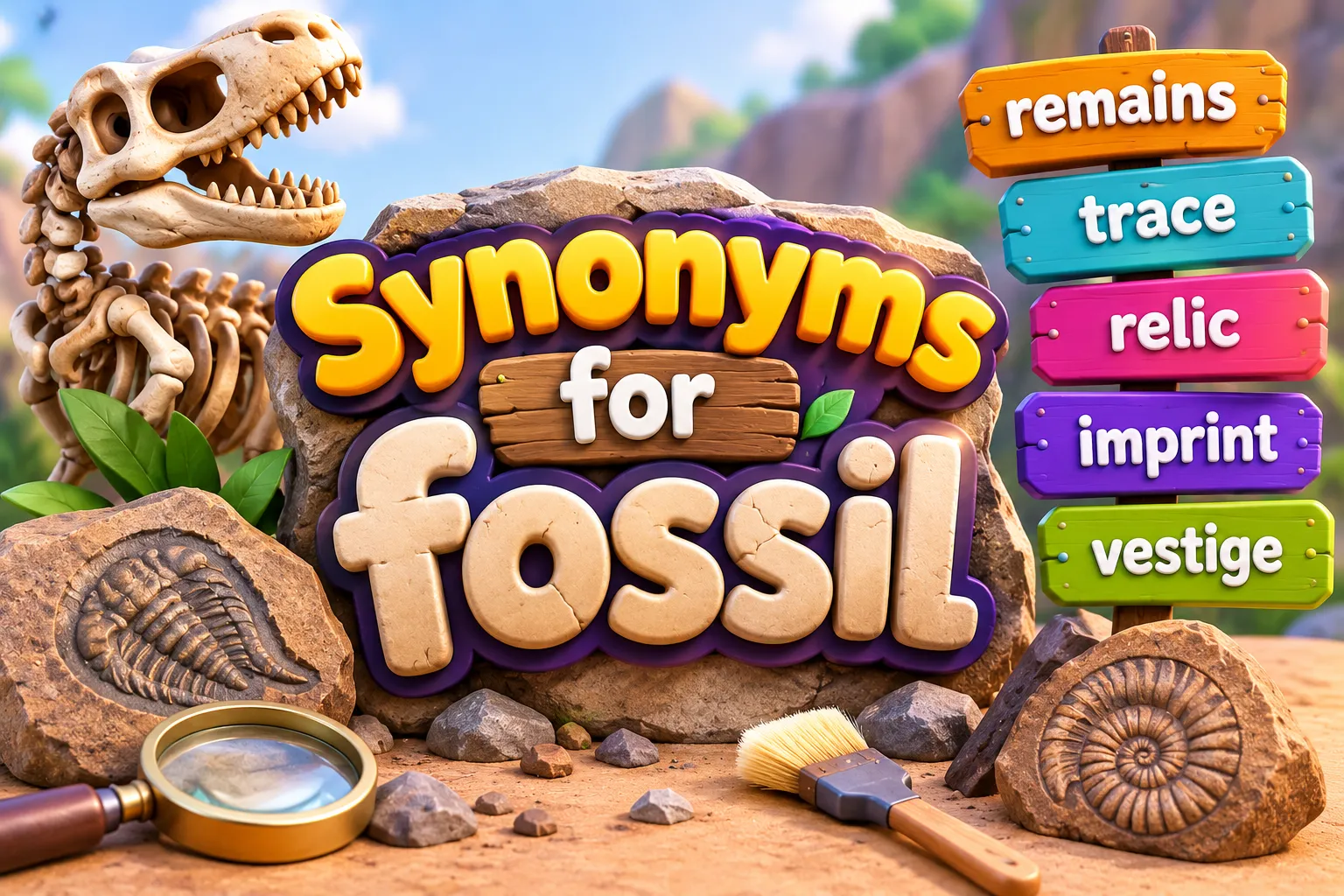
A fossil is the preserved remains, impression, or trace of a plant or animal that lived long ago. Words such as remnant, relic, remains, specimen, imprint, trace, artifact, petrification, petrified remains, and prehistoric remains can be used as related terms, but they are not always exact synonyms. Fossil is mainly used in science and history for evidence of ancient life, while some related words can describe old objects, traces, or things from the past. Learning these words helps English learners and content writers describe ancient life, history, archaeology, and old ideas with greater accuracy and less repetition.
Introduction
Imagine walking through a museum and seeing the clear shape of an ancient shell pressed into a piece of rock. The guide explains that it is a fossil, a preserved sign of life from a very distant time. The word fossil is common in science, geology, archaeology, museums, and everyday speech. It can also describe something very old or outdated when used figuratively. Learning synonyms is useful because different words can show small differences in meaning. For English learners, these words build stronger vocabulary and make speaking more natural. For content writers, they help avoid repetition and add detail. In this guide, we explore the meaning, examples, grammar, history, pronunciation, word formation, synonyms, antonyms, and semantic categories of fossils.
Meaning of Fossil
Definition
Fossil (noun): The preserved remains, impression, or trace of a plant or animal that lived in the distant past.
Fossil (adjective): Very old or outdated, especially when describing a person, idea, or system.
Examples
- Scientists discovered a fossil of an ancient fish in the rock.
- The museum has a large collection of dinosaur fossils.
Connotative Meaning
(Connotation means the feeling or idea that a word suggests beyond its basic meaning.)
- Positive tone: A fossil can suggest scientific discovery, history, knowledge, or wonder.
- Negative tone: When used for a person or idea, fossil can suggest something old-fashioned or outdated.
- Neutral tone: In science, fossil is usually a neutral term for preserved evidence of ancient life.
Etymology
The word fossil comes from Latin fossilis, meaning “dug up” or “obtained by digging.” It entered English through French and was first used for things found by digging, especially geological objects.
| Period | Development |
| Old English (450–1100) | There was no direct English form of fossil in common use. |
| Middle English (1100–1500) | Related Latin and French forms influenced scientific vocabulary entering English. |
| Modern English (1500–Present) | Fossil developed as a term for preserved remains or traces of ancient life and later gained the figurative meaning “old-fashioned.” |
Pronunciation (IPA)
- IPA: /ˈfɒs.əl/ (UK), /ˈfɑː.səl/ (US)
- Syllables: fos-sil
Affixation Pattern of Fossil
- Root: fossil
- Prefix: None
- Suffix: None in the basic word
- Word formations:
- Fossil — noun/adjective
- Fossils — plural noun
- Fossilize — verb
- Fossilized — adjective/past participle
- Fossilization — noun
- Fossiliferous — adjective, meaning containing fossils
- Fossiliferousness — noun, referring to the quality of being fossil-bearing
29 Synonyms of Fossil With Meaning & Examples
1. Remnant (Noun)
Meaning: Something left from an earlier time or larger whole.
Examples:
- The fossil was a remnant of ancient marine life.
- Only a few remnants of the old settlement remain.
2. Relic (Noun)
Meaning: An old object or thing that has survived from the past.
Examples:
- The museum displayed a relic from an ancient civilization.
- The fossil is a relic of prehistoric life.
3. Remains (Noun)
Meaning: What is left after something has disappeared or changed.
Examples:
- Scientists examined the remains of an ancient animal.
- The remains were carefully preserved in the museum.
4. Trace (Noun)
Meaning: A small sign or piece of evidence left behind.
Examples:
- Scientists found traces of an ancient plant.
- The fossil provides a trace of life from millions of years ago.
5. Imprint (Noun)
Meaning: A mark or shape left by something on another surface.
Examples:
- The rock contains an imprint of a leaf.
- Researchers studied the animal’s imprint in the stone.
6. Impression (Noun)
Meaning: A mark or image left by pressure.
Examples:
- The fossil contains an impression of a shell.
- We could see the impression clearly in the rock.
7. Specimen (Noun)
Meaning: A particular example collected for scientific study.
Examples:
- The museum has a rare fossil specimen.
- Students examined the specimen during the science lesson.
8. Petrified Remains (Noun Phrase)
Meaning: Ancient remains that have become stone-like through mineral replacement.
Examples:
- The scientist studied the petrified remains of a tree.
- Petrified remains can preserve details of ancient organisms.
9. Petrification (Noun)
Meaning: The process in which organic material becomes stone-like through mineralization.
Examples:
- Petrification helped preserve the ancient wood.
- The fossil formed through a long process of petrification.
10. Petrified Object (Noun Phrase)
Meaning: An object from the past that has become stone-like.
Examples:
- The museum displayed a petrified object from an ancient forest.
- The petrified object looked like ordinary stone at first.
11. Ancient Remains (Noun Phrase)
Meaning: Physical remains from a very distant past.
Examples:
- Researchers discovered ancient remains in the cave.
- The ancient remains helped scientists study prehistoric life.
12. Prehistoric Remains (Noun Phrase)
Meaning: Remains from a time before recorded history.
Examples:
- The team found prehistoric remains underground.
- These prehistoric remains are important to scientists.
13. Organic Remains (Noun Phrase)
Meaning: Material that once came from a living organism.
Examples:
- The rock contained organic remains.
- Scientists studied the organic remains carefully.
14. Fossilized Remains (Noun Phrase)
Meaning: Ancient remains that have been preserved through fossilization.
Examples:
- Fossilized remains were found near the river.
- The fossilized remains revealed the animal’s size.
15. Fossil Record (Noun Phrase)
Meaning: The collection of fossils that provides evidence about ancient life.
Examples:
- The fossil record shows how some animals changed over time.
- Scientists use the fossil record to study evolution.
16. Archaeological Remains (Noun Phrase)
Meaning: Physical evidence left by past human societies.
Examples:
- Archaeological remains were found near the ancient city.
- The remains helped researchers understand the settlement.
17. Artifact (Noun)
Meaning: An object made or changed by humans in the past.
Examples:
- The museum contains an ancient artifact.
- Researchers carefully examined the artifact.
Note: Artifact is related to the past but is not an exact synonym for fossil, because fossils are usually natural remains or traces of ancient life.
18. Historical Remnant (Noun Phrase)
Meaning: Something left from a past historical period.
Examples:
- The old wall is a historical remnant.
- The object is a historical remnant of the early settlement.
19. Survival (Noun)
Meaning: Something that continues to exist from an earlier period.
Examples:
- The old tradition is a survival from an earlier age.
- The fossil is a physical survival from ancient life.
20. Vestige (Noun)
Meaning: A small remaining sign of something that existed in the past.
Examples:
- The fossil is a vestige of an ancient ecosystem.
- Scientists found vestiges of prehistoric life.
21. Echo (Noun)
Meaning: A sign or reminder of something from the past.
Examples:
- The fossil is an echo of life from a distant age.
- The ancient structure is an echo of an earlier culture.
22. Remembrance (Noun)
Meaning: Something that helps preserve the memory of the past.
Examples:
- The fossil serves as a reminder of ancient life.
- The museum keeps the specimen as a remembrance of Earth’s past.
23. Memento (Noun)
Meaning: An object kept as a reminder of a person, place, or event.
Examples:
- He bought a small fossil as a memento of the museum visit.
- The object became a memento of her trip.
24. Curio (Noun)
Meaning: An unusual or interesting object, often collected because of its rarity.
Examples:
- The shop displayed an unusual fossil as a curio.
- He collected fossils and other curios.
25. Geological Remnant (Noun Phrase)
Meaning: A remaining piece of geological material from an earlier period.
Examples:
- The rock contains a geological remnant from an ancient environment.
- Scientists examined the geological remnant closely.
26. Preserved Remains (Noun Phrase)
Meaning: Remains that have survived in a protected or preserved form.
Examples:
- The cave contained preserved remains.
- The preserved remains gave researchers useful information.
27. Ancient Specimen (Noun Phrase)
Meaning: An old example of an organism or material kept for study.
Examples:
- The laboratory received an ancient specimen.
- The ancient specimen was placed in a protective case.
28. Paleontological Specimen (Noun Phrase)
Meaning: A specimen used to study ancient life.
Examples:
- The museum received a valuable paleontological specimen.
- Researchers examined the paleontological specimen for evidence of ancient life.
29. Fossilized Organism (Noun Phrase)
Meaning: An ancient organism or its remains preserved through fossilization.
Examples:
- The rock contained a fossilized organism.
- Scientists identified the fossilized organism as an ancient marine animal.
Prototype Meaning
The most typical meaning of fossil is the preserved remains, impression, or trace of an ancient plant or animal found in rock. When people hear the word, they often imagine a dinosaur bone, a shell, a leaf imprint, or another ancient life form preserved over a very long period. In science, the word mainly refers to evidence that helps researchers understand life and environments from the distant past.
Prototype Categorization
- Direct fossil-related terms: petrified remains, fossilized remains, fossilized organisms, paleontological specimens, and ancient specimens are closely connected with scientific study of ancient life.
- Evidence and trace terms: trace, imprint, impression, remains, and preserved remains focus on physical evidence left behind.
- Old or historical objects: relic, remnant, artifact, vestige, curio, and memento can describe objects connected with the past, but they are not always scientific synonyms.
- Ancient-life terms: prehistoric remains, ancient remains, organic remains, and geological remnants highlight age and connection with earlier life or environments.
- Figurative terms: echo, survival, and time capsule can describe something that represents or preserves the past in a broader sense.
This categorization helps writers select a word based on context. A science article may need specimens or fossilized remains, while a history article may better use relics or remnants.
Antonyms of Fossil
Because fossils mainly describe something preserved from the distant past, its antonyms depend on the intended meaning.
| Antonym | Part of Speech | Meaning |
| Living organism | Noun phrase | An organism that is alive now |
| Modern | Adjective | Relating to the present or recent times |
| Contemporary | Adjective | Existing or happening at the present time |
| New | Adjective | Recently made, created, or discovered |
| Current | Adjective | Existing or relevant now |
| Fresh | Adjective | Recent or newly produced |
| Developing | Adjective | Growing or changing toward a newer form |
| Innovative | Adjective | Introducing new ideas or methods |
Short Questions and Answers
What does fossil mean?
A fossil is preserved evidence of ancient life, such as a bone, shell, footprint, or plant impression found in rock.
When should fossils be used?
Use fossils when talking about preserved remains or traces of ancient life. It can also describe something very old or outdated in a figurative sense.
Is fossil positive or negative?
In scientific writing, fossils are usually neutral. In informal speech, calling a person or idea a fossil can have a negative meaning because it may suggest that something is old-fashioned.
How is fossil different from similar words?
A fossil specifically relates to preserved evidence of ancient life. A relic is a surviving object from the past, while a remnant is something left behind. A specimen is an example collected for study and does not have to be ancient.
Conclusion
Learning fossils and its related words can make your English vocabulary stronger and more precise. The word usually refers to preserved evidence of ancient life, but related terms such as relic, remnant, specimen, trace, and impression have different meanings and uses. Understanding these small differences helps you choose the right word for science, history, education, and creative writing. Synonyms also help you avoid repeating the same word in your essays and articles. They can make your speaking and writing clearer and more natural. For English learners, regular vocabulary practice is a simple way to build confidence. Try learning a few new words each day and use them in your own sentences.
Read More:
Synonyms for smirk: 30 Clever Alternatives

I am Rubab content specialist focused on creating accurate, user-friendly, and search-optimized language resources. Through Synonyminstant, I help readers find synonyms, antonyms, meanings, and vocabulary with ease. Every article is carefully researched and optimized to provide reliable information, clear explanations, and an excellent user experience.