
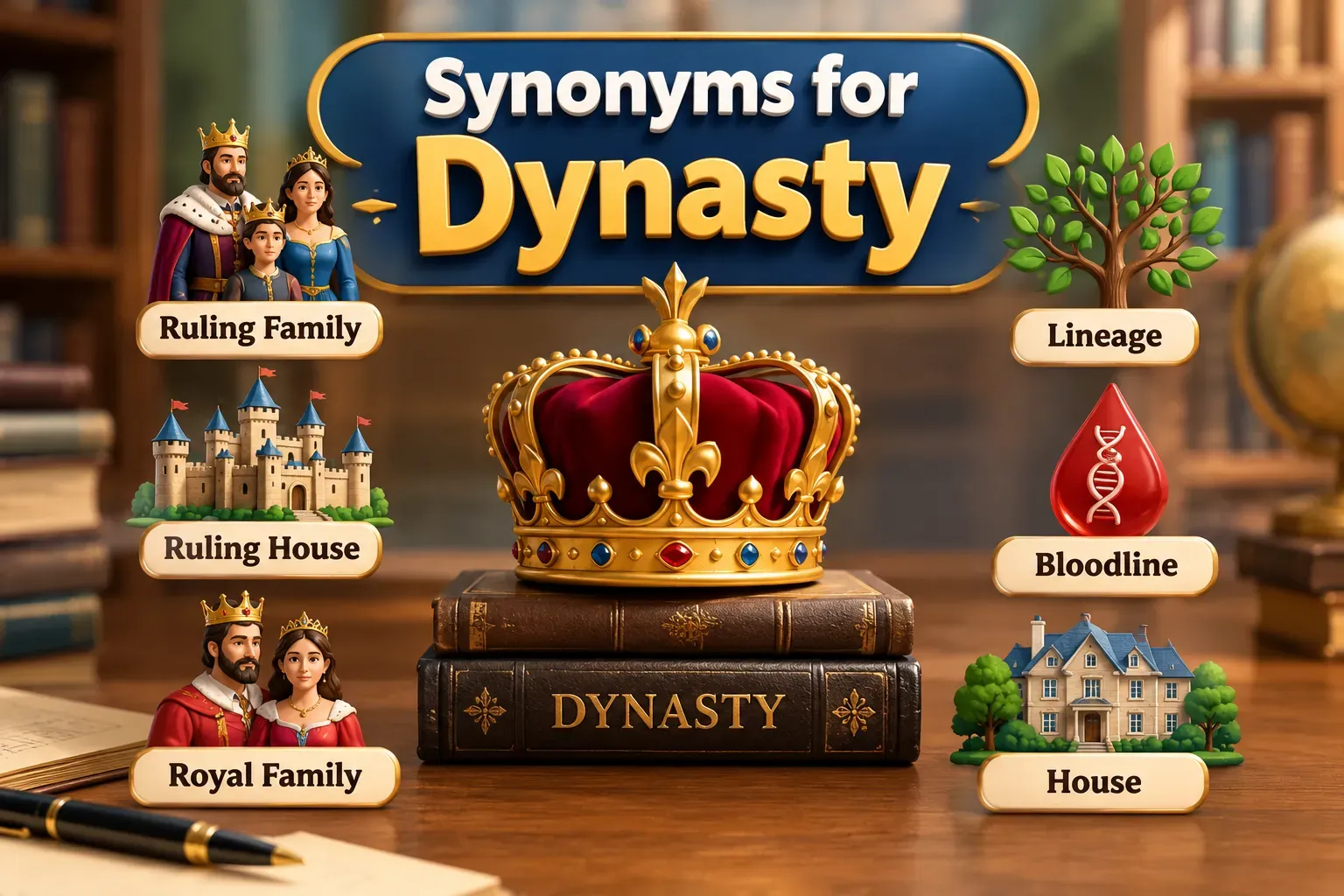
The best synonyms for dynasty include ruling family, ruling house, royal family, lineage, bloodline, and house. Each word has a slightly different meaning and works best in a specific context. Use ruling family or ruling house when talking about a family that holds political or royal power, while lineage and bloodline focus more on family descent. If you mean a long period of family rule, dynasty itself is usually the clearest choice.
The word dynasty is commonly used when talking about royal families, political families, and even successful sports teams. It usually describes a succession of rulers from the same family or a period of family rule.
Learning synonyms for dynasty can help English learners avoid repetition. It can also help content writers choose a word that fits the exact context. In this guide, you will learn the meaning, history, pronunciation, word formation, 30 useful alternatives, semantic categories, antonyms, and practical examples of dynasty.
Meaning of Dynasty
Definition
Dynasty (noun): A succession of rulers or leaders from the same family, or the period during which that family rules.
A dynasty is most often connected with royal or political power. However, modern English can also use the word more broadly for a family or group that maintains great influence or success over generations.
Examples
- The Ming dynasty ruled China for several centuries.
- The family built a powerful political dynasty over several generations.
Connotative Meaning
Connotation means the feeling or idea that a word suggests beyond its basic dictionary meaning.
- Positive tone: A dynasty can suggest strength, success, tradition, prestige, and achievement.
- Negative tone: It can suggest concentrated power, inherited privilege, or family control, depending on the context.
- Neutral tone: In history,a dynasty can simply describe a succession of rulers from one family.
Etymology
The history of the dynasty goes back to Greek and later Latin. Etymonline traces it to Medieval Latin dynastia, from Greek dynasteia, meaning “power, lordship, sovereignty,” related to Greek dynastes, meaning “ruler” or “chief.”
- Old English (450–1100): Dynasty was not an Old English word. It entered English much later.
- Middle English (1100–1500): The word appeared in English in the late 14th century as dynastia. By the mid-15th century, dynasty referred to a succession of sovereigns from the same family.
- Modern English (1500–Present): The word developed its modern sense of a ruling family or succession of rulers. Today, it can also be used figuratively for powerful or highly successful families, organizations, or sports teams.
Pronunciation (IPA)
- IPA: UK /ˈdɪn.ə.sti/; US /ˈdaɪ.nə.sti/
- Syllables: dyn-as-ty
Cambridge gives separate UK and US pronunciations, with the main difference occurring in the first syllable.
Affixation Pattern of Dynasty
- Root: dynast-
- Prefix: None in the modern English word
- Suffix: -y
- Word formations:
- dynast noun: a ruler belonging to a dynasty
- dynastic adjective: relating to a dynasty
- dynastical adjective: relating to a dynasty; less common
- dynastically adverb: in a dynastic manner
The related noun dynast means a ruler who belongs to a ruling family.
30 Synonyms of Dynasty With Meaning & Examples
1. Ruling House (Noun)
Meaning: A family or house that rules a country or kingdom.
Examples:
- The Tudor ruling house shaped English history.
- The old ruling house lost power after the revolution.
2. Royal Family (Noun)
Meaning: A family connected to a monarchy, especially the reigning family.
Examples:
- The royal family played an important role in the kingdom.
- Several members of the royal family attended the ceremony.
3. Ruling Family (Noun)
Meaning: A family whose members hold political or royal power.
Examples:
- The ruling family controlled the kingdom for generations.
- The new king came from the same ruling family.
4. House (Noun)
Meaning: A family or line of rulers, especially a royal family.
Examples:
- The House of Tudor became an important part of English history.
- A new house came to the throne after the conflict.
5. Lineage (Noun)
Meaning: A person’s or family’s line of descent from earlier generations.
Examples:
- The king could trace his lineage back many generations.
- Her royal lineage was carefully recorded.
6. Bloodline (Noun)
Meaning: A family line connected through descent.
Examples:
- The ruler wanted to protect the royal bloodline.
- His bloodline had held power for centuries.
7. Family Line (Noun)
Meaning: A sequence of family members connected through generations.
Examples:
- The throne remained in the same family line.
- The family line ended when the ruler died without an heir.
8. Succession (Noun)
Meaning: A series of people who follow one another in an important position.
Examples:
- The succession continued through several generations.
- Questions about royal succession created conflict.
9. Reigning House (Noun)
Meaning: The family currently holding royal power.
Examples:
- The reigning house announced a new heir.
- The treaty strengthened the position of the reigning house.
10. Royal House (Noun)
Meaning: A royal family or family line.
Examples:
- The royal house had ruled the region for centuries.
- Two royal houses joined through marriage.
11. Royal Line (Noun)
Meaning: A family line connected with royal inheritance.
Examples:
- He belonged to an ancient royal line.
- The royal line continued through her children.
12. House of Rulers (Noun Phrase)
Meaning: A family or group of related rulers from the same line.
Examples:
- The house of rulers controlled the kingdom for generations.
- Historians studied the house of rulers carefully.
13. Reign (Noun)
Meaning: The period during which a monarch rules.
Examples:
- The king’s reign lasted forty years.
- The palace was built during her reign.
Note: Reign is related to dynasty but is not an exact synonym. A dynasty can contain many reigns.
14. Monarchy (Noun)
Meaning: A system of government led by a monarch.
Examples:
- The country changed from a monarchy to a republic.
- The monarchy survived several political crises.
Note: A monarchy is a political system, while a dynasty is a ruling family or succession.
15. Kingship (Noun)
Meaning: The position, authority, or status of a king.
Examples:
- He inherited kingship from his father.
- The struggle for kingship divided the family.
16. Royalty (Noun)
Meaning: Members of a royal family or the status of being royal.
Examples:
- The palace welcomed foreign royalty.
- Her connection to royalty attracted public attention.
17. Sovereign Line (Noun Phrase)
Meaning: A family line that produces sovereign rulers.
Examples:
- The sovereign line continued for generations.
- Historians documented the ancient sovereign line.
18. Hereditary Line (Noun)
Meaning: A line of succession passed through family inheritance.
Examples:
- The crown followed a hereditary line.
- The hereditary line determined who could inherit the throne.
19. Ancestral Line (Noun)
Meaning: A sequence of ancestors connected through generations.
Examples:
- The prince researched his ancestral line.
- Her ancestral line included several rulers.
20. Family Succession (Noun Phrase)
Meaning: The continuation of leadership through members of one family.
Examples:
- The kingdom followed a system of family succession.
- Family succession kept the throne within one household.
21. Hereditary Rule (Noun Phrase)
Meaning: A system in which leadership is passed through a family.
Examples:
- The country was governed by hereditary rule.
- Hereditary rule kept political power within the same family.
22. Royal Succession (Noun Phrase)
Meaning: The process by which royal power passes to a new ruler.
Examples:
- The king prepared the court for royal succession.
- Royal succession became uncertain after the prince died.
23. Political Dynasty (Noun Phrase)
Meaning: A family whose members hold political influence or office across generations.
Examples:
- The family became a powerful political dynasty.
- The political dynasty influenced national politics for decades.
24. Power Family (Noun Phrase)
Meaning: A family with strong political, economic, or social influence.
Examples:
- The business grew into a famous power family.
- Several generations turned the family into a regional power family.
25. Legacy Family (Noun Phrase)
Meaning: A family known for maintaining an important legacy across generations.
Examples:
- The athletes came from a famous legacy family.
- Their legacy family was known for excellence in the sport.
26. Bloodline of Rulers (Noun Phrase)
Meaning: A family line consisting of rulers and their descendants.
Examples:
- The historian studied the bloodline of rulers.
- The bloodline of rulers extended across several centuries.
27. Successive Rulers (Noun Phrase)
Meaning: Rulers who hold power one after another.
Examples:
- Successive rulers expanded the kingdom.
- The palace was changed by successive rulers.
Note: This phrase describes the rulers rather than the family itself.
28. Successive Generations (Noun Phrase)
Meaning: Family generations that follow one another.
Examples:
- The tradition continued through successive generations.
- Successive generations preserved the family’s influence.
29. Family Reign (Noun Phrase)
Meaning: A period when one family maintains political or royal control.
Examples:
- The family’s reign lasted more than a century.
- The family’s reign ended after a major rebellion.
30. Line of Rulers (Noun Phrase)
Meaning: A series of rulers connected by succession or family descent.
Examples:
- The country had a long line of rulers.
- Historians recorded every ruler in the line of rulers.
Prototype Meaning
The most typical meaning of dynasty is a family line that produces rulers over several generations. When people hear the word, they often imagine a royal family, a throne, a kingdom, and power being passed from one generation to another. Cambridge defines a dynasty as a series of rulers or leaders from the same family, or the period when that family rules.
The word can also be used outside traditional royalty. For example, a sports team with repeated championship success may be described as a dynasty, even though no royal family is involved.
Prototype Categorization
The 30 alternatives above fall into several useful semantic groups. This helps writers choose a word based on the exact idea they want to express.
- Royal and ruling-family terms:ruling house, royal family, ruling family, house, royal house, reigning house
- Use these when discussing an actual royal family or ruling household.
- Family and ancestry terms:lineage, bloodline, family line, ancestral line, royal line
- These focus more on descent and family connections than political power.
- Succession terms:succession, family succession, royal succession, hereditary line, hereditary rule
- These work well when discussing how power passes from one person to another.
- Reign and authority terms:reign, monarchy, kingship, royalty
- These words focus on rule, royal status, or the political system rather than the family itself.
- Historical description terms:successive rulers, successive generations, line of rulers, bloodline of rulers
- These are useful when writing history and describing several generations.
- Modern influence terms:political dynasty, power family, legacy family
- These can describe influential families outside traditional monarchies.
Choosing the right synonym matters because these words are not completely interchangeable. For example, monarchy describes a system of government, while lineage describes descent. Reign describes a period of rule, while dynasty usually describes a family succession or the period associated with that family.
Antonyms of Dynasty
There is no single perfect opposite of dynasty because the word can describe either a family line or a period of family rule. However, these terms can express contrasting ideas:
1. Republic (Noun)
Meaning: A form of government in which the state is not ruled by a hereditary monarch.
2. Nonhereditary Rule (Noun Phrase)
Meaning: A system in which leadership does not automatically pass through a family.
3. Elected Government (Noun Phrase)
Meaning: A government in which leaders are chosen through elections.
4. Single-Term Leadership (Noun Phrase)
Meaning: Leadership limited to one term rather than continuing through generations.
5. Political Turnover (Noun Phrase)
Meaning: Frequent changes in political leadership.
6. Power Rotation (Noun Phrase)
Meaning: A situation in which leadership moves among different people or groups.
Short Questions and Answers
What does dynasty mean?
Dynasty means a succession of rulers or leaders from the same family, or the period during which that family rules.
When should dynasty be used?
Use dynasty when you are talking about a family that holds power across generations. It is especially common in historical and political writing. It can also describe a highly successful family, team, or organization in a figurative sense.
Is dynasty positive or negative?
Dynasty is neutral by itself. Its tone depends on context. It can suggest tradition and achievement, but it can also suggest inherited privilege or concentrated power.
How is dynasty different from similar words?
A dynasty is usually a family line connected with long-term rule. A lineage focuses on ancestry. A reign means a period of a ruler’s authority. A monarchy is a system of government. A royal family refers to the family itself.
What is the best synonym for dynasty?
There is no single best synonym for every sentence. The ruling house, ruling family, and royal family are useful when discussing royal power. Lineage and bloodline are better when the focus is ancestry.
Can dynasty be used outside politics?
Yes. Modern English often uses dynasty figuratively for a family, team, or organization that achieves strong and lasting success across generations or over a long period.
What is the plural of dynasty?
The plural is dynasties.
Conclusion
Learning synonyms for dynasty gives you more control over your English. The word usually describes a family of rulers or a period of family rule. However, alternatives such as ruling house, royal family, lineage, bloodline, succession, and reign highlight different parts of the idea.
Good vocabulary is not about replacing one word with another at random. It is about choosing the word that gives your sentence the exact meaning you want. A history writer may prefer ruling house. A writer discussing ancestry may choose lineage. A political writer may use political dynasty.
Using these alternatives can improve your vocabulary, strengthen your writing and speaking, reduce repetition, and build confidence. Try learning a few new synonyms each day. Then use them in your own sentences so they become part of your active English vocabulary.
Read More:
Synonyms for Advertise: 29 Powerful Alternatives

I am Rubab content specialist focused on creating accurate, user-friendly, and search-optimized language resources. Through Synonyminstant, I help readers find synonyms, antonyms, meanings, and vocabulary with ease. Every article is carefully researched and optimized to provide reliable information, clear explanations, and an excellent user experience.