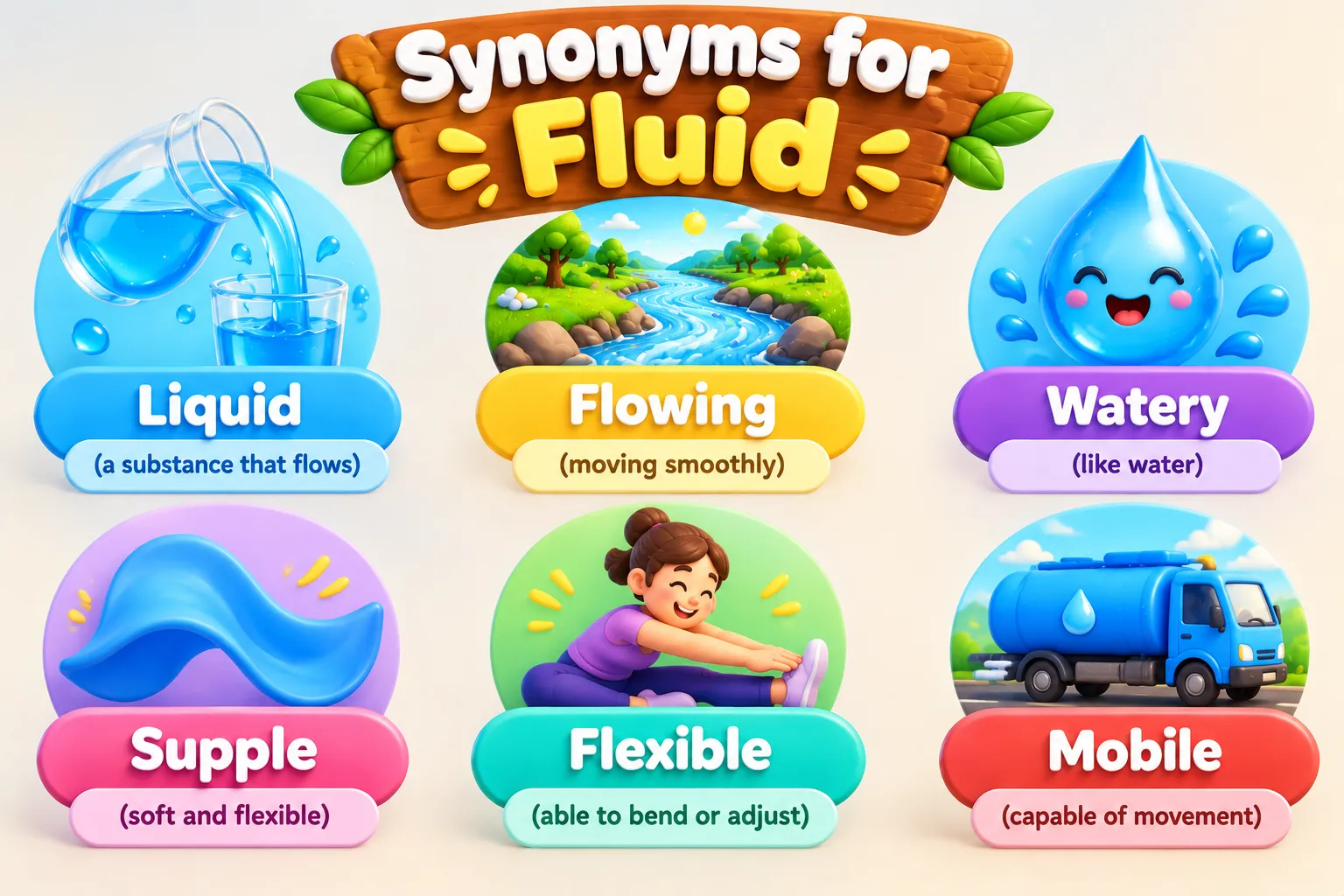
The word fluid describes a substance that can flow, such as a liquid or gas. It can also describe smooth movement or something that changes easily. Common synonyms for fluid include liquid, flowing, runny, free-flowing, smooth, flexible, adaptable, and changeable. However, each word has a slightly different meaning. For example, liquid describes a state of matter, whereas flexible describes something that can bend or adapt.
Learning synonyms for fluid can expand your English vocabulary and make your writing more effective. Moreover, these alternatives help you avoid repeating the same word in every sentence. In this guide, you will discover 25 synonyms, their meanings, and simple examples. You will also learn about pronunciation, word forms, antonyms, and the different contexts in which you can use each word.
Meaning of Fluid
Definition
Fluid (noun and adjective)
- As a noun: A substance that can flow, such as a liquid or gas.
- As an adjective: Something that flows smoothly, moves easily, or changes without difficulty.
Examples of Fluid in Sentences
Consider these examples to understand how people use fluid in everyday English.
- Water is a fluid that flows through pipes.
- The dancer’s fluid movements made the performance look graceful.
- Their plans remained fluid because the situation kept changing.
As these sentences show, fluid can describe substances, physical movements, and changing situations. Therefore, the surrounding words help you understand its exact meaning.
Connotative Meaning of Fluid
Connotation refers to the feelings or ideas a word suggests beyond its basic definition. Depending on the context, fluid can create positive, negative, or neutral impressions.
- Positive tone: Fluid can suggest grace, creativity, and flexibility. For example, the dancer’s fluid movements looked elegant and natural.
- Negative tone: The word may suggest uncertainty when plans or rules keep changing. For instance, constantly changing rules can create confusion.
- Neutral tone: In science, fluid simply describes a substance that flows, such as water, oil, or air.
Overall, the word does not carry a strongly positive or negative meaning by itself. Instead, its tone depends on how the writer uses it.
Etymology of Fluid
The word fluid comes from the Latin word fluidus, meaning “flowing.” It is also related to the Latin verb fluere, which means “to flow.”
Over time, English adopted the word and developed several uses for it.
- Old English (450–1100): Speakers used native words to describe flowing water and moving substances.
- Middle English (1100–1500): Latin and French influenced English vocabulary, particularly in scientific and scholarly writing.
- Modern English (1500–present): Fluid became a common scientific term for liquids and gases. Later, its meaning expanded to include smooth movement, flexible ideas, and changing conditions.
Today, people use fluid in science, art, communication, and everyday conversation. Consequently, understanding its different meanings can help you choose the right synonym.
Pronunciation of Fluid
Correct pronunciation makes it easier to use the word confidently in conversations and presentations.
- IPA: /ˈfluː.ɪd/
- Syllables: Flu-id
- Syllable count: 2
- Word stress: The first syllable receives the main stress: FLU-id.
To practise, say the word slowly before using it in a complete sentence. For example, “The dancer moved with fluid grace.”
Affixation Pattern of Fluid
The word fluid does not contain a common, productive prefix or suffix in modern English.
- Base word: Fluid — something that flows or moves smoothly.
- Prefix: None.
- Suffix: The ending -id belongs to the word’s historical form. English speakers do not normally add it to create new words.
Word Forms of Fluid
Learning related word forms helps you understand how to use the word in different contexts.
| Word | Part of Speech | Meaning |
|---|---|---|
| Fluid | Noun | A substance that flows, such as a liquid or gas |
| Fluid | Adjective | Able to flow, move smoothly, or change easily |
| Fluids | Plural noun | More than one fluid or type of fluid |
| Fluidity | Noun | The quality of flowing smoothly or changing easily |
| Fluidly | Adverb | In a smooth, flowing, or flexible way |
| Fluidic | Adjective | Related to the movement or control of fluids |
| Fluidize | Verb | To make a material behave like a fluid under certain conditions |
| Fluidized | Adjective | Made to behave like a fluid, often by passing gas through particles |
| Fluidizing | Verb form | Making or causing a material to behave like a fluid |
For example, fluidity describes the quality of flowing or changing easily. Similarly, fluidly explains how an action takes place, as in “She moved fluidly across the stage.”
25 Synonyms of Fluid With Meanings and Examples
The word fluid has several meanings, so its synonyms work in different situations. Some describe substances, while others refer to movement, flexibility, or change. Therefore, check each definition before replacing fluid with another word.
1. Liquid
Meaning: A substance that flows and takes the shape of its container.
Examples:
- Water is a clear liquid.
- The medicine comes in liquid form.
When to use it: Use liquid when describing a substance in a liquid state. For example, water and milk are liquids, while air is a gas.
2. Flowing
Meaning: Moving steadily and smoothly in a particular direction.
Examples:
- The flowing river passed through the valley.
- She wore a dress with flowing sleeves.
When to use it: Choose flowing when describing water, fabric, movement, or another thing that moves freely.
3. Runny
Meaning: Having a thin consistency rather than a thick or firm one.
Examples:
- The sauce became too runny.
- I prefer a runny egg yolk.
When to use it: Use runny when describing food or another substance that is thinner than expected. However, it is generally less suitable for formal scientific writing.
4. Free-Flowing
Meaning: Able to move freely without being blocked or restricted.
Examples:
- The free-flowing stream crossed the field.
- The meeting encouraged free-flowing discussion.
When to use it: This term works well when describing unrestricted movement or conversation. In addition, it can suggest that people are sharing ideas without unnecessary restrictions.
5. Watery
Meaning: Containing a lot of water or having a thin, weak consistency.
Examples:
- The soup was too watery.
- His eyes became watery in the cold wind.
When to use it: Choose watery when describing a substance with too much water or a weak consistency. Unlike fluid, it can suggest that something is thinner than desired.
6. Liquefied
Meaning: Changed into a liquid state.
Examples:
- The heat turned the material into a liquefied mass.
- The liquefied gas was stored in a special tank.
When to use it: Use liquefied when a substance has changed into a liquid. This word is particularly useful in scientific and technical contexts.
7. Molten
Meaning: Made liquid by intense heat.
Examples:
- Molten metal flowed into the mold.
- The workers handled the molten glass with care.
When to use it: Choose molten for materials such as metal, glass, or rock that have melted because of heat. It is more specific than the general word fluid.
8. Viscous
Meaning: Thick and resistant to flowing.
Examples:
- Honey is more viscous than water.
- The machine uses a viscous oil.
When to use it: Use viscous when discussing how easily a liquid flows. In contrast to runny, this word describes a liquid that resists movement.
9. Runny-Textured
Meaning: Having a thin consistency that allows something to flow easily.
Examples:
- The runny-textured mixture spread across the pan.
- We added flour to make the mixture thicker.
When to use it: This phrase can describe a thin mixture, although runny or thin sounds more natural in everyday English. Therefore, use the shorter alternatives whenever possible.
10. Pourable
Meaning: Thin enough to be poured from one container into another.
Examples:
- The dressing should be pourable but not watery.
- Add milk until the mixture becomes pourable.
When to use it: Choose pourable when describing liquids or mixtures that can be poured easily. However, something can be pourable without being completely watery.
11. Smooth
Meaning: Moving or happening without sudden stops, roughness, or interruptions.
Examples:
- The skater made smooth movements across the ice.
- Their conversation had a smooth, natural rhythm.
When to use it: Use smooth when describing movement, speech, writing, or a process that happens without difficulty. For example, smooth writing flows naturally from one idea to another.
12. Graceful
Meaning: Moving in an attractive, controlled, and elegant way.
Examples:
- The dancer made graceful turns.
- Her graceful movements looked almost effortless.
When to use it: Choose graceful when describing elegant movement. Although it is not a direct synonym in every context, it works well when fluid describes physical motion.
13. Seamless
Meaning: Happening smoothly without noticeable breaks or problems.
Examples:
- The software update created a seamless user experience.
- The dancers made a seamless transition between scenes.
When to use it: Use seamless when describing a process or transition that feels continuous and natural. In business and technology, it often suggests that something works without disruption.
14. Continuous
Meaning: Continuing without stopping or being interrupted.
Examples:
- The machine produces a continuous stream of water.
- Continuous movement kept the wheels turning.
When to use it: Choose continuous when something carries on without stopping. However, it emphasizes duration rather than flexibility or ease of movement.
15. Uninterrupted
Meaning: Continuing without a break or interruption.
Examples:
- We enjoyed an uninterrupted flow of music.
- The team worked for two hours without interruption.
When to use it: Use uninterrupted when describing an activity or process that continues without disturbance. It is especially useful when emphasizing the absence of breaks.
16. Flexible
Meaning: Able to bend or change without breaking or becoming fixed.
Examples:
- The flexible material bends easily.
- We need a flexible plan for the event.
When to use it: Choose flexible when describing something that can adapt to new conditions or ideas. Unlike smooth, this word focuses on the ability to change.
17. Adaptable
Meaning: Able to adjust to new conditions or situations.
Examples:
- An adaptable worker can handle new tasks.
- The adaptable design suits different needs.
When to use it: Use adaptable when describing a person, system, or plan that can adjust to change. For example, an adaptable team can respond effectively when its priorities change.
18. Changeable
Meaning: Likely to change over time.
Examples:
- The weather is changeable in spring.
- Their plans remained changeable until the last day.
When to use it: Choose changeable when describing something that does not remain the same. However, the word can suggest unpredictability rather than the smooth flexibility associated with fluid.
19. Variable
Meaning: Able to change in amount, form, or condition.
Examples:
- The region has variable weather.
- Fluid pressure can be affected by variable conditions.
When to use it: Use variable when something can differ or change. It is particularly useful in scientific, mathematical, and technical writing.
20. Dynamic
Meaning: Active and often changing or developing.
Examples:
- The city has a dynamic economy.
- The team works in a dynamic environment.
When to use it: Choose dynamic when describing an active situation that continues to develop. Although it overlaps with fluid, it also emphasizes energy and activity.
21. Mobile
Meaning: Able to move or be moved easily.
Examples:
- The mobile unit can travel to different locations.
- The patient became more mobile after therapy.
When to use it: Use mobile when describing the ability to move from one place to another. In contrast, fluid often describes how something flows or changes.
22. Movable
Meaning: Able to be moved from one place to another.
Examples:
- The room has movable walls.
- We used movable chairs for the event.
When to use it: Choose movable when an object can be relocated or repositioned. However, being movable does not necessarily mean that an object flows easily.
23. Flexible-Minded
Meaning: Willing to consider new ideas or different ways of thinking.
Examples:
- A flexible-minded teacher listens to different views.
- Being flexible-minded can help solve difficult problems.
When to use it: This phrase describes someone who is willing to consider different perspectives. Nevertheless, open-minded is usually more natural in everyday English.
24. Malleable
Meaning: Able to be shaped or changed without breaking.
Examples:
- Gold is a malleable metal.
- The artist shaped the malleable material by hand.
When to use it: Use malleable when describing a material that can be shaped. It can also describe ideas or situations that can be influenced.
25. Pliable
Meaning: Easy to bend, shape, or adjust.
Examples:
- The warm leather became more pliable.
- The pliable material was easy to cut and shape.
When to use it: Choose pliable when describing a material that bends or changes shape easily. In some contexts, it can also describe someone who is easily influenced.
Core Meaning of Fluid
The central meaning of fluid is a substance that can flow, such as a liquid or gas. For example, water moves through pipes, while air flows through an open space.
In everyday English, however, the word has broader uses. It can describe smooth movement, natural speech, or a situation that changes easily. A dancer may have fluid movements, while a team may follow a fluid plan that changes as new needs arise.
Consequently, the surrounding context determines the intended meaning. Before selecting a synonym, identify whether fluid refers to a substance, a movement, or a changing situation.
Categories of Fluid Synonyms
Grouping related words makes them easier to understand and remember. More importantly, these categories help you select alternatives that fit your intended meaning.
1. Liquid Substances
Examples: Liquid, runny, watery, pourable, and free-flowing.
These words describe substances that can flow or be poured. However, their meanings differ. For example, watery may suggest that a mixture contains too much water, whereas pourable simply describes its ability to be poured.
2. States and Properties of Matter
Examples: Liquefied, molten, viscous, and fluidized.
These terms are useful in science, cooking, engineering, and other technical settings. For instance, molten describes a material melted by heat, while viscous describes a liquid that resists flowing.
3. Smooth Movement
Examples: Smooth, graceful, seamless, continuous, and uninterrupted.
Use these words when describing movement, speech, music, or a process. Nevertheless, each word emphasizes a different feature. Graceful highlights elegance, while seamless emphasizes the absence of noticeable breaks.
4. Change and Flexibility
Examples: Flexible, adaptable, changeable, variable, and dynamic.
These words describe plans, systems, ideas, or situations that can change. For example, adaptable emphasizes the ability to adjust, while dynamic suggests activity and development.
5. Movement and Shaping
Examples: Mobile, movable, malleable, and pliable.
These words relate to movement or the ability to change shape. However, they are not direct synonyms for every meaning of fluid. Use mobile for something that can move and malleable for a material that can be shaped.
6. Unfixed Conditions
Examples: Unsettled and unfixed.
These words describe plans or situations that are not yet final. They may suit contexts where fluid means changeable, but they do not describe flowing substances.
7. Human Behavior and Thinking
Examples: Flexible-minded and open-minded.
These expressions describe people who are willing to consider new ideas. Similarly, they can suggest adaptability in thinking. However, they do not replace fluid when it refers to a physical substance.
How to Choose the Right Synonym
First, identify what you want to describe. If you mean a substance, consider liquid or pourable. If you mean movement, choose smooth or graceful. On the other hand, if you mean changing plans, flexible or adaptable may be more appropriate.
This approach makes your writing clearer and helps you avoid choosing a word that changes the original meaning.
Antonyms of Fluid
There is no single antonym of fluid that works in every situation. Instead, the best opposite depends on whether the word describes a substance, movement, or a changing situation.
| Antonym or Contrasting Word | Part of Speech | Meaning |
|---|---|---|
| Solid | Noun or adjective | Matter that generally keeps its own shape |
| Fixed | Adjective | Set and not intended to change |
| Rigid | Adjective | Stiff or unwilling to bend or adapt |
| Stiff | Adjective | Difficult to bend or move smoothly |
| Stagnant | Adjective | Not flowing or moving |
| Static | Adjective | Not changing or developing |
| Immobile | Adjective | Unable to move |
| Inflexible | Adjective | Unable or unwilling to change |
| Unchanging | Adjective | Staying the same over time |
| Thick | Adjective | Having a consistency that makes flowing difficult |
| Viscous | Adjective | Thick and resistant to flow; an opposite in some contexts where fluid means thin or free-flowing |
| Settled | Adjective | Decided, stable, or no longer uncertain |
For example, solid contrasts with fluid when discussing states of matter. By comparison, rigid and inflexible work better when describing a person, plan, or system that cannot adapt easily.
Therefore, select an antonym that matches the meaning you want to express.
Frequently Asked Questions About Fluid
What does fluid mean?
Fluid means a substance that flows, such as a liquid or gas. It can also describe smooth movement or something that changes easily.
When should I use fluid?
Use fluid when describing liquids, gases, smooth movement, or changing situations. For example, you can discuss fluid pressure, fluid movements, or fluid plans.
Is fluid a positive or negative word?
Fluid is usually neutral. It can sound positive when describing graceful movement or flexibility. However, it may suggest uncertainty when plans or rules keep changing.
How is fluid different from similar words?
Liquid refers to a state of matter, while smooth describes movement without roughness or interruption. In comparison, flexible means able to bend or change, whereas adaptable describes the ability to adjust to new conditions.
The word fluid can describe flowing substances, smooth movement, and situations that change easily. Therefore, its exact meaning depends on the context.
What are the most common synonyms for fluid?
Common alternatives include liquid, flowing, runny, smooth, flexible, and adaptable. Nevertheless, the best choice depends on the sentence and the intended meaning.
What is the opposite of fluid?
There is no single opposite for every context. Solid is a useful contrast when discussing matter, while rigid and inflexible work better when discussing movement, plans, or behavior.
Conclusion
Learning synonyms for fluid can improve your English vocabulary and help you express ideas more accurately. Words such as liquid, flowing, smooth, flexible, and adaptable share related meanings, but they are not interchangeable in every sentence.
For example, liquid describes a state of matter, whereas smooth describes movement without interruptions. Similarly, flexible and adaptable emphasize the ability to adjust to changes.
These distinctions are useful in schoolwork, science, creative writing, and everyday conversation. Moreover, practising synonyms helps you avoid repetition and communicate more clearly. Try learning a few new words each day, then use them in your own sentences. Over time, this habit can strengthen your vocabulary, improve your writing, and build your confidence in English.
Read More:
Synonyms for Pirate: 30 Similar Words and Their Uses

I am Rubab content specialist focused on creating accurate, user-friendly, and search-optimized language resources. Through Synonyminstant, I help readers find synonyms, antonyms, meanings, and vocabulary with ease. Every article is carefully researched and optimized to provide reliable information, clear explanations, and an excellent user experience.