
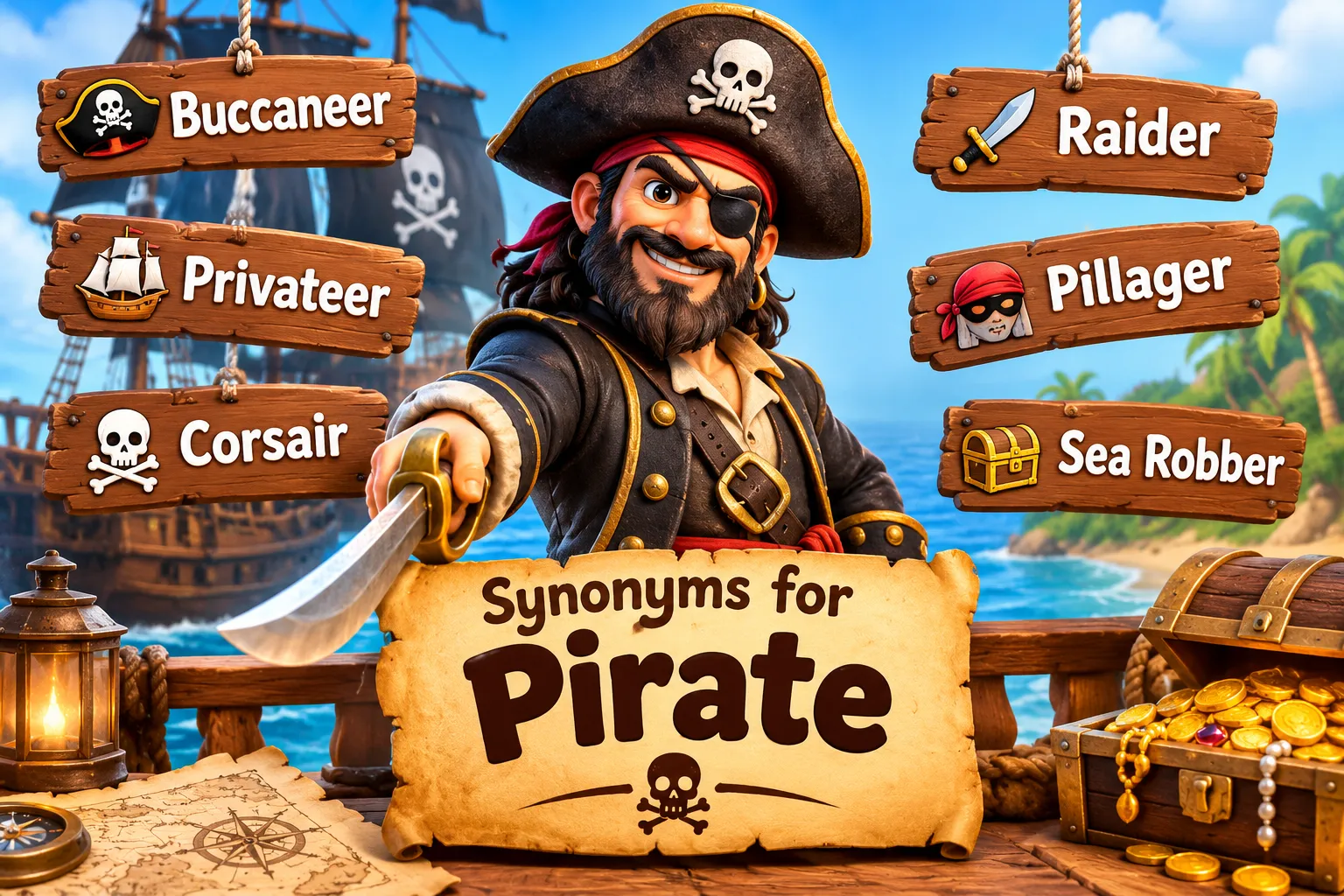
A pirate is a person who attacks ships or steals goods at sea. Common synonyms and related words include buccaneer, corsair, sea raider, freebooter, and privateer. Some words describe sea robbers, while others refer to people who attack ships under special legal authority or steal digital content. For example, a buccaneer was a type of sea raider, while a privateer operated with official permission. The right word depends on the context. Learning these alternatives can help you improve your vocabulary and write more clearly about history, adventure stories, crime, and online piracy.
A pirate is a person who attacks ships, steals cargo, or commits robbery at sea. Imagine a ship sailing across the ocean when another vessel approaches and its crew tries to steal the goods. The attackers may be called pirates. The word is common in history books, adventure stories, films, and news about illegal copying of digital content. Learning synonyms for pirate helps English learners understand different types of sea raiders and choose words that fit each situation. For example, buccaneer often appears in historical or adventure writing, while digital pirate refers to someone who illegally copies or shares protected content. This guide explains the meaning, pronunciation, history, and word forms of pirate. It also explores 30 related words and phrases, with simple meanings, examples, semantic groups, and antonyms to help you use them correctly.
Meaning of Pirate
Definition
Pirate (Noun): A person who attacks ships or steals goods at sea, often using violence or threats.
Pirate (Verb): To copy, use, or distribute something illegally, especially copyrighted material.
Examples
- The pirates attacked a merchant ship and stole its cargo.
- Some websites pirate films and share them without permission.
Connotative Meaning
Connotation (the feeling or idea a word suggests beyond its basic meaning) can change with context.
- Positive tone: In adventure stories, pirate may suggest freedom, daring, and excitement, though these qualities do not make real piracy acceptable.
- Negative tone: The word often suggests theft, danger, violence, and lawbreaking.
- Neutral tone: In historical writing, it may simply describe a person or group involved in piracy.
Etymology of Pirate
The word pirate comes through Latin pirata and Greek peiratēs, meaning a sea robber or attacker. The Greek word is linked to the idea of attempting or making an attack.
- Old English (450–1100): Pirate was not a common inherited Old English word. The idea of sea robbery could be expressed through other terms.
- Middle English (1100–1500): The word entered English through French and Latin influences and was used for people who robbed ships at sea.
- Modern English (1500–Present): Pirate became widely used in historical, legal, and literary contexts. Its meaning later expanded to include the illegal copying or distribution of books, music, films, software, and other protected works.
Pronunciation (IPA)
- IPA: /ˈpaɪ.rət/
- Syllables: pi-rate (2 syllables)
Affixation Pattern of Pirate
- Root: Pirate — a person who robs ships or illegally copies protected material.
- Prefix: No prefix is used in the base word pirate.
- Suffix: The base word has no productive suffix in its noun form. Related words can be formed with suffixes such as -ing, -ed, and -ry.
Word Formations
| Word | Part of Speech | Meaning |
| Pirate | Noun | A person who commits piracy |
| Pirate | Verb | To rob at sea or copy protected material illegally |
| Pirates | Noun, plural | More than one pirate |
| Pirates | Verb | Attacks or copies something illegally, depending on context |
| Pirated | Verb / Adjective | Copied illegally or taken by piracy |
| Pirating | Verb / Noun | The act of committing piracy |
| Piracy | Noun | The act or practice of piracy |
| Piratical | Adjective | Related to pirates or their actions |
| Pirate-like | Adjective | Similar to a pirate in appearance or behavior |
| Anti-piracy | Adjective / Noun | Intended to prevent or oppose piracy |
30 Synonyms of Pirate With Meaning and Examples
The word pirate has several close synonyms, especially for people who rob ships at sea. Other terms describe specific historical groups, unlawful copying, or related forms of theft. Some are near-synonyms rather than exact replacements, so the context matters.
1. Buccaneer (Noun)
Meaning: A sea raider, especially one active in the Caribbean during the 17th century.
Examples:
- The story follows a buccaneer searching for hidden treasure.
- The museum displayed a map used by Caribbean buccaneers.
2. Corsair (Noun)
Meaning: A sea raider, especially one associated with the Mediterranean.
Examples:
- The novel tells of a corsair who sailed across the Mediterranean.
- The corsair captured a merchant vessel near the coast.
3. Freebooter (Noun)
Meaning: A person who takes part in robbery or plunder, often at sea.
Examples:
- The freebooter seized goods from passing ships.
- The old tale describes a freebooter who searched for gold.
4. Sea robber (Noun phrase)
Meaning: A person who steals from ships or attacks them at sea.
Examples:
- The sea robber escaped before help arrived.
- The sailors feared an attack by a sea robber.
5. Sea raider (Noun phrase)
Meaning: A person who attacks ships or coastal places from the sea.
Examples:
- The sea raider targeted merchant vessels.
- The coastal town prepared for another sea raider attack.
6. Maritime raider (Noun phrase)
Meaning: A person who attacks ships or targets goods and property at sea.
Examples:
- The maritime raider stole valuable cargo.
- The navy searched for the maritime raider near the harbor.
7. Sea rover (Noun phrase)
Meaning: A person who travels by sea and may engage in raiding or piracy.
Examples:
- The sea rover sailed from port to port.
- In the legend, a sea rover found a lost island.
8. Privateer (Noun)
Meaning: A privately owned ship or sailor authorized by a government to attack enemy vessels during wartime.
Examples:
- The privateer captured an enemy ship during the war.
- The history book explains how a privateer received official permission to raid enemy vessels.
Note: A privateer is not exactly the same as a pirate because a privateer had official authorization.
9. Rover (Noun)
Meaning: A person who travels from place to place; in some historical or literary contexts, a seafarer or raider.
Examples:
- The old poem describes a rover crossing the ocean.
- The rover sailed away in search of adventure.
10. Raider (Noun)
Meaning: A person who attacks a place, group, or vessel to steal or damage something.
Examples:
- The raider took supplies from the ship.
- The coastal guards watched for raiders.
11. Plunderer (Noun)
Meaning: A person who steals goods or valuables by force.
Examples:
- The plunderer took gold from the abandoned fort.
- The story portrays the invaders as plunderers.
12. Pillager (Noun)
Meaning: A person who steals goods from a place during an attack.
Examples:
- The pillager carried away valuable objects.
- The village feared another group of pillagers.
13. Robber (Noun)
Meaning: A person who steals property, often by force or threat.
Examples:
- The robber stole money from the shop.
- The captain called the attackers sea robbers.
14. Thief (Noun)
Meaning: A person who steals something that belongs to someone else.
Examples:
- The thief took a valuable watch.
- The pirate was treated as a thief under the law.
15. Bandit (Noun)
Meaning: A person who steals from or attacks people, often as part of a group.
Examples:
- The bandit stopped travelers on the road.
- The story describes a bandit who stole goods from merchants.
16. Marauder (Noun)
Meaning: A person who roams around attacking people or places and stealing property.
Examples:
- The marauder attacked the settlement at night.
- The villagers hid their supplies from the marauders.
17. Brigand (Noun)
Meaning: A robber who attacks travelers or people, often in a group.
Examples:
- The brigand stole goods from passing merchants.
- The legend tells of a brigand who lived near the coast.
18. Outlaw (Noun)
Meaning: A person who breaks the law or lives outside its protection.
Examples:
- The outlaw hid from the authorities.
- The pirate became an outlaw after attacking merchant ships.
19. Plunderer of ships (Noun phrase)
Meaning: A person who steals goods from ships.
Examples:
- The plunderer of ships was feared by local traders.
- The guards searched for the plunderer of ships after the attack.
20. Ship raider (Noun phrase)
Meaning: A person who attacks ships to steal cargo or valuables.
Examples:
- The ship raider escaped with the stolen goods.
- The crew reported the ship raider to the authorities.
21. Ship robber (Noun phrase)
Meaning: A person who robs ships or steals goods carried by them.
Examples:
- The ship robber took the merchant’s cargo.
- The guards arrested the ship robber near the port.
22. Sea bandit (Noun phrase)
Meaning: A robber who attacks people or vessels at sea.
Examples:
- The sea bandit demanded the crew’s valuables.
- The sailors tried to escape the sea bandit.
23. Ocean raider (Noun phrase)
Meaning: A person who attacks vessels or targets property across the ocean.
Examples:
- The ocean raider followed the trading ship.
- The film features an ocean raider searching for treasure.
24. Maritime thief (Noun phrase)
Meaning: A person who steals goods or property in a maritime setting.
Examples:
- The maritime thief stole equipment from the docked vessel.
- The port officers investigated the maritime thief.
25. Cargo thief (Noun phrase)
Meaning: A person who steals goods being transported or stored.
Examples:
- The cargo thief took several boxes from the ship.
- The company improved security to catch the cargo thief.
26. Digital pirate (Noun phrase)
Meaning: A person who illegally copies, shares, or distributes digital content.
Examples:
- The digital pirate shared films without permission.
- The website was investigated for helping digital pirates distribute software.
27. Copyright infringer (Noun phrase)
Meaning: A person who uses or distributes copyrighted work without the required permission.
Examples:
- The copyright infringer uploaded the book without permission.
- The artist reported the copyright infringer.
28. Software pirate (Noun phrase)
Meaning: A person who illegally copies or distributes computer software.
Examples:
- The software pirate sold unlicensed programs.
- The company warned users about software pirates.
29. Media pirate (Noun phrase)
Meaning: A person who illegally copies or shares films, music, or other media.
Examples:
- The media pirate distributed films without permission.
- The campaign aims to reduce illegal sharing by media pirates.
30. Bootlegger (Noun)
Meaning: A person who makes, sells, or distributes goods illegally, often unauthorized recordings or copies.
Examples:
- The bootlegger sold unauthorized recordings of the concert.
- Police investigated a bootlegger who distributed copied films.
Usage note: Buccaneer, corsair, and freebooter are strong choices for historical or literary writing about sea raiders. Privateer has a specific historical meaning and should not be used as an exact synonym in every case. Copyright infringer, software pirate, and media pirate relate to illegal copying rather than robbery at sea. Words such as thief, robber, and bandit are broader terms.
Prototype Meaning
The most typical meaning of pirate is a person who attacks ships at sea and steals their cargo or valuables. People often picture an old sailing ship, a crew searching for treasure, and a flag associated with pirates. This image is common in adventure books, films, and games. However, the word has a broader modern use. A person who illegally copies or shares films, music, books, or software may also be called a pirate. The main idea is taking or using something unlawfully, although sea piracy and digital piracy are different acts.
Prototype Categorization
The 30 synonyms and related terms can be grouped by meaning. This helps writers choose a word that fits the time period, setting, and type of wrongdoing.
- Historical sea raiders: buccaneer, corsair, freebooter, sea rover, and privateer. Use these in historical writing, but remember that a privateer had official authorization.
- People who attack ships: sea robber, sea raider, maritime raider, ship raider, ship robber, sea bandit, and ocean raider. These phrases focus on attacks at sea.
- People who steal or plunder: plunderer, pillager, robber, thief, marauder, and brigand. These terms can apply to theft on land as well as at sea.
- General lawbreakers: bandit, outlaw, and raider. These words describe people who attack, steal, or break the law, but they are not always pirates.
- Theft involving ships and cargo: plunderer of ships, maritime thief, and cargo thief. These phrases focus on stolen goods and property.
- Digital and copyright piracy: digital pirate, copyright infringer, software pirate, and media pirate. Use these for illegal copying or sharing of protected content.
- Literary and general terms: rover and bootlegger. Rover can suggest a wandering adventurer, while bootlegger usually refers to illegal trade or unauthorized copies rather than sea robbery.
Choosing a synonym by category makes your writing more precise. For example, use corsair for a historical Mediterranean raider, privateer for a government-authorized wartime vessel, and software pirate for someone who illegally copies computer programs.
Antonyms of Pirate
There is no single exact antonym for every meaning of pirate. The best opposite depends on whether you mean a sea raider, a thief, or someone who illegally copies protected content.
| Antonym | Part of Speech | Meaning | Example |
| Sailor | Noun | A person who works or travels on a ship | The sailor helped guide the ship safely to port. |
| Merchant | Noun | A person who buys and sells goods | The merchant shipped legal goods across the sea. |
| Defender | Noun | A person who protects someone or something | The defender protected the ship from attack. |
| Protector | Noun | A person who keeps someone or something safe | The protector guarded the harbor. |
| Law-abiding citizen | Noun phrase | A person who follows the law | The law-abiding citizen reported the stolen goods. |
| Honest trader | Noun phrase | A person who sells goods fairly and legally | The honest trader kept clear records of every sale. |
| Authorized distributor | Noun phrase | A person or business allowed to distribute a product | The film was released by an authorized distributor. |
| Licensed user | Noun phrase | A person who uses software or content with permission | The licensed user installed the program legally. |
| Copyright holder | Noun phrase | A person or organization that owns copyright in a work | The copyright holder approved the use of the song. |
| Legal publisher | Noun phrase | A publisher authorized to publish a work | The legal publisher released the book with permission. |
Short Questions and Answers
What does pirate mean?
A pirate is a person who attacks ships and steals goods at sea. The word can also describe someone who illegally copies or distributes protected content.
When should pirate be used?
Use pirate when discussing sea robbery, historical sea raiders, or illegal copying of digital and creative works. Choose a more specific term when the context calls for it.
Is pirate positive or negative?
The word is usually negative because it refers to theft or illegal activity. In fiction, it may also create a sense of adventure, danger, or excitement.
How is pirate different from similar words?
A pirate traditionally robs ships at sea. A buccaneer is a historical type of sea raider, a corsair is linked especially to Mediterranean piracy, and a privateer had government permission to attack enemy vessels. A thief can steal in any setting, while a digital pirate illegally copies protected content.
Conclusion
Learning synonyms for pirate can improve your vocabulary and help you describe sea raiders, historical figures, and illegal copying with greater accuracy. Words such as buccaneer, corsair, and freebooter suit historical or adventure writing, while thief, robber, and plunderer describe broader forms of theft. Modern terms such as digital pirate and software pirate refer to unauthorized copying and sharing. These words are related, but they do not all mean exactly the same thing. Understanding their differences helps you avoid repetition and choose the right term for each situation. Practise by writing a sentence with one new word each day. Over time, you can strengthen your reading, writing, and speaking skills and feel more confident using English.
Read More:
Synonyms for Requirement: 26 Words for Better English

I’m Pinki, an SEO writer at SynonymsInstant.com, specializing in synonyms, antonyms, vocabulary, word meanings, grammar, and English usage. I create accurate, well-researched, reader-friendly content that combines language expertise with SEO best practices. My goal is to make English vocabulary simple, useful, and accessible for students, writers, professionals, and English learners.