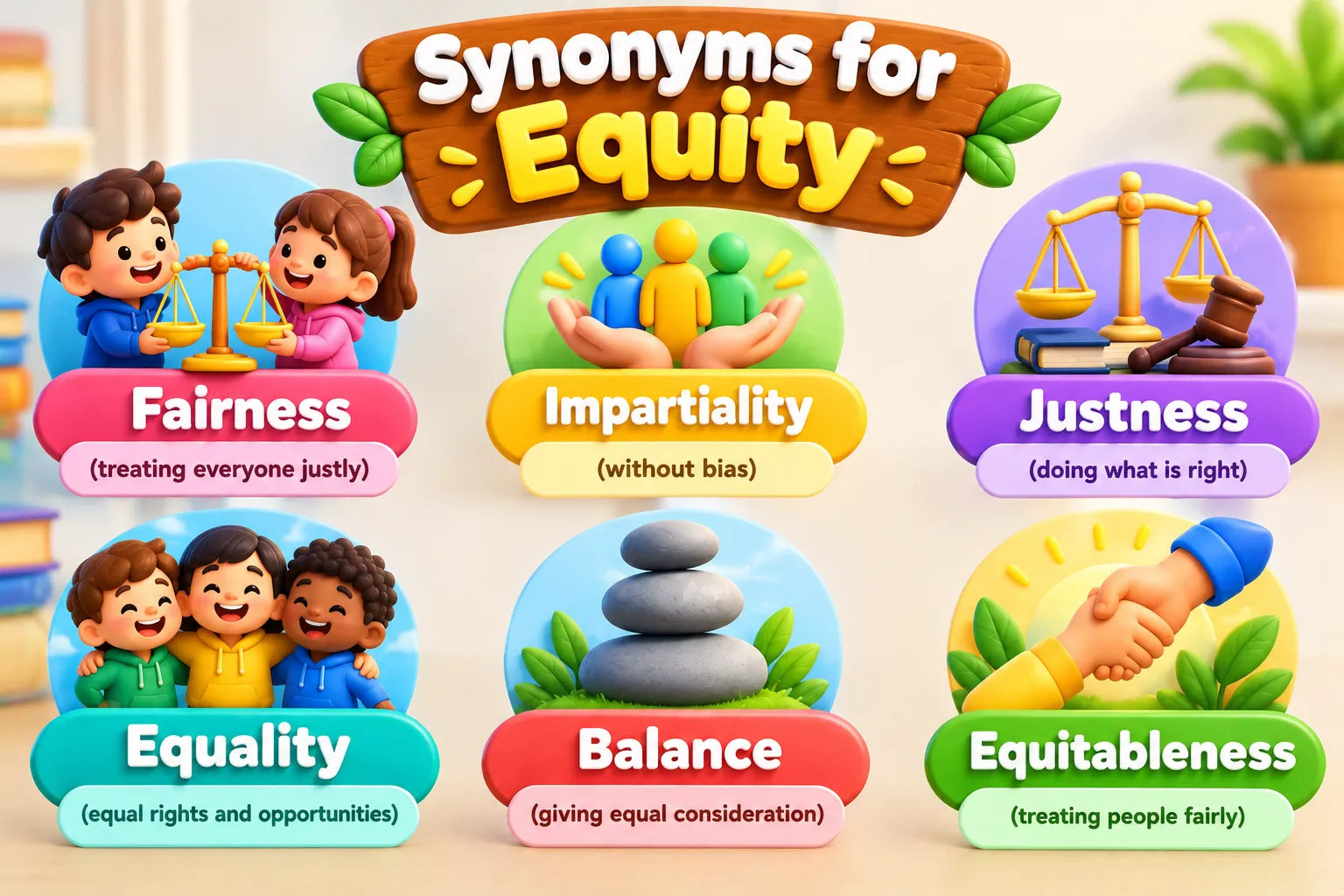
Equity means fairness and impartial treatment, or the value a person owns in an asset after debts are deducted. Common synonyms include fairness, justice, impartiality, equality, ownership, stake, and net worth. The best alternative depends on the context. In social matters, fairness and justice may fit best. In finance, ownership and stake may be more suitable. Learning synonyms for equity helps you understand its different meanings and use the right words in essays, business writing, and everyday English.
Equity has two common meanings. It can mean fairness and the fair treatment of people, or it can refer to the value someone owns in a business or property. For example, a teacher shows equity by giving students the support they need to learn. A homeowner builds equity when the value of their property exceeds the amount they still owe. The word is widely used in education, law, business, finance, and social issues. Learning synonyms for equity helps English learners understand these different uses and express ideas more clearly. It also helps writers avoid repetition and choose words that fit their message. This guide explains the meaning, pronunciation, history, and word forms of equity. It also explores 27 synonyms and related terms with simple definitions and examples, along with semantic categories, antonyms, and tips for choosing the right alternative.
Meaning of Equity
Definition
Equity (Noun): Fair and impartial treatment based on what is just, or the value of an asset that remains after debts and other claims are deducted.
Examples
- The school promotes equity by giving every student the support they need.
- The homeowner has built equity by paying down the mortgage.
Connotative Meaning
Connotation (the feeling or idea a word suggests beyond its basic meaning) depends on the context in which equity is used.
- Positive tone: Equity often suggests fairness, equal opportunity, inclusion, and responsible ownership.
- Negative tone: The word itself is usually neutral or positive, but debates about equity may involve concerns about unfair policies, unequal outcomes, or financial risk.
- Neutral tone: In finance, equity can simply describe the ownership value held in a business or asset.
Etymology of Equity
The word equity comes through Old French and Latin. It is linked to Latin aequitas, meaning fairness, evenness, or justice, and aequus, meaning equal or even.
- Old English (450–1100): Equity was not a common inherited Old English word. English speakers used other words to express fairness and justice.
- Middle English (1100–1500): The word entered English through French and Latin influences. It was used in legal and moral contexts to describe fairness and justice.
- Modern English (1500–Present): Equity became an important legal and social term. Its financial meaning also developed to describe ownership value in property, companies, and investments.
Pronunciation (IPA)
- IPA: /ˈek.wə.ti/
- Syllables: eq-ui-ty (3 syllables)
Affixation Pattern of Equity
- Root: Equ- — related to the Latin idea of being equal or even.
- Prefix: No prefix is added to form equity.
- Suffix: -ity — a suffix that forms nouns expressing a state or quality.
- Word formations: The following words belong to the same word family or are closely related.
| Word | Part of Speech | Meaning |
| Equity | Noun | Fairness or ownership value |
| Equities | Noun, plural | Shares or investments representing ownership in companies |
| Equitable | Adjective | Fair and impartial |
| Equitably | Adverb | In a fair and impartial way |
| Equitableness | Noun | The quality of being equitable; uncommon |
| Inequity | Noun | A lack of fairness |
| Inequitable | Adjective | Unfair or not equitable |
| Inequitably | Adverb | In an unfair way |
| Inequitableness | Noun | The quality of being inequitable; uncommon |
| Equity-based | Adjective | Based on fairness or ownership, depending on context |
27 Synonyms of Equity With Meaning and Examples
The word equity has different meanings in social justice and finance. Some words below are close synonyms, while others are useful alternatives in specific contexts. Always choose a word that matches the meaning you intend.
1. Fairness (Noun)
Meaning: The quality of treating people in a just and reasonable way.
Examples:
- Fairness is important when teachers grade students.
- The manager promised fairness in the hiring process.
2. Justice (Noun)
Meaning: Fair treatment according to what is right or lawful.
Examples:
- The community called for justice after the incident.
- The court aims to deliver justice to all parties.
3. Impartiality (Noun)
Meaning: The quality of not favoring one person or group over another.
Examples:
- A judge must show impartiality during a trial.
- The referee acted with impartiality throughout the match.
4. Equality (Noun)
Meaning: The state of having the same rights, status, or opportunities.
Examples:
- Equality gives everyone the same legal rights.
- The school promotes equality among its students.
Note: Equality and equity are related but not identical. Equality gives people the same treatment or resources, while equity considers different needs and barriers.
5. Evenhandedness (Noun)
Meaning: The quality of treating people fairly and without bias.
Examples:
- The coach showed evenhandedness when choosing the team.
- Employees valued the manager’s evenhandedness.
6. Objectivity (Noun)
Meaning: The quality of judging a matter based on facts rather than personal feelings.
Examples:
- Objectivity is important when reviewing evidence.
- The researcher tried to maintain objectivity.
7. Neutrality (Noun)
Meaning: The state of not supporting either side in a dispute.
Examples:
- The mediator maintained neutrality during the discussion.
- Neutrality helped the group reach an agreement.
8. Fair-mindedness (Noun)
Meaning: The habit of considering people and ideas fairly.
Examples:
- Her fair-mindedness helped resolve the conflict.
- Fair-mindedness is a valuable quality in a leader.
9. Justness (Noun)
Meaning: The quality of being fair or morally right.
Examples:
- The justness of the decision was widely discussed.
- The judge considered the justness of the rule.
10. Righteousness (Noun)
Meaning: The quality of acting in a morally right way.
Examples:
- The story explores righteousness and honesty.
- He believed righteousness required him to speak up.
11. Proportionality (Noun)
Meaning: The quality of being appropriate in size, amount, or response to a situation.
Examples:
- The court considered the proportionality of the penalty.
- Proportionality matters when setting fair rules.
12. Balance (Noun)
Meaning: A fair or sensible arrangement between different needs or interests.
Examples:
- The policy seeks a balance between cost and access.
- A balance of interests helped the team agree.
13. Due process (Noun phrase)
Meaning: A fair legal process that follows the required rules.
Examples:
- Every person deserves due process under the law.
- The case was reviewed through due process.
14. Equal treatment (Noun phrase)
Meaning: Treating people in the same way under similar conditions.
Examples:
- The policy promises equal treatment for all applicants.
- Equal treatment is important in the workplace.
15. Social justice (Noun phrase)
Meaning: Fair access to rights, opportunities, and resources across society.
Examples:
- The group works to promote social justice.
- Education can play a role in social justice.
16. Inclusiveness (Noun)
Meaning: The quality of welcoming and involving people from different backgrounds.
Examples:
- Inclusiveness helps students feel part of the class.
- The company values inclusiveness in its workplace.
17. Fair access (Noun phrase)
Meaning: A fair chance to use or obtain a service, resource, or opportunity.
Examples:
- The program aims to provide fair access to education.
- Fair access to health care is a public concern.
18. Fair distribution (Noun phrase)
Meaning: The reasonable sharing of resources, costs, or benefits.
Examples:
- The committee discussed the fair distribution of funds.
- Fair distribution of supplies helped every village.
19. Ownership (Noun)
Meaning: The legal right to possess or control something.
Examples:
- She has ownership of the small business.
- Ownership gives investors certain rights in a company.
20. Stake (Noun)
Meaning: A share or interest in a business, project, or outcome.
Examples:
- He bought a stake in the company.
- Each investor has a stake in the project.
21. Shareholding (Noun)
Meaning: The ownership of shares in a company.
Examples:
- Her shareholding increased after she bought more stock.
- The report lists the major shareholdings in the firm.
22. Net worth (Noun phrase)
Meaning: The value of a person’s or organization’s assets after debts are subtracted.
Examples:
- The financial adviser helped calculate her net worth.
- The business increased its net worth over time.
Note: Net worth is not always the same as equity. Net worth usually covers a person’s or organization’s overall financial position, while equity can refer to the ownership value in a specific asset or business.
23. Residual value (Noun phrase)
Meaning: The value that remains after certain costs, deductions, or claims are accounted for.
Examples:
- The accountant calculated the asset’s residual value.
- The report explained the residual value after liabilities.
Note: In finance, residual value has a specific technical meaning and is not a direct synonym for equity in every case.
24. Capital (Noun)
Meaning: Money or assets used to start, run, or grow a business.
Examples:
- The company raised capital to expand its operations.
- Investors supplied the capital needed for the project.
25. Net assets (Noun phrase)
Meaning: The value of assets after liabilities are subtracted.
Examples:
- The report showed an increase in net assets.
- The accountant reviewed the organization’s net assets.
26. Ownership interest (Noun phrase)
Meaning: A person’s share or legal interest in an asset or business.
Examples:
- She holds an ownership interest in the firm.
- The agreement explains each partner’s ownership interest.
27. Shareholder value (Noun phrase)
Meaning: The financial value created for people who own shares in a company.
Examples:
- The board aims to increase shareholder value.
- Strong performance helped improve shareholder value.
Prototype Meaning
The most common meaning of equity is fairness: treating people justly while considering their needs and circumstances. People may picture a school that gives extra support to students who face barriers to learning. In business and finance, however, equity often means the value an owner holds in an asset or company after debts are deducted. For example, a homeowner may build equity by paying off a mortgage. The word therefore has two important uses: one linked to fair treatment and another linked to ownership value. Context helps readers understand which meaning is intended.
Prototype Categorization
Grouping the synonyms by meaning helps writers choose the right word for each situation.
- Fairness and justice: fairness, justice, justness, and righteousness. Use these words when discussing what is right, fair, or morally sound.
- Neutral and unbiased judgment: impartiality, evenhandedness, objectivity, and neutrality. These fit decisions, legal matters, research, and conflict resolution.
- Equal rights and fair treatment: equality, equal treatment, equitable treatment, and fair-mindedness. These are useful when discussing rights, policies, and how people are treated.
- Social access and inclusion: social justice, inclusiveness, fair access, and fair distribution. Use these terms when writing about education, public services, and social opportunities.
- Fair systems and balanced decisions: proportionality, balance, due process, and fair dealing. These terms fit law, policy, agreements, and business conduct.
- Ownership and investment: ownership, stake, shareholding, ownership interest, and shareholder value. Use these when discussing business interests or company shares.
- Financial value: net worth, residual value, capital, and net assets. These terms relate to assets, finances, and accounting, but each has a distinct technical meaning.
- Resource allocation: just distribution. This phrase is useful when discussing the fair sharing of money, resources, or responsibilities.
These categories help you avoid using a financial term in a social context or a general fairness term in an accounting report. For example, impartiality suits a judge’s decision, while ownership interest fits a business agreement.
Antonyms of Equity
The opposite of equity depends on its meaning. In social contexts, it may be unfairness or injustice. In finance, a possible contrast is debt, although debt is not a strict antonym of equity.
| Antonym | Part of Speech | Meaning | Example |
| Inequity | Noun | A lack of fairness | The report highlighted inequity in access to education. |
| Injustice | Noun | Unfair or unjust treatment | The community protested against injustice. |
| Unfairness | Noun | The quality of treating people unjustly | The students complained about unfairness in the selection process. |
| Bias | Noun | An unfair preference for or against someone or something | Bias can affect hiring decisions. |
| Discrimination | Noun | Unfair treatment based on personal or group characteristics | The law protects people from discrimination. |
| Partiality | Noun | Flavoring one person or side over another | The referee was criticized for partiality. |
| Favoritism | Noun | Giving unfair advantages to certain people | Favoritism can harm trust in a workplace. |
| Unequal treatment | Noun phrase | Treating people differently in an unfair way | Unequal treatment led to complaints. |
| Prejudice | Noun | An unfair opinion formed without enough knowledge | Prejudice can prevent fair decisions. |
| Debt | Noun | Money owed to another person or organization | The business reduced its debt over the year. |
Short Questions and Answers
What does equity mean?
Equity means fairness and impartial treatment. In finance, it can also mean the ownership value of an asset or business after debts are deducted.
When should equity be used?
Use equity when discussing fairness, access, and just treatment, or when talking about ownership value in property, companies, and investments. The context determines the meaning.
Is equity positive or negative?
Equity usually has a positive meaning when it refers to fairness. In finance, it is a neutral term. Its meaning in a debate depends on the topic and how the word is used.
How is equity different from similar words?
Equality often means giving people the same rights or resources, while equity considers different needs to support fair outcomes. In finance, equity is an ownership interest, while debt is money owed.
Conclusion
Learning synonyms for equity helps you discuss fairness, justice, and financial ownership with greater accuracy. Words such as fairness, impartiality, and equitable treatment work well in social and educational contexts. Terms such as stake, ownership interest, and net assets are more useful in business and finance. Understanding these differences can improve your vocabulary, make your writing clearer, and help you avoid repeating the same word. It can also strengthen your speaking skills by helping you explain complex ideas in simple language. When you learn a new synonym, practise using it in a sentence and check whether it fits your meaning. Daily practice will build your confidence and help you communicate more effectively in English.
Read More:
Synonyms for Fluid: 25 Common Alternatives to Learn

I’m Ayesha Haram, an English content and SEO writer at SynonymsInstant.com. I focus on creating helpful vocabulary resources, word guides, and practical English content that readers can understand quickly. I combine language research, clear explanations, and SEO-focused writing to produce reliable content that supports learners, writers, and everyday English users.