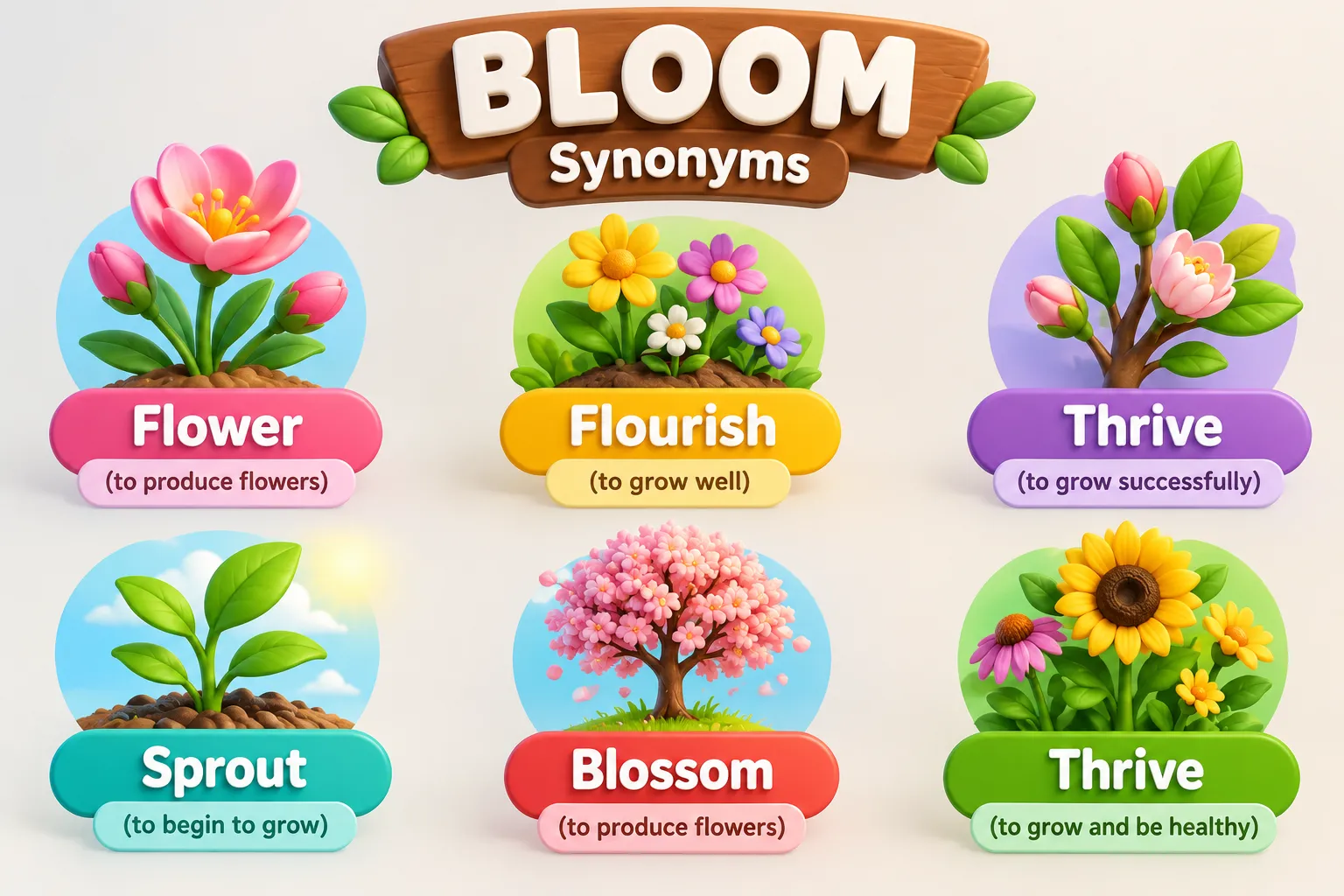
Synonyms for bloom include blossom, flower, flourish, thrive, prosper, grow, develop, and flourish. The best choice depends on whether you mean a flower opening, a person growing, or something becoming successful.
Bloom means to produce flowers or to grow and develop well. In spring, a garden may bloom with bright roses and tulips. A person can also bloom by gaining confidence, learning new skills, or finding success. The word is often used in nature, personal growth, health, and business. Learning synonyms for bloom helps you describe growth and beauty in more precise ways. It also helps English learners build vocabulary and gives writers more choices when creating articles, stories, and descriptions. In this guide, you will explore the meaning of bloom, its pronunciation, word forms, and history. You will also learn 27 synonyms and related expressions with simple meanings and examples. These words can help you choose the right expression for flowers, personal progress, or success.
Meaning of Bloom
Definition
Bloom (Noun and Verb): As a verb, bloom means to produce flowers or develop well. As a noun, it means a flower, a period of flowering, or a fresh and healthy appearance.
Examples
- The roses bloom every spring.
- Her confidence began to bloom after she joined the class.
Connotative Meaning
Connotation (the feeling or idea a word suggests beyond its basic meaning) helps explain how bloom sounds in different contexts.
- Positive tone: Beauty, freshness, health, growth, and success.
- Negative tone: Bloom rarely has a negative tone, but it may suggest a temporary or unwanted growth in some contexts.
- Neutral tone: The natural process of a plant producing flowers.
Etymology of Bloom
| Period | Origin and Development |
| Old English (450–1100) | The modern word bloom was not clearly established in its present form during this period. Related Germanic words referred to flowers or flowering. |
| Middle English (1100–1500) | Bloom developed in English with the sense of a flower or flowering, influenced by related Germanic forms. |
| Modern English (1500–Present) | Bloom came to refer to flowers opening and later gained figurative meanings, such as growing, thriving, or reaching a successful stage. |
Pronunciation (IPA)
- IPA: /bluːm/
- Syllables: bloom (1 syllable)
Affixation Pattern of Bloom
- Root: Bloom
- Prefix: None in the base word.
- Suffix: The base word can take suffixes such as -ing, -ed, and -er in related forms.
Word Formations
| Word | Grammatical Category | Meaning |
| Bloom | Noun/verb | A flower or the act of flowering |
| Blooms | Noun/verb | Flowers or produces flowers |
| Bloomed | Verb | Produced flowers or developed well |
| Blooming | Verb/adjective | Producing flowers or growing well |
| Bloomer | Noun | A plant or person that blooms; also has other meanings in some contexts |
| Bloomingness | Noun, rare | The state of blooming |
| Bloom-like | Adjective | Resembling a bloom |
| In bloom | Adjective phrase | Producing flowers |
| Full bloom | Noun phrase | The stage when flowers are fully open |
| Blooming season | Noun phrase | The period when a plant produces flowers |
27 Synonyms for Bloom With Meanings and Examples
Note: Bloom has different meanings. Some words below are close synonyms for flowering, while others describe growth, health, or success. They are not interchangeable in every sentence.
1. Blossom (Verb/Noun)
Meaning: To produce flowers or develop in a positive way.
Examples:
- The cherry trees blossom in spring.
- Their friendship began to blossom at school.
2. Flower (Verb/Noun)
Meaning: To produce flowers or reach a stage of development.
Examples:
- These plants flower in early summer.
- Her talent began to flower with practice.
3. Flourish (Verb)
Meaning: To grow or develop in a strong and healthy way.
Examples:
- The plants flourish in warm sunlight.
- His business began to flourish after a year.
4. Thrive (Verb)
Meaning: To grow, succeed, or remain healthy.
Examples:
- These flowers thrive in rich soil.
- Children thrive when they feel supported.
5. Prosper (Verb)
Meaning: To become successful or do well, especially financially.
Examples:
- The small business began to prosper.
- The town prospered through trade.
6. Grow (Verb)
Meaning: To increase in size, strength, or development.
Examples:
- The seedlings grow quickly in spring.
- She continued to grow as a writer.
7. Develop (Verb)
Meaning: To change or grow into a more advanced form.
Examples:
- The flower develops from a small bud.
- His skills developed through daily practice.
8. Expand (Verb)
Meaning: To become larger or increase in range.
Examples:
- The flower’s petals expand as it opens.
- The company plans to expand its services.
9. Mature (Verb)
Meaning: To become fully grown or reach a more developed stage.
Examples:
- The fruit matures in late summer.
- Her ideas matured over time.
10. Spring Up (Phrasal Verb)
Meaning: To appear or begin to grow quickly.
Examples:
- Wildflowers spring up after the rain.
- New cafés sprang up across the city.
11. Bud (Verb/Noun)
Meaning: To begin forming a flower or a new growth.
Examples:
- The rose bushes bud in early spring.
- Tiny buds appeared on the branches.
12. Open (Verb)
Meaning: To unfold or spread out, especially when a flower opens.
Examples:
- The tulips open in the morning sun.
- The flower opened after several warm days.
13. Unfurl (Verb)
Meaning: To open or spread out from a folded or closed position.
Examples:
- The petals unfurl in the sunlight.
- New leaves unfurled after the rain.
14. Sprout (Verb/Noun)
Meaning: To begin growing from a seed or other starting point.
Examples:
- Green shoots sprout after the first rain.
- The seeds sprouted in a few days.
15. Germinate (Verb)
Meaning: To begin growing from a seed.
Examples:
- The seeds germinate in moist soil.
- Some seeds germinate faster in warm weather.
16. Vegetate (Verb)
Meaning: To grow like a plant or live without much activity.
Examples:
- The ground began to vegetate after the rain.
- Some plants vegetate slowly in cold weather.
17. Rejuvenate (Verb)
Meaning: To make something feel or look fresh and full of life again.
Examples:
- Spring rain rejuvenated the garden.
- A short break helped rejuvenate her energy.
18. Revive (Verb)
Meaning: To bring something back to life, strength, or activity.
Examples:
- The rain revived the dry flowers.
- The new manager helped revive the struggling business.
19. Enliven (Verb)
Meaning: To make something more lively or full of energy.
Examples:
- Bright flowers enliven the garden.
- Music helped enliven the quiet gathering.
20. Brighten (Verb)
Meaning: To make something lighter, happier, or more cheerful.
Examples:
- The blooming roses brighten the yard.
- Her kind words brightened his day.
21. Glow (Verb/Noun)
Meaning: To shine with a soft light or look healthy and happy.
Examples:
- The garden seemed to glow in the morning light.
- Her face glowed with happiness.
22. Radiate (Verb)
Meaning: To show or send out light, warmth, or a strong feeling.
Examples:
- The flowers radiate color across the garden.
- She radiated confidence during the speech.
23. Emerge (Verb)
Meaning: To appear or come into view.
Examples:
- New leaves emerge in early spring.
- A talented artist emerged from the local community.
24. Advance (Verb)
Meaning: To move forward or make progress.
Examples:
- The plant advanced through each stage of growth.
- Her career advanced after she gained new skills.
25. Progress (Verb/Noun)
Meaning: To move forward or improve over time.
Examples:
- The seedlings progressed well in the greenhouse.
- His reading skills progressed throughout the year.
26. Improve (Verb)
Meaning: To become better in quality, condition, or ability.
Examples:
- The garden improved after the soil was treated.
- Her writing improved with regular practice.
27. Succeed (Verb)
Meaning: To achieve a goal or get a good result.
Examples:
- The flowers succeeded in the warm, sunny bed.
- She worked hard to succeed in her new role.
Prototype Meaning
The most common meaning of bloom is for a flower to open and show its petals. People often picture a rose, tulip, or tree covered in flowers during spring. Bloom can also describe a person or thing that is growing, becoming healthier, or reaching a successful stage. For example, a child may bloom when they gain confidence, while a business may bloom when it attracts more customers. The central idea is a change toward beauty, health, growth, or success.
Prototype Categorization
The synonyms and related expressions for bloom fit into several groups. These groups help writers choose a word that matches the intended meaning.
- Flowering and opening: Blossom, flower, bud, open, and unfurl. Use these for plants and flowers.
- Plant growth: Sprout, germinate, grow, develop, and spring up. These describe the start or progress of growth.
- Healthy growth and success: Flourish, thrive, prosper, mature, and excel. Use these when something is doing well or reaching its potential.
- Renewal and energy: Rejuvenate, revive, enliven, brighten, glow, and radiate. These suggest new life, energy, or a fresh appearance.
- Progress and change: Expand, emerge, advance, progress, and improve. These describe development or movement toward a better state.
- Peak development: Peak and come into one’s own. These describe reaching a high point or showing full ability.
Choosing words by category helps writers avoid repetition and match the word to the context.
Antonyms of Bloom
The best opposite of bloom depends on whether you mean a flower opening, healthy growth, or success.
| Antonym | Part of Speech | Meaning |
| Wilt | Verb | To become weak or droop, especially from lack of water |
| Wither | Verb | To dry up, shrink, or lose freshness |
| Fade | Verb | To lose brightness, strength, or freshness |
| Decline | Verb/Noun | To become weaker or less successful |
| Deteriorate | Verb | To become worse in condition or quality |
| Shrivel | Verb | To become wrinkled or smaller from drying |
| Die | Verb | To stop living or growing |
| Fail | Verb | To be unsuccessful |
| Stagnate | Verb | To stop growing or making progress |
| Decay | Verb/Noun | To break down or rot over time |
Short Questions and Answers
What does bloom mean?
Bloom means to produce flowers or to grow and develop well. It can also describe beauty, health, or success.
When should bloom be used?
Use bloom when talking about flowers opening or when describing personal growth, new success, or a fresh and healthy appearance.
Is bloom positive or negative?
Bloom usually has a positive meaning because it suggests beauty, growth, and success. Its literal meaning is neutral when it simply describes flowering.
How is bloom different from similar words?
Bloom often suggests flowering or healthy development. Blossom is especially common for flowers and figurative growth, while flourish and thrive focus more on strong growth or success.
Conclusion
Learning synonyms for bloom can improve your English vocabulary and help you describe nature, personal growth, and success more clearly. Words such as blossom, flower, and unfurl fit descriptions of plants. Flourish, thrive, and prosper work better when you mean growth or success. Other words, such as revive, brighten, and rejuvenate, highlight fresh energy or renewed life. Each word has its own meaning, so choose one that fits your sentence. Using a wider range of words also makes your writing more engaging and reduces repetition. Try learning a few synonyms each day and writing your own examples. With regular practice, you can speak and write with greater confidence.
Read More:
Synonyms for Trendy: 30 Stylish Alternatives

I’m Ayesha Haram, an English content and SEO writer at SynonymsInstant.com. I focus on creating helpful vocabulary resources, word guides, and practical English content that readers can understand quickly. I combine language research, clear explanations, and SEO-focused writing to produce reliable content that supports learners, writers, and everyday English users.