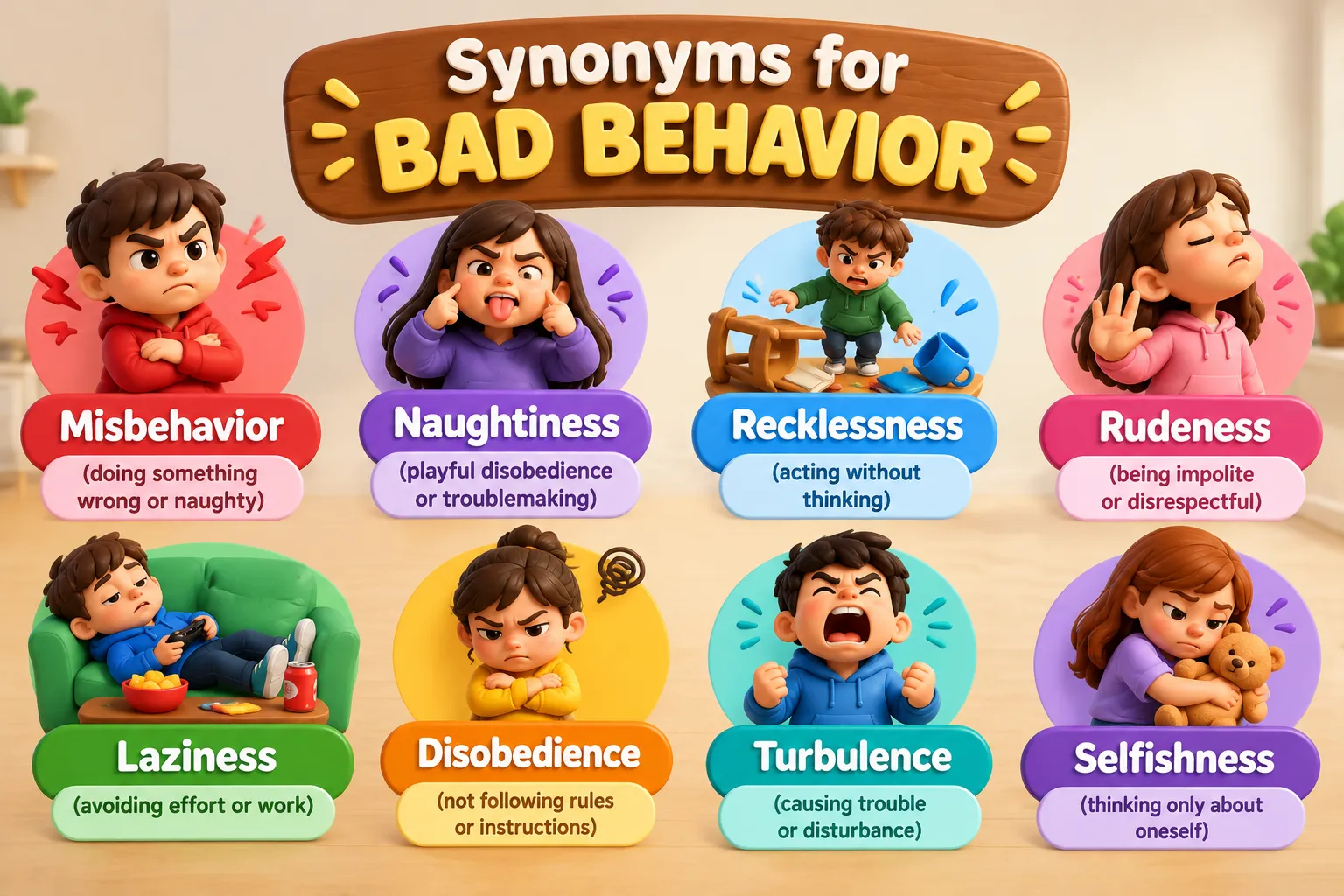
Synonyms for bad behavior include misconduct, misbehavior, wrongdoing, mischief, indiscipline, rudeness, disobedience, and inappropriate conduct. The best choice depends on the action and situation.
Bad behavior means acting in a way that is rude, harmful, dishonest, or against accepted rules. For example, a child who shouts at a teacher or a person who treats others unfairly may show bad behavior. This phrase is common at home, in schools, at work, and in daily life. Learning synonyms for bad behavior helps you describe actions more clearly and choose words that fit each situation. English learners can use these words to build vocabulary and improve speaking and writing. Content writers can also use them to avoid repetition and explain different types of conduct. In this guide, you will learn the meaning, pronunciation, history, and word forms of bad behavior. You will also explore 25 related words with simple meanings and examples.
Meaning of Bad Behavior
Definition
Bad behavior (Noun Phrase): Actions that are rude, harmful, dishonest, disruptive, or against accepted rules.
Examples
- The teacher spoke to the student about his bad behavior in class.
- His bad behavior upset the other people at the meeting.
Connotative Meaning
Connotation (the feeling or idea a word suggests beyond its basic meaning) helps explain the tone of this phrase.
- Positive tone: The phrase itself is usually negative, though discussing bad behavior can lead to positive change.
- Negative tone: It suggests rude, harmful, dishonest, or unacceptable actions.
- Neutral tone: In a report, it can describe conduct without explaining the reason behind it.
Etymology of Bad Behavior
The phrase combines two words with different histories.
| Period | Origin and Development |
| Old English (450–1100) | Bad has uncertain origins and became established in English later. Behavior comes from a word family related to the verb behave, which has roots in older Germanic and French forms. |
| Middle English (1100–1500) | Bad developed as an adjective meaning poor or undesirable. Behave entered English through Anglo-French, while behaviour developed from the verb and referred to the way someone acts. |
| Modern English (1500–Present) | Bad behavior became a common phrase for conduct considered rude, harmful, improper, or against social rules. American English usually spells behavior, while British English often uses behaviour. |
Pronunciation (IPA)
- IPA: /ˌbæd bɪˈheɪvjər/ (American English)
- Syllables: bad be-hav-ior (4 syllables)
Affixation Pattern of Bad Behavior
- Root words: Bad and behave
- Prefix: No prefix in the phrase bad behavior.
- Suffix: Behavior includes the suffix -ior in its historical word formation; the modern word is generally treated as a whole noun.
- Word formations: Related forms include behave, behavior, behavioral, and misbehavior.
Word Formations
| Word | Grammatical Category | Meaning |
| Bad | Adjective | Not good or acceptable |
| Behave | Verb | To act in a particular way |
| Behavior | Noun | The way a person acts |
| Behavioral | Adjective | Related to actions or conduct |
| Misbehave | Verb | To act in an improper way |
| Misbehavior | Noun | Improper or unacceptable conduct |
| Well-behaved | Adjective | Acting in a polite or acceptable way |
| Badly behaved | Adjective phrase | Acting in a rude or improper way |
| Behaviorally | Adverb | In a way related to behavior |
| Behaved | Verb/adjective | Acted in a particular way |
25 Synonyms for Bad Behavior With Meanings and Examples
Note: These words describe different forms or levels of bad behavior. Some refer to breaking rules, while others focus on rudeness, harm, or poor self-control. They are related terms, not exact replacements in every sentence.
1. Misconduct (Noun)
Meaning: Behavior that breaks rules or accepted standards.
Examples:
- The school investigated the student’s misconduct.
- The worker was warned about professional misconduct.
2. Misbehavior (Noun)
Meaning: Actions that are not acceptable or well-mannered.
Examples:
- The teacher addressed the children’s misbehavior.
- Repeated misbehavior can disrupt a class.
3. Wrongdoing (Noun)
Meaning: An action that is dishonest, unfair, or morally wrong.
Examples:
- The report revealed serious wrongdoing.
- Everyone should take responsibility for their wrongdoing.
4. Misdeed (Noun)
Meaning: A wrong or harmful action.
Examples:
- He apologized for his misdeed.
- The story follows a character who regrets a past misdeed.
5. Indiscipline (Noun)
Meaning: A lack of control or failure to follow rules.
Examples:
- Indiscipline made it hard for the class to learn.
- The coach worked to reduce indiscipline on the team.
6. Rudeness (Noun)
Meaning: A lack of politeness or respect for others.
Examples:
- His rudeness offended the guests.
- Rudeness can damage friendships.
7. Disobedience (Noun)
Meaning: The act of refusing to follow instructions or rules.
Examples:
- The child was punished for repeated disobedience.
- Disobedience to safety rules can cause accidents.
8. Inappropriate Conduct (Noun Phrase)
Meaning: Behavior that does not suit a particular place or situation.
Examples:
- The manager warned him about inappropriate conduct.
- Inappropriate conduct is not allowed during the exam.
9. Antisocial Behavior (Noun Phrase)
Meaning: Actions that harm others or disrupt social life.
Examples:
- The program aims to reduce antisocial behavior.
- Vandalism can be a form of antisocial behavior.
10. Mischief (Noun)
Meaning: Playful or troublesome behavior that may cause minor harm.
Examples:
- The children were up to mischief after school.
- His mischief caused a small mess in the kitchen.
11. Disruption (Noun)
Meaning: An action that interrupts an activity or stops it from running smoothly.
Examples:
- Shouting caused disruption during the lesson.
- The school took steps to prevent disruption.
12. Defiance (Noun)
Meaning: Open refusal to obey a rule or authority.
Examples:
- His defiance upset the coach.
- The manager treated the refusal as an act of defiance.
13. Insolence (Noun)
Meaning: Rude and disrespectful behavior toward someone.
Examples:
- The teacher did not accept the student’s insolence.
- His insolence made the discussion difficult.
14. Impoliteness (Noun)
Meaning: The act of being rude or showing poor manners.
Examples:
- Interrupting others can seem like impoliteness.
- She apologized for her impoliteness.
15. Aggression (Noun)
Meaning: Behavior that shows hostility or a desire to attack or harm.
Examples:
- The coach addressed the player’s aggression.
- Aggression can make conflicts worse.
16. Bullying (Noun)
Meaning: Repeated behavior meant to hurt, frighten, or control another person.
Examples:
- The school has a strict policy against bullying.
- Bullying can harm a student’s confidence.
17. Harassment (Noun)
Meaning: Behavior that troubles, intimidates, or targets another person repeatedly.
Examples:
- The company investigated the harassment complaint.
- Online harassment can cause serious distress.
18. Vandalism (Noun)
Meaning: Deliberately damaging property.
Examples:
- The police investigated the vandalism at the park.
- Vandalism can cost a community a lot of money.
19. Dishonesty (Noun)
Meaning: The act of lying, cheating, or hiding the truth.
Examples:
- Dishonesty damaged their trust.
- The teacher explained why dishonesty was wrong.
20. Deceit (Noun)
Meaning: The act of misleading someone through lies or tricks.
Examples:
- His deceit hurt his closest friends.
- The story reveals a pattern of deceit.
21. Cheating (Noun)
Meaning: Acting dishonestly to gain an unfair advantage.
Examples:
- Cheating during an exam can lead to serious consequences.
- The team was warned against cheating.
22. Irresponsibility (Noun)
Meaning: Failure to act with proper care or to meet one’s duties.
Examples:
- His irresponsibility caused the group to miss its deadline.
- Leaving the door unlocked showed carelessness and irresponsibility.
23. Carelessness (Noun)
Meaning: A lack of attention or care that can lead to mistakes.
Examples:
- Carelessness caused the glass to break.
- A little more care could have prevented the mistake.
24. Selfishness (Noun)
Meaning: Caring too much about one’s own needs while ignoring others.
Examples:
- His selfishness upset the whole group.
- Sharing can help children learn to avoid selfishness.
25. Disrespect (Noun)
Meaning: A lack of respect for another person or their rights.
Examples:
- Talking over the speaker showed disrespect.
- Disrespect can make teamwork difficult.
Prototype Meaning
The most common meaning of bad behavior is conduct that breaks rules, shows disrespect, or harms others. People may picture a child shouting in class, someone lying to a friend, or a person damaging public property. However, bad behavior can range from minor actions, such as interrupting someone, to serious acts, such as bullying or harassment. The phrase is broad, so the best synonym depends on what happened. Rudeness highlights poor manners, misconduct suggests breaking rules, and wrongdoing focuses on an action that is morally or legally wrong.
Prototype Categorization
These synonyms can be grouped by the kind of behavior they describe. This helps writers choose a more precise word instead of repeating bad behavior.
- Rule-breaking and poor discipline: Misconduct, misbehavior, indiscipline, disobedience, defiance, and unruliness. Use these terms for breaking rules or refusing to follow instructions.
- Rudeness and disrespect: Rudeness, impoliteness, insolence, impudence, and disrespect. These words focus on how people treat others.
- Harmful actions: Aggression, bullying, harassment, vandalism, and antisocial behavior. Use these when actions hurt people or damage property.
- Dishonest actions: Wrongdoing, misdeed, dishonesty, deceit, and cheating. These terms describe lying, unfairness, or morally wrong acts.
- Disruption and lack of control: Mischief, disruption, disruptiveness, and rowdiness. These words fit actions that interrupt activities or create disorder.
- Poor judgment or responsibility: Irresponsibility, carelessness, and selfishness. These highlight a failure to act with care or concern for others.
- Serious disregard for rules or law: Lawlessness. Use this for wider situations where laws or public order are ignored.
Choosing a word from the right category makes your writing clearer and helps readers understand the exact type of behavior being described.
Antonyms of Bad Behavior
The best opposite of bad behavior is usually good behavior or positive conduct. Other options describe specific positive qualities.
| Antonym | Part of Speech | Meaning |
| Good behavior | Noun phrase | Actions that follow rules and show respect |
| Proper conduct | Noun phrase | Behavior that suits a situation |
| Good manners | Noun phrase | Polite and respectful ways of acting |
| Courtesy | Noun | Polite behavior toward others |
| Respectfulness | Noun | The quality of showing respect |
| Discipline | Noun | The ability to follow rules and control actions |
| Obedience | Noun | The act of following instructions or rules |
| Honesty | Noun | The quality of telling the truth |
| Kindness | Noun | The quality of being caring and helpful |
| Responsibility | Noun | The quality of doing one’s duties and accepting the results of one’s actions |
Short Questions and Answers
What does bad behavior mean?
Bad behavior means acting in a rude, harmful, dishonest, or unacceptable way.
When should bad behavior be used?
Use this phrase when describing actions that break rules, show disrespect, cause trouble, or harm others. Choose a more specific term when the type of behavior is clear.
Is bad behavior positive or negative?
It has a negative meaning because it describes actions considered wrong, rude, harmful, or unacceptable.
How is bad behavior different from similar words?
Bad behavior is a broad phrase. Misconduct often refers to breaking rules, rudeness means a lack of politeness, and wrongdoing refers to dishonest or morally wrong actions.
Conclusion
Learning synonyms for bad behavior helps you describe actions with greater care and detail. Words such as misconduct, disobedience, and indiscipline focus on breaking rules. Rudeness and disrespect describe poor treatment of others, while dishonesty and cheating refer to unfair actions. Choosing the right term improves your vocabulary, makes your writing clearer, and reduces repetition. It also helps you speak about difficult situations in a more precise way. Remember that not every synonym has the same meaning or level of seriousness. Think about the action, the people involved, and the setting before choosing a word. Practice a few terms each day, write your own examples, and use them in conversation to build confidence in English.
Read More:
Synonyms for Bloom: 27 Beautiful Alternatives to Learn

I’m Falak Naaz, an SEO writer at SynonymsInstant.com focused on creating clear, engaging, and search-friendly English content. I specialize in vocabulary, synonyms, antonyms, word usage, and language guides. I combine careful research with practical writing to deliver trustworthy content that helps readers choose the right words and improve their English with confidence.