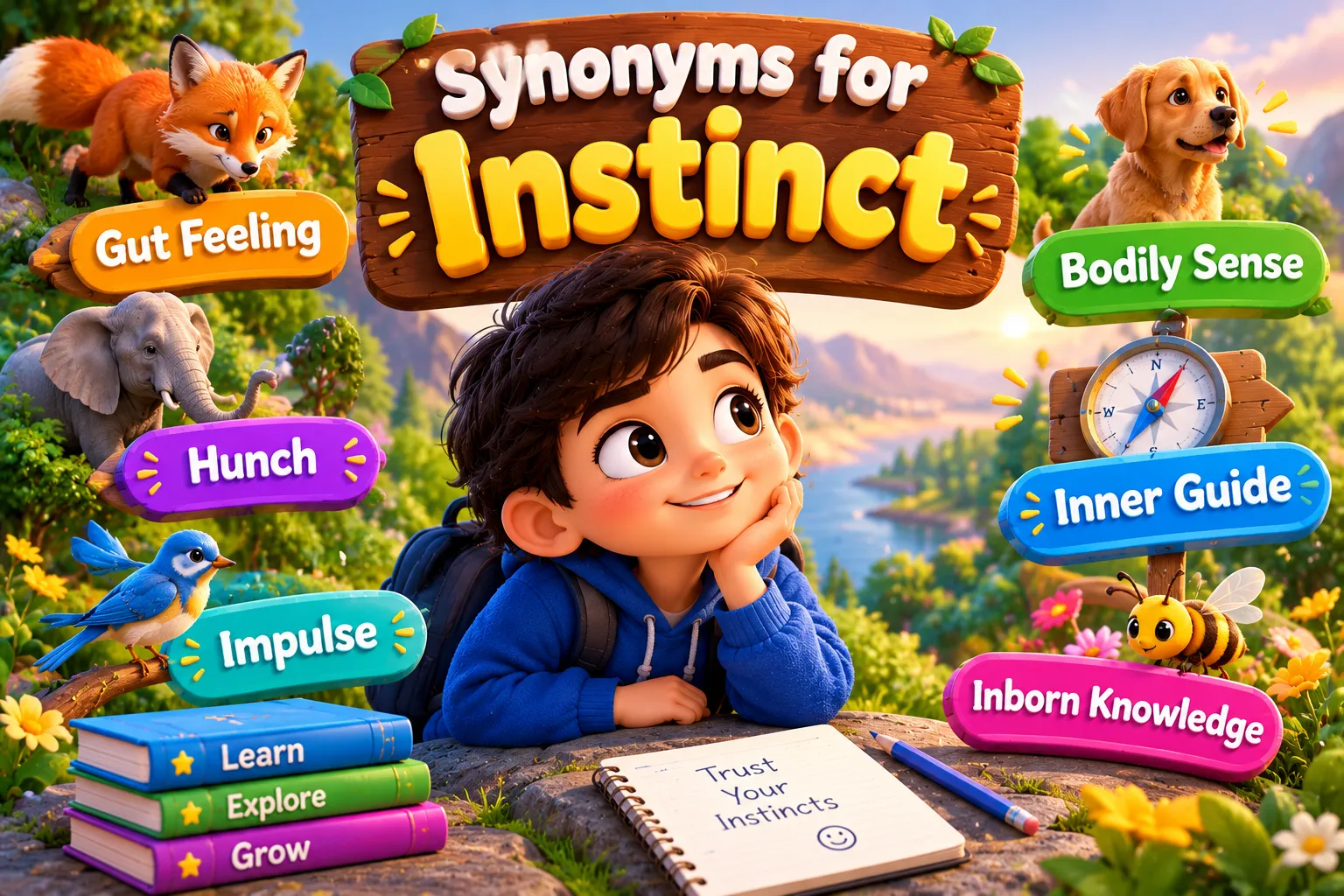
Instinct means a natural feeling or ability that helps you act without careful thought. Common synonyms for instinct include intuition, impulse, hunch, insight, reflex, urge, feeling, and inclination. These words have slightly different meanings. For example, intuition helps you sense something, while a reflex is an automatic physical response. A hunch is a feeling that something may be true. Learning these alternatives can improve your vocabulary and make your writing more clear, natural, and engaging.
Instinct is a natural feeling that guides us without the need for careful thought. Imagine walking down a quiet street and suddenly feeling that something is wrong. You may not know why, but your instinct tells you to be careful. This is a common example of how instinct works in daily life.
People use the word instinct when talking about feelings, natural behavior, quick reactions, and basic needs. It appears in everyday conversations, stories, science, and psychology. Learning synonyms for instinct helps English learners understand small differences between words. It also helps writers avoid repetition and express ideas more clearly. In this guide, you will learn the meaning of instinct, its history, pronunciation, word forms, synonyms, and antonyms. Simple definitions and examples will help you choose the right word for each situation.
Meaning of Instinct
Definition
Instinct (noun): A natural feeling or ability that makes a person or animal act in a certain way without learning or careful thought.
Instinct can guide decisions, protect us from danger, or lead us to meet basic needs.
Examples
- My instinct told me to stay away from the strange place.
- Birds use instinct to build nests and care for their young.
Connotative Meaning
Connotation is the feeling or idea that a word suggests beyond its basic meaning.
- Positive tone: Instinct can suggest wisdom, awareness, or a natural ability to make good choices.
Example: Her instinct helped her choose the right path. - Negative tone: Instinct can suggest a sudden urge or a reaction made without enough thought.
Example: He acted on instinct and made a poor choice. - Neutral tone: Instinct can describe natural behavior or an automatic response.
Example: A baby’s instinct helps it search for food.
The word instinct is usually neutral. Its tone depends on the situation.
Etymology of Instinct
The word instinct comes from the Latin word instinctus, meaning an impulse or an urge. It entered English through French and developed into its modern meaning of a natural tendency or ability.
- Old English (450–1100): The modern word instinct was not commonly used in Old English. People expressed related ideas through words about natural urges, feelings, and behavior.
- Middle English (1100–1500): The word entered English through Old French and Latin influences. It was associated with an inner impulse or natural tendency.
- Modern English (1500–Present): Instinct became widely used for natural behavior, automatic reactions, and feelings that guide actions without conscious reasoning. Today, it is common in everyday speech, psychology, and biology.
Pronunciation of Instinct (IPA)
- IPA: /ˈɪn.stɪŋkt/
- Syllables: in-stinct
- Syllable count: 2
- Word stress: The first syllable, in, is stressed.
Affixation Pattern of Instinct
- Root: Instinct is the base word in modern English.
- Prefix: No productive prefix is normally added to instinct.
- Suffix: The noun instinct has no commonly used modern suffix that can be removed to reveal a separate English base word.
The word has a Latin origin. Its historical structure is not the same as a simple modern English word formed by adding a prefix or suffix.
Word Formations
| Word | Part of Speech | Meaning |
| Instinct | Noun | A natural feeling or ability |
| Instinctive | Adjective | Based on natural feeling rather than careful thought |
| Instinctively | Adverb | In a natural or automatic way |
| Instinctual | Adjective | Related to instinct or natural behavior |
| Instinctiveness | Noun | The quality of being instinctive |
26 Synonyms of Instinct With Meanings and Examples
Some words below are close alternatives rather than exact synonyms. The best choice depends on whether you mean a natural ability, a sudden urge, a quick reaction, or a feeling about a situation.
1. Intuition (Noun)
Meaning: The ability to understand or sense something without needing clear proof or careful reasoning.
Examples:
- My intuition told me that something was wrong.
- She trusted her intuition when choosing a friend.
2. Impulse (Noun)
Meaning: A sudden desire to do something without planning it first.
Examples:
- He bought the jacket on impulse.
- She had an impulse to call her mother.
3. Hunch (Noun)
Meaning: A feeling that something is true, even when you cannot explain why.
Examples:
- I have a hunch that we will win.
- His hunch turned out to be correct.
4. Reflex (Noun)
Meaning: An automatic reaction to something, often without conscious thought.
Examples:
- She pulled her hand away by reflex.
- Blinking is a natural reflex.
5. Urge (Noun)
Meaning: A strong desire to do something.
Examples:
- He felt an urge to run outside.
- She resisted the urge to shout.
6. Feeling (Noun)
Meaning: An emotional response or inner sense about a person or situation.
Examples:
- I had a strange feeling about the meeting.
- She had a feeling that he would return.
7. Inclination (Noun)
Meaning: A natural tendency or preference to act in a certain way.
Examples:
- He has an inclination to help others.
- Her inclination was to stay at home.
8. Intimation (Noun)
Meaning: A slight sign or suggestion that something may be true or about to happen.
Examples:
- I had an intimation that changes were coming.
- She gave no intimation of her plans.
9. Insight (Noun)
Meaning: A clear understanding of a situation or its deeper meaning.
Examples:
- Her insight helped us solve the problem.
- The teacher gave us insight into human behavior.
10. Perception (Noun)
Meaning: The way someone notices, understands, or interprets something.
Examples:
- His perception of danger was strong.
- Good perception can help you notice small changes.
11. Hunchbacked Feeling (Noun Phrase)
Meaning: This is not a standard synonym for instinct. A more natural alternative is gut feeling, which means a strong inner sense about something.
Examples:
- My gut feeling told me to wait.
- She trusted her gut feeling about the offer.
12. Gut Feeling (Noun Phrase)
Meaning: A strong feeling about something that comes without clear evidence.
Examples:
- I had a gut feeling that he was honest.
- Her gut feeling helped her avoid trouble.
13. Natural Tendency (Noun Phrase)
Meaning: A way of behaving that comes easily or naturally to someone.
Examples:
- He has a natural tendency to lead.
- Her natural tendency is to care for others.
14. Natural Ability (Noun Phrase)
Meaning: A skill or power that a person seems to have without much training.
Examples:
- She has a natural ability to understand children.
- His natural ability for music appeared at a young age.
15. Drive (Noun)
Meaning: A strong inner force that pushes someone to act or achieve something.
Examples:
- Her drive helped her reach her goals.
- He has a strong drive to succeed.
16. Motivation (Noun)
Meaning: The reason or inner force that makes someone want to act.
Examples:
- His motivation comes from helping people.
- She found the motivation to keep learning.
17. Desire (Noun)
Meaning: A strong wish to have or do something.
Examples:
- He had a desire to explore the world.
- Her desire to learn English grew each day.
18. Need (Noun)
Meaning: Something necessary or a strong feeling that something is required.
Examples:
- Humans have a basic need for food and water.
- She felt a need to protect her family.
19. Instinctiveness (Noun)
Meaning: The quality of acting or responding in a natural, instinctive way.
Examples:
- The animal’s instinctiveness helped it survive.
- The character’s instinctiveness made the scene feel real.
20. Inborn Tendency (Noun Phrase)
Meaning: A pattern of behavior or response that exists from birth rather than being learned.
Examples:
- Some babies show an inborn tendency to grasp objects.
- The study examined inborn tendencies in young animals.
21. Natural Impulse (Noun Phrase)
Meaning: A sudden urge that arises naturally without deliberate planning.
Examples:
- Her natural impulse was to help the injured bird.
- He followed his natural impulse to protect his friend.
22. Automatic Response (Noun Phrase)
Meaning: A reaction that happens without conscious planning.
Examples:
- Smiling can be an automatic response to a friendly face.
- His automatic response was to step back.
23. First Impression (Noun Phrase)
Meaning: An initial opinion or feeling about someone or something.
Examples:
- My first impression was that she was kind.
- His first impression of the city was positive.
Note: A first impression is an initial judgment, not necessarily an instinct.
24. Premonition (Noun)
Meaning: A feeling that something, often something unpleasant, may happen in the future.
Examples:
- She had a premonition that trouble was near.
- His premonition made him feel uneasy.
25. Foreboding (Noun)
Meaning: A strong feeling that something bad may happen.
Examples:
- A sense of foreboding filled the room.
- He felt foreboding before the storm.
26. Hunch-Based Judgment (Noun Phrase)
Meaning: A decision based mainly on a hunch rather than clear facts.
Examples:
- Her hunch-based judgment proved useful.
- He made a hunch-based judgment about the stranger.
Prototype Meaning of Instinct
The most typical meaning of instinct is a natural feeling or response that guides behavior without careful thought. People often imagine a person sensing danger, a parent protecting a child, or an animal finding food without being taught how. Instinct may help someone react quickly when there is little time to think. It can also describe a natural tendency, such as caring for others or seeking safety. However, instinct is not always correct. It can guide a person, but facts and careful thinking are still important when making major decisions.
Prototype Categorization
The words related to instinct can be grouped by the kind of natural feeling or response they describe. These groups help writers choose the most accurate word for each situation.
- Inner knowledge and judgment: Intuition, hunch, gut feeling, insight, and intuitive judgment describe a sense or understanding that may come without clear proof. Use these words when someone senses something or makes a judgment.
- Sudden urges and desires: Impulse, urge, desire, and natural impulse describe a strong wish to act. Use them when someone feels pushed to do something.
- Automatic reactions: Reflex, automatic response, and natural response describe actions that happen quickly, often without conscious control. Use them for physical or immediate reactions.
- Natural behavior and abilities: Natural tendency, natural ability, inborn tendency, and instinctiveness describe traits or behaviors that come naturally rather than through training.
- Motivation and inner drive: Drive, motivation, and need describe forces that encourage action. They overlap with instinct in some contexts but are not exact synonyms.
- Warnings and future feelings: Premonition and foreboding describe feelings that something may happen, often something unpleasant.
- Initial or unplanned reactions: First impression, spontaneity, and gut reaction describe early judgments or actions made without much planning. They are related to instinct but have distinct meanings.
Choosing words from the right group helps writers avoid vague language. For example, use reflex for an automatic physical response, hunch for an uncertain belief, and intuition for a deeper inner sense.
Antonyms of Instinct
Instinct has no single perfect antonym in every context. However, words that describe conscious thought, learned behavior, or deliberate planning can express the opposite idea.
| Antonym | Part of Speech | Meaning |
| Reasoning | Noun | The process of thinking carefully to reach a conclusion |
| Logic | Noun | A way of thinking based on clear rules and evidence |
| Deliberation | Noun | Careful thought before making a decision |
| Analysis | Noun | A close study of something to understand it |
| Conscious thought | Noun phrase | Thinking with awareness and attention |
| Calculation | Noun | Careful thought used to plan an action or result |
| Planning | Noun | Deciding in advance what to do |
| Reflection | Noun | Careful thought about an idea, choice, or experience |
| Judgment | Noun | The ability to make a decision after considering information |
| Learned behavior | Noun phrase | Behavior developed through experience or teaching |
Short Questions and Answers
What does instinct mean?
Instinct is a natural feeling or ability that guides behavior without careful thought or learning.
When should instinct be used?
Use instinct when describing a natural response, an inner feeling, or behavior that happens without deliberate reasoning. For example, you might say, “My instinct told me to be careful.”
Is instinct positive or negative?
Instinct is usually neutral. It can be positive when it helps someone make a good choice, but it can lead to mistakes when a person acts without checking the facts.
How is instinct different from similar words?
Instinct often refers to natural behavior or an inner guide. Intuition is a sense of knowing without clear proof. Impulse is a sudden urge to act, while reflex is an automatic reaction, often physical. A hunch is a feeling that something may be true.
Conclusion
Learning synonyms for instinct can help you express thoughts and feelings with greater accuracy. Words such as intuition, hunch, impulse, and reflex may seem similar, but each has its own meaning. Choosing the right word makes your writing clearer and your speech more natural. These words can also help you understand books, conversations, and articles more easily. For English learners, building this vocabulary is a useful step toward stronger communication. Content writers can use these alternatives to avoid repetition and make their work more engaging. Try learning a few new words each day and using them in your own sentences. With regular practice, you can improve your vocabulary, strengthen your writing, and speak English with more confidence.
Read More:
Synonyms for Transcend: 25 Powerful Alternatives

I am Rubab content specialist focused on creating accurate, user-friendly, and search-optimized language resources. Through Synonyminstant, I help readers find synonyms, antonyms, meanings, and vocabulary with ease. Every article is carefully researched and optimized to provide reliable information, clear explanations, and an excellent user experience.