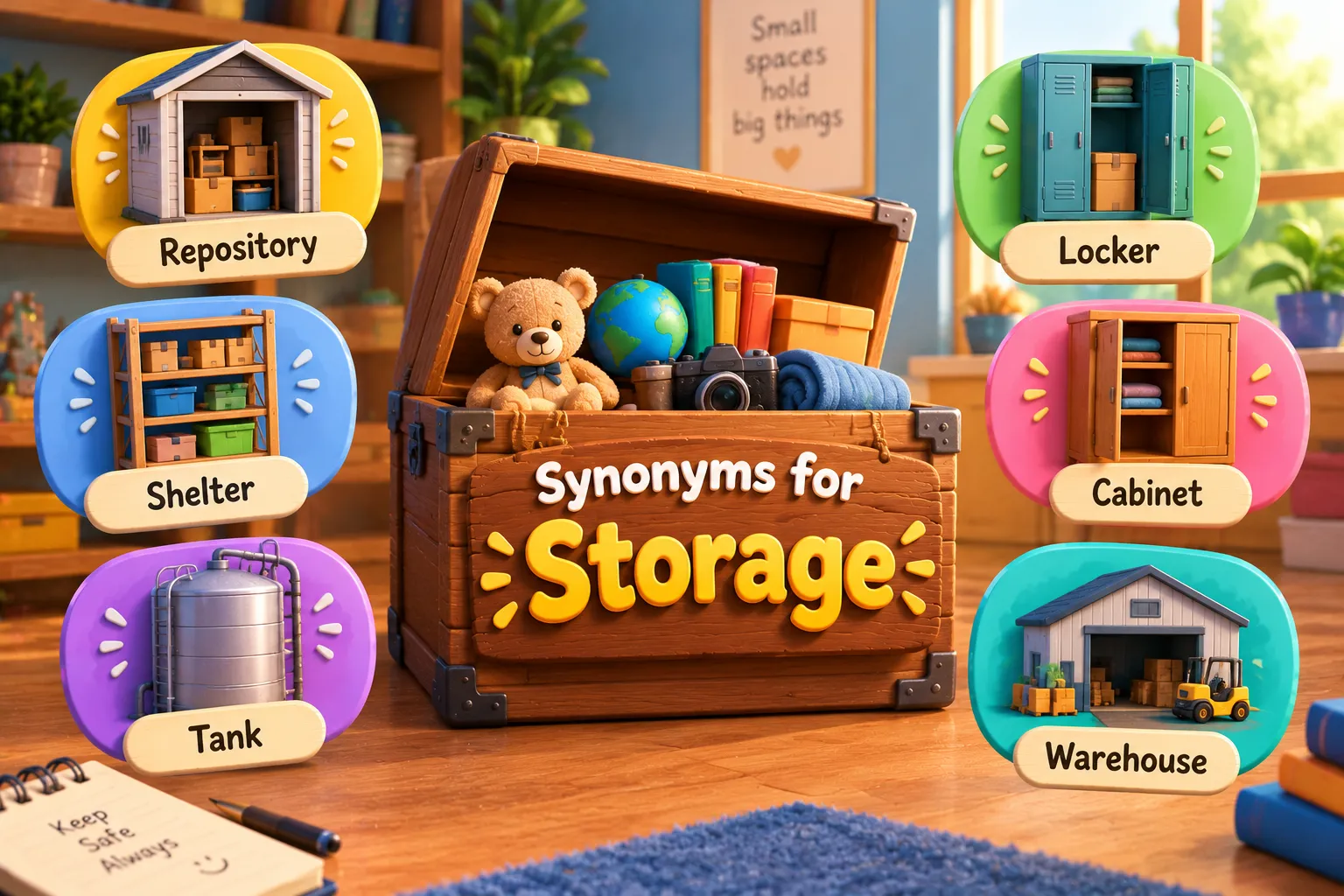
Synonyms for storage include repository, warehouse, storehouse, depot, archive, container, cache, reserve, stockpile, and holding. Storage means keeping items, information, or materials in a safe place for future use. For example, a warehouse provides storage for goods, while a computer uses storage to save files and data. The best synonym depends on the context. Words such as repository suit digital information, while storehouse often refers to physical goods. Learning these alternatives helps you improve your English vocabulary and describe different types of storage more clearly.
Storage means keeping things in a place where they can be used later. Imagine putting your winter clothes in boxes during summer. You are using storage to keep them safe until you need them again. The word is common in daily life, business, technology, and education. People use it when talking about warehouses, cupboards, computer memory, and online files.
Learning synonyms for storage helps English learners and content writers express ideas clearly. Different words suit different situations. For example, a warehouse holds goods, while a repository stores information or digital files. Using the right word makes your writing more accurate and helps you avoid repetition. This guide explains the meaning, pronunciation, history, and word forms of storage. It also presents 30 related words with simple meanings and examples, along with semantic categories, antonyms, and common questions to help you use these words correctly.
Meaning of Storage
Definition
Storage (Noun):
Storage is the act of keeping items, materials, or information in a place or system so they can be used later.
Examples
- We need more storage for our clothes and books.
- Cloud storage lets users save files online.
- The shop uses a large room for the storage of goods.
Connotative Meaning
Connotation (the feelings or ideas linked to a word beyond its basic meaning) helps explain the tone of storage.
- Positive tone: Storage can suggest safety, order, and good planning. For example, proper storage keeps important documents safe.
- Negative tone: It may suggest clutter, limited space, or extra costs. For example, the lack of storage made the small room feel crowded.
- Neutral tone: In technology and business, storage is a practical term for keeping data, goods, or materials.
Etymology of Storage
The word storage comes from the verb store, which entered English through Old French and has roots in words associated with keeping supplies or provisions.
- Old English (450–1100): The modern word storage was not used in Old English. Related ideas were expressed through words for keeping, guarding, and storing supplies.
- Middle English (1100–1500): Store developed through Old French estor and related forms, referring to supplies or provisions. The word family gradually became associated with keeping goods for later use.
- Modern English (1500–Present): Storage developed as a noun for the act, place, or capacity used to keep things. Today, it refers to physical goods, household items, business stock, and digital information.
Pronunciation of Storage (IPA)
- IPA: /ˈstɔːrɪdʒ/ (British English); /ˈstɔːrɪdʒ/ or /ˈstɔrɪdʒ/ (American English)
- Syllables: stor-age
- Number of syllables: 2
- Word stress: The first syllable, stor, receives the main stress.
Affixation Pattern of Storage
- Root: Store, meaning to keep something for future use.
- Prefix: No prefix is used in the word storage.
- Suffix: -age, a suffix used to form nouns related to an action, process, result, or collection.
- Word formation: The word belongs to a family of terms related to keeping goods or information.
Word Formations of Storage
| Word | Part of Speech | Meaning |
| Store | Noun | A place where goods are sold or kept |
| Store | Verb | To keep something for future use |
| Storage | Noun | The act, place, or capacity for keeping things |
| Stored | Verb (past tense) | Kept something for later use |
| Stored | Adjective | Kept in a place for future use |
| Storing | Verb (present participle) | Keeping something for future use |
| Storehouse | Noun | A building used to keep goods or supplies |
| Storage space | Noun phrase | An area or capacity used to keep things |
| Storage unit | Noun phrase | A space or facility used to store belongings |
| Storable | Adjective | Able to be stored |
30 Synonyms of Storage With Meaning and Examples
The following words are related to storage, but they are not all exact synonyms. Some name places where things are kept, while others describe collections, containers, or the act of keeping items. Choose the word that best matches your context.
1. Repository (Noun)
Meaning: A repository is a place or system where things, especially information, are stored.
Examples:
- The website is a repository of useful learning materials.
- The company keeps its research in a digital repository.
2. Warehouse (Noun)
Meaning: A warehouse is a large building used to store goods.
Examples:
- The company stores its products in a large warehouse.
- Workers moved the boxes into the warehouse.
3. Storehouse (Noun)
Meaning: A storehouse is a building or place used to keep supplies or goods.
Examples:
- The farmer kept grain in the storehouse.
- The old storehouse held tools and equipment.
4. Depot (Noun)
Meaning: A depot is a place where goods, vehicles, or supplies are stored or handled.
Examples:
- The delivery trucks returned to the depot.
- The company built a depot for its supplies.
5. Archive (Noun)
Meaning: An archive is a place or collection where important records and documents are kept.
Examples:
- The library has an archive of old newspapers.
- Researchers searched the archive for historical letters.
6. Cache (Noun)
Meaning: A cache is a hidden or reserved collection of items or data kept for future use.
Examples:
- The hikers found a cache of emergency supplies.
- The browser stores images in a cache to load pages faster.
7. Stockpile (Noun)
Meaning: A stockpile is a large supply of items kept for future use.
Examples:
- The town created a stockpile of food before the storm.
- The factory maintained a stockpile of spare parts.
8. Reserve (Noun)
Meaning: A reserve is a supply kept for use when needed.
Examples:
- We keep a reserve of candles for power cuts.
- The hospital maintains a reserve of essential supplies.
9. Holding (Noun)
Meaning: A holding is something kept, owned, or stored by a person or organization.
Examples:
- The museum displayed items from its private holdings.
- The company reviewed its financial holdings.
10. Stock (Noun)
Meaning: Stock is a supply of goods or materials available for use or sale.
Examples:
- The shop keeps extra stock in the back room.
- The factory checked its stock of raw materials.
11. Store (Noun)
Meaning: A store is a place or supply where items are kept for future use.
Examples:
- The village had a store of clean water.
- They kept a store of blankets for winter.
12. Repository System (Noun Phrase)
Meaning: A repository system is an organized system for keeping and managing information or materials.
Examples:
- The school uses a repository system for digital lessons.
- A repository system helps staff find files quickly.
13. Container (Noun)
Meaning: A container is an object used to hold or store something.
Examples:
- Put the rice in an airtight container.
- The container protects the tools from dust.
14. Locker (Noun)
Meaning: A locker is a small, secure space used to store personal belongings.
Examples:
- She left her bag in the school locker.
- The gym provides a locker for each member.
15. Cabinet (Noun)
Meaning: A cabinet is a piece of furniture with shelves or compartments used to store items.
Examples:
- The files are kept in a metal cabinet.
- She placed the dishes inside the kitchen cabinet.
16. Cupboard (Noun)
Meaning: A cupboard is a piece of furniture with doors and shelves used to store household items.
Examples:
- The cups are in the cupboard.
- He keeps his tools in a small cupboard.
17. Pantry (Noun)
Meaning: A pantry is a room or cupboard used to store food and kitchen supplies.
Examples:
- We keep flour and sugar in the pantry.
- She organized the pantry before shopping.
18. Vault (Noun)
Meaning: A vault is a secure room or container used to protect valuable items.
Examples:
- The bank keeps important documents in a vault.
- The museum placed the valuable jewels in a secure vault.
19. Safe (Noun)
Meaning: A safe is a strong, locked box or cabinet used to protect valuables.
Examples:
- He kept his passport in a safe.
- The hotel room has a safe for small valuables.
20. Bin (Noun)
Meaning: A bin is a container used to hold or store items.
Examples:
- She placed the toys in a storage bin.
- The warehouse uses large bins for spare parts.
21. Rack (Noun)
Meaning: A rack is a frame or structure used to hold and organize items.
Examples:
- The garage has a rack for tools.
- The shop stores extra boxes on a metal rack.
22. Shelf (Noun)
Meaning: A shelf is a flat surface used to hold or store objects.
Examples:
- The books are arranged on the shelf.
- He placed the jars on a high shelf.
23. Compartment (Noun)
Meaning: A compartment is a separate section used to hold or store items.
Examples:
- She kept her keys in a small compartment.
- The toolbox has a compartment for screws.
24. Stowage (Noun)
Meaning: Stowage is the act or process of packing and storing items in a suitable place.
Examples:
- The crew checked the stowage of the luggage.
- Proper stowage kept the equipment secure during the trip.
25. Safekeeping (Noun)
Meaning: Safekeeping is the act of keeping something safe from loss or harm.
Examples:
- She left her important papers with her brother for safekeeping.
- The bank offers safekeeping for valuable documents.
26. Preservation (Noun)
Meaning: Preservation is the act of keeping something in good condition or protecting it from damage.
Examples:
- Proper preservation protects old photographs.
- The preservation of food helps reduce waste.
27. Retention (Noun)
Meaning: Retention is the act of keeping or holding something over time.
Examples:
- Data retention rules explain how long records are kept.
- The company reviewed its document retention policy.
28. Accumulation (Noun)
Meaning: Accumulation is the gradual gathering or collection of items over time.
Examples:
- The accumulation of old boxes filled the storeroom.
- The accumulation of digital files made the computer hard to organize.
29. Stockpiling (Noun)
Meaning: Stockpiling is the act of collecting and keeping large amounts of supplies for future use.
Examples:
- Stockpiling food helped the family prepare for winter.
- The agency began stockpiling medical supplies before the storm.
30. Warehousing (Noun)
Meaning: Warehousing is the activity of storing goods in warehouses until they are needed or sold.
Examples:
- Warehousing helps businesses manage large amounts of stock.
- The company reduced its warehousing costs by improving its delivery system.
Prototype Meaning of Storage
The most typical meaning of storage is the act or space used to keep something safe until it is needed. People often imagine a cupboard, warehouse, storeroom, or box filled with items. However, storage can also refer to digital information saved on a computer, phone, or online service. Its central idea is keeping something available for later use. Whether you store food, clothes, business products, or computer files, storage helps protect and organize items so they are easier to find when needed.
Prototype Categorization of Storage Synonyms
The 30 related words can be grouped by the type of storage they describe. These categories help writers select a word that fits the subject and context.
1. Buildings and Storage Facilities
These words describe places used to keep goods or supplies.
- Warehouse: A large building for goods.
- Storehouse: A building for supplies.
- Depot: A place for goods, vehicles, or supplies.
- Archive: A place or collection for records.
- Pantry: A place for food supplies.
- Vault: A secure place for valuables.
- Warehousing: The process of storing goods in warehouses.
2. Digital and Information Storage
These terms relate to data, records, and organized information.
- Repository: A place or system for storing information.
- Cache: A temporary or reserved collection of data.
- Repository system: A system for organizing and managing stored information.
- Archive: A collection of records kept for future reference.
- Retention: The continued keeping of data or records.
3. Containers and Storage Furniture
These words name objects or structures used to hold items.
- Container: An object that holds things.
- Locker: A secure space for personal items.
- Cabinet: Furniture with shelves or compartments.
- Cupboard: Furniture used to keep household items.
- Safe: A secure box for valuables.
- Bin: A container for holding items.
- Rack: A structure for organizing objects.
- Shelf: A flat surface for holding things.
- Compartment: A separate section within a larger space.
4. Supplies and Collections
These words describe goods or items kept for later use.
- Stockpile: A large supply of items.
- Reserve: A supply saved for future needs.
- Holding: Something kept or owned.
- Stock: Goods available for use or sale.
- Store: A supply kept for future use.
- Cache: A collection of items kept for later use.
- Accumulation: A collection that grows over time.
- Stockpiling: The act of collecting large supplies.
5. Actions and Purposes of Storage
These terms describe why or how items are kept.
- Stowage: Packing and placing items in a suitable space.
- Safekeeping: Keeping something safe.
- Preservation: Protecting something from damage or loss.
- Retention: Continuing to keep something.
- Warehousing: Storing goods until they are needed.
How these categories help: Use a warehouse for a building that holds products, a repository for a digital collection, a cabinet for household storage, and preservation when the main goal is to protect something. Choosing words by category makes your writing clearer and more precise.
Antonyms of Storage
Storage has no single direct antonym because it can refer to an action, a place, or the capacity to keep things. However, the following words express opposite or contrasting ideas in different contexts.
| Antonym or Contrast | Part of Speech | Meaning |
| Retrieval | Noun | The act of finding and getting stored items or information |
| Removal | Noun | The act of taking something away from a place |
| Disposal | Noun | The act of getting rid of something |
| Release | Noun / Verb | The act of letting something go or making it available |
| Distribution | Noun | The act of delivering or sharing items among people or places |
| Deletion | Noun | The act of removing digital information |
| Consumption | Noun | The act of using up a resource |
| Depletion | Noun | The reduction or exhaustion of a supply |
| Emptying | Noun / Verb | The act of removing the contents of a container or space |
| Dispersal | Noun | The act of spreading items or people over an area |
| Expenditure | Noun | The act of spending or using resources |
| Unloading | Noun / Verb | The act of removing goods from a vehicle or container |
Note: These words are contextual opposites, not exact antonyms. For example, retrieval contrasts with keeping data stored when the focus is on accessing it, while disposal contrasts with retaining physical items.
Short Questions and Answers
1. What does storage mean?
Storage means keeping items, materials, or information in a place or system so they can be used later.
2. When should storage be used?
Use storage when talking about keeping goods, household items, documents, or digital information for future use. For example, cloud storage keeps computer files online.
3. Is storage positive or negative?
Storage is usually neutral. It can have a positive meaning when it suggests safety and organization, but it may suggest clutter or extra costs in some situations.
4. How is storage different from similar words?
Storage is the general act or capacity of keeping things. A warehouse is a building for goods, an archive holds records, and a repository stores information or other collections.
Conclusion
Learning synonyms for storage can improve your English vocabulary and help you describe places, objects, and processes more accurately. Words such as warehouse, repository, archive, container, and stockpile relate to different forms of storage. Each has a specific meaning, so choosing the right word makes your writing clearer and more useful.
These alternatives can also help you avoid repetition in essays, reports, website articles, and daily conversations. For example, a business writer may use warehousing when discussing goods, while a technology writer may choose a repository when discussing digital information. English learners can build confidence by learning a few related words each day and using them in their own sentences. Regular practice will help you understand the differences between similar terms and communicate with greater accuracy.
Read More:
Synonyms for Adrenaline: 30 Exciting Alternatives

I’m Ayesha Haram, an English content and SEO writer at SynonymsInstant.com. I focus on creating helpful vocabulary resources, word guides, and practical English content that readers can understand quickly. I combine language research, clear explanations, and SEO-focused writing to produce reliable content that supports learners, writers, and everyday English users.