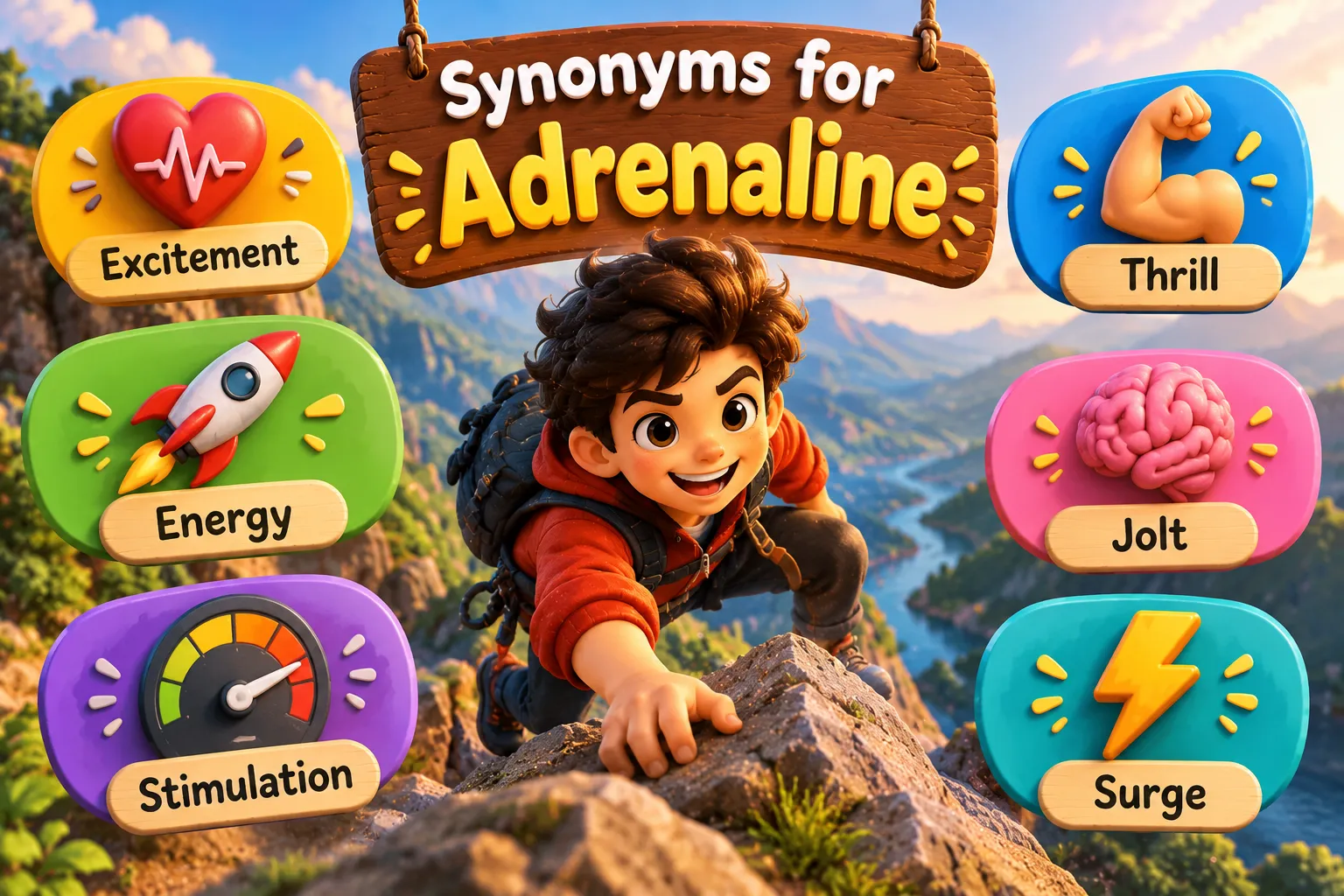
Synonyms for adrenaline include excitement, thrill, rush, energy, exhilaration, stimulation, and arousal. Adrenaline is a hormone that helps your body react to danger, stress, or excitement. For example, you may feel an adrenaline rush before a race or while riding a roller coaster. Although no word is an exact synonym for the hormone itself, many words describe the feelings and effects linked to adrenaline. The best choice depends on the situation. Learning these related words helps you describe excitement, energy, fear, and intense experiences more clearly.
Adrenaline is a hormone that helps your body respond to stress, danger, and excitement. Imagine standing at the top of a tall roller coaster. Your heart beats faster, your breathing changes, and you feel a sudden burst of energy. This feeling is often called an adrenaline rush. The word is common in sports, health, travel, and everyday conversations because it describes powerful physical reactions and exciting moments.
Learning synonyms for adrenaline can help English learners and content writers express these feelings in different ways. For example, thrill describes strong excitement, while rush suggests a sudden wave of energy or emotion. These words are related to adrenaline, but they do not all mean the same thing. This guide explains the meaning, pronunciation, history, and word forms of adrenaline. It also explores 30 related words with simple meanings, examples, antonyms, and semantic categories to help you use them correctly.
Meaning of Adrenaline
Definition
Adrenaline (Noun):
Adrenaline is a hormone made by the adrenal glands that prepares the body to respond quickly to stress, danger, or excitement. It is also called epinephrine.
In everyday English, adrenaline can refer to the strong feeling of excitement or energy linked to this hormone.
Examples
- The fast car ride gave me an adrenaline rush.
- Adrenaline helped the athlete react quickly during the race.
- She loves the adrenaline of outdoor adventures.
Connotative Meaning
Connotation (the feelings or ideas linked to a word beyond its basic meaning) helps explain the emotional tone of adrenaline.
- Positive tone: Adrenaline can suggest excitement, courage, energy, and adventure. For example, the adrenaline of skydiving made the trip unforgettable.
- Negative tone: It can suggest fear, panic, stress, or danger. For example, adrenaline surged through him when he heard the crash.
- Neutral tone: In science and medicine, adrenaline refers to a hormone involved in the body’s response to stress.
Etymology of Adrenaline
The word adrenaline comes from the name of the adrenal glands, which sit above the kidneys. It was formed from Latin-based elements and the chemical suffix -ine.
- Old English (450–1100): The word adrenaline did not exist in Old English. People described related experiences with words for fear, excitement, energy, and bodily reactions.
- Middle English (1100–1500): The word adrenaline was not yet in use. Related ideas were expressed through words such as fear, force, and spirit.
- Modern English (1500–Present): Adrenaline entered scientific English in the late nineteenth century as a name for a substance produced by the adrenal glands. Today, it is used in medicine, biology, sports, and everyday speech.
Pronunciation of Adrenaline (IPA)
- IPA: /əˈdrenəlɪn/
- Syllables: a-dren-a-line
- Number of syllables: 4
- Word stress: The second syllable, dren, receives the main stress.
Affixation Pattern of Adrenaline
- Root: Renal relates to the kidneys. The word adrenal refers to the glands located above the kidneys.
- Prefix: Ad- comes from a Latin element meaning “to” or “near” in this word’s historical formation.
- Suffix: -ine is used in the names of many chemical substances.
- Word formation: The related forms below are used in medical, scientific, and everyday English.
Word Formations of Adrenaline
| Word | Part of Speech | Meaning |
| Adrenaline | Noun | A hormone that prepares the body for rapid action |
| Adrenal | Adjective / Noun | Related to the adrenal glands; also a term for an adrenal gland |
| Adrenalin | Noun | An alternative spelling of adrenaline |
| Adrenaline-fueled | Adjective | Driven by excitement, stress, or intense energy |
| Adrenaline-pumping | Adjective | Causing strong excitement or a feeling of intense energy |
| Adrenalize | Verb (rare) | To stimulate or excite strongly |
| Adrenalized | Adjective | Intensely excited or stimulated |
| Adrenalizing | Verb form (rare) | Causing intense excitement or stimulation |
Note: Many words listed as synonyms for adrenaline describe its effects or the feelings associated with it. They are not exact scientific substitutes for the hormone’s name.
30 Synonyms of Adrenaline With Meaning and Examples
The following words describe the excitement, energy, stimulation, or intense feelings often associated with adrenaline. Some are close alternatives in everyday speech, while others fit only certain contexts.
1. Excitement (Noun)
Meaning: Excitement is a strong feeling of happiness, interest, or eagerness.
Examples:
- The excitement of the final match kept everyone on their feet.
- She felt great excitement before her first flight.
2. Thrill (Noun)
Meaning: A thrill is a sudden feeling of great excitement or pleasure.
Examples:
- The roller coaster gave me a real thrill.
- He enjoys the thrill of mountain biking.
3. Rush (Noun)
Meaning: A rush is a sudden, strong feeling of energy or emotion.
Examples:
- She felt a rush of excitement before the race.
- The steep climb gave him an adrenaline rush.
4. Energy (Noun)
Meaning: Energy is the strength needed to act, move, or do work.
Examples:
- The players had enough energy to finish the game.
- The exciting music filled the room with energy.
5. Exhilaration (Noun)
Meaning: Exhilaration is a feeling of great happiness, excitement, and energy.
Examples:
- She felt exhilaration as she crossed the finish line.
- The open road gave him a sense of exhilaration.
6. Stimulation (Noun)
Meaning: Stimulation is something that increases activity, interest, or alertness.
Examples:
- The fast-paced game provided mental stimulation.
- Physical activity can offer stimulation and help people feel more alert.
7. Arousal (Noun)
Meaning: Arousal is a state of increased physical or mental alertness.
Examples:
- The sudden noise caused a state of arousal.
- Emotional arousal can make the heart beat faster.
8. Invigoration (Noun)
Meaning: Invigoration is the process of making someone feel more energetic or refreshed.
Examples:
- The cold morning air gave him a feeling of invigoration.
- A short run brought invigoration after a long day.
9. Euphoria (Noun)
Meaning: Euphoria is an intense feeling of happiness or well-being.
Examples:
- She felt euphoria after winning the championship.
- The crowd erupted in euphoria when the team scored.
10. Excitement Rush (Noun Phrase)
Meaning: An excitement rush is a sudden wave of strong excitement.
Examples:
- The surprise announcement gave everyone an excitement rush.
- He felt an excitement rush before stepping onto the stage.
11. Buzz (Noun)
Meaning: A buzz is a lively feeling of excitement or energy.
Examples:
- The festival created a buzz throughout the town.
- She loves the buzz of a busy city.
12. High (Noun)
Meaning: A high is a strong feeling of happiness, excitement, or energy.
Examples:
- Winning the race gave him an emotional high.
- She felt a high after completing the difficult climb.
13. Rush of Energy (Noun Phrase)
Meaning: A rush of energy is a sudden increase in the feeling of being active or alert.
Examples:
- The final song gave the dancers a rush of energy.
- He felt a rush of energy as the race began.
14. Stimulation of the Senses (Noun Phrase)
Meaning: Stimulation of the senses is an experience that makes sight, sound, touch, or other senses more active.
Examples:
- The bright lights and loud music offered strong stimulation of the senses.
- The adventure park provided stimulation of the senses at every turn.
15. Alertness (Noun)
Meaning: Alertness is the state of being awake, aware, and ready to respond.
Examples:
- The sudden sound increased his alertness.
- Good sleep can improve alertness during the day.
16. Intensity (Noun)
Meaning: Intensity is the quality of being very strong or powerful.
Examples:
- The intensity of the race kept the audience focused.
- She enjoyed the intensity of the final competition.
17. Excitation (Noun)
Meaning: Excitation is a state of increased activity, emotion, or energy.
Examples:
- The announcement caused excitement and excitation among the fans.
- In science, excitation can describe a change in the energy state of an atom.
18. Animation (Noun)
Meaning: Animation is a lively state full of energy and activity.
Examples:
- His face showed animation as he told the story.
- The children spoke with animation about their trip.
19. Enthusiasm (Noun)
Meaning: Enthusiasm is strong interest or eagerness for something.
Examples:
- She showed great enthusiasm for the new sport.
- His enthusiasm inspired the whole team.
20. Passion (Noun)
Meaning: Passion is a strong feeling of love, interest, or commitment.
Examples:
- His passion for racing began when he was young.
- She spoke with passion about her latest adventure.
21. Zeal (Noun)
Meaning: Zeal is great energy and eagerness in doing something.
Examples:
- The young athlete trained with zeal.
- Her zeal for learning encouraged her classmates.
22. Vigor (Noun)
Meaning: Vigor is physical or mental strength and energy.
Examples:
- He played the game with vigor.
- Regular exercise helped her work with more vigor.
23. Vitality (Noun)
Meaning: Vitality is the state of being full of life and energy.
Examples:
- The long walk gave him a renewed sense of vitality.
- The dancers performed with remarkable vitality.
24. Dynamism (Noun)
Meaning: Dynamism is the quality of being active, energetic, and full of ideas.
Examples:
- Her dynamism helped the team complete the project.
- The coach brought dynamism to every training session.
25. Drive (Noun)
Meaning: Drive is a strong desire and energy to achieve something.
Examples:
- His drive pushed him to train every day.
- She has the drive to reach her goals.
26. Momentum (Noun)
Meaning: Momentum is the force or energy that keeps an activity moving forward.
Examples:
- The team gained momentum after scoring the first goal.
- Her early success gave the project momentum.
27. Frenzy (Noun)
Meaning: Frenzy is a state of intense excitement or uncontrolled activity.
Examples:
- The winning goal sent the fans into a frenzy.
- The crowd worked in a frenzy to prepare for the event.
28. Fever Pitch (Noun Phrase)
Meaning: Fever pitch is a state of extreme excitement or activity.
Examples:
- Excitement reached fever pitch before the final match.
- The concert crowd was at fever pitch when the singer appeared.
29. Surge (Noun)
Meaning: A surge is a sudden increase in a feeling, force, or amount.
Examples:
- A surge of excitement swept through the crowd.
- He felt a surge of energy near the finish line.
30. Adrenaline Rush (Noun Phrase)
Meaning: An adrenaline rush is a sudden feeling of energy and excitement linked to the body’s stress response.
Examples:
- Skydiving gave her an unforgettable adrenaline rush.
- He felt an adrenaline rush when the race began.
Prototype Meaning of Adrenaline
The most typical meaning of adrenaline is the hormone that prepares the body to respond quickly to stress, danger, or excitement. In everyday speech, people often use the word to describe the intense feeling that comes with a thrilling experience. They may imagine a racing heart, quick breathing, sharp attention, and a sudden burst of energy. Riding a roller coaster, competing in a close race, or facing a frightening event may produce this feeling. Although words such as thrill, rush, and excitement describe related experiences, they do not mean the hormone itself.
Prototype Categorization of Adrenaline Synonyms
The 30 related words can be grouped into meaningful categories. These groups help writers choose the best expression for a particular feeling or situation.
1. Excitement and Thrill
These words describe the pleasure and excitement of an intense experience.
- Excitement: Strong happiness or eagerness.
- Thrill: A sudden feeling of excitement.
- Rush: A sudden wave of emotion or energy.
- Exhilaration: Great excitement and happiness.
- Buzz: A lively feeling of excitement.
- High: A strong feeling of happiness or excitement.
- Excitement rush: A sudden wave of excitement.
- Adrenaline rush: A feeling of excitement or energy linked to the body’s stress response.
2. Energy and Strength
These words focus on physical or mental power.
- Energy: Strength for activity.
- Invigoration: A feeling of renewed energy.
- Rush of energy: A sudden increase in energy.
- Vigor: Strength and active energy.
- Vitality: A feeling of being full of life.
- Dynamism: Active energy and force.
- Drive: Motivation to reach a goal.
- Momentum: Force that keeps progress moving.
3. Alertness and Stimulation
These terms describe increased activity or awareness.
- Stimulation: Increased activity or interest.
- Arousal: Increased physical or mental alertness.
- Stimulation of the senses: Increased sensory activity.
- Alertness: Readiness to notice and respond.
- Excitation: Increased activity or emotional response.
- Intensity: Great strength or power.
4. Happiness and Motivation
These words describe positive emotions and a strong desire to act.
- Euphoria: Intense happiness.
- Animation: Lively expression and activity.
- Enthusiasm: Eagerness and interest.
- Passion: Strong interest or commitment.
- Zeal: Great eagerness.
- Surge: A sudden increase in a feeling or force.
5. Extreme Excitement and Activity
These expressions describe powerful feelings or situations that become intense.
- Frenzy: Uncontrolled excitement or activity.
- Fever pitch: A state of extreme excitement.
- Drive: Strong motivation to act.
- Intensity: A high degree of strength or emotion.
How these categories help: Use thrill when describing an exciting activity, alertness when focusing on awareness, vigor when describing strength, and frenzy when a crowd becomes wildly excited. For scientific writing, use adrenaline or epinephrine when referring to the hormone itself.
Antonyms of Adrenaline
Adrenaline has no exact antonym because it is the name of a hormone. However, several words describe states that contrast with the excitement, alertness, or energy often associated with an adrenaline rush.
| Antonym or Contrast | Part of Speech | Meaning |
| Calmness | Noun | A state without strong excitement or worry |
| Relaxation | Noun | A state of rest and reduced tension |
| Tranquility | Noun | A peaceful and quiet state |
| Stillness | Noun | A lack of movement or activity |
| Inactivity | Noun | A state of not being active |
| Lethargy | Noun | A lack of energy or enthusiasm |
| Sluggishness | Noun | A state of moving or acting slowly |
| Drowsiness | Noun | A feeling of being sleepy |
| Composure | Noun | A calm state of mind |
| Serenity | Noun | A state of deep peace |
| Apathy | Noun | A lack of interest or emotion |
| Fatigue | Noun | Extreme tiredness or lack of energy |
Note: These are contrasting terms, not direct biological opposites of adrenaline. Their suitability depends on whether you mean the hormone, physical energy, alertness, or excitement.
Short Questions and Answers
1. What does adrenaline mean?
Adrenaline is a hormone that prepares the body to respond to stress, danger, or excitement. In everyday English, it can also describe the intense feeling linked to thrilling experiences.
2. When should adrenaline be used?
Use adrenaline when talking about the hormone or the sudden feeling of excitement and energy associated with it. For example, a person may feel an adrenaline rush during a race or an adventure.
3. Is adrenaline positive or negative?
Adrenaline is neither purely positive nor purely negative. It is a natural hormone that helps the body respond to challenges. An adrenaline rush may feel exciting, but it can also occur during fear or stress.
4. How is adrenaline different from similar words?
Adrenaline is the name of a hormone, while excitement describes a feeling, energy refers to the capacity to act, and thrill describes strong excitement. These words are related but are not exact substitutes.
Conclusion
Learning synonyms for adrenaline can help you describe excitement, energy, fear, and intense experiences with greater accuracy. Words such as thrill, rush, exhilaration, alertness, and vigor express different feelings or effects associated with adrenaline. Each word has its own meaning, so choosing the right one makes your writing clearer and more natural.
These related words can also help English learners build vocabulary, improve speaking, and avoid repetition in essays, stories, and online articles. Content writers can use them to create more engaging descriptions of sports, travel, adventures, and emotional experiences. However, remember that these words describe related feelings or effects rather than the hormone itself. Try learning a few words each day and using them in your own sentences. With regular practice, you can strengthen your English skills and communicate with greater confidence.
Read More:
Synonyms for Distress: 29 Essential Words to Know

I am Rubab content specialist focused on creating accurate, user-friendly, and search-optimized language resources. Through Synonyminstant, I help readers find synonyms, antonyms, meanings, and vocabulary with ease. Every article is carefully researched and optimized to provide reliable information, clear explanations, and an excellent user experience.