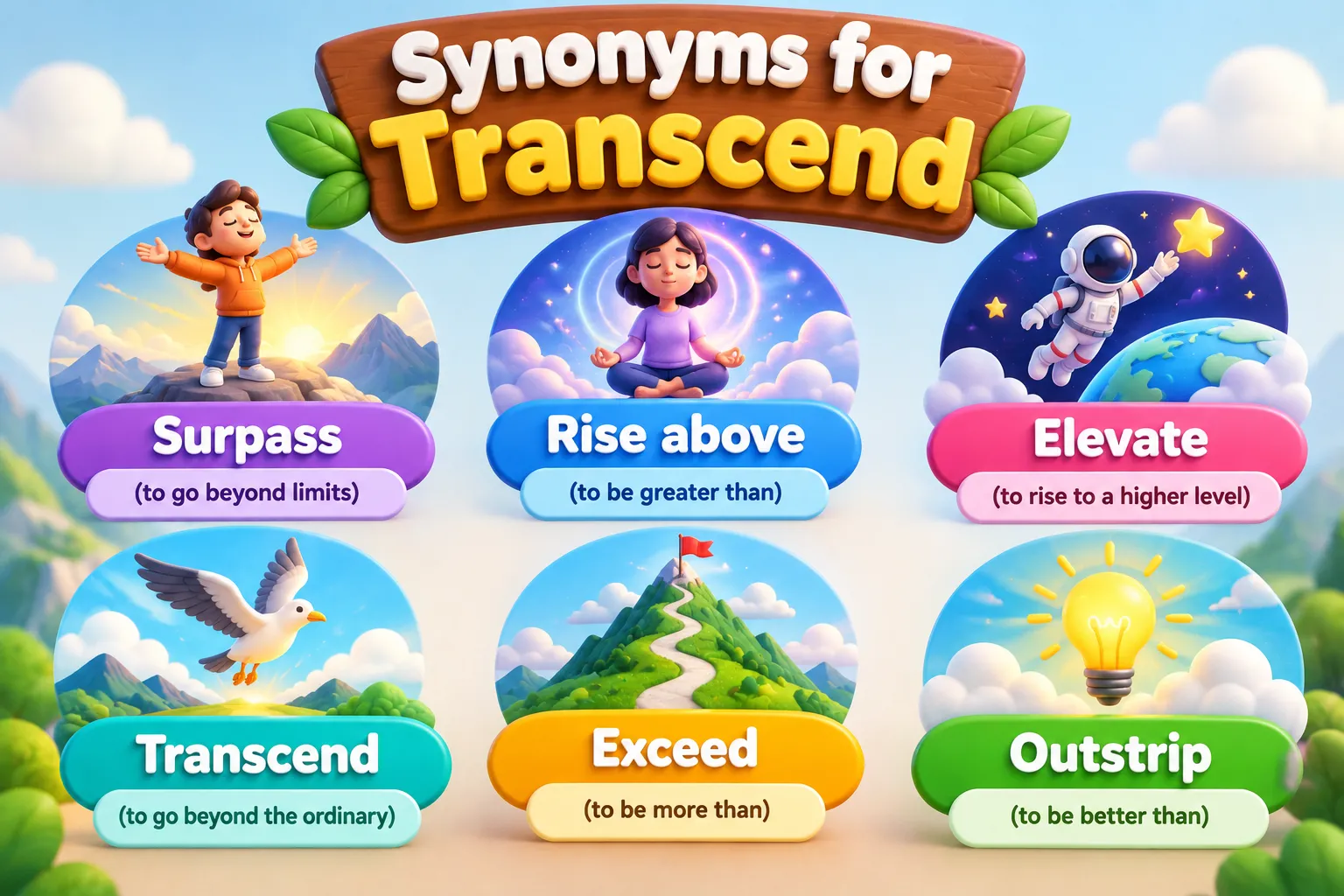
Synonyms for transcend include surpass, exceed, rise above, go beyond, outstrip, and overcome.Transcend means to go beyond a limit, level, or usual experience.A person can transcend fear by acting with courage.An achievement can transcend expectations by being better than expected.The word can also describe ideas or experiences that go beyond ordinary limits.The best synonym depends on whether you mean exceeding a standard, overcoming a problem, or going beyond normal experience.
Transcend means to go beyond a limit, level, or ordinary experience. Imagine a student who works hard and achieves far more than anyone expected. The student has transcended those expectations. A person may also transcend fear by facing a challenge with courage. The word often appears in books, speeches, education, art, and personal growth because it describes going beyond what is usual or expected.
Learning synonyms for transcend helps English learners express ideas with greater detail. It also helps writers avoid repeating the same word. For example, surpass often means doing better than a standard, while rise above can mean not letting a problem control you. This guide explains the meaning, pronunciation, history, and word forms of transcend. It also presents 25 related words and phrases with simple meanings and examples to help you choose the best alternative for each situation.
Meaning of Transcend
Definition
Transcend (Verb):
To transcend means to go beyond a limit, standard, expectation, or ordinary experience.
Examples
- Her kindness transcends cultural differences.
- The team worked hard to transcend its own expectations.
- Great art can transcend time and place.
- He learned to transcend his fear of failure.
Connotative Meaning
Connotation is the feeling or idea that a word suggests beyond its basic meaning.
- Positive tone: Transcend often suggests growth, excellence, freedom, or achievement. Example: She transcended her limits and reached her goal.
- Negative tone: The word can describe going beyond an accepted limit in an unwanted way, depending on context. Example: The cost transcended the amount the company could afford.
- Neutral tone: It can simply describe something that goes beyond a boundary or category. Example: The study explores ideas that transcend traditional subject areas.
Etymology of Transcend
The word transcend comes from Latin transcendere, meaning “to climb over” or “to go beyond.” It combines trans- (“across” or “beyond”) with scandere (“to climb”).
- Old English (450–1100): The modern word transcend was not a common Old English word. People used other words to express ideas such as passing beyond or rising above.
- Middle English (1100–1500): The word entered English through French and Latin forms, carrying the idea of going beyond a boundary or limit.
- Modern English (1500–Present): Transcend developed its common meanings of surpassing limits, exceeding expectations, and going beyond ordinary experience or understanding.
Pronunciation (IPA)
- IPA: /trænˈsend/
- Syllables: tran-scend (2 syllables)
Affixation Pattern of Transcend
- Root: Scend, related to Latin scandere, meaning “to climb.”
- Prefix: Trans-, meaning “across,” “through,” or “beyond.”
- Suffix: There is no separate suffix in the base word transcend.
Word Formations
| Word | Part of Speech | Meaning |
| Transcend | Verb | To go beyond a limit or standard |
| Transcends | Verb | Goes beyond a limit or standard |
| Transcended | Verb | Went beyond a limit or standard |
| Transcending | Verb/Adjective | Going beyond a limit or standard |
| Transcendence | Noun | The state or quality of going beyond ordinary limits |
| Transcendent | Adjective | Going beyond ordinary limits or experience |
| Transcendentally | Adverb | In a way related to transcendence or what goes beyond ordinary experience |
| Transcendental | Adjective | Going beyond ordinary experience or, in philosophy, relating to conditions of knowledge |
| Transcendentalism | Noun | A philosophical and literary movement that stresses intuition and spiritual insight |
| Transcendentalist | Noun | A person who follows transcendentalism |
25 Synonyms of Transcend With Meaning & Examples
Note: These words are related to transcend, but they do not all fit every sentence. Some focus on doing better than a standard, while others describe overcoming a problem or going beyond ordinary limits.
1. Surpass (Verb)
Meaning: To do better than or go beyond a person, level, or standard.
Examples:
- Her results surpassed everyone’s expectations.
- The new model surpasses the older one in speed.
2. Exceed (Verb)
Meaning: To go beyond a set limit, amount, or expectation.
Examples:
- The costs exceeded our budget.
- His work exceeded the required standard.
3. Outstrip (Verb)
Meaning: To become greater, faster, or more successful than something else.
Examples:
- Demand outstripped supply.
- Her progress outstripped that of the other students.
4. Outdo (Verb)
Meaning: To do better than someone else.
Examples:
- The team worked hard to outdo its previous performance.
- She outdid herself with her latest design.
5. Outperform (Verb)
Meaning: To perform better than another person, group, or thing.
Examples:
- The new product outperformed its rivals.
- He outperformed his own results from last year.
6. Eclipse (Verb)
Meaning: To become more impressive or important than someone or something else.
Examples:
- Her latest achievement eclipsed her earlier success.
- The bright moon eclipsed the smaller stars in the sky.
7. Outshine (Verb)
Meaning: To be better or more impressive than others.
Examples:
- Her clear speech helped her outshine the other speakers.
- The young player outshone many experienced athletes.
8. Excel (Verb)
Meaning: To be very good at something.
Examples:
- He excels at solving difficult problems.
- She worked hard to excel in science.
9. Top (Verb)
Meaning: To be better than or reach a higher level than something else.
Examples:
- The team topped its previous score.
- Her latest result topped all her earlier efforts.
10. Beat (Verb)
Meaning: To do better than a person, result, or standard.
Examples:
- She beat her personal record.
- The company beat its sales target.
11. Go Beyond (Verb Phrase)
Meaning: To move past a limit, rule, expectation, or usual level.
Examples:
- The teacher encouraged students to go beyond simple answers.
- Her kindness went beyond what anyone expected.
12. Rise Above (Verb Phrase)
Meaning: To avoid being controlled by a problem, difficulty, or negative feeling.
Examples:
- He learned to rise above criticism.
- She rose above the challenges and kept working.
13. Overcome (Verb)
Meaning: To successfully deal with or defeat a problem.
Examples:
- She overcame her fear of public speaking.
- The team overcame many obstacles to win.
14. Conquer (Verb)
Meaning: To gain control over or defeat a difficult problem or fear.
Examples:
- He worked to conquer his fear of heights.
- The team conquered many challenges during the season.
15. Triumph Over (Verb Phrase)
Meaning: To succeed despite a problem or opponent.
Examples:
- She triumphed over many difficulties.
- The community triumphed over hardship through teamwork.
16. Break Through (Verb Phrase)
Meaning: To pass through a barrier or make a major advance.
Examples:
- The researchers broke through a major scientific barrier.
- He broke through his fear and spoke to the crowd.
17. Advance Beyond (Verb Phrase)
Meaning: To move to a level beyond an earlier stage.
Examples:
- The students advanced beyond basic grammar.
- Her research advanced beyond earlier findings.
18. Rise Beyond (Verb Phrase)
Meaning: To move past a limit or difficulty to reach a higher level.
Examples:
- She rose beyond the limits others had set for her.
- The group rose beyond its early struggles.
19. Exceed the Limits (Verb Phrase)
Meaning: To go beyond what is normally allowed or expected.
Examples:
- The athlete trained to exceed the limits of his performance.
- The costs exceeded the limits set by the plan.
20. Go Past (Verb Phrase)
Meaning: To move beyond a point, stage, or limit.
Examples:
- The discussion went past the original topic.
- Her skills went past the basic level.
21. Overstep (Verb)
Meaning: To go beyond an accepted limit, rule, or boundary, often in an improper way.
Examples:
- He overstepped his authority.
- The company overstepped the limits of its agreement.
22. Outgrow (Verb)
Meaning: To develop beyond a former need, habit, stage, or condition.
Examples:
- She outgrew her fear of performing on stage.
- The business outgrew its small office.
23. Leave Behind (Verb Phrase)
Meaning: To move beyond a former state, habit, or situation.
Examples:
- He left behind his old doubts and moved forward.
- The town left behind its past struggles.
24. Move Beyond (Verb Phrase)
Meaning: To progress past a problem, stage, or way of thinking.
Examples:
- The team moved beyond its early mistakes.
- She moved beyond the limits of her first project.
25. Transgress (Verb)
Meaning: To go beyond a rule or moral boundary, usually in a negative sense.
Examples:
- The action transgressed the rules of the group.
- He was warned not to transgress the agreed limits.
Prototype Meaning
The most typical meaning of transcend is to go beyond an ordinary limit, standard, or expectation. People may imagine someone achieving more than expected, rising above a difficult situation, or finding a way past a barrier. The word can also describe ideas, art, or experiences that seem to go beyond normal boundaries. Its meaning depends on the context: surpass often refers to performance, overcome refers to difficulties, and rise above often refers to handling problems or criticism.
Prototype Categorization
The synonyms above can be grouped by their main meanings. These categories help writers select words that express the exact kind of change or achievement they want to describe.
- Exceeding standards or expectations: Surpass, exceed, outstrip, outdo, outperform, top, and beat. Use these when someone or something does better than a target or another result.
- Being more impressive: Eclipse, outshine, and excel. These words fit achievements, talents, or performances that stand out.
- Moving beyond a limit: Go beyond, go past, advance beyond, rise beyond, exceed the limits, and move beyond. These phrases focus on passing a boundary or stage.
- Overcoming challenges: Overcome, conquer, triumph over, and break through. Use these when someone defeats a problem, fear, or barrier.
- Growing or leaving the past behind: Outgrow and leave behind. These describe moving past an earlier habit, stage, or situation.
- Crossing boundaries in a negative way: Overstep, transgress, and overreach. These words often suggest breaking rules or going too far.
- Improving or raising quality: Elevate, enhance, refine, and transform. These words focus on improving, developing, or changing something rather than simply surpassing a standard.
Understanding these groups helps you choose a synonym that matches your meaning. For example, use surpass for a result, overcome for a challenge, and overstep when someone goes beyond an accepted boundary.
Antonyms of Transcend
The opposite of transcending depends on the context. The following words describe staying within limits, failing to exceed a standard, or moving to a lower level.
| Antonym | Part of Speech | Meaning |
| Fall Short | Verb Phrase | To fail to reach a goal or standard |
| Underperform | Verb | To perform below the expected level |
| Fail | Verb | To be unsuccessful in reaching a goal |
| Remain Within | Verb Phrase | To stay inside a limit or boundary |
| Stay Below | Verb Phrase | To remain at a lower level than a standard |
| Conform | Verb | To follow accepted rules or standards |
| Obey | Verb | To follow a rule, order, or instruction |
| Submit | Verb | To yield to another person’s authority or control |
| Decline | Verb | To move to a lower level or become weaker |
| Deteriorate | Verb | To become worse in quality or condition |
Short Questions and Answers
1. What does transcend mean?
Transcend means to go beyond a limit, standard, expectation, or ordinary experience.
2. When should transcend be used?
Use transcend when describing something that goes beyond usual limits or expectations. For example, her achievement transcended everyone’s expectations.
3. Is transcend positive or negative?
It is often positive because it suggests growth or achievement. However, context matters. Going beyond a rule or reasonable limit can have a negative meaning.
4. How is transcendence different from similar words?
Transcend often suggests going beyond a limit or ordinary experience. Surpass usually means doing better than a standard, while overcome means successfully dealing with a problem.
Conclusion
Learning synonyms for transcend helps you express growth, achievement, and change more clearly. Words such as surpass, exceed, and outperform work well when describing results that go beyond expectations. Words like overcome and triumph over focus on defeating challenges, while rise above can describe handling criticism or hardship. Other words, such as overstep and transgress, show that going beyond a limit can sometimes be negative. Choosing the right synonym makes your writing clearer and more precise. Read examples, practice new words in your own sentences, and notice how they are used in books and articles. Daily practice can strengthen your vocabulary, improve your speaking and writing, and build confidence in English.
Read More:
Synonyms for Midnight: 30 Helpful Vocabulary Alternatives

I’m Pinki, an SEO writer at SynonymsInstant.com, specializing in synonyms, antonyms, vocabulary, word meanings, grammar, and English usage. I create accurate, well-researched, reader-friendly content that combines language expertise with SEO best practices. My goal is to make English vocabulary simple, useful, and accessible for students, writers, professionals, and English learners.