
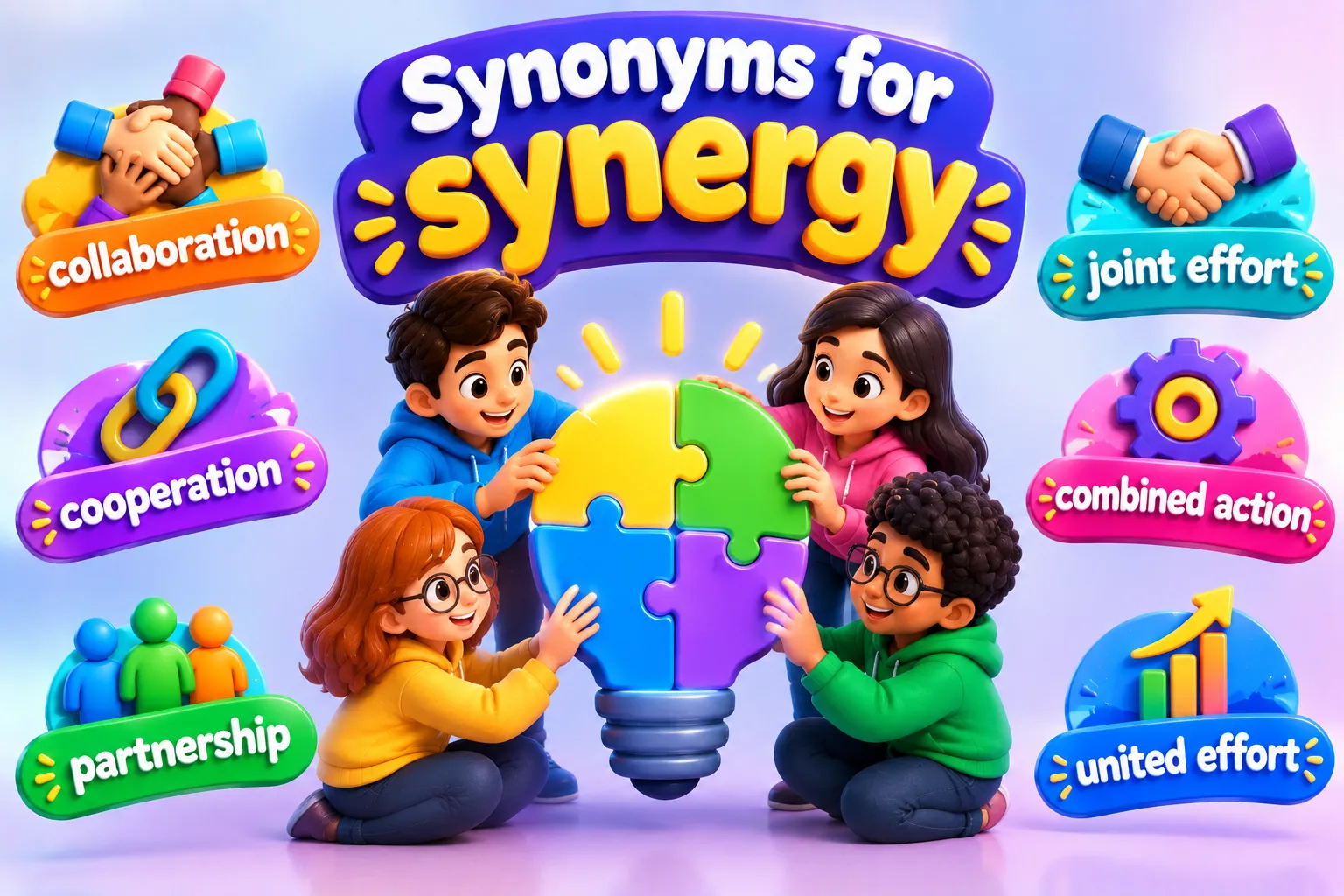
Common synonyms for synergy include cooperation, collaboration, teamwork, partnership, coordination, unity, harmony, alliance, and integration. The best synonym depends on the situation. For example, collaboration works well for people working together, while integration is better when separate systems or parts are joined into one. Learning these alternatives helps English learners and writers communicate ideas clearly without repeating the same word.
Synergy means that two or more people, teams, or things work together and create a stronger result. Imagine two students working on a school project. One is good at research, while the other is good at design. When they combine their skills, the final project can be much better than either student could make alone. This is synergy. The word is common in business, education, science, teamwork, and everyday communication. Learning synonyms for synergy helps English learners understand different ways to describe cooperation and combined strength. It also helps content writers avoid repeating the same word. In this guide, we explore the meaning, examples, grammar, history, pronunciation, word formation, synonyms, antonyms, and semantic categories of synergy in simple English.
Meaning of Synergy
Definition
Synergy (Noun):
Synergy is the extra benefit or stronger result created when two or more people, groups, or things work together.
Examples
- The two teams created great synergy during the project.
- There was strong synergy between the teacher and the students.
Connotative Meaning
- Positive tone: Synergy often suggests teamwork, success, shared strength, and better results.
- Negative tone: The word itself is not negative, but it may sound vague or overused in some business writing.
- Neutral tone: It can simply describe how separate parts work together.
(Connotation means the feeling or idea that a word suggests beyond its basic meaning.)
Etymology
The word synergy comes from Greek synergia, meaning “joint work” or “working together.” It comes from Greek synergos, meaning “working together” or “working with.”
| Period | Development |
| Old English (450–1100) | Synergy was not an Old English word. Its Greek root had not entered English. |
| Middle English (1100–1500) | The Greek term remained mainly part of learned and scholarly language rather than everyday English. |
| Modern English (1500–Present) | Synergy entered English from Greek through scholarly and scientific usage. It later became common in business, medicine, teamwork, and management. |
Pronunciation (IPA)
- IPA: /ˈsɪnərdʒi/
- Syllables: syn-er-gy
Affixation Pattern of Synergy
- Root: Greek synergos, meaning “working together”
- Prefix: syn-, meaning “together” or “with”
- Suffix: -ergy, related to Greek ergon, meaning “work”
- Word formations:
- synergy — noun
- synergize — verb
- synergized — verb, past tense
- synergizing — verb, present participle
- synergistic — adjective
- synergistically — adverb
30 Synonyms of Synergy With Meaning & Examples
1. Cooperation (Noun)
Meaning: Cooperation means working together to achieve a shared goal.
Examples:
- The project succeeded through close cooperation.
- Good cooperation helped the teams finish early.
2. Collaboration (Noun)
Meaning: Collaboration means working with others to create or achieve something.
Examples:
- The book was created through collaboration between two writers.
- Their collaboration produced excellent results.
3. Teamwork (Noun)
Meaning: Teamwork means people working together as a team.
Examples:
- Good teamwork helped us win the competition.
- The task requires strong teamwork.
4. Partnership (Noun)
Meaning: Partnership means two or more people or groups working together.
Examples:
- The companies formed a strong partnership.
- Their partnership helped both businesses grow.
5. Coordination (Noun)
Meaning: Coordination means organizing different actions so they work well together.
Examples:
- The event required careful coordination.
- Good coordination between departments saved time.
6. Unity (Noun)
Meaning: Unity means being joined together around a common purpose.
Examples:
- Unity helped the team overcome the problem.
- The group showed great unity during the challenge.
7. Harmony (Noun)
Meaning: Harmony means different people or things working together smoothly.
Examples:
- The team worked in perfect harmony.
- Their ideas fit together in harmony.
8. Alliance (Noun)
Meaning: An alliance is a relationship in which people or groups agree to work together.
Examples:
- The two organizations formed an alliance.
- Their alliance created new opportunities.
9. Integration (Noun)
Meaning: Integration means combining separate parts into one working system.
Examples:
- The integration of the two systems improved efficiency.
- Software integration made the process easier.
10. Cooperation (Noun)
Meaning: Cooperation is the act of helping and working with others.
Examples:
- We need your cooperation to complete the task.
- Their cooperation made the meeting successful.
11. Teaming (Noun)
Meaning: Teaming means joining with others to work toward a common goal.
Examples:
- Teaming with experts improved the project.
- The company encourages teaming across departments.
12. Coordination (Noun)
Meaning: Coordination is the careful arrangement of activities so they work together.
Examples:
- Strong coordination improved the team’s performance.
- The manager handled the coordination of the project.
13. Consolidation (Noun)
Meaning: Consolidation means bringing separate things together into a stronger whole.
Examples:
- The consolidation of resources reduced costs.
- The company planned the consolidation of several departments.
14. Combination (Noun)
Meaning: Combination means putting two or more things together.
Examples:
- The combination of their skills was powerful.
- This combination produced better results.
15. Union (Noun)
Meaning: Union means joining people or things together.
Examples:
- Their union created a stronger organization.
- The project benefited from the union of different skills.
16. Association (Noun)
Meaning: Association means a connection or relationship between people or things.
Examples:
- The association between the groups created new ideas.
- Their professional association lasted for years.
17. Teaming Up (Verb Phrase)
Meaning: Teaming up means joining another person or group to achieve something.
Examples:
- The two students are teaming up for the project.
- We should team up to solve this problem.
18. Joint Effort (Noun Phrase)
Meaning: A joint effort is work done by two or more people together.
Examples:
- The event was a joint effort by several schools.
- Their joint effort solved the problem quickly.
19. Shared Effort (Noun Phrase)
Meaning: A shared effort is work that people contribute to together.
Examples:
- The success was the result of a shared effort.
- Cleaning the park was a shared effort.
20. Mutual Support (Noun Phrase)
Meaning: Mutual support means people helping each other.
Examples:
- The team grew stronger through mutual support.
- Mutual support helped everyone complete the task.
21. Interdependence (Noun)
Meaning: Interdependence means that people or systems depend on one another.
Examples:
- Modern businesses show strong interdependence.
- The teams developed a useful interdependence.
22. Synchronization (Noun)
Meaning: Synchronization means making different actions happen together or work at the same time.
Examples:
- The synchronization of the teams improved performance.
- Better synchronization reduced delays.
23. Alignment (Noun)
Meaning: Alignment means having goals, ideas, or actions that support each other.
Examples:
- There was strong alignment between the teams.
- Goal alignment helped the project succeed.
24. Compatibility (Noun)
Meaning: Compatibility means the ability of people or things to work well together.
Examples:
- The two systems have excellent compatibility.
- Their skills showed strong compatibility.
25. Convergence (Noun)
Meaning: Convergence means different ideas or paths coming together.
Examples:
- The convergence of their ideas created a new plan.
- The project grew from the convergence of several fields.
26. Fusion (Noun)
Meaning: Fusion means combining different things into one.
Examples:
- The design is a fusion of modern and traditional styles.
- The fusion of their skills produced something new.
27. Interplay (Noun)
Meaning: Interplay means the way different people or things affect and influence one another.
Examples:
- The interplay between technology and education is important.
- The team’s success came from the interplay of many skills.
28. Reciprocity (Noun)
Meaning: Reciprocity means exchanging help, actions, or benefits between people.
Examples:
- Their relationship was based on reciprocity.
- Reciprocity created trust between the groups.
29. Cohesion (Noun)
Meaning: Cohesion means the quality of staying together as a strong and connected group.
Examples:
- Team cohesion improved after the training.
- Strong cohesion helped the group handle pressure.
30. Synergism (Noun)
Meaning: Synergism is the interaction of parts that produces a combined effect.
Examples:
- The study examined the synergism between two treatments.
- The researchers found synergism between the two methods.
Prototype Meaning
The most typical meaning of synergy is combined effort that produces a stronger or better result. When people hear this word, they often imagine a team where different people bring different skills and work toward one goal. For example, a writer and designer may create better content together than either could create alone. Synergy focuses not only on working together but also on the extra value created by that cooperation.
Prototype Categorization
The 30 alternatives can be grouped into useful semantic categories:
- Teamwork and cooperation: cooperation, collaboration, teamwork, teaming, teaming up, joint effort, shared effort, mutual support. These are useful for people working together.
- Partnership and relationships: partnership, alliance, association, reciprocity, interdependence. These words fit long-term relationships between people or organizations.
- Organization and coordination: coordination, synchronization, alignment, consolidation, integration. These work well in business, management, technology, and systems.
- Unity and connection: unity, harmony, cohesion, compatibility. These describe how well people or parts fit together.
- Combination and interaction: combination, union, fusion, convergence, interplay, synergism. These are useful when separate elements combine or influence one another.
This grouping helps writers choose a synonym based on the exact idea they want to express instead of using synergy in every situation.
Antonyms of Synergy
| Antonym | Part of Speech | Meaning |
| Conflict | Noun | A serious disagreement between people or groups. |
| Competition | Noun | A situation where people or groups try to defeat each other. |
| Disunity | Noun | A lack of agreement or togetherness. |
| Division | Noun | A state in which people or things are separated. |
| Isolation | Noun | Separation from others. |
| Separation | Noun | The state of being apart rather than joined. |
| Disconnection | Noun | A lack of connection between people or things. |
| Discord | Noun | A lack of harmony or agreement. |
| Opposition | Noun | Resistance against another person, idea, or group. |
| Incompatibility | Noun | The inability of people or things to work well together. |
Short Questions and Answers
What does synergy mean?
Synergy means that people, groups, or things work together and create a stronger result than they might achieve separately.
When should synergy be used?
Use synergy when you want to describe the extra value created by combined efforts, skills, systems, or ideas.
Is synergy positive or negative?
Synergy is usually positive because it suggests that working together creates better results. However, its meaning depends on context.
How is synergy different from similar words?
Synergy focuses on the added benefit created by working together. Cooperation simply means working together, while collaboration focuses on creating or achieving something together.
Conclusion
Learning synergy and its synonyms can make English vocabulary stronger and more flexible. Words such as collaboration, teamwork, partnership, coordination, harmony, integration, and alignment help describe different forms of working together. Choosing the right synonym makes writing clearer and prevents unnecessary repetition. It also helps speakers explain teamwork, business relationships, group projects, and combined efforts with greater accuracy. The key is to understand the small difference between each word before using it. English learners can improve by reading these words in real sentences and using them in daily writing and conversation. Practice a few new words each day, and your vocabulary will grow naturally. With regular practice, you can use synergy and its alternatives with greater confidence.
Read More:
Synonyms for video games: 26 Powerful Alternatives

I’m Falak Naaz, an SEO writer at SynonymsInstant.com focused on creating clear, engaging, and search-friendly English content. I specialize in vocabulary, synonyms, antonyms, word usage, and language guides. I combine careful research with practical writing to deliver trustworthy content that helps readers choose the right words and improve their English with confidence.