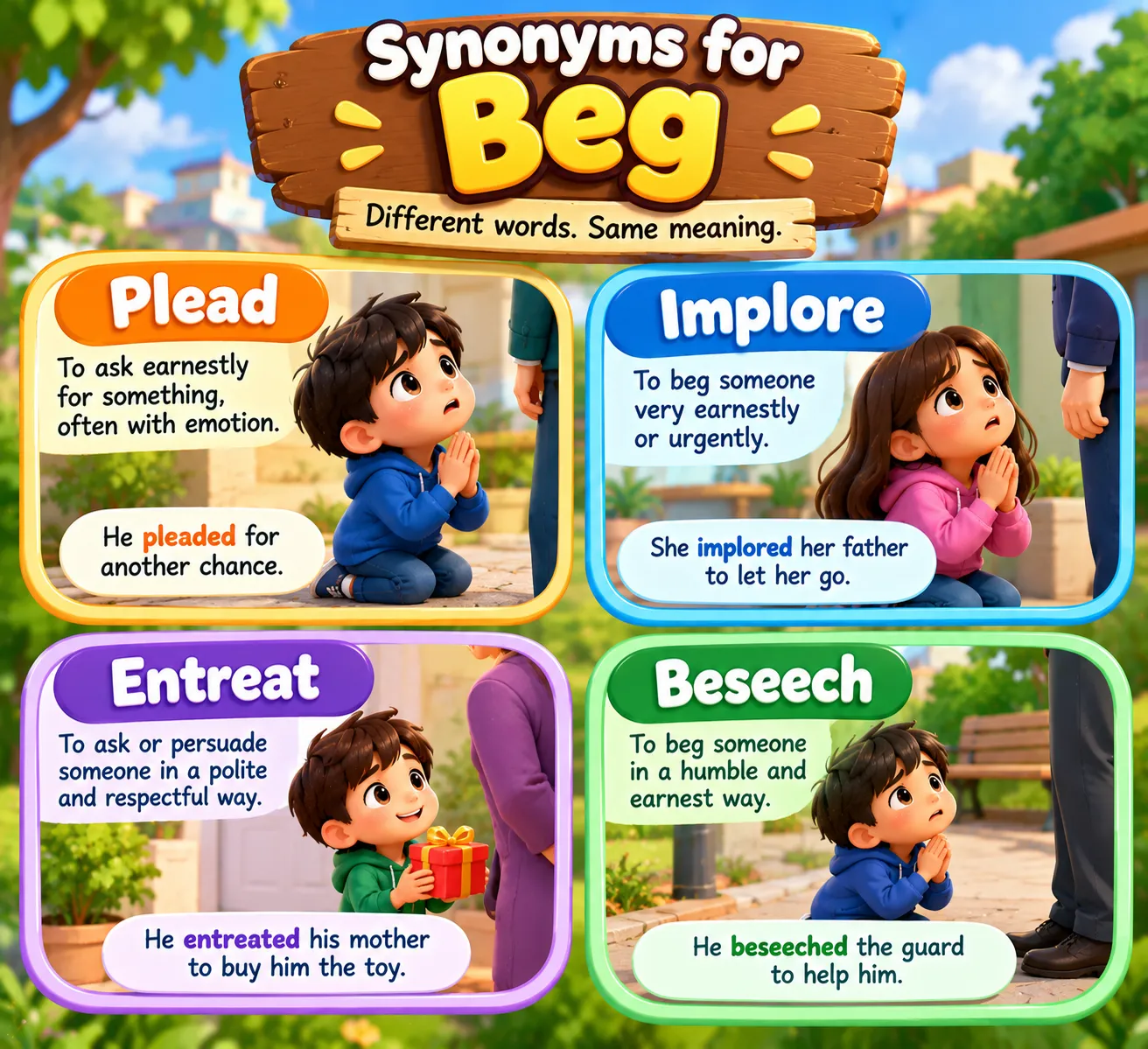
To beg means to ask for something with great need, strong emotion, or urgency. Common synonyms for beg include plead, implore, beseech, entreat, request, appeal, and ask earnestly. Some words express a strong emotional request, while others describe asking for help, money, or forgiveness. For example, you might plead with a friend to stay or beg for food when you are hungry. Learning these synonyms helps you choose the right words, improve your English, and make your writing clearer and more expressive.
To beg means to ask for something in a very strong or urgent way. Imagine a child asking a parent for one more day to play with a friend. The child may beg because the request matters so much. People also beg for help, money, forgiveness, or another chance. The word is common in daily conversations, books, stories, and news reports.
Learning synonyms for beg helps English learners express different feelings and situations. For example, plead often shows deep emotion, while implore suggests an urgent and heartfelt request. Content writers can use these alternatives to avoid repetition and make their writing more engaging. In this guide, you will learn the meaning, history, pronunciation, and word forms of beg. You will also explore 30 synonyms, their meanings, examples, antonyms, and common uses.
Meaning of Beg
Definition
Beg (verb): To ask for something earnestly or urgently, often because you need it very much.
Beg can also mean asking people for money or food, often because you are poor or in need.
Examples
- I beg you to give me one more chance.
- The hungry man had to beg for food.
Connotative Meaning
Connotation is the feeling or idea that a word suggests beyond its basic meaning.
- Positive tone: Beg can show deep love, care, or a strong desire to save someone from harm.
Example: She begged her brother to stay safe. - Negative tone: Beg can suggest desperation, helplessness, or a loss of dignity.
Example: He had to beg for money on the street. - Neutral tone: Beg can simply describe an urgent request.
Example: I beg you to listen to my explanation.
The word beg often carries a strong emotional tone, but its meaning depends on the situation.
Etymology of Beg
The word beg has an uncertain origin. It appeared in Middle English and may have been influenced by Old French begart, a term associated with a religious mendicant. Its exact history is not fully settled.
- Old English (450–1100): There is no firmly established Old English form that directly explains the modern word beg. People used other words to express asking, requesting, and seeking help.
- Middle English (1100–1500): Beggen appeared in Middle English, with the sense of asking for charity or seeking something from others. The word developed during this period.
- Modern English (1500–Present): Beg came to mean asking earnestly or urgently for something. It is now used for requests involving help, money, forgiveness, permission, and emotional appeals.
Pronunciation of Beg (IPA)
- IPA: /beɡ/
- Syllables: beg
- Syllable count: 1
- Word stress: The single syllable is stressed.
Affixation Pattern of Beg
- Root: Beg is the base verb.
- Prefix: No prefix appears in the basic word beg.
- Suffix: The verb can take common grammatical endings, such as -s, -ging, and -ged.
Word Formations
| Word | Part of Speech | Meaning |
| Beg | Verb | To ask urgently or earnestly |
| Begs | Verb | Asks earnestly; third-person singular form |
| Begged | Verb | Asked earnestly; past tense and past participle |
| Begging | Verb/Noun | Asking earnestly or urgently |
| Beggar | Noun | A person who asks others for money or help |
| Beggarly | Adjective/Adverb | Very poor or, in some uses, mean and inadequate |
| Beggingly | Adverb | In a manner that shows pleading; uncommon |
Spelling note: The final consonant doubles in begged and begging because the short verb ends in a consonant-vowel-consonant pattern.
30 Synonyms of Beg With Meaning and Examples
These alternatives vary in tone and use. Some mean to ask urgently, while others refer to polite requests, emotional appeals, or asking for charity. Choose the word that best fits your sentence.
1. Plead (Verb)
Meaning: To ask strongly and emotionally for something.
Examples:
- I pleaded with my father to forgive me.
- She pleaded for another chance.
2. Implore (Verb)
Meaning: To ask someone earnestly and urgently to do something.
Examples:
- I implore you to tell the truth.
- They implored the driver to stop.
3. Beseech (Verb)
Meaning: To ask someone very seriously and sincerely for something.
Examples:
- She beseeched him to stay.
- I beseech you to hear my request.
4. Entreat (Verb)
Meaning: To ask someone earnestly to do something.
Examples:
- He entreated his friend to help him.
- She entreated the judge for mercy.
5. Appeal (Verb)
Meaning: To make a serious request for help, support, or understanding.
Examples:
- The family appealed for public support.
- I appeal to you to reconsider your choice.
6. Request (Verb)
Meaning: To ask for something politely or formally.
Examples:
- I requested more time to finish the work.
- She requested help from her teacher.
7. Ask (Verb)
Meaning: To say that you want someone to give or do something.
Examples:
- He asked his friend for money.
- I asked her to wait for me.
8. Petition (Verb)
Meaning: To make a formal request to a person or authority.
Examples:
- Residents petitioned the council for safer roads.
- The workers petitioned their manager for better pay.
9. Supplicate (Verb)
Meaning: To ask humbly and earnestly for help or mercy.
Examples:
- The prisoner supplicated the king for mercy.
- They supplicated for peace during the crisis.
10. Solicit (Verb)
Meaning: To ask for or seek something, such as help, money, or support.
Examples:
- The charity solicited donations from local businesses.
- She solicited advice from an experienced teacher.
11. Plead for (Verb Phrase)
Meaning: To ask urgently for something that is important to you.
Examples:
- The child pleaded for another story.
- They pleaded for more time.
12. Beg for (Verb Phrase)
Meaning: To ask desperately or urgently to receive something.
Examples:
- The lost traveler begged for water.
- He begged for forgiveness after his mistake.
13. Ask Earnestly (Verb Phrase)
Meaning: To make a sincere and serious request.
Examples:
- She asked earnestly for his help.
- I asked earnestly for another opportunity.
14. Appeal to (Verb Phrase)
Meaning: To make an emotional or serious request to someone.
Examples:
- The mother appealed to the crowd for help.
- He appealed to his teacher for understanding.
15. Call Upon (Verb Phrase)
Meaning: To ask someone to help or take action.
Examples:
- The leader called upon citizens to support the project.
- She called upon her friends to help the family.
16. Implore for (Verb Phrase)
Meaning: To make an urgent and emotional request for something. The more natural form is often to implore someone for something or to implore someone to do something.
Examples:
- He implored his parents for forgiveness.
- She implored the doctor to help her child.
17. Entreat for (Verb Phrase)
Meaning: To ask earnestly for something; often, entreat someone for something or entreat someone to do something is more natural.
Examples:
- The villagers entreated the official for assistance.
- I entreated her to reconsider the decision.
18. Solicit Help (Verb Phrase)
Meaning: To ask someone for help or support.
Examples:
- The student solicited help from a classmate.
- The group solicited help to clean the park.
19. Seek (Verb)
Meaning: To try to find or obtain something you need or want.
Examples:
- She sought help from a counselor.
- They sought permission to enter the building.
20. Appeal for Mercy (Verb Phrase)
Meaning: To ask someone to show kindness instead of punishment.
Examples:
- The prisoner appealed for mercy.
- He appealed for mercy after admitting his mistake.
21. Pray (Verb)
Meaning: To speak to God or a higher power, often to ask for help or guidance.
Examples:
- She prayed for her family’s safety.
- He prayed for strength during hard times.
22. Plead Humbly (Verb Phrase)
Meaning: To make a request in a humble and respectful way.
Examples:
- He pleaded humbly for forgiveness.
- She pleaded humbly for a chance to explain.
23. Grovel (Verb)
Meaning: To behave in an overly humble way to gain someone’s favor or forgiveness.
Examples:
- He refused to grovel for approval.
- She felt she should not have to grovel for respect.
24. Crave (Verb)
Meaning: To want something very strongly.
Examples:
- The child craved attention from his parents.
- She craved a chance to prove her skills.
Note: Crave means to desire strongly, not to ask someone for something.
25. Yearn (Verb)
Meaning: To have a deep and strong desire for something.
Examples:
- He yearned for a peaceful life.
- She yearned to see her family again.
Note: Yearn describes a deep desire, not necessarily a request.
26. Appeal Earnestly (Verb Phrase)
Meaning: To make a serious and heartfelt request.
Examples:
- The teacher appealed earnestly for more classroom resources.
- He appealed earnestly to his friends for support.
27. Solicit Donations (Verb Phrase)
Meaning: To ask people or groups to give money or goods to support a cause.
Examples:
- Volunteers solicited donations for the shelter.
- The school solicited donations to buy new books.
28. Call for Help (Verb Phrase)
Meaning: To ask others to provide help or assistance.
Examples:
- The injured hiker called for help.
- She called for help when the fire started.
29. Ask for Mercy (Verb Phrase)
Meaning: To request kindness or a lighter punishment.
Examples:
- The man asked for mercy before the judge.
- They asked for mercy after breaking the rules.
30. Entreat Earnestly (Verb Phrase)
Meaning: To ask someone with deep feeling and serious intent.
Examples:
- She entreated earnestly for a second chance.
- He entreated the group to listen to his concerns.
Prototype Meaning of Beg
The most common meaning of beg is to ask for something with strong emotion, urgency, or great need. People often imagine someone pleading for food, money, forgiveness, or another chance. The word can also describe a heartfelt request, such as when someone begs a loved one to stay. In some situations, begging suggests poverty or desperation. In others, it shows how much a person cares about the result. The meaning depends on the words around it and the situation in which it is used.
Prototype Categorization
The synonyms and related expressions for beg can be grouped by their purpose and emotional tone. These groups help writers choose words that match the situation.
- Strong and emotional requests: Plead, implore, beseech, entreat, and beg for show urgency and deep feeling. Use them when a person desperately wants someone to act.
- Polite or general requests: Ask, request, and ask earnestly describe asking for something. Request is usually more formal, while ask is common in everyday speech.
- Formal appeals and petitions: Appeal, petition, solicit, and call upon are useful when asking a person, group, or authority for help or action.
- Requests for mercy or forgiveness: Appeal for mercy, ask for mercy, and plead humbly focus on seeking kindness, forgiveness, or a lighter punishment.
- Requests for help or support: Solicit help, call for help, and appeal earnestly are useful when someone needs assistance or wants others to support a cause.
- Deep desires rather than direct requests: Crave and yearn describe strong wants or emotional longing. They are related to begging but do not necessarily mean asking someone for something.
- Humble or submissive behavior: Grovel describes extreme humility, often to gain favor. It has a negative tone and is not a neutral substitute for beg.
Grouping these words helps writers avoid repetition and express the right emotion. For example, use a petition for a formal request, implore for a heartfelt plea, and solicit when asking people for donations.
Antonyms of Beg
There is no single antonym for every meaning of beg. The best opposite depends on whether beg means asking, pleading, or seeking charity.
| Antonym | Part of Speech | Meaning |
| Give | Verb | To hand something to another person |
| Offer | Verb | To present something for someone to accept |
| Grant | Verb | To agree to give or allow something |
| Provide | Verb | To supply something needed |
| Refuse | Verb | To say no to a request |
| Reject | Verb | To refuse to accept or agree to something |
| Demand | Verb | To ask for something firmly as if you have a right to it |
| Command | Verb | To tell someone to do something with authority |
| Insist | Verb | To state firmly that something must happen |
| Decline | Verb | To politely refuse an offer or request |
| Supply | Verb | To give or make something available |
| Bestow | Verb | To give something as an honor or gift |
Note: Demand and command are not direct opposites of beg in every context, but they contrast with begging because they express authority or firmness rather than humble pleading.
Short Questions and Answers
What does beg mean?
Beg means to ask for something earnestly or urgently. It can also mean asking for money, food, or help because of need.
When should beg be used?
Use beg when someone asks for something with strong emotion, desperation, or urgency. For example, “I beg you to forgive me.”
Is beg positive or negative?
Beg can be neutral when describing a request, but it often suggests desperation or helplessness. It may also show deep care, love, or concern.
How is beg different from similar words?
Beg often suggests great need or urgency. Plead emphasizes emotional appeal, implore expresses a very strong request, and request is more polite or formal. Solicit often refers to seeking help, money, or support.
Conclusion
Learning synonyms for beg helps you express requests and emotions more clearly. Words such as plead, implore, beseech, and entreat can show strong feelings, while request and appeal fit more formal situations. Other words, such as crave and yearn, describe deep desires rather than direct requests. Knowing these differences helps you choose the right word for your message. It also improves your speaking, writing, and reading skills. English learners can build confidence by learning a few synonyms each day and using them in original sentences. Content writers can use suitable alternatives to reduce repetition and make their articles more engaging. With regular practice, you can grow your vocabulary and communicate with greater accuracy.
Read More:
Synonyms for Instinct: 25 Essential Words to Know

I’m Ayesha Haram, an English content and SEO writer at SynonymsInstant.com. I focus on creating helpful vocabulary resources, word guides, and practical English content that readers can understand quickly. I combine language research, clear explanations, and SEO-focused writing to produce reliable content that supports learners, writers, and everyday English users.