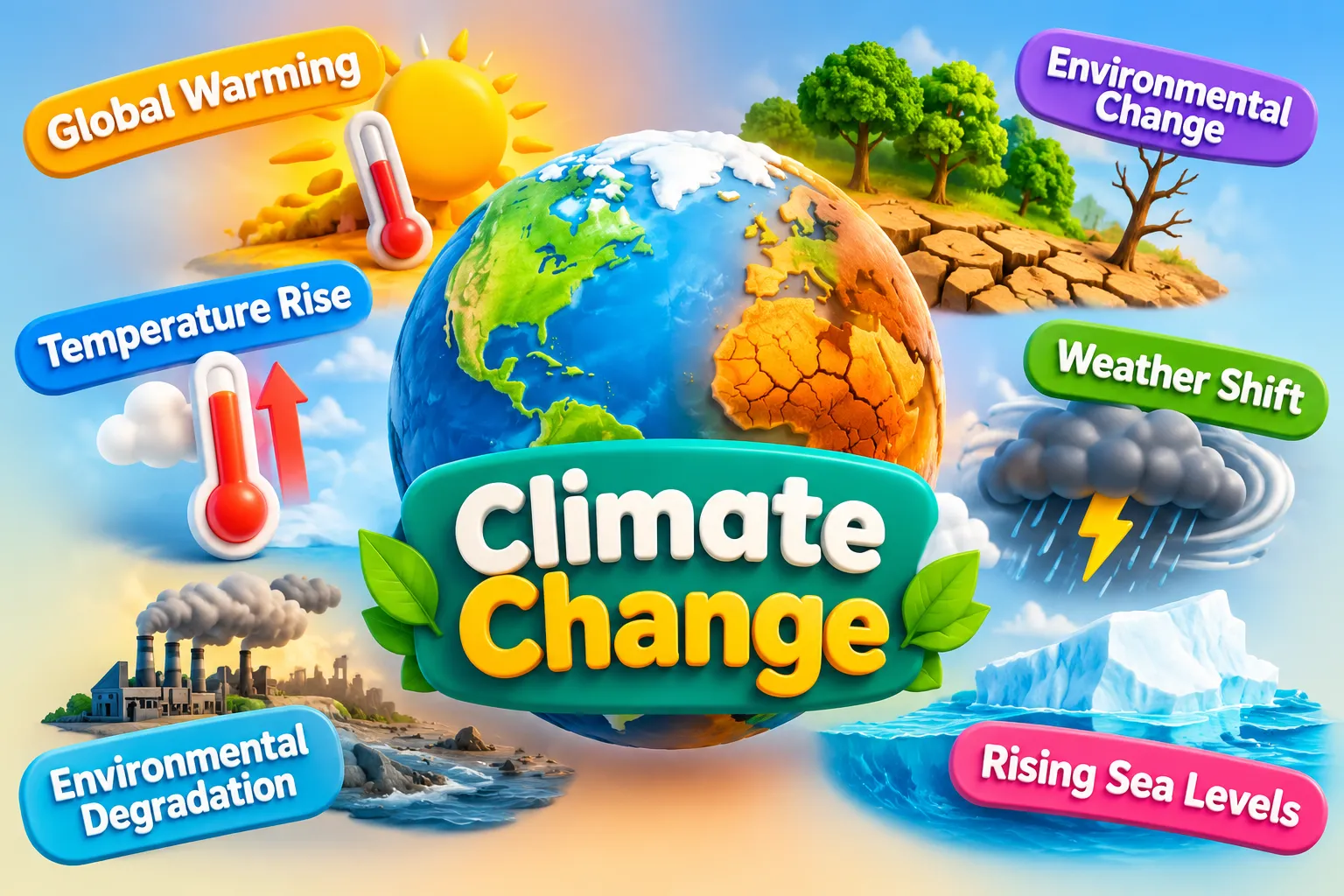
Synonyms for climate change include global warming, climate crisis, climate shift, climatic change, and climate variation. However, these terms do not all have exactly the same meaning. Climate change refers to long-term changes in Earth’s temperatures and weather patterns. Global warming describes the rise in Earth’s average temperature, while the climate crisis highlights the serious risks linked to these changes. Other expressions, such as climate disruption and changing climate, describe related aspects of the same issue.
Climate change means long-term changes in Earth’s temperatures and weather patterns. For example, a farmer may notice that the rainy season starts later than usual or that summers feel hotter than they did years ago. Such changes can affect crops, water supplies, wildlife, and daily life. The term climate change is widely used in science, education, news, and environmental discussions.
Learning synonyms and related expressions helps English learners explain this topic in different ways. It also helps students and content writers avoid repeating the same words in essays, reports, and articles. However, not every alternative has exactly the same meaning. Global warming focuses on rising temperatures, while the climate crisis stresses the serious effects of climate change. This guide explains the meaning, pronunciation, history, and grammar of climate change. It also presents 29 related terms with simple definitions and examples.
Meaning of Climate Change
Definition
Climate change (Noun Phrase):
Climate change refers to long-term changes in Earth’s average temperatures, rainfall, winds, and other climate patterns.
These changes may result from natural processes, human activities, or a combination of both. Current global warming is mainly driven by human activities, especially the burning of fossil fuels.
Examples
- Climate change can affect rainfall and farming in many parts of the world.
- Scientists study climate change to understand its effects on people, plants, and animals.
- Rising temperatures are one important sign of modern climate change.
Connotative Meaning
Connotation (the feelings or ideas associated with a word beyond its basic meaning) helps explain how climate change is used in different situations.
- Positive tone: Climate change itself is not usually positive, but discussion of climate solutions can express hope. For example, “New technology may help communities respond to climate change.”
- Negative tone: The term may suggest harmful effects, such as heat waves, droughts, and rising sea levels. For example, “Climate change threatens some coastal communities.”
- Neutral tone: In science, the phrase describes long-term changes in climate without automatically expressing an emotional judgment. For example, “Researchers measure climate change using temperature records.”
The phrase is generally neutral in scientific use. The surrounding words and context often determine its emotional tone.
Etymology of Climate Change
The phrase climate change combines two words with different histories.
- Old English (450–1100): The word climate was not a common native Old English term. English later adopted it through French and Latin, ultimately from Greek klima, meaning an inclination or slope, referring to the Earth’s surface and its zones. The word change developed from Old French changier, with roots in Late Latin cambiare, meaning to exchange or alter.
- Middle English (1100–1500): Climate entered English through French and Latin forms. Change also became established in English, referring to making or becoming different.
- Modern English (1500–Present): Climate came to describe the usual weather conditions of a region over time. The phrase climate change now refers to long-term changes in climate patterns, especially the modern changes associated with rising global temperatures and human activities.
Pronunciation (IPA)
- IPA: /ˈklaɪmət tʃeɪndʒ/
- Syllables: cli-mate change
- Number of syllables: Three
- Word stress: The main stress falls on the first syllable of climate.
Affixation Pattern of Climate Change
- Root: Climate comes through Latin and Greek; change comes through French and Late Latin.
- Prefix: Neither word has a prefix in the phrase climate change.
- Suffix: Climate contains the ending -ate, but it is not a productive suffix in this word’s modern use. Change has no suffix in the phrase.
- Word formations: Related forms include climatic, climatology, climatologist, changing, and changed.
Word Formation Table
| Word | Part of Speech | Meaning |
| Climate | Noun | The usual weather patterns of a place over time |
| Climatic | Adjective | Related to climate |
| Climatology | Noun | The scientific study of climate |
| Climatologist | Noun | A scientist who studies climate |
| Climatological | Adjective | Related to climatology |
| Change | Noun / Verb | An act of becoming or making something different |
| Changed | Verb / Adjective | Made or became different |
| Changing | Verb / Adjective | Becoming different |
| Changeable | Adjective | Likely to change |
| Unchanged | Adjective | Remaining the same |
| Climate-related | Adjective | Connected with climate |
| Climate-driven | Adjective | Caused or influenced by climate factors |
29 Synonyms of Climate Change With Meaning and Examples
Important: Climate change is a scientific term, so it has few exact synonyms. The expressions below include close alternatives, technical terms, and related phrases. Some emphasize rising temperatures, while others describe climate patterns, impacts, or causes. Choose the term that fits your meaning.
1. Global Warming (Noun Phrase)
Meaning: Global warming is the long-term rise in Earth’s average surface temperature.
Examples:
- Global warming is linked to the burning of fossil fuels.
- Scientists measure global warming by studying temperature records.
2. Climate Crisis (Noun Phrase)
Meaning: Climate crisis is a term that emphasizes the serious risks and harmful effects of climate change.
Examples:
- The climate crisis has increased concern about extreme heat.
- Many communities are developing plans to respond to the climate crisis.
3. Climate Emergency (Noun Phrase)
Meaning: Climate emergency describes climate change as an urgent problem that needs action.
Examples:
- The city declared a climate emergency to highlight environmental risks.
- A climate emergency plan may include cleaner transport and energy.
4. Climate Disruption (Noun Phrase)
Meaning: Climate disruption refers to changes that disturb established climate patterns.
Examples:
- Climate disruption can affect rainfall in farming areas.
- Researchers study climate disruption to understand changing weather patterns.
5. Climatic Change (Noun Phrase)
Meaning: Climatic change refers to a long-term change in the climate of a region or the planet.
Examples:
- Climatic change can influence the growth of certain crops.
- The study examined climatic change over several centuries.
6. Climate Shift (Noun Phrase)
Meaning: Climate shift describes a change in established climate conditions or patterns.
Examples:
- A climate shift may affect the timing of seasonal rainfall.
- Scientists examined evidence of a climate shift in the region.
7. Changing Climate (Noun Phrase)
Meaning: A changing climate is a climate whose long-term patterns are becoming different.
Examples:
- A changing climate may create new challenges for farmers.
- Wildlife must adapt to a changing climate.
8. Climate Variation (Noun Phrase)
Meaning: Climate variation refers to differences in climate conditions over time or between places.
Examples:
- Climate variation affects the amount of rain a region receives.
- Researchers compared climate variation across different decades.
9. Climate Fluctuation (Noun Phrase)
Meaning: Climate fluctuation refers to changes in climate conditions over a period of time.
Examples:
- Climate fluctuation can influence local water supplies.
- The study recorded climate fluctuations over many years.
10. Climate Alteration (Noun Phrase)
Meaning: Climate alteration means a change in the usual climate conditions of a place or region.
Examples:
- Climate alteration may affect local plants and animals.
- The report examined climate alteration in dry regions.
11. Climate Transformation (Noun Phrase)
Meaning: Climate transformation describes a major change in climate conditions or patterns.
Examples:
- Climate transformation may change the way people use land.
- Researchers explored climate transformation over long periods.
12. Climate Instability (Noun Phrase)
Meaning: Climate instability describes a climate system that shows unusual or changing patterns.
Examples:
- Climate instability can make seasonal planning more difficult.
- Scientists investigated signs of climate instability in the region.
13. Atmospheric Warming (Noun Phrase)
Meaning: Atmospheric warming refers to an increase in the temperature of Earth’s atmosphere.
Examples:
- Atmospheric warming can influence weather patterns.
- The researchers measured atmospheric warming over time.
14. Planetary Warming (Noun Phrase)
Meaning: Planetary warming refers to a rise in the average temperature of a planet, especially Earth in environmental discussions.
Examples:
- Planetary warming is a major topic in climate science.
- The report explained the causes of planetary warming.
15. Earth Warming (Noun Phrase)
Meaning: Earth warming is an informal expression for the increase in Earth’s average temperature.
Examples:
- Earth warming can contribute to the loss of ice.
- The lesson explained how Earth warming affects the oceans.
16. Global Temperature Rise (Noun Phrase)
Meaning: Global temperature rise refers to an increase in Earth’s average temperature.
Examples:
- Global temperature rise can affect glaciers and sea levels.
- Scientists track global temperature rise using long-term records.
17. Rising Global Temperatures (Noun Phrase)
Meaning: Rising global temperatures describes the ongoing increase in Earth’s average temperature.
Examples:
- Rising global temperatures can increase the risk of heat waves.
- Rising global temperatures are closely linked to human-caused global warming.
18. Long-Term Climate Change (Noun Phrase)
Meaning: Long-term climate change refers to changes in climate that persist over many years or longer.
Examples:
- Long-term climate change can reshape natural habitats.
- Researchers use historical records to study long-term climate change.
19. Anthropogenic Climate Change (Noun Phrase)
Meaning: Anthropogenic climate change is climate change caused by human activities.
Examples:
- Burning coal and oil contributes to anthropogenic climate change.
- Scientists study anthropogenic climate change to assess human impacts.
20. Human-Induced Climate Change (Noun Phrase)
Meaning: Human-induced climate change refers to climate change caused by human actions.
Examples:
- Human-induced climate change is mainly driven by greenhouse gas emissions.
- The class discussed ways to reduce human-induced climate change.
21. Natural Climate Change (Noun Phrase)
Meaning: Natural climate change refers to climate changes caused by natural processes rather than human activities.
Examples:
- Natural climate change has occurred throughout Earth’s history.
- Scientists compare natural climate change with changes caused by humans.
22. Climate Trend (Noun Phrase)
Meaning: A climate trend is a long-term direction of change in climate data.
Examples:
- The climate trend shows a rise in average temperatures.
- Researchers studied the climate trend over fifty years.
23. Climate Pattern Change (Noun Phrase)
Meaning: Climate pattern change refers to a shift in established patterns of temperature, rainfall, or other climate conditions.
Examples:
- Climate pattern change can affect planting seasons.
- The study examined climate pattern change in the region.
24. Weather Pattern Change (Noun Phrase)
Meaning: Weather pattern change describes a change in recurring weather conditions, though weather and climate are not the same.
Examples:
- Weather pattern change can influence local farming decisions.
- Scientists examined whether the observed weather pattern change reflected a longer climate trend.
25. Environmental Change (Noun Phrase)
Meaning: Environmental change refers to changes in the natural world, including but not limited to climate change.
Examples:
- Environmental change can affect forests and wildlife.
- The students studied environmental change in their science class.
26. Global Climate Shift (Noun Phrase)
Meaning: A global climate shift is a large-scale change in Earth’s climate patterns.
Examples:
- A global climate shift can influence rainfall in many regions.
- Researchers looked for signs of a global climate shift in historical records.
27. Climate-System Change (Noun Phrase)
Meaning: Climate-system change refers to changes in the connected parts of Earth’s climate system.
Examples:
- Climate-system change can affect oceans, ice, and the atmosphere.
- The report described climate-system change over several decades.
28. Climate Pattern Shift (Noun Phrase)
Meaning: A climate pattern shift is a change in the usual distribution of climate conditions.
Examples:
- A climate pattern shift may affect the length of a rainy season.
- Scientists studied a climate pattern shift in the area.
29. Climate Change Effects (Noun Phrase)
Meaning: Climate change effects are the results or impacts of climate change, rather than climate change itself.
Examples:
- Climate change effects include rising sea levels and heat risks.
- The report described climate change effects on local wildlife.
Prototype Meaning of Climate Change
The most common meaning of climate change is a long-term shift in Earth’s average temperatures and weather patterns. People often picture hotter days, melting glaciers, rising sea levels, changing rainfall, and more frequent or intense heat extremes. These are examples of possible climate-related changes, although their effects differ by region. Climate change can result from natural factors, but the rapid warming observed in recent decades is mainly caused by human activities, especially greenhouse gas emissions. The phrase is broader than global warming because it includes changes in rainfall, seasons, oceans, and other parts of the climate system, not just rising temperatures.
Prototype Categorization of Climate Change Synonyms
Grouping these expressions by meaning helps writers select accurate words instead of using every term as if it meant exactly the same thing.
1. General Climate Change Terms
These expressions describe long-term changes in climate patterns.
- Climatic change: A standard alternative for climate change.
- Climate shift: A change in established climate conditions.
- Changing climate: A simple phrase for a climate that is changing.
- Climate alteration: A change in climate conditions.
- Climate transformation: A major change in climate patterns.
- Long-term climate change: A change that continues over an extended period.
2. Terms Focused on Warming
These expressions emphasize rising temperatures rather than every part of climate change.
- Global warming: The long-term rise in Earth’s average temperature.
- Atmospheric warming: Warming of Earth’s atmosphere.
- Planetary warming: Warming of a planet.
- Earth warming: An informal expression for Earth’s warming.
- Global temperature rise: An increase in Earth’s average temperature.
- Rising global temperatures: The continuing increase in global average temperatures.
3. Terms That Highlight Urgency or Risk
These terms stress the seriousness of climate change or the need for action.
- Climate crisis: Emphasizes serious risks and harmful effects.
- Climate emergency: Emphasizes the need for urgent action.
- Climate disruption: Highlights disturbances to established climate patterns.
- Climate instability: Describes unstable or unusual climate patterns.
4. Terms About Causes
These expressions distinguish human-caused changes from naturally occurring changes.
- Anthropogenic climate change: Climate change caused by human activity.
- Human-induced climate change: Climate change resulting from human actions.
- Natural climate change: Climate change caused by natural processes.
5. Terms About Patterns and Trends
These expressions describe how climate conditions vary or develop over time.
- Climate variation: Differences in climate conditions.
- Climate fluctuation: Changes in climate conditions over time.
- Climate trend: The long-term direction shown by climate data.
- Climate pattern change: A change in established climate patterns.
- Weather pattern change: A change in recurring weather conditions.
- Global climate shift: A large-scale change in global climate patterns.
- Climate-system change: A change in Earth’s connected climate systems.
- Climate pattern shift: A shift in usual climate conditions.
6. Broader Environmental Terms and Impact Terms
These phrases are related to climate change but do not mean the same thing.
- Environmental change: Any change in the natural environment, including changes unrelated to climate.
- Climate change effects: The results of climate change.
- Climate change impacts: The consequences of climate change for people and ecosystems.
Antonyms of Climate Change
Climate change has no exact antonym because it describes a real-world process. However, the following words and phrases express contrasting ideas, such as stability, consistency, or the absence of change.
| Contrasting Word or Phrase | Part of Speech | Meaning |
| Climate stability | Noun phrase | A climate that remains relatively stable over time |
| Climate constancy | Noun phrase | A state in which climate conditions remain consistent |
| Stable climate | Noun phrase | A climate with little long-term change |
| Unchanging climate | Noun phrase | A climate that remains the same |
| Climatic stability | Noun phrase | Relative stability in long-term climate patterns |
| Temperature stability | Noun phrase | Temperatures that remain relatively steady |
| Environmental stability | Noun phrase | An environment that remains relatively balanced |
| Consistency | Noun | The state of remaining similar over time |
| Stasis | Noun | A state of little or no change |
| Equilibrium | Noun | A state of balance between different forces or processes |
Note: These terms describe contrasting conditions, not exact opposites. Earth’s climate naturally varies, so a completely unchanging climate is not a realistic general description of Earth’s history.
Short Questions and Answers
1. What does climate change mean?
Climate change means long-term changes in Earth’s temperatures and weather patterns, including changes in rainfall, seasons, and other climate conditions.
2. When should climate change be used?
Use climate change when discussing long-term changes in the climate of Earth or a specific region. It is suitable for school essays, scientific reports, news articles, and environmental discussions.
3. Is climate change positive or negative?
The phrase itself is neutral, but climate change can have harmful effects, especially the rapid human-caused warming happening today. Some local effects may differ, but many risks increase as global warming continues.
4. How is climate change different from similar terms?
Climate change covers long-term changes in temperatures and other climate patterns. Global warming focuses on rising average temperatures. Climate crisis emphasizes serious risks, while climate variation describes differences in climate conditions over time.
Conclusion
Learning synonyms and related expressions for climate change can improve vocabulary, strengthen writing, and help you explain environmental topics more clearly. Terms such as global warming, climatic change, and climate shift can be useful in the right context, but they do not always mean the same thing. Some focus on rising temperatures, while others describe climate patterns, human causes, or the effects on people and nature.
Understanding these differences helps students, English learners, and content writers avoid repetition without losing accuracy. It also makes essays, reports, and articles easier to read. Try learning a few terms each day and using them in your own sentences. Read science articles, compare word meanings, and practice explaining climate topics in simple English. With regular practice, you can build a stronger vocabulary and communicate environmental ideas with greater confidence.
Read More:
Synonyms for Your: 25 Best Alternatives to Know

I’m Pinki, an SEO writer at SynonymsInstant.com, specializing in synonyms, antonyms, vocabulary, word meanings, grammar, and English usage. I create accurate, well-researched, reader-friendly content that combines language expertise with SEO best practices. My goal is to make English vocabulary simple, useful, and accessible for students, writers, professionals, and English learners.