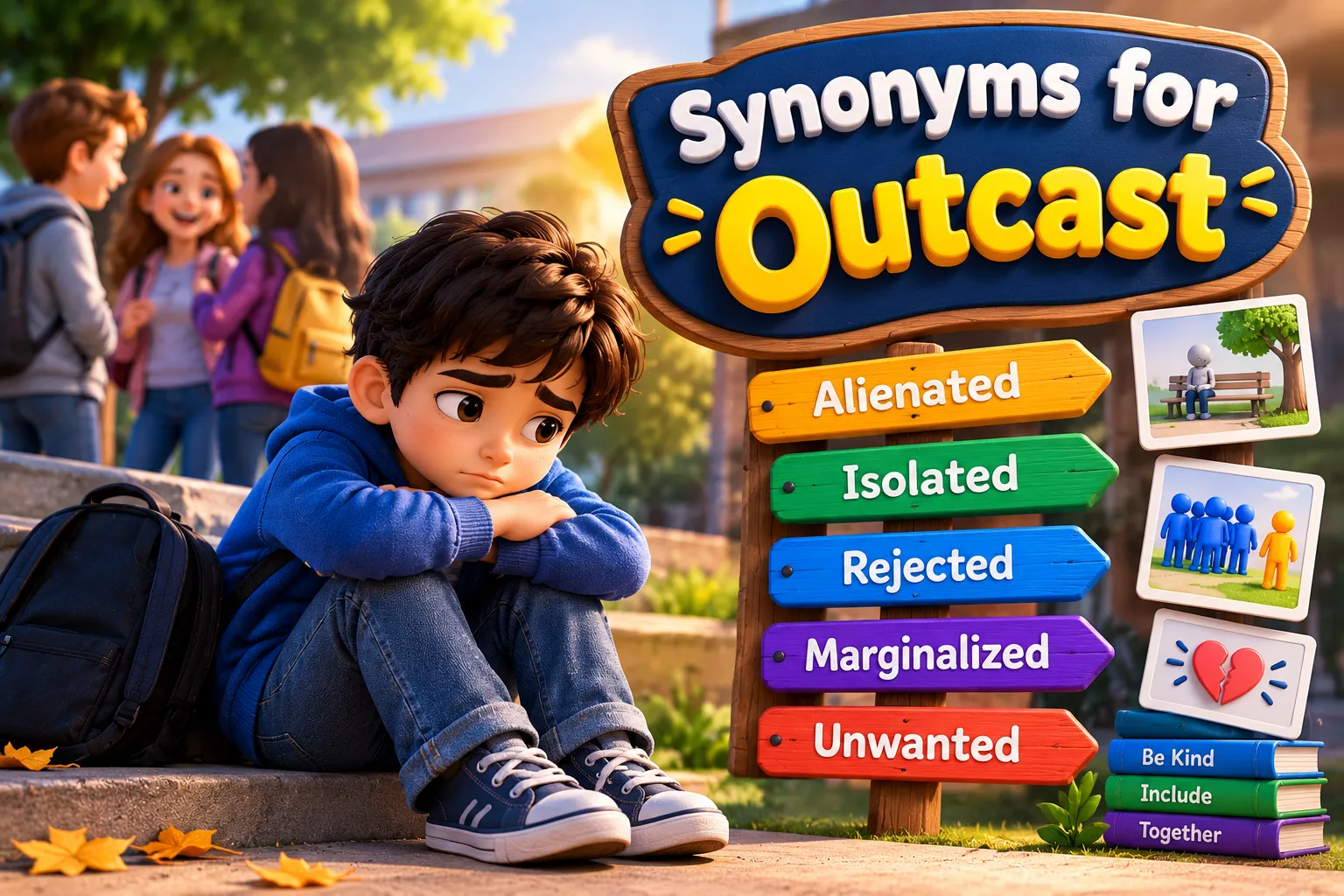
Synonyms for outcast include outsider, exile, pariah, misfit, reject, loner, and social outlier. An outcast is someone whom a group or community does not accept. For example, a student may feel like an outcast when classmates leave them out of activities. However, some related words describe people who prefer to be alone rather than those who face rejection. Therefore, the best synonym depends on the situation.
An outcast is someone who feels rejected or excluded by a group. Imagine a student who sits alone because classmates never invite them to join their games. That student may feel like an outcast. Similarly, someone who does not fit in with a community may experience the same feeling.
Learning synonyms for outcast can help you build your English vocabulary. It can also make your writing more interesting and reduce repetition. However, these words do not all have the same meaning. For example, a pariah faces strong social rejection, while a recluse prefers to avoid other people.
In this guide, you will learn the meaning, pronunciation, history, and word forms of outcast. In addition, you will discover 27 alternatives with simple meanings and examples. You will also learn how to use these words correctly in everyday conversations, essays, and stories.
Meaning of Outcast
Definition
Outcast (Noun): A person whom a group or community rejects or excludes.
Outcast (Adjective): Describes someone who has experienced rejection or exclusion.
Examples
- The new student felt like an outcast because nobody spoke to them.
- The villagers treated the man as an outcast after the dispute.
Connotative Meaning
Connotation refers to the feelings or ideas that a word suggests beyond its basic meaning.
The word outcast usually has a negative tone. However, its meaning can change depending on the situation.
- Positive tone: In some stories, an outcast shows courage by standing up against unfair rules.
- Negative tone: The word often suggests rejection, loneliness, or unfair treatment.
- Neutral tone: In a factual or literary discussion, it can simply describe someone who does not belong to a group.
Therefore, consider the context before using this word to describe someone.
Etymology of Outcast
The word outcast combines two words: out and cast. It originally described someone who had been cast out, or driven away, from a group or place.
| Period | Historical Development |
|---|---|
| Old English (450–1100) | Out comes from Old English ūt, meaning “outside.” The word cast has Germanic roots. |
| Middle English (1100–1500) | English speakers used out and cast to describe throwing someone out or driving someone away. |
| Modern English (1500–Present) | The word outcast became a common noun and adjective for someone rejected by a group, community, or society. |
Today, outcast often describes social rejection or a feeling of not belonging. Writers also use it in stories to describe characters who struggle to find acceptance.
Pronunciation of Outcast
- IPA: /ˈaʊt.kæst/
- Syllables: out-cast
- Syllable count: Two
- Stress: The first syllable receives the stress: OUT-cast.
Pronunciation tip: Say out as in outside and cast as in cast a shadow. Then join the two parts smoothly.
Affixation Pattern of Outcast
The word outcast is a compound word formed from out and cast. It does not have a separate modern prefix or suffix in its basic form.
- Root elements: Out and cast.
- Prefix: The word has no separate prefix. However, out adds the idea of being outside or away.
- Suffix: The basic word outcast has no suffix.
Word Formations
| Word | Part of Speech | Meaning |
|---|---|---|
| Outcast | Noun | A person rejected by a group. |
| Outcast | Adjective | Describes someone who has been rejected or excluded. |
| Outcasts | Plural noun | People who have experienced rejection or exclusion. |
| Outcast status | Noun phrase | The condition of being excluded from a group. |
| Outcast community | Noun phrase | A group of people who experience social exclusion. |
| Outcast figure | Noun phrase | A person presented as rejected by society. |
Grammar tip: Use outcast as a noun when you name a person. You can also use it as an adjective to describe someone who faces rejection.
- Noun: He became an outcast in his village.
- Adjective: The story follows an outcast character who searches for acceptance.
27 Synonyms for Outcast With Meanings and Examples
The following words describe different forms of rejection, exclusion, or social separation. Some are close synonyms, while others have related meanings. Therefore, check each definition before choosing a replacement for outcast.
1. Outsider (Noun)
Meaning: Someone who does not belong to or feel accepted by a particular group.
Examples:
- As a newcomer, he felt like an outsider at school.
- She felt like an outsider in a town where everyone knew each other.
2. Exile (Noun)
Meaning: Someone who must leave their home or country, often because of punishment or political pressure.
Examples:
- The former leader lived as an exile for many years.
- The story follows an exile who searches for a new home.
Usage note: An exile is not always a social outcast. The word often refers to someone who has been forced to leave a place.
3. Pariah (Noun)
Meaning: Someone whom a community or society strongly rejects.
Examples:
- After the scandal, he became a pariah in his community.
- The novel tells the story of a pariah who seeks acceptance.
4. Misfit (Noun)
Meaning: Someone who finds it difficult to fit into a group or social setting.
Examples:
- The quiet boy felt like a misfit among the other students.
- She felt like a misfit because her hobbies differed from those of her classmates.
5. Reject (Noun)
Meaning: Someone whom a person or group refuses to accept.
Examples:
- He felt like a reject after his friends stopped inviting him.
- The story follows a young reject who finds a place to belong.
Usage note: Calling someone a reject can sound insulting. Use this word carefully when discussing real people.
6. Castaway (Noun)
Meaning: Someone left alone or stranded, often far from other people.
Examples:
- The castaway survived on the island for several weeks.
- The film tells the story of a castaway who tries to return home.
Usage note: A castaway is usually stranded or abandoned. Therefore, the word does not always describe social rejection.
7. Pariah Figure (Noun Phrase)
Meaning: A person whom a story presents as strongly rejected by a group or society.
Examples:
- The novel presents the hero as a pariah figure.
- The character becomes a pariah figure after speaking against the rulers.
8. Social Outlier (Noun Phrase)
Meaning: Someone whose behavior or position differs from that of most people in a group.
Examples:
- He was a social outlier because he avoided most gatherings.
- The study explored how social outliers build friendships.
Usage note: A social outlier is not always rejected. The phrase can simply describe someone who differs from the group.
9. Lone Wolf (Noun)
Meaning: Someone who prefers to act or live independently rather than as part of a group.
Examples:
- He was a lone wolf who enjoyed working alone.
- The story features a lone wolf who avoids social gatherings.
Usage note: A lone wolf may choose to be alone. In contrast, an outcast often experiences rejection from others.
10. Recluse (Noun)
Meaning: Someone who avoids other people and prefers a very private life.
Examples:
- The old writer became a recluse in his later years.
- The recluse rarely left the house.
11. Hermit (Noun)
Meaning: Someone who lives alone and has little contact with other people.
Examples:
- The hermit lived in a small cabin in the mountains.
- In the story, the hermit helps a lost traveler.
Usage note: A hermit often chooses a quiet, solitary life. Therefore, the word does not necessarily mean that others have rejected the person.
12. Isolate (Noun, Rare)
Meaning: A person who lives apart from others or has little social contact.
Examples:
- The novel portrays him as an isolate who struggles to make friends.
- The isolate spent most of his time away from the village.
Usage note: Isolate is much more common as a verb. For a person, isolated person or loner usually sounds more natural.
13. Loner (Noun)
Meaning: Someone who prefers to spend time alone or has few social connections.
Examples:
- He was a loner who enjoyed reading by himself.
- The new employee seemed like a loner at first.
Usage note: A loner may enjoy being alone. However, an outcast may want to join others but feel excluded.
14. Alien (Noun)
Meaning: In a social context, someone who feels unfamiliar or out of place in a group.
Examples:
- She felt like an alien in a place where she knew nobody.
- The character felt like an alien in their own community.
Usage note: Alien has several meanings. It can refer to a being from another world or, in some contexts, a person from another country. When describing a real person, choose your words carefully.
15. Stranger (Noun)
Meaning: Someone whom another person or group does not know.
Examples:
- As a stranger in the town, he found it hard to make friends.
- She felt like a stranger among people she had known for years.
Usage note: A stranger is not necessarily rejected. The person may simply be unfamiliar to others.
16. Displaced Person (Noun Phrase)
Meaning: Someone forced to leave their home because of conflict, disaster, or another serious event.
Examples:
- The displaced person searched for safe shelter.
- The program provided food and clothing to displaced people.
Usage note: This phrase describes forced movement, not social rejection alone.
17. Refugee (Noun)
Meaning: Someone who has fled their country to escape war, persecution, or serious danger.
Examples:
- The refugee hoped to build a safe life in a new country.
- The charity helped refugees find shelter and education.
Usage note: A refugee is not automatically an outcast. The two words describe different situations.
18. Banished Person (Noun Phrase)
Meaning: Someone formally sent away from a place or community.
Examples:
- The banished person waited beyond the city walls.
- The tale describes a banished prince who hopes to return home.
19. Excluded Person (Noun Phrase)
Meaning: Someone who has been left out of a group or activity.
Examples:
- The excluded person asked why they could not attend the meeting.
- Teachers should make sure every student can take part in class activities.
20. Social Reject (Noun Phrase)
Meaning: Someone whom other people refuse to accept socially.
Examples:
- The character sees himself as a social reject.
- The story shows how a social reject finds friendship.
Usage note: This expression can sound hurtful or insulting. Use it with care, especially when discussing real people.
21. Pariah of Society (Noun Phrase)
Meaning: Someone whom the wider community strongly rejects or avoids.
Examples:
- The character became a pariah of society after the trial.
- The book explores the life of someone treated as a pariah of society.
22. Banished Outcast (Noun Phrase)
Meaning: Someone who faces social rejection and must also leave a group or place.
Examples:
- The banished outcast searched for a safe place to live.
- The legend follows a banished outcast who seeks justice.
23. Social Exile (Noun Phrase)
Meaning: Someone who has lost normal social contact or acceptance within a community.
Examples:
- After the argument, he felt like a social exile.
- The novel portrays her as a social exile in her own town.
24. Marginalized Person (Noun Phrase)
Meaning: Someone pushed to the edges of society and denied equal access, power, or opportunities.
Examples:
- The project supports marginalized people in rural areas.
- The report explains how marginalized people can face barriers to education.
Usage note: Marginalization often involves wider social or economic barriers. It does not simply mean that a person has been rejected by friends.
25. Alienated Person (Noun Phrase)
Meaning: Someone who feels separated from other people or disconnected from a community.
Examples:
- The alienated person struggled to trust their classmates.
- The story follows an alienated person who slowly finds friendship.
26. Isolated Person (Noun Phrase)
Meaning: Someone who has little contact or connection with other people.
Examples:
- The isolated person had no one nearby to ask for help.
- The program offered support to older adults who felt isolated.
27. Nonconformist (Noun)
Meaning: Someone who does not follow common customs, ideas, or social rules.
Examples:
- The nonconformist chose a different path from the rest of the group.
- She was a nonconformist who questioned old traditions.
Usage note: A nonconformist may be respected and accepted. Therefore, this word is not an exact synonym for outcast.
Prototype Meaning of Outcast
The most common meaning of outcast is someone whom a group rejects or excludes. For example, people may imagine a student who sits alone, a person whom a community avoids, or someone who must leave their home.
An outcast may feel lonely, unwanted, or misunderstood. However, being an outcast does not mean that the person has done something wrong. Sometimes, people face rejection because they are different or challenge unfair rules.
In stories, an outcast may later find friendship or become a hero. Therefore, the main idea behind the word is a lack of acceptance or belonging.
Prototype Categorization of Outcast Synonyms
You can group these 27 alternatives according to their main meanings. This approach helps you choose the most suitable word for each situation.
- Direct rejection: Pariah, reject, social reject, and pariah of society describe people who face strong social rejection.
- Not belonging to a group: Outsider, misfit, and social outlier describe people who do not fit easily into a social setting. However, they may not always face rejection.
- Forced separation: Exile, castaway, banished person, banished outcast, and social exile suggest being sent away or cut off from a place or community.
- Solitude and isolation: Loner, recluse, hermit, isolate, and isolated person describe people who live alone or have little social contact. Some may choose this lifestyle.
- Social difference: Nonconformist and alien can describe someone who differs from the group. However, these words do not always suggest rejection.
- Exclusion and disadvantage: Excluded person, marginalized person, and alienated person describe people who experience exclusion, social barriers, or separation from a community.
- Displacement and refuge: Displaced person and refugee describe people who leave their homes because of danger or other serious circumstances. These terms relate to separation but are not direct synonyms for outcast.
- Other descriptive terms: Pariah figure, stranger, and lone wolf describe different experiences of social distance, unfamiliarity, or independence.
Choosing the right category makes your writing more accurate. For example, use pariah for strong social rejection and recluse for someone who avoids other people. Similarly, use marginalized person when wider social barriers limit someone’s opportunities.
Antonyms of Outcast
Antonyms have opposite or contrasting meanings. Since outcast describes someone who faces exclusion, its opposites often suggest acceptance, friendship, or belonging.
| Antonym | Part of Speech | Meaning |
|---|---|---|
| Insider | Noun | Someone who belongs to or knows a group well. |
| Member | Noun | Someone who belongs to a group or organization. |
| Belonging | Noun | The feeling or state of being accepted by a group. |
| Accepted person | Noun phrase | Someone whom a group welcomes. |
| Friend | Noun | Someone who cares about and supports another person. |
| Ally | Noun | Someone who supports another person or group. |
| Companion | Noun | Someone who spends time with another person. |
| Associate | Noun | Someone connected with a person or group. |
| Participant | Noun | Someone who takes part in an activity or group. |
| Welcome guest | Noun phrase | Someone whom others invite or gladly receive. |
| Socially included person | Noun phrase | Someone included in social activities and relationships. |
| Accepted member | Noun phrase | Someone whom a group recognizes as one of its members. |
| Beloved member | Noun phrase | Someone whom a group likes and values. |
Example: “He felt like an outcast at school” suggests rejection. In contrast, “His classmates welcomed him into their group” shows acceptance and belonging.
Frequently Asked Questions
What does outcast mean?
An outcast is someone whom a group, community, or society rejects or excludes. For example, a student may feel like an outcast when classmates leave them out of activities.
When should I use the word outcast?
Use outcast when describing someone who does not receive acceptance from a group. For example, “The character became an outcast after speaking against the unfair rule.”
Is outcast a positive or negative word?
The word usually has a negative tone because it suggests rejection or loneliness. However, a story may present an outcast as brave, independent, or unfairly treated.
How is outcast different from similar words?
An outcast usually faces rejection from others. An outsider may simply not belong to a group. In contrast, a recluse avoids social contact, while a pariah faces strong social rejection. A nonconformist thinks or acts differently but may still be accepted.
Conclusion
Learning synonyms for outcast can improve your vocabulary and help you describe social relationships more clearly. Words such as outsider, exile, pariah, and misfit describe different kinds of exclusion. Meanwhile, terms such as recluse and nonconformist describe people who live or think differently but do not always face rejection.
Understanding these differences helps you choose the right word for essays, stories, and everyday conversations. In addition, using a wider range of vocabulary makes your writing more interesting and reduces repetition.
To improve your English, learn a few new words each day and use them in your own sentences. You can also read examples aloud and notice how writers use these words in context. With regular practice, you will express your ideas more accurately and build confidence in English.
Read More:
Synonyms for Reluctantly: 26 Helpful Vocabulary Alternatives

I am Rubab content specialist focused on creating accurate, user-friendly, and search-optimized language resources. Through Synonyminstant, I help readers find synonyms, antonyms, meanings, and vocabulary with ease. Every article is carefully researched and optimized to provide reliable information, clear explanations, and an excellent user experience.