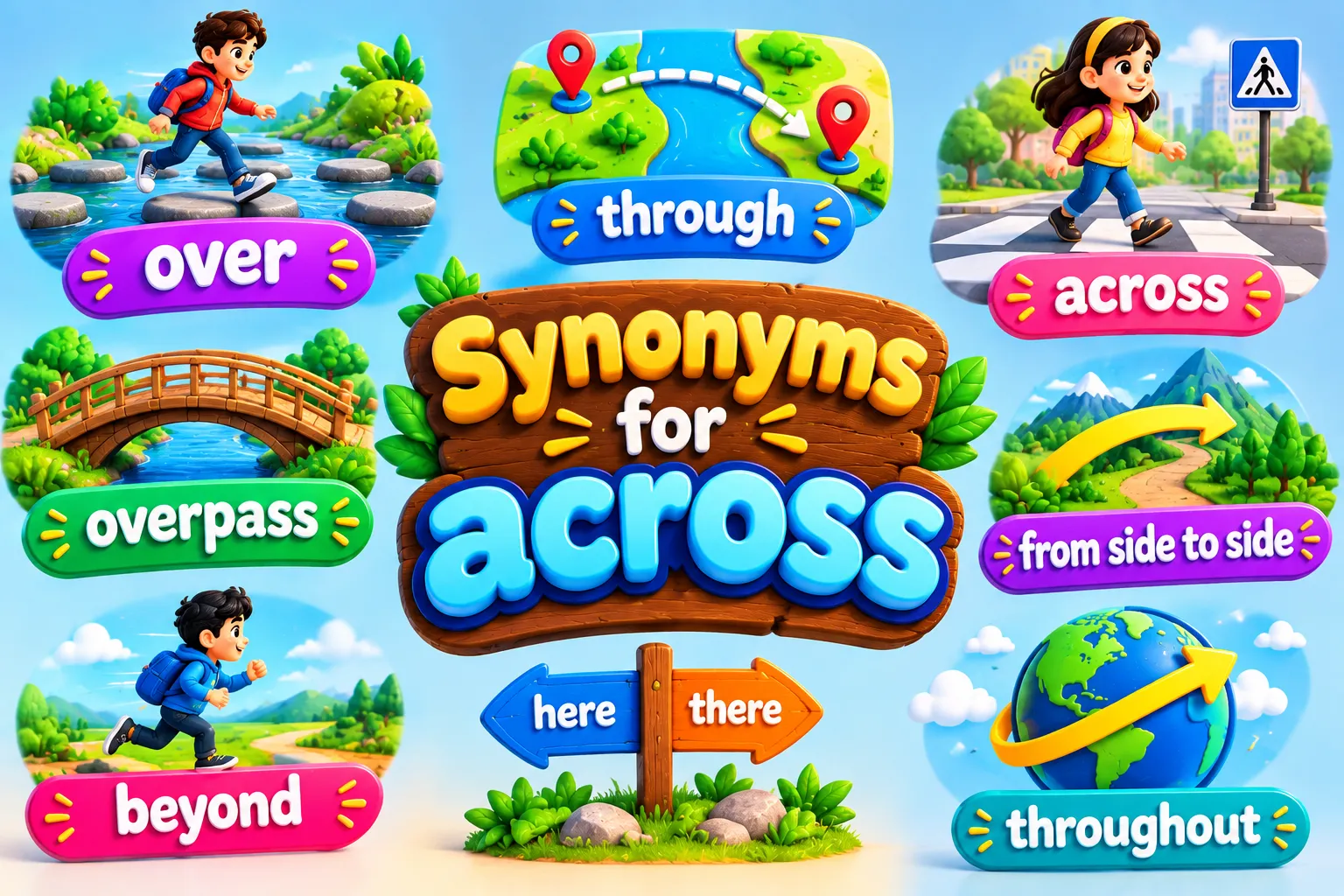
Common synonyms include over, through, crosswise, from side to side, throughout, around, beyond, opposite, on the other side, and all over. The best alternative depends on the meaning and sentence. For example, “She walked across the road” can become “She walked over the road,” while “The news spread across the country” can become “The news spread throughout the country.” Learning these alternatives helps English learners understand different uses of across and makes writing more varied.
Across is a common English word used to describe movement, position, direction, and distribution. Imagine walking from one side of a street to the other. You might say, “I walked across the street.” The word can also describe something spread over a large area, such as “The festival is celebrated across the country.” Because across has several meanings, its best synonym changes with the context. Learning related words helps English learners choose more precise expressions and avoid repeating the same word. It is also useful for content writers who want their sentences to sound natural and varied. This guide explores the meaning, grammar, history, pronunciation, word formation, 25 synonyms, semantic categories, and antonyms of across with simple examples.
Meaning of Across
Definition
Across (Preposition/Adverb): From one side to another, on the opposite side, or throughout an area or group.
Examples
- We walked across the bridge.
- She lives across the street.
Connotative Meaning
Positive tone: Across can suggest connection, reach, or movement from one place to another.
Negative tone: It can sometimes suggest distance, separation, or an obstacle between two places.
Neutral tone: It usually gives a simple idea of position, direction, or movement.
(Connotation means the feeling or idea that a word suggests beyond its basic meaning.)
Etymology
The word across developed from the idea of being “on cross” or “in a crosswise direction.” It combines a-, meaning “on” or “in,” with cross, referring to a crossing or intersection.
| Period | Development |
| Old English (450–1100) | The idea was expressed through words related to crossing, such as cross, which ultimately came from Latin crux through Germanic and Old English development. |
| Middle English (1100–1500) | Forms related to across developed from expressions meaning “crosswise” or “on cross.” |
| Modern English (1500–Present) | Across became a common preposition and adverb meaning from one side to another, on the opposite side, or throughout an area. |
Pronunciation (IPA)
- IPA: /əˈkrɒs/ (British English), /əˈkrɔːs/ (American English)
- Syllables: a-cross
Affixation Pattern of Across
- Root: cross
- Prefix: a- — a historical element meaning “on” or “in”
- Suffix: none
- Word formations:
- Across — preposition/adverb
- Cross — noun/verb/adjective
- Crossed — verb/adjective
- Crossing — noun/verb
- Crosswise — adverb/adjective
- Crossroad — noun
- Crosswalk — noun
- Crossing-over — noun
25 Synonyms of Across With Meaning & Examples
Note: “Across” has several meanings, so these alternatives are not all interchangeable. Some describe movement, some describe position, and others describe distribution.
1. Over (Preposition/Adverb)
Meaning: From one side to another or above something.
Examples:
- She walked over the bridge.
- The bird flew over the river.
2. Through (Preposition/Adverb)
Meaning: From one end or side of something to another, often inside it.
Examples:
- We walked through the park.
- The train traveled through the tunnel.
3. Throughout (Preposition/Adverb)
Meaning: In every part of a place, group, or period.
Examples:
- The rule applies throughout the country.
- Music played throughout the building.
4. Crosswise (Adverb/Adjective)
Meaning: From one side to another or in a direction that crosses something.
Examples:
- Place the board crosswise across the table.
- The lines run crosswise across the page.
5. From Side to Side (Phrase)
Meaning: Moving or extending from one side to the other.
Examples:
- The child ran from side to side.
- The curtain moved from side to side.
6. All Over (Phrase)
Meaning: In many or every part of a place or area.
Examples:
- Posters were placed all over the city.
- The news spread all over the country.
7. Around (Preposition/Adverb)
Meaning: In or to different parts of an area.
Examples:
- We traveled around the country.
- People gathered around the field.
8. Beyond (Preposition/Adverb)
Meaning: On or to the farther side of something.
Examples:
- The village lies beyond the river.
- Look beyond the mountain.
9. Opposite (Preposition/Adjective)
Meaning: On the other side or facing something.
Examples:
- The bank is opposite the school.
- She lives opposite the park.
10. On the Other Side (Phrase)
Meaning: Located on the side opposite to the current position.
Examples:
- The shop is on the other side of the road.
- We waited on the other side of the bridge.
11. From One Side to Another (Phrase)
Meaning: Moving or extending between two sides.
Examples:
- The rope stretches from one side to another.
- He moved from one side to another.
12. Over the Surface (Phrase)
Meaning: Extending or moving from one part of a surface to another.
Examples:
- The cloth spread over the surface.
- Water flowed over the surface.
13. Beyond the Boundary (Phrase)
Meaning: On the other side of a limit or border.
Examples:
- The village lies beyond the boundary.
- The animals moved beyond the boundary.
14. Cross-Country (Adjective/Adverb)
Meaning: Across a country or over a large area of land.
Examples:
- They planned a cross-country trip.
- The team traveled cross-country.
15. Transversely (Adverb)
Meaning: In a direction that crosses from side to side.
Examples:
- The material was cut transversely.
- The lines run transversely across the structure.
16. Horizontally (Adverb)
Meaning: In a level direction from side to side.
Examples:
- Place the picture horizontally.
- The line extends horizontally across the screen.
17. Crossways (Adverb)
Meaning: From one side to the other.
Examples:
- The tree fell crossways over the road.
- The boxes were placed crossways.
18. Crossly (Adverb)
Meaning: In a manner that crosses or intersects.
Examples:
- The beams were arranged crossly.
- The lines meet crossly at the center.
19. Amid (Preposition)
Meaning: In the middle of or surrounded by something.
Examples:
- A small house stood amid the trees.
- She walked amid the crowd.
20. Among (Preposition)
Meaning: In or surrounded by a group.
Examples:
- The message spread among the students.
- She walked among the visitors.
21. Over the Width (Phrase)
Meaning: Extending from one side of a wide area to another.
Examples:
- The bridge stretches over the width of the river.
- A banner was placed over the width of the wall.
22. From End to End (Phrase)
Meaning: From one end of something to the other.
Examples:
- The road runs from end to end of the valley.
- The table was covered from end to end.
23. Sideways (Adverb)
Meaning: Toward or from one side.
Examples:
- Move the box sideways.
- The car slid sideways on the wet road.
24. Cross-Cutting (Adjective)
Meaning: Extending across different groups, areas, or subjects.
Examples:
- The issue is cross-cutting across many departments.
- The report examines several cross-cutting concerns.
25. Permeating (Verb)
Meaning: Spreading throughout something.
Examples:
- The smell was permeating the entire room.
- The idea is permeating modern culture.
Prototype Meaning
The most typical meaning of across is from one side to another. When people hear this word, they often imagine someone moving across a road, bridge, river, room, or field. However, across can also describe something located on the opposite side or something spread throughout a large area. The exact meaning depends on the sentence.
Prototype Categorization
- Movement from side to side: over, through, crosswise, from side to side, from one side to another, crossways — useful for physical movement or crossing.
- Position on the other side: opposite, beyond, on the other side, beyond the boundary — useful for describing location.
- Spread over an area: throughout, all over, around, widespread, distributed, scattered — useful for describing things found in many places.
- Extension across a distance: spanning, extending, from end to end, over the width — useful for roads, bridges, objects, periods, and distances.
- Direction or arrangement: transversely, horizontally, sideways, cross-country — useful when describing a specific direction or layout.
This grouping helps writers choose a synonym based on whether across describes movement, location, direction, distribution, or distance.
Antonyms of Across
| Antonym | Part of Speech | Meaning |
| Along | Preposition/Adverb | Following the length or direction of something. |
| Beside | Preposition | Next to or at the side of something. |
| Within | Preposition/Adverb | Inside a particular area or limit. |
| Here | Adverb | In this place. |
| Near | Preposition/Adverb | At a short distance from something. |
| Adjacent | Adjective | Next to or directly beside something. |
| Inside | Preposition/Adverb | Within the interior of something. |
| Under | Preposition/Adverb | Below something rather than across it. |
Short Questions and Answers
What does across mean?
Across means from one side to another, on the opposite side, or throughout an area or group.
When should across be used?
Use across when describing movement from one side to another, a position on the opposite side, or something spread over an area.
Is across positive or negative?
Across is usually neutral. Its meaning depends on the situation in which it is used.
How is across different from similar words?
Across often suggests movement or extension from one side to another. Through usually suggests movement inside something, while throughout means in every part of an area. Opposite mainly describes position.
Conclusion
Learning across and its synonyms can make English vocabulary more flexible and precise. The word has several meanings, so its alternatives depend on the context. Words such as over, through, crosswise, opposite, throughout, spanning, extending, and widespread can describe movement, location, distance, or distribution. Understanding these differences helps English learners choose the right word instead of using across in every situation. It also helps content writers create smoother and more varied sentences. Practice each synonym with your own examples and notice how its meaning changes with context. Daily vocabulary practice can improve reading, writing, and speaking skills. By learning these useful alternatives, you can describe movement, position, distance, and wide distribution with greater accuracy and confidence.
Read More:
Synonyms for extremely: 30 Powerful Alternatives

I’m Falak Naaz, an SEO writer at SynonymsInstant.com focused on creating clear, engaging, and search-friendly English content. I specialize in vocabulary, synonyms, antonyms, word usage, and language guides. I combine careful research with practical writing to deliver trustworthy content that helps readers choose the right words and improve their English with confidence.